To avoid these ads, REGISTER NOW!

20 amp breaker, 15 amp receptacles

rieferman

Well-known member
Joined
May 18, 2009
Messages
2,586
Location
Collegeville PA (30 min west of Philly)
I'm sorry, I know I've seen this discussed, but my searches weren't finding it.

Would like advice from electricians please:

Did my shopping for electrical last night. 20 amp receptacles are very expensive. We're totally rewiring the entire barn (and by "we" I mean a licensed electrician that is a close friend.. I'm just the grunt work guy for this one). Re-using what makes sense, but otherwise using new materials.

Anyhow, we are doing 20 amp breakers for the receptacles. 12-2 wire. And I went into the store thinking "20 amp receptacles" even though electrician friend had said it would be cost prohibitive for the 40 or so that we're installing.

The on staff electrician at HD, without me leading him or tell him what my electrician said, agreed.

They both advised getting high end 15 amp receptacles.

Here's what I'll have going on in the building:
- exercise room with treadmill, mini-fridge, TV, stereo. Two circuits in this room dividing the load of all of these items.
- Workshop with wood working tools (not a "pro" shop.. chop saw, table saw, shop vac). Again two circuits dividing the load.
- Garage parking/storage

All that to ask this: Really, truly, honestly.. is the 15 amp receptacle ok? In the future if needs change, could I just upgrade a particular receptacle here or there as needed? Or is it really critical to have the 20 amp receptacles with the 12-2 and 20 amp breaker setup that we're planning?

MANY THANKS in advance
 
To avoid these ads, REGISTER NOW!

twostory

Well-known member
Joined
Dec 23, 2005
Messages
554
Location
Duluth, Georgia
If it is a 20 amp breaker you should use a 20 amp outlet. Using 15 amp outlets would be against code.

If you want to save money, just use 15 amp breakers and 15 amp outlet.

It is legal to wire a 15 amp circuit with a 12 guage wire.
 

mrb

Well-known member
Joined
Dec 31, 2008
Messages
3,734
If it is a 20 amp breaker you should use a 20 amp outlet. Using 15 amp outlets would be against code.

If you want to save money, just use 15 amp breakers and 15 amp outlet.

It is legal to wire a 15 amp circuit with a 12 guage wire.

this is NOT true. (NEC in usa, i dont know how canada works)

Here is what is allowed per code:
15 amp circuit:
single 15 amp receptacle
multiple 15 amp receptacles

20 amp circuit:
single 20 amp receptacle
multiple 20 amp receptacles
multiple 15 amp receptacles

I would suggest using quality receptacles, not the $0.50 tract home builder specials. For leviton BR15 (commercial grade) if youre on a budget, and 5262 (industrial grade) if you can spend a few bucks a piece. Both of these have a pressure plate type clamp, you stick wire in hole or under clamp and tighten screw.
 

nadogail

Well-known member
Joined
Jan 23, 2009
Messages
31,894
Location
Coronado, CA
You have been given good advice; Multiple 15 Amp receptacles on 20 amp circuits. I caution you to not use the receptacle as the junction when hooking up. Wire Nut the 12 guage conductors going into and out of the box together with a pigtail going to the regeptacle.

Eventually a receptacle will fail, and the extra effort to do the pigtails will be paid back with intrest in ease of trouble shooting and repair.
 

Stuart in MN

Well-known member
Joined
Sep 8, 2005
Messages
22,974
Location
Minneapolis
It's allowed per Article 210.20.B of the NEC as long as there are two or more 15 amp receptacles on the 20 amp circuit. 15 amp receptacles are rated for 20 amp feed through by the receptacle manufacturers. As recommended, pass on the 50 cent bargain bin receptacles and spend a few bucks for the good ones.
 
OP
R

rieferman

Well-known member
Joined
May 18, 2009
Messages
2,586
Location
Collegeville PA (30 min west of Philly)
Excellent, thanks guys. I really appreciate your time answering my question!

The best layman's argument my electrician friend gave me (because I was having trouble wrapping my mind around it) was:

"A true 20 amp product will have a plug that can only be plugged into a 20 amp style receptacle. Do your items have that kind of plug?"

Also, I saw posted elsewhere a response from UL.. they said:

"For receptacles rated 15 or 20 A, 125 or 250 V, the feed-through construction is evaluated using a test current of 20 A and is considered suitable for use in a 20 A branch circuit."

edit: btw, the HD guy (he was awesome) did help me pick out the top of the line Levitron 15 amp receptacles instead of the cheap-o ones. A little more expensive, but still a bargain compared to 20 amp recepts.
 
Last edited:

Falcon67

Well-known member
Joined
Jun 11, 2009
Messages
18,371
Location
Merkel, TX
edit: btw, the HD guy (he was awesome) did help me pick out the top of the line Levitron 15 amp receptacles instead of the cheap-o ones. A little more expensive, but still a bargain compared to 20 amp recepts.

Having used the "contractor 10 pack" tract home units, you spent well. I replace mine with the better models when they break. Heavy duty power cord on the bigger 110V equipment make short work of the cheapo ones. The pigtail suggestion is spot on also.
 
OP
R

rieferman

Well-known member
Joined
May 18, 2009
Messages
2,586
Location
Collegeville PA (30 min west of Philly)
Similar to the high end vs. cheap-o receptacles conversation... What's your take on these couple of things (in terms of buying quality vs. buying on price):

Price
- For light switches, I went as cheap as I could get. Contractror pack special. Cheap cheap cheap.

- plate covers - cheap as I could find, plastic

- heater - got the most basic baseboard electric Farenheat model.. got 2 of them though so that I have about 30% more btu's than my room really needs.

- Thermostat - again, got the most basic one available. It's a part time usage room, we plan to only heat it when necessary.

Quality
- Boxes - I actually spent extra to get slightly deeper boxes (forget the exact volume number now) because electrician had mentioned pigtailing and I figured extra space might be easier for him to fold wires in etc.

- conduit - over spent and got 2 inch thick instead of 1 1/4 as he'd requested. I just thought it would make for easier wire pulling since we have a few bends.

- flourescant fixutres - middle of the road purchase.. not the best, not the cheapest.
 

GTO

Well-known member
Joined
May 8, 2009
Messages
3,926
Location
NJ,FL
Are you installing GFCI's ?
I know 20amp GFCI's are expensive (apx $15 around here)
 
OP
R

rieferman

Well-known member
Joined
May 18, 2009
Messages
2,586
Location
Collegeville PA (30 min west of Philly)
For one outlet on the outside of the building by my basketball court, I'll be using gfci outlet (and the waterproof housing etc.).

Inside the barn, we talked it over and decided to skip it. Though he was waffling back and forth on it a bit...
 

Falcon67

Well-known member
Joined
Jun 11, 2009
Messages
18,371
Location
Merkel, TX
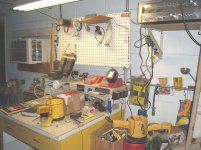
All my shop outlets are on the load side of a GFCI. I used normal 15A models and have lost about 3 over the last 10 years. Everything has been plugged into those circuits - drill press, chop saws, 110V 140A wire welder, 1.5HP compressor, sawsall, etc, etc. I used the contractor grade switches in the shop and in the house re-wire and have replaced maybe a couple over that same period. I cover the outlets and heavily used switches in the shop with metal covers - takes almost no effort to crack a plastic cover. Bounce it off the bench, SMACK - busted cover plate. Hate electric heaters - very inefficient, but that all depends on what you have available for fuel. My t-stat is the knob on the propane bottle. ;) Good call on the deep boxes. Flo. Lights - get T8 fixtures. They use less energy, make less noise, generate less heat, last longer (IMHO so far) and with 6500K bulbs put out a lot of light. Not very expensive - I think I gave $18 each for the 4' dual bulb fixtures at Lowes. 8' fixtures run $33 - not bad. Bulbs are cheaper in the 12 pack IIRC.
 
Last edited:
To avoid these ads, REGISTER NOW!

mrb

Well-known member
Joined
Dec 31, 2008
Messages
3,734
Similar to the high end vs. cheap-o receptacles conversation... What's your take on these couple of things (in terms of buying quality vs. buying on price):

Price
- For light switches, I went as cheap as I could get. Contractror pack special. Cheap cheap cheap.

- plate covers - cheap as I could find, plastic

- heater - got the most basic baseboard electric Farenheat model.. got 2 of them though so that I have about 30% more btu's than my room really needs.

- Thermostat - again, got the most basic one available. It's a part time usage room, we plan to only heat it when necessary.

Quality
- Boxes - I actually spent extra to get slightly deeper boxes (forget the exact volume number now) because electrician had mentioned pigtailing and I figured extra space might be easier for him to fold wires in etc.

- conduit - over spent and got 2 inch thick instead of 1 1/4 as he'd requested. I just thought it would make for easier wire pulling since we have a few bends.

- flourescant fixutres - middle of the road purchase.. not the best, not the cheapest.


plate covers, dont use the plastic cheapest ones, use the nylon plates. they are only a few cents more.

switches, i would spend the $1.50ea or whatever and get better switches -especially if they have more than a couple hundred watt load on them
 

sberry

Banned
Joined
Jun 18, 2005
Messages
35,747
Location
Brethren, Michigan
I use the 49 cent recepts and switches by the box, cant recall the last one that failed. I have a couple on a bench, used daily, 100's or 1000's of cycles that still work. 90% of the stuff is very little draw anyway. chargers, clock, radio, etc. Only a few circuits in a garage really get used much.
The 15A recept on a 20 circuit is legit as the configuration can only accept a 15A plug. Biggest real reason I use a better unit is if I have crowded box where being able to backwire makes it easier.
 

cortez

Well-known member
Joined
Apr 9, 2009
Messages
171
Location
Chicago
What is up to code and what a receptacle or other electrical item can "handle" are two different things. Real world wise the code is very often ignored!!!

It is up to you and your nerves as to what you decide. Where I live, Inspectors will overlook a small problem for the cost of a good lunch.

If you are the type to fret about something then do it to code (which even engineers cannot agree on many times) that is why it is called electrical theory!!!
 

MisterCMK

Well-known member
Joined
Nov 29, 2007
Messages
170
Location
USA
Hate electric heaters - very inefficient, but that all depends on what you have available for fuel. My t-stat is the knob on the propane bottle. ;)

On the contrary, 100% of electricity supplied to an electric heater is turned into heat. So, for the consumer it is a 100% efficient form of heating.

If you include the generation of the electricity in the equation then that changes.
 

MisterCMK

Well-known member
Joined
Nov 29, 2007
Messages
170
Location
USA
this is NOT true. (NEC in usa, i dont know how canada works)

Here is what is allowed per code:
15 amp circuit:
single 15 amp receptacle
multiple 15 amp receptacles

20 amp circuit:
single 20 amp receptacle
multiple 20 amp receptacles
multiple 15 amp receptacles

I would suggest using quality receptacles, not the $0.50 tract home builder specials. For leviton BR15 (commercial grade) if youre on a budget, and 5262 (industrial grade) if you can spend a few bucks a piece. Both of these have a pressure plate type clamp, you stick wire in hole or under clamp and tighten screw.

Just thought I'd mention that a duplex receptacle is actually 2 receptacles. You can install a single duplex 15a receptacle on a 20amp branch circuit and be legal.
 

sberry

Banned
Joined
Jun 18, 2005
Messages
35,747
Location
Brethren, Michigan
Yup, I got a bunch of circuits, probably a couple dozen or more of them in the shop alone with breaker, wire to single duplex. It cant get any better than that especially for common used hi power tools, a chop saw. comp or welding machine. Not only does it eliminate a lot of potential human error but some of these tools have high start currents. If you have a dedicated wire not so much of a problem to tune a breaker.
 

sberry

Banned
Joined
Jun 18, 2005
Messages
35,747
Location
Brethren, Michigan
The amount of heavy loads in small garages is highly over estimated in most cases. Even heavy tools are intermittent and lighting is more efficient than ever. Lots of parasitic loads one didn't have back in the day requiring way more outlets, most measured in a few watts vs amps. The advent of battery technology has even removed the need to some extent for cords, 2 A circuit required for less than an hour. Biggest non dedicated loads we have are a couple portable lights and occasional vacuum, battery charger. Even trouble lights run from batteries about 95% of the time.
 

Attachments

  • ps outlets 1.JPG
    ps outlets 1.JPG
    67.6 KB · Views: 64

redsky49

Well-known member
Joined
Jan 21, 2009
Messages
582
Location
near the coast in eastern North Carolina
[QUOTE I would suggest using quality receptacles, not the $0.50 tract home builder specials. For leviton BR15 (commercial grade) if youre on a budget, and 5262 (industrial grade) if you can spend a few bucks a piece. Both of these have a pressure plate type clamp, you stick wire in hole or under clamp and tighten screw.[/QUOTE]

There are two schools of thought regarding the pressure type clamp. My take on them is that they were developed to allow less skilled workers make an adequate hookup in less time than the typical curled pigtail around the screw type connection. Their shortcoming is that you cannot see the actual finished connection, and I suspect that there is less conductor to conductor contact than is achieved with the standard screw type connection.

"On the contrary, 100% of electricity supplied to an electric heater is turned into heat. So, for the consumer it is a 100% efficient form of heating."

While this statement is correct, it is certainly misleading.

Electric resistance heat is used as a baseline for judging relative performance of all electric powered heaters. Resistance heat produces a theoretical 3.42 btu per watt of input. A heat pump's heating performance is rated by its COP (or coefficient of performance) relative to resistance heat. A typical heat pump may produce anywhere from 2 to 4 times the btus per watt input as compared to resistance heat. In addition, some advanced technology heat pumps are producing way more than this and soon the public may be able to purchase units with a COP of 6 and higher.

So, for the consumer, the true cost comparison is the delivered btus per watt of input.

As always, offered only as opinion
 

mrb

Well-known member
Joined
Dec 31, 2008
Messages
3,734
There are two schools of thought regarding the pressure type clamp. My take on them is that they were developed to allow less skilled workers make an adequate hookup in less time than the typical curled pigtail around the screw type connection. Their shortcoming is that you cannot see the actual finished connection, and I suspect that there is less conductor to conductor contact than is achieved with the standard screw type connection.

I would have to disagree there. The industrial grade receptacles all use pressure plate, the top of the line hubbell costing as much as $20 a receptacle. You cant really wrap the screw with these.
 

sberry

Banned
Joined
Jun 18, 2005
Messages
35,747
Location
Brethren, Michigan
Those are old file pics, but if I was building my sweetheart garage there would be some method of running new circuits as needed.
 
To avoid these ads, REGISTER NOW!
Top Bottom