To avoid these ads, REGISTER NOW!

Quincy 325 craigslist find and repair

OP
M

mattblast

Well-known member
Joined
Jan 30, 2013
Messages
782
Location
Bridgewater, NJ
I finally got around to ordering a starter. The ones on eBay were more than I wanted to spend or weren't good quality so I kept looking. I ended up buying one from Amazon for $119 with free shipping. It's a Square D 8911 with 220 coil and included a heater for a 5 HP motor.

It ended up getting lost by FedEx so they sent me a replacement. The included directions weren't too helpful but with the help of my continuity tester I figured how to wire it up.

Here is the starter I bought. Motor Starter, DP, 208/240V, 2P, 30A, NEMA 1 https://www.amazon.com/dp/B004PHB5U8/?tag=atomicindus08-20

The seller (UPE Group) sells the same starter on their website for $20 more. The wiring info page on their site links to a thread on this site on wiring up a definite purpose starter. I read that and a few more threads and found a few good diagrams for proper hookup.

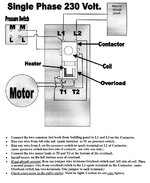
The simple part is connecting the incoming power at the top and motor at the bottom. The trick is how to hook up the pressure switch (and override switch).
3ba939427a6e7206e9573f95da040012.jpg

6bc43abdeb691aac29629174b164316d.jpg

From the second diagram:
L1/L2 to incoming power (order not important on a 220 line)
T1/T2 to motor (again order not important)
Ground wire (not shown) to ground screw to back of box (threaded hole included but I had to supply screw)

Behind the L1/L2 connectors are two secondary connectors. These are for the coil.
Beside the L1/L2 connectors are additional terminals to tap off the power.
There is a red wire pre installed from the secondly L2 connector to a terminal below T1 and another red wire from the other terminal below T1 to the coil behind L1

The coil is energized with 220v which magnetically moves switch and activates power to motor and motor then runs. To get compressor to start automatically with low pressure and turn off at high pressure requires that the pressure switch be connected in series with the coil. This was very clear to me but I had no idea how to do it. After fiddling around for an hour I figured it out.

The two terminals under T1 should have continuity and provide a safety shutoff should the motor draw too much power. The pressure switch provides continuity when pressure is low, and the override switch provides continuity when switched to ON.

To hook up the pressure switch connect from terminal besides L1 to terminal under T1, then for other terminal under T1 to one connector at pressure switch (doesn't matter which one), then from other terminal from pressure switch (the one right beside the other wire - only one pair of terminals at pressure switch get used) to the override switch and from there to the coil (terminal behind either L1 or L2. Finally connect other end of coil to L2. The exact order doesn't matter as long as you put all items in series with L1 and L2 at either end. If any of the switches is open, coil was my energize and motor will be off.
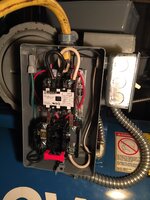
5fd643e0222b2ccbd19a0d0c4a3f47fc.jpg

Here it is all hooked up!

Quincy has a "tear down and rebuild" manual that I wish I knew about earlier. You can download it from their website (search qr25 literature) and this link should work too.
http://www.revbase.com/TagTeam/client/Download.asp?FileID=2326531&DataID=202338&ViewID=2&OrderID=0

Shows step by step how to take apart and put together.
2af577a28f9f1c1bdb38beda15447ae6.jpg
 
To avoid these ads, REGISTER NOW!
OP
M

mattblast

Well-known member
Joined
Jan 30, 2013
Messages
782
Location
Bridgewater, NJ
Now that compressor powers up and makes air, there are two issues.

1. The oil pressure is low and fluctuates between 5 and 20 PSI. The oil pressure was set to 0 PSI when I first powered it up so I adjusted it to maximum and it got up to 20. It should be able to go much higher than that. While the pump runs the gauge moves slowly to 20, then quickly drops down to 5, then jumps around a bit. I'm hoping that is a sign of a bad gauge and will get a new one on order.

2. As the pump starts, the dip stick pops out of the crankcase and onto the floor. There must be pressure building up in the crankcase. The dipstick doesn't fit too tightly. I replaced the worn oring on it, but it is still kind of loose. I may just order a new one to see if that improves it.
 

MacMcMacmac

Well-known member
Joined
Oct 21, 2014
Messages
1,573
Location
canada
Oil pressure:

Make sure the suction screen in the oil sump is not clogged, and that the tube likewise is unobstructed.

There is a small o-ring on the oil pump input shaft. The shaft fits inside the end of the crankshaft, driven by a roll pin. The o-ring seals the oil pump shaft to the inside of this bored recess. If this o-ring is worn, proper oil pressure may be impossible to attain, since it is leaking out of the end of the crankshaft before it is getting distributed throughout the compressor's lube circuit.

There is an oil pressure relief valve in some of the rear cylinder counterweights on the crankshaft. This is a centrifugally actuated oil pressure dump valve that seals when the crankshaft is running, but opens when the compressor stops. This allows oil pressure to drop quickly so the pump will unload fully between cycles. If this valve is not operating normally, it might not be sealing fully while the pump is running, resulting in low oil pressure, o no oil pressure.
 
OP
M

mattblast

Well-known member
Joined
Jan 30, 2013
Messages
782
Location
Bridgewater, NJ
Oil pressure:

Make sure the suction screen in the oil sump is not clogged, and that the tube likewise is unobstructed.

There is a small o-ring on the oil pump input shaft. The shaft fits inside the end of the crankshaft, driven by a roll pin. The o-ring seals the oil pump shaft to the inside of this bored recess. If this o-ring is worn, proper oil pressure may be impossible to attain, since it is leaking out of the end of the crankshaft before it is getting distributed throughout the compressor's lube circuit.

Thanks for the tips. The suction screen looked clean prior to adding the oil. I never removed it though. I'll take a look at oring tonight and if that is OK I'll remove and clean the screen.

Is this the oring you are referring to? (1.3 in diagram). Looks like I can remove oil pump housing (1.8) to get access to the driveshaft (1.4) and that it can be pulled out to replace the oring. I do not want to remove the bearing carrier assembly (1.1)

attachment.php
 

Attachments

  • oil pump.jpg
    oil pump.jpg
    82.3 KB · Views: 488

MacMcMacmac

Well-known member
Joined
Oct 21, 2014
Messages
1,573
Location
canada
Yes, that's the o-ring.

Check that the small plastic ball in the crankcase vent is moving properly so that crankcase pressure is being vented properly as well. The vent tube may also be plugged. This is why your dipstick could blowing out.
 
OP
M

mattblast

Well-known member
Joined
Jan 30, 2013
Messages
782
Location
Bridgewater, NJ
Issue solved - oil level was low!

Turns out that Quincy gave me only some of the info when I asked how much oil the 325 takes. They replied back to my email with "216, 240*, 310* & 325* --1qt. & 16 oz. (1.42 lit.)". So I filled it up with 3 16oz containers of oil and assumed that was correct. What they neglected to tell me is that the models with an * need 10 more oz if using an oil filter.

Here is excerpt from the manual

Pressure Lubricated Model Oil Capacity
206 & 210 20 oz. (591 ml.)
216*, 240*, 310* & 325* 1qt. & 16 oz. (1.42 lit.)
270*, 340*,350* & 370* 4 qts, & 24 oz. (4.5 lit.)
390 9 qts.& 16 oz. (9 lit.)
4125*,5120* 9 qts & 24 oz. (9.22 lit.)

*These models may be equipped with oil filters. Add 10 oz. of oil if so equipped.

I only noticed this after taking pump apart and replacing slightly worn oring, then draining the oil to check the screen (it was perfectly clean).

The manual listed several possibilities for low oil pressure
• Oil pump direction reversed (it wasn't, it made pressure, just not enough)
• Oil sump strainer plugged (perfectly clean)
• Excessive leakage at crankshaft seals (I replaced seal at pump drive shaft, not sure if there are other seals)
• Low oil level (hmmm)
• Oil pump incorrectly assembled to the bearing carrier - “o”ring not properly located between oil pump body & bearing carrier (oring was fine and sealing body tightly)
• Oil pressure adjusting screw not set properly (put at max and still low pressure)
• Defective oil pressure gauge (didn't appear faulty since it read pressure, just kept fluctuating and was low)
• Plugged oil filter (filter was new Quincy brand)

That left only low oil level or leakage at seals. Went back through the manual and found the note about 10 more oz of oil (by that time it needed a full 16oz more since some oil was lost when I drained it)

So it now builds up good oil pressure and remains steady at 20psi.

Pump sounds good. What is left to do now is to add a drain **** to the bottom of the tank and see how the pilot valve works for continuous run (and if I need to modify starter wiring to accommodate continuous run function)

The dip stick still pops out when first started - there is alternating slight pressure and suction at in the crankcase as the pump runs. The dip stick fits in very loosely and easily pops out. I checked the crankcase vent and the plastic ball moves freely. I'll keep working on solving this issue.
 
Last edited:
OP
M

mattblast

Well-known member
Joined
Jan 30, 2013
Messages
782
Location
Bridgewater, NJ
I decided to make a Quicy unloader body wrench (PN 4-0-12) after finding that they sell for $172.80. I could make a dozen for that price.

The Teardown and Rebuild guide shows a photo of the tool.

attachment.php


I took a measurement of the unloader body and it was 3.00" and scaled the photo to match. Then I quickly sketched a tool to fit.

attachment.php


I have a 3.05" hexagon inside a 4.75" circle attached to a 16.3" handle. Does anyone have an official wrench to take some measurements to see how close I am before I send these off to be CNC plasma cut?

Looking closely at a scaled version of the photo, the thickness appears to be between 0.15" and 0.20" (6ga - 9ga steel).
 

Attachments

  • tools.jpg
    tools.jpg
    145.1 KB · Views: 448
  • Unloader tool.jpg
    Unloader tool.jpg
    61.3 KB · Views: 448
Last edited:
To avoid these ads, REGISTER NOW!

deranged

Well-known member
Joined
Jun 21, 2010
Messages
48
Location
Lima, OH
I'm in the process of rebuilding a 240, and have used a 3" socket with a 1" drive instead of that tool.
 
OP
M

mattblast

Well-known member
Joined
Jan 30, 2013
Messages
782
Location
Bridgewater, NJ
I considered a 3" socket but even used they were more then it would cost to make a custom wrench.

I fine tuned the shape of the wrench so that the outer circle is 5" and length is 14.5".

c467c14df9c134e1b51c8ee1b9b9468c.jpg

I cut the prototype out of 16pt poster paper using a flatbed cutter (Graphtec FC2250) and test fitted it on the unloader tower. It fit nicely so I sent the DXF file to the shop for plasma cutting. I'm getting 4 made and plan to sell 3 to defray the costs. Should be about $80 for all 4. At 1/4" thick, each wrench will be just over 2 lbs. If all goes according to plan the 3 extras will pay cost for wrenches plus pay part of cost for compressor.

The issue with a popping dipstick is now solved. I called Quincy and they determined the only issue was that the dipstick was in too loosely. The slight puff of air coming into the crankcase was enough to pop it. I wasn't sure it the cause was a bad oring or a bad inspection plate. Found a dipstick on eBay for $10 new or a used plate with dipstick for $25. So worse case I could fix it for $25.

I got in touch with the seller of the inspection plate and he said stick was tight fitting. Then I got in touch with the dipstick seller to ask what the stick diameter was. It is supposed to be 0.660 and mine measured that exactly. In the message he offered to send me an oring to try out. He wasn't trying to sell me one, just offering a complete stranger a free oring in order to help out.

Oring arrived and fit snugly. No more popping dipstick!

Along with the oring he sent a sticker to put on tank in case I need any other parts. I'll definitely buy from them!

40613caeff312abff726c690a1220684.jpg

They are a family business and I can say they have incredible customer service. Website is www.compressorpartsunlimited.com or eBay is cpu661. Their prices are very reasonable.

It's too cold in the garage right now to do any more work. I'll order the last part this weekend (tank draincock).
 
OP
M

mattblast

Well-known member
Joined
Jan 30, 2013
Messages
782
Location
Bridgewater, NJ
I added an elbow and ball valve for a tank drain and fired compressor up to test pressure switch. It ran until it hit 150 psi then shut off. Turn back on again at 120 psi. Perfect.

Next was to test the pilot valve. This unloads the compressor when the set pressure is reached so that motor never has to shut down, reducing load needed to keep starting motor up in high demand applications (blasting). There is a bypass valve to feed tank pressure to pilot valve and when off it will allow pressure switch to shut off motor. When on the valve monitors tank pressure. It was a bit tricky to set but I got it to 130psi unloading. Pilot unload pressure has to be set lower than pressure switch pressure (150 psi) or compressor will shut off before it gets a chance to unload. Top toggle switch needs to be down or it won't stop unloading (not sure if this toggle has any use. Quincy said it is used for gas motor units)

13b6bd8312dad4c2de39ff88fcef832a.jpg

So I don't have to flip through the manual again I printed out a label on adhesive vinyl and laminated it. The label was easy to layout. First step was to import the page from the pdf manual then I adjusted as needed. Cleaned an area of the tank and applied it.

Here is manual and my layout side by side.
841bf7e34698dc677c8acde3c3e294eb.jpg

Also made an oil volume label so I don't forget that it takes 58oz!

And applied.
d3e6f5034610919fa7321bd6917d5edc.jpg

Drain valve
279996113e9827eed2962c1c961a5686.jpg
Yes, it's on dollys so I can move it around for now.

Everything is working but two issues need to be solved:

fe478f0358fdde9aa1d0f437527bd8d9.jpg
How does top of belt guard connect to pump? Am I missing a bracket? What does bracket attach to? I can't find any photos of the back of compressor on Google.

And the second issue is that there is a leak somewhere. After an hour it loses 10psi. I'll try to find the leak this weekend with some soapy water.
 

MacMcMacmac

Well-known member
Joined
Oct 21, 2014
Messages
1,573
Location
canada
You need a bracket. It goes under the head bolt. comes down to the belt guard, then runs along top of it, to be held in place with another bolt in the guard. It's the shape of half a ********.
 
OP
M

mattblast

Well-known member
Joined
Jan 30, 2013
Messages
782
Location
Bridgewater, NJ
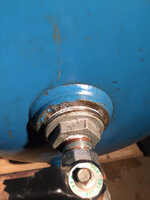
Found the leak at the tank bushing. Swapped out the Teflon tape with rectorseal and that let me tighten each fitting a full turn more. No more leaks at this fitting.

1e4524e40d0698c05992bcefd93c2311.jpg

You can see the bubble forming here.

And after
afe5d6037ad90d7a9ddc4ca2c3c6db93.jpg

Here is what I used to fix it

baca1cbd54426c61ec63cb1b81eb75c2.jpg

There is still a small leak somewhere that I can't find. It loses about 20 psi overnight (was losing 50 psi every hour originally)
 

Avispex

Active member
Joined
Jul 21, 2012
Messages
38
This was an absolutely awesome rebuild thread. I have no idea if the OP will see this reply, but how are things with the Quincy 2 years in? Also, does that valve between the pilot valve and the tank switch it from pressure switch control to continuous?

I'm picking up an older service truck mounted Quincy in the morning that I got because it had all the parts for continuous mode. I figured that I could swap those out to the compressor I am keeping and do better than if I had to buy all the parts separately, but I might keep it as is.

Thanks,

Andy
 
To avoid these ads, REGISTER NOW!
Top Bottom