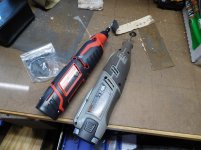
I have a total of three M12 rotary tools. They are overall decent tools, a lot of power, and more RPM than most. But problems in the past with them and back-and-forth with stores and Milwaukee service make me cautious when using them.
First off, it seems to be hit-and-miss if you will get a noisy bearing when you buy these things. It seems the main (chuck-end) ball bearing is either of very variable quality, or the bearings are getting damaged when they are installed. One of the first tools I got had an extremely noisy and "sticking" bearing. Twisting the chuck by hand, I could feel it stick on occasions, sometimes so bad the tool would not begin turning with the speed set to its lowest. I took that tool apart and did some investigating. Like most cordless rotary tools, there is a single, larger ball bearing nearest to the chuck. The motor itself has two ball bearings as well, unlike many cordless tools that use simple bronze oilite bearings. The "main" bearing on this particular tool was terrible, and actually would get warm after less than a minute of use, with no load. I returned that tool, and got a replacement. Night and day difference. Smooth running, no issues, no heat. Not long after that, I discovered what happens if you bind up the bit, or, in this case, a cutting disc, into the work and the speed is set to about midway or higher. If you stall the motor, the speed control will almost immediately burn up. One of the two internal power transistors that control the speed will pop and let loose the magic smoke. Once this happens, the tool will actually still run, but will have no appreciable torque. Take the tool back, exchange it for another (this is a span of about two weeks since buying the first tool). I ended up with another loud bearing. Once again, I head back to HD and talk to the customer service people. I was not the first to have an issue with these tools (they had been just released within a month or two) and we all figured there was a bad batch of first run production examples. I get a replacement, the bearing in this case wasn't entirely silent, but didn't sound like it was self destructing. My projects of that time using the new tool went along fine and dandy, and life was good. Or so I thought.
A friend had come to visit and we had, as usual, been chatting about tools and working on stuff. The subject of the M12 rotary tool came up, and I was singing the praises of the power and speed of that tool compared to my previous cordless Dremels. He was interested in getting one, so I set up some scrap and let him try it out. All went fine, until he either engaged the spindle lock or held onto the chuck while turning up the speed to feel the torque, and, POP. There went the MOSFET in the tool, and, again, the same near-zero torque, despite being able to adjust the speed with the dial. The motor wouldn't start on its own until you dialed up a bit, but the tool was useless. This one ended up going to the local Milwaukee service center. They simply handed me a new one, no questions asked. In so many words, the rep said that these tools don't have a good enough overload circuit, and will be damaged if stalled when the speed is set close to or at maximum. For the record, the bearing on THAT replacement was pretty decent.
I decided I wanted a second , and bought another when there was a bit of a sale. I was surprised at this one. The bearings were nearly silent; on a low speed the tool sounded like an old-school aircraft gyro, with the ball bearings quietly zinging along. I thought they had finally gotten their act together and figured out the bearing issues, but was too afraid to see if the overload fault had been fixed. My buddy that burned up my first tool got one for himself, and, so far, hasn't had any problems either. The bearing on his is a bit noisy, though.
To wrap up this tale, I found the M12 rotary tool to be the most variable in quality of all the Milwaukee cordless tools I have (and that's quite a lot). If yours is spinning but has no power, the fault is in the speed control. My "circuit analysis" tells me the control is sort of two stage in nature, there are two separate power MOSFETs that feed power to the motor, both driven by the same PWM set by the dial, but one is more set to deliver power under load, while the other maintains the no-load speed. The nice thing about the tool is that the speed doesn't vary a whole lot under power compared to other cordless tools like it, or the old corded Dremel tools. I recommend them, but, whatever you do, don't stall the bit in your work or otherwise overload the tool with the speed dial set above #2.