
vonhef
Well-known member
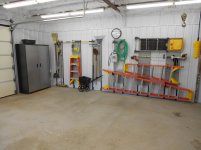
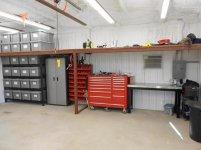
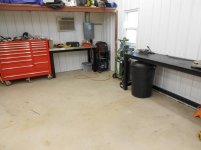
Just wanted to share a few photos of my project (wish I had taken the photos as I progressed). Wife & I moved into a house over 3 years ago, and at the time it had a new 24 x 24 unfinished work shop.
With no time or money... the shop was relegated to became nothing but a storage building full of an unorganized mess of "stuff" both good and not so good.
Well.... no more! Starting back in May I started moving the "stuff" out and anything that wasn't deemed worth keeping was either tossed in the dumpster or set on the sidewalk for others to carry off.
During the cleanup I found large piles of red dirt on the floor. It never ceases to amaze how much wind Western Oklahoma has, and that wind can cover everything with dirt!!! For this reason I decided that the shop would need to not only be insulated, but sealed with foam insulation. A spray foam would seal every crack insulate with an R7 per inch, and also add a bit of rigitity to the metal building.
But first thing on the list was to have electricity run from the opposite end of the property to the shop. I had the electricians run this 100 amp service from the meter into the shop and wire up one 110 and one 220 recepticle out of the bottom of the breaker box. This would allow me to use power tools and a welder to prepare the shop for insulation. Once electricity is in the shop... I can wire everything else.
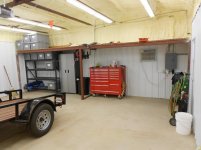
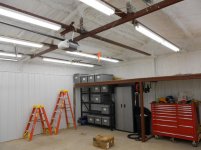
Now that the welder was working, I added some additional steel to to some areas of the shop for added reinforcment (such as to the loft) and welded in additional c-channel rafters to mount the lights on.
I really like the look of epoxie floors... but welding would be a problem, so opted to simply apply a densifier product from legacy industrial instead.
Knowing that the application of the spray foam would be messy, I debated wether to wait until after to install the lights. In retrospect... that may have been the wiser choice, but I didn't
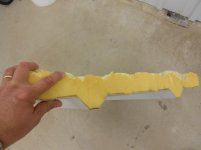
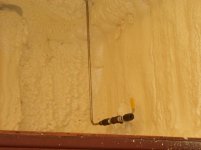
Once the lights were installed I hired the shop insulated with 2 inches of foam. As you can see from one of the photos, the application was every bit of that. In some place it may have been a little less, but in many places much more. All in all I am happy with how it came out. That photo of the insulation is from a hole I cut in the wall when the AC was installed.
With no time or money... the shop was relegated to became nothing but a storage building full of an unorganized mess of "stuff" both good and not so good.
Well.... no more! Starting back in May I started moving the "stuff" out and anything that wasn't deemed worth keeping was either tossed in the dumpster or set on the sidewalk for others to carry off.
During the cleanup I found large piles of red dirt on the floor. It never ceases to amaze how much wind Western Oklahoma has, and that wind can cover everything with dirt!!!
For this reason I decided that the shop would need to not only be insulated, but sealed with foam insulation. A spray foam would seal every crack insulate with an R7 per inch, and also add a bit of rigitity to the metal building.But first thing on the list was to have electricity run from the opposite end of the property to the shop. I had the electricians run this 100 amp service from the meter into the shop and wire up one 110 and one 220 recepticle out of the bottom of the breaker box. This would allow me to use power tools and a welder to prepare the shop for insulation. Once electricity is in the shop... I can wire everything else.
Now that the welder was working, I added some additional steel to to some areas of the shop for added reinforcment (such as to the loft) and welded in additional c-channel rafters to mount the lights on.
I really like the look of epoxie floors... but welding would be a problem, so opted to simply apply a densifier product from legacy industrial instead.
Knowing that the application of the spray foam would be messy, I debated wether to wait until after to install the lights. In retrospect... that may have been the wiser choice, but I didn't
Once the lights were installed I hired the shop insulated with 2 inches of foam. As you can see from one of the photos, the application was every bit of that. In some place it may have been a little less, but in many places much more. All in all I am happy with how it came out. That photo of the insulation is from a hole I cut in the wall when the AC was installed.
Attachments
Last edited:













 so I can understand part of the cost to have this type of insulation applied.
