To avoid these ads, REGISTER NOW!

Can you have too much insulation in wall ?

mebedave

Well-known member
Joined
Jan 17, 2010
Messages
260
Location
Atlantic county area, New Jersey USA
Can you have too much insulation in your walls? What I mean by that is, do you only need to insulate you walls to a certain R factor then any more than that is just a waste. I know the ceiling is where most your heat is lost and you need to insulate that with as much insulation as you can afford and space allows, I plan on about a R50 in attic. I have a pole barn (3)2x8’s for the post, on the outside of post 2x4 on their side with a 2x3 strong back attached to stiffen the 2x4. The tin is attached to the stiffened 2x4.
Most people frame in between their post, add insulation whatever then wall board. I’m planning on doing it a little different so I can get more R rating in my walls and a large air gap between back of tin and the insulation for ventilation. I don’t have soffits, I'm trying to get as much air flowing as possible, hopefully some venturi action up between the wall gap into the attic and out the gable vent. My plan is to frame a 2x4 wall on the outside of the 2x8 post (toward the interior side just to clarify) This gives me enough room for R30 unfaced insulation which is about 10”and allows a few inches of space for air flow. Before installing the unfaced insulation and the stud wall I plan on installing a Tyvek wrap around and between the 2x8 post to protect insulation from any water leaks and cut down on air drafts thru my walls as much as possible. Then once the stud wall/insulation is complete a 6 mil vapor barrier over that from the interior side. Now I don’t what to spend the money on that R30 if R19 is all I need,that is if anymore above R19 would be a waste. But if more is better then I’ll use R30. This is where I need you guy’s advice. Also please comment on my wall system in regards to the building wrap, the vapor barrier, and the air flow gap does this seem to be a good plan or do any of you see a problem. I only want to heat the shop when I'm working in it. My hope is if I insulate it correctly it will never get below freezing. I most likely will heat with electric, like a G73 (no gas)and maybe a wood stove on the real cold days, I have 65 acres of hard wood timber so fire wood is free. This pole barn I have is 40X80 I'm finishing off 40x40
 
Last edited:
To avoid these ads, REGISTER NOW!

samert111

Well-known member
Joined
Feb 28, 2010
Messages
185
Location
Rockford, Mi
I pretty much did the same thing as you have described with the exception that my studded wall is in between the post and not in front of it. This allows for R19 fiberglass batts. Your additional 3 1/2" of studded wall in front of the post to the inside will give you more room for insulation but in my opinion overkill for the walls. Spend the extra $$ in the ceiling.

I also placed Tyvek house wrap inside the posts stapled to the posts and the horizontal 2x4's to protect the insulation and knock down the drafts. I have full soffit vents so air flow up into the attic area is not a problem so I also used the foam filler strips at the top and bottom of the metal siding to further reduce air drafts.

You will get alot of responses here to have the inside walls spray foamed instead. It will create an airtight building. It's expensive and since you plan to use the ribs in the metal siding to provide air flow up into the attic I'm not sure if it would work.
 

Kevin54

MEMBER EMERITUS
Joined
Jan 12, 2005
Messages
29,341
Location
Urbana, Ohio
As long as you don't have a vapor barrier in between the insulation, you really can't have too much. Heat rises hence the thicker insulation in the ceiling. But you can also lose heat through a wall, so the more insulation you have the better. If you have R50 in the ceiling and you have R30 in the walls, you could probably heat the area with a match!!!
 

mad57

Well-known member
Joined
Jan 30, 2009
Messages
1,698
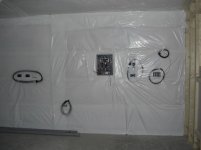
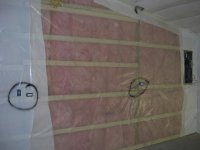
I did the same except for the inner wrap i didnt want anything touching the exterior metal, i used wire to help hold my insulation in place with a few nails worked great, i doubled the wall insulation with uncrafted because it was a good deal when i bought it i bought someones left overs cheap my pole barn is 30x80 my biggest heat loss is the 7 garage doors, i have no heat out there just a salamander heater even when it was 7 degs out last winter the garage didnt freeze it went to 33 degs close but didnt happen. id say go with your idea, oh i went with 5/8 sheetrock i also taped all the plastic seams or really over lapped them before the rock good luck enjoy the build.
 

Attachments

  • insulation1.jpg
    insulation1.jpg
    122.5 KB · Views: 141
  • insulation2.jpg
    insulation2.jpg
    129.5 KB · Views: 90

dirttracker18

Well-known member
Joined
Aug 10, 2009
Messages
3,191
Location
Slate River, ON
You can find heat loss calculators online that can give you data to make decision easier. My "feeling" is that beyond R19 the cost savings will be longer than it is worth.
 

clarky456

Well-known member
Joined
Feb 11, 2011
Messages
129
Location
Central Ohio
Based upon the details you provided, the limiting factor will be your floor. Look up "superinsulating" and perhaps double stud wall construction on google. Most seem to aim for 40+ in the walls and 80+ in the ceilings. Your floor, assuming dirt or crete will conduct the heat not lost through ceilings walls and windows straight into the ground. There likely is a point of diminishing returns when it comes to insulation but when it's done right the money invested is energy saved.

Joe
 

jkeyser14

Well-known member
Joined
Dec 19, 2008
Messages
1,819
Location
(rural) Maryland
The new green/LEED construction using SIP construction methods shoot for R30 in the walls and R60 in the ceiling. I believe they estimate the payback for the added R value to be around 20 years.
 

ForceFed70

Well-known member
Joined
Apr 27, 2010
Messages
3,441
Location
BC, Canada
My opinion: While more insulation will help, anything over R20 in the walls isn't going to give you a lot of payback. I would focus on other methods if you really want to improve efficiency (good wind and vapor barriers for example).
 

trbomax

Well-known member
Joined
Mar 21, 2010
Messages
2,556
Location
starvation lake,mi.
I did the same except for the inner wrap i didnt want anything touching the exterior metal, i used wire to help hold my insulation in place with a few nails worked great, i doubled the wall insulation with uncrafted because it was a good deal when i bought it i bought someones left overs cheap my pole barn is 30x80 my biggest heat loss is the 7 garage doors, i have no heat out there just a salamander heater even when it was 7 degs out last winter the garage didnt freeze it went to 33 degs close but didnt happen. id say go with your idea, oh i went with 5/8 sheetrock i also taped all the plastic seams or really over lapped them before the rock good luck enjoy the build.

when you were at this point, why didnt you fit 1 1/2" foam sheets between those 2x4's and pick up a thermal break and another r9 or so?
 

K'ledgeBldr

Well-known member
Joined
Aug 22, 2011
Messages
1,925
Location
Johns Creek, GA
I've have a lot of people ask me about differences in wall insulation vs. $$$ and ROI. This is the example I've always used:
If we use f/glass batt insulation a 2X4 wall will yield a little better than R13 (that's insulation plus whatever sheathing is on the exterior). 2X6 wall, R20. Perfect case scenario. But what happens when you have air permeance, there is a loss of performance- and that batt insulation becomes an air filter.
So, if the purpose is to reduce the amount of conductive heat- here's where the dollars come into play...
If I build a 2X4 wall and use a spray foam insulation, not only am I getting a better R-value for the amount of material but I'm also reducing air infiltration to almost 0. The additional cost of the spray foam over the batt probably doesn't exceed (saving dollars) the additional cost of 2X6 framing material.

Another way you could look at it- if you can control 94% of conductive heat with approximately 4" of material, how do you justify two additional inches of material for 1 (one) more percent of conductive heat?

Heat flows due to:
Conduction, Convection, Radiation

The ability of insulation to limit air movement should not be confused with "air-sealing". Insulation can reduce air movement to some degree but only within the space it occupies. It can not reduce air movement through other cracks or sources between building components.

So, in your particular case the best case scenario would be a 2X4 framed wall with 1" XPS on the "outer side" of the wall- sealed seams. R-13 unfaced batt insulation then d/wall (this will yield almost an R-19 wall complete). The ability to put the insulation in a sealed air void yields it's maximum R-value.
Put the $$ in the attic space.
 
To avoid these ads, REGISTER NOW!

NitroPress

Well-known member
Joined
Jul 26, 2011
Messages
1,329
Location
Aurora, CO
One thing I haven't seen mentioned here is avoiding too much compression on batt insulation. If you compress thicker insulation into a narrower stud space, you won't get the full rated R value, and you can get less than you would with the correct thickness. Insulation is all about holding air cells in place to prevent heat migration, so if you compress the material too much you'll get fewer air cells and more solid material transmission.
 

mad57

Well-known member
Joined
Jan 30, 2009
Messages
1,698
when you were at this point, why didnt you fit 1 1/2" foam sheets between those 2x4's and pick up a thermal break and another r9 or so?

Well as stated i had gotten the insulation at a really good price and didnt feel that i needed anything more in the walls after i doubled it with the un faced any way with out compressing it. not to mention the cost to buy the foam. I gotta say im happy with it the way it is, if i can get a waste oil heater out there ill be set:)
 
OP
M

mebedave

Well-known member
Joined
Jan 17, 2010
Messages
260
Location
Atlantic county area, New Jersey USA
As long as you don't have a vapor barrier in between the insulation, you really can't have too much. Heat rises hence the thicker insulation in the ceiling. But you can also lose heat through a wall, so the more insulation you have the better. If you have R50 in the ceiling and you have R30 in the walls, you could probably heat the area with a match!!!

A match would be nice :beer:
 
OP
M

mebedave

Well-known member
Joined
Jan 17, 2010
Messages
260
Location
Atlantic county area, New Jersey USA
I feel that type of method could result in moisture in the walls. Here is a similar type of setup that has those issues. http://garagejournal.com/forum/showthread.php?t=114298

Thanks Rich but I think the problem the poster had in your link is he went with the vapor barrier in front AND behind the batts BIG NO NO !! Vapor barrier should only be on the inside of the building (heated side) and a breathable paper like Tyvek on the outside. In and out vapor barrier will trap moister inside your insulation
 
OP
M

mebedave

Well-known member
Joined
Jan 17, 2010
Messages
260
Location
Atlantic county area, New Jersey USA
I pretty much did the same thing as you have described with the exception that my studded wall is in between the post and not in front of it. This allows for R19 fiberglass batts. Your additional 3 1/2" of studded wall in front of the post to the inside will give you more room for insulation but in my opinion overkill for the walls. Spend the extra $$ in the ceiling.

I also placed Tyvek house wrap inside the posts stapled to the posts and the horizontal 2x4's to protect the insulation and knock down the drafts. I have full soffit vents so air flow up into the attic area is not a problem so I also used the foam filler strips at the top and bottom of the metal siding to further reduce air drafts.

You will get alot of responses here to have the inside walls spray foamed instead. It will create an airtight building. It's expensive and since you plan to use the ribs in the metal siding to provide air flow up into the attic I'm not sure if it would work.


samert111 please tell me what you did with your ceiling !!! I'm going with first a vapor barrier,then hang tin (may have to use osb due to cost) finally blow in glass insulation from above. I do worry about the roof tin sweating water down onto my insulation, if that happens and I can not control it with more vents. I have a plan B; I will try one section at first to see if it works, between truss I will hang tyvek lapping it so any water dripping off tin will drip onto the Tyvek and drain it down to the wall Tyvek outer layer witch will drain down the air gap area and out.
 

samert111

Well-known member
Joined
Feb 28, 2010
Messages
185
Location
Rockford, Mi
samert111 please tell me what you did with your ceiling !!! I'm going with first a vapor barrier,then hang tin (may have to use osb due to cost) finally blow in glass insulation from above. I do worry about the roof tin sweating water down onto my insulation, if that happens and I can not control it with more vents. I have a plan B; I will try one section at first to see if it works, between truss I will hang tyvek lapping it so any water dripping off tin will drip onto the Tyvek and drain it down to the wall Tyvek outer layer witch will drain down the air gap area and out.

mebeedave,
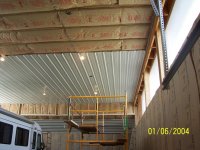
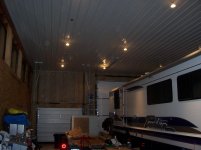
I went with kraft faced R30 batts in the ceiling then covered it with tin. Got a quote for drywall on the ceiling and it was almost as much as the entire insulation, OSB wall covering and tin ceiling combined. Plus a risk of cracking as these pole buildings move around a bit. The tin is really light and no joints to mud and sand. Plus the white really makes it bright and reflects the light down from the lexan that runs the length of the building on both sides.

Attached is a photo of the ceiling installation in progress. I went with 10'-1" panels so I could handle them myself using scaffolding and "L" shaped lifting outriggers fabricated out of some metal electricial conduit and put inside the vertical tubing of the scaffolding. Forgot to reset the date on the camera. I just did this last winter and the ceiling is all finished and the OSB is on side and back walls. Working on the front wall with the overhead doors.
 

Attachments

  • 100_2185.jpg
    100_2185.jpg
    145 KB · Views: 76

dirttracker18

Well-known member
Joined
Aug 10, 2009
Messages
3,191
Location
Slate River, ON
I do worry about the roof tin sweating water down onto my insulation, if that happens and I can not control it with more vents.

Even with a metal roof you should not have sweating issues so long as your attic space in properly ventilated. Best case is a full perforated aluminum soffit and an appropriate number of roof vents. In your case, with a metal roof, a ridge vent is the best and simplest solution with optimum sealing. No other vents for possible leaks. :beer:
 
OP
M

mebedave

Well-known member
Joined
Jan 17, 2010
Messages
260
Location
Atlantic county area, New Jersey USA
mebeedave,
I went with kraft faced R30 batts in the ceiling then covered it with tin. Got a quote for drywall on the ceiling and it was almost as much as the entire insulation, OSB wall covering and tin ceiling combined. Plus a risk of cracking as these pole buildings move around a bit. The tin is really light and no joints to mud and sand. Plus the white really makes it bright and reflects the light down from the lexan that runs the length of the building on both sides.

Attached is a photo of the ceiling installation in progress. I went with 10'-1" panels so I could handle them myself using scaffolding and "L" shaped lifting outriggers fabricated out of some metal electricial conduit and put inside the vertical tubing of the scaffolding. Forgot to reset the date on the camera. I just did this last winter and the ceiling is all finished and the OSB is on side and back walls. Working on the front wall with the overhead doors.

samert111 nice shop!!!!! the lexan sure lets a lot of light in. Thanks for the info. :beer:
 
To avoid these ads, REGISTER NOW!
Top Bottom