
Charles (in GA)
Well-known member
Way back in time, I installed lights in my "shop". Here is the thread.
http://www.garagejournal.com/forum/showthread.php?t=21048
What I did was install Twelve 400 watt Metal Halide lights. Three rows of four lights each. These draw 4.0 amps at 120v for a total load of 480 watts per fixture, do the math, thats 5,760 total watts. Makes you cringe when you think about that meter "spinning" (its electronic now, so it doesn't actually spin, buttttttt.........)
Here is what it looks like with everything on.

Well, while I like lots of light, there are times when I simply do not need all of that light. Up till now, I was turning on one or two rows to save power, but often, that left one end darker than I cared for.
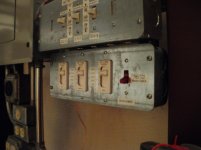
The lights are wired on three circuits, each with one row of four on a circuit. These are MULTI-WIRE circuits, two hots fed from a double pole, common trip breaker, thru a double pole light switch, and sharing a common neutral. Thus two lights on the A side (or red wire side) and two lights on the B side (or black wire side), using split outlets, clearly marked A and B on the top and bottom of each receptacle.

The switches are installed in a five gang panel. They are P&S double pole, 30 amp switches I picked up at Home Depot on clearance for $7 each.

What I was looking for was a way to turn on just half the lights, or all of them. I started looking and found that Hubble, Cooper, and Leviton all make double pole, double throw, center off, maintained (ie they stay on, and are not momentary) switches. Looked in Grainger and found the Leviton switches, 1286-I , a 20 amp rated switch was just what I needed, but they wanted $121 each for them, and I needed three of them. Finally found three of them from an Ebay seller, Fruitridgetools, for $49.95 each and $5 shipping for all three.
After thinking about it for a while, I installed the switches so that if you push down, you turn on the A side of the circuit only, and if you raise the switch up, you turn on both sides of the circuit (this is accomplished by a couple of pigtails from two of the terminals wire nutted together).

In the top pic the lights are from right to left, plugged in, A then B then A then B. This allows me to turn on the far right lights, and the next to the left most lights. In the middle row, I reversed which socket the plugs were in, thus the first and third rows are the first and third lights, while the middle row has the second and fourth lights on.
Now I can only burn 2,880 watts if I want to, and still have decent lighting.

I also can turn on all the lights, plus two 500 watt quartz floods on the back wall, plus the two 8ft T5HO fixtures over the workbenches for a total of 7,192 watts of light. Sheesh! Georgia Power loves me.

Edited to add a wiring diagram for the switch. I had this posted originally in a Temp thread in the test area for a specific individual, thought I'd add it here.

Charles
http://www.garagejournal.com/forum/showthread.php?t=21048
What I did was install Twelve 400 watt Metal Halide lights. Three rows of four lights each. These draw 4.0 amps at 120v for a total load of 480 watts per fixture, do the math, thats 5,760 total watts. Makes you cringe when you think about that meter "spinning" (its electronic now, so it doesn't actually spin, buttttttt.........)
Here is what it looks like with everything on.
Well, while I like lots of light, there are times when I simply do not need all of that light. Up till now, I was turning on one or two rows to save power, but often, that left one end darker than I cared for.
The lights are wired on three circuits, each with one row of four on a circuit. These are MULTI-WIRE circuits, two hots fed from a double pole, common trip breaker, thru a double pole light switch, and sharing a common neutral. Thus two lights on the A side (or red wire side) and two lights on the B side (or black wire side), using split outlets, clearly marked A and B on the top and bottom of each receptacle.
The switches are installed in a five gang panel. They are P&S double pole, 30 amp switches I picked up at Home Depot on clearance for $7 each.
What I was looking for was a way to turn on just half the lights, or all of them. I started looking and found that Hubble, Cooper, and Leviton all make double pole, double throw, center off, maintained (ie they stay on, and are not momentary) switches. Looked in Grainger and found the Leviton switches, 1286-I , a 20 amp rated switch was just what I needed, but they wanted $121 each for them, and I needed three of them. Finally found three of them from an Ebay seller, Fruitridgetools, for $49.95 each and $5 shipping for all three.
After thinking about it for a while, I installed the switches so that if you push down, you turn on the A side of the circuit only, and if you raise the switch up, you turn on both sides of the circuit (this is accomplished by a couple of pigtails from two of the terminals wire nutted together).
In the top pic the lights are from right to left, plugged in, A then B then A then B. This allows me to turn on the far right lights, and the next to the left most lights. In the middle row, I reversed which socket the plugs were in, thus the first and third rows are the first and third lights, while the middle row has the second and fourth lights on.
Now I can only burn 2,880 watts if I want to, and still have decent lighting.
I also can turn on all the lights, plus two 500 watt quartz floods on the back wall, plus the two 8ft T5HO fixtures over the workbenches for a total of 7,192 watts of light. Sheesh! Georgia Power loves me.
Edited to add a wiring diagram for the switch. I had this posted originally in a Temp thread in the test area for a specific individual, thought I'd add it here.
Charles
Attachments
-
 all metal halides on small pic.jpg76.8 KB · Views: 1,118
 -
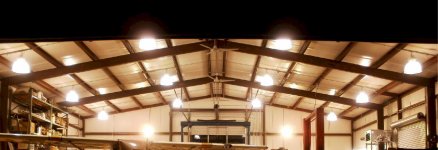 all MH and quartz and T5HO lights on small pic.jpg79 KB · Views: 1,212
 -
 split multiwire receptacle for MH lights small pic.jpg59.3 KB · Views: 1,265
 -
 half lights on new small pic.jpg107.4 KB · Views: 1,141
 -
 light switches with new labels new small pic.jpg98.5 KB · Views: 919
Last edited:


 I see this first hand in many of the government sites I visit so more than likely both of you are correct.