
To avoid these ads, REGISTER NOW!

Oil coming out of my IR 60 gallon compressor--comments?

Goldhawg

Well-known member
Joined
Nov 27, 2010
Messages
363
I bought this IR compressor used off c/l from some electricians in Cinci who installed a new larger unit at a hospital. Thought I was getting a good deal, and they changed the oil and filter before I bought (w/correct IR oil). Pumped right up to 175 during my look at it, so I transported home in my minivan horizontally. Left it lying down in the minivan for a day until I could get some help to unload. I had asked on the board if transporting like that was ok, and posters didn't see a problem.

So the compressor has been vertical for almost two weeks while I've been getting the black pipe and other parts necessary, and it has a large amount of oil coming out of the drain. When I fired it up the first time at home (a couple of days after I got it) it went up to 175 but yellow frothy stuff came out the blow off valve. I was hoping it was just somehow they filled it too full, or the horizontal transport somehow got oil where it wasn't supposed to be. But today I opened the drain valve and more oil comes out. I look at the oil sight gauge but it just looks dark to me--does this mean its too full? Should there be a line such that you can see the oil across at some level?

Thoughts? What should be my next step to evaluate?
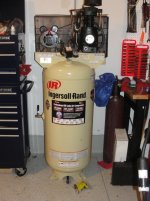
 

Attachments

  • IR compressor.jpg
    IR compressor.jpg
    91.4 KB · Views: 44
  • DSC00663.jpg
    DSC00663.jpg
    132.6 KB · Views: 49
To avoid these ads, REGISTER NOW!

Gixerfixer

Well-known member
Joined
Dec 18, 2011
Messages
156
Location
England
Don't panic, you have not damaged anything its either been over filled with oil or when it was laid over some oil got the wrong side of the piston area via a breather past the rings etc, it should stabilize but you do need to check that oil level correctly 1st as it my now be low if you have drained some from the receiver already.
 

A_Pmech

Well-known member
Joined
May 8, 2007
Messages
8,002
Location
IL
It is likely that when it was horizontal some crankcase oil seeped past the rings and was pumped into the tank.

Sight glasses provide an ambiguous indication of liquid level unless the meniscus is visible in the glass. However, not all manufacturers follow the basic principle of "full" being in the center of the sight glass, resulting in an ambiguous indication. Example: "Is the machine out of oil, or is the oil just new and clean?"

It would be best to remove the fill cap and check the oil level with a bent piece of wire. Compare the level to the sight glass to be sure. Also, check your manual to determine if the sight glass should be partially or fully submerged when the crankcase is full.
 

Chris Adams

Well-known member
Joined
Oct 21, 2007
Messages
2,117
I think you are too full of it.
Oil that is.
Seriously, as previous poster stated, don't panic.

If I owned it, I would probably invest an oil change in it right now. Drain the sucker, let it drain for at least an hour. Very gently turn the motor over one or two turns by hand after it drains.
Then clean the sight glass carefully.
Fill it SLOWLY. It can take forever. Well, I've needed an hour to fill one compressor, so it feels like forever.
It takes a long time for the oil to come up to the mid point (full) on the sight glass. A very long time, so people get in a hurry, and keep dumping in more oil till it's over full.
Then you get lots of oil in the air, dirty brown drains.

Yes, if the rings are bad, say from lots of hard use, or being run low on oil you get the same discharge, but really I think you are just over full of oil.
Take your time and don't start ripping parts off it or anything.
 
OP
G

Goldhawg

Well-known member
Joined
Nov 27, 2010
Messages
363
Thx for your comments. I'll change the oil per the recco and make sure its the right level.
 
Last edited:

Shadowdog500

Well-known member
Joined
Dec 7, 2009
Messages
9,868
Location
Down the shore
I just got a SS5L5 5HP IR compressor and mine uses a full sight glass to indicate full and a half sight glass to indicate low. Check to see what the manual for your two stage compressor says.

What is the model number? If you go into the IR Website you can get the PDF manual for your compressor or order a paper version.


Chris
 
Last edited:

Greatbear

Well-known member
Joined
Jan 17, 2008
Messages
1,702
Location
Columbia/Fulton, MD
The oil in the tank will help slow down the normal rusting that happens. :thumbup:

As others have said, change the oil. After letting it drain for at least an hour or so, look at the sight glass. If it is obviously displaying no oil, you are good to go. Otherwise, it could be a good idea to remove it and clean it. When adding oil use the mfgrs specs as a start for knowing the amount. Add it slowly and wait for the level to appear. Many sight glasses allow oil to move through them very slowly, and will continue to show rising oil levels for a few minutes after the filling has stopped. Wait for the level to stabilize then slowly add to the proper level. As Shadowdog500 mentioned, some applications have a mid-point level as a full indication (my Dayton and Champion compressors, and the pressure washers do this), other use a full glass as the maximum. Overfilling a compressor can cause oil carryover as well as oil misting from the crankcase breather. This is generally not going to harm the compressor, but the oil carryover into the air stream can cause issues when painting or media blasting, and oil depositing in rubber air hoses can cause them to fail.
 
To avoid these ads, REGISTER NOW!

e-tek

Well-known member
Joined
Dec 19, 2007
Messages
10,690
Location
Saskatoon, SK
I recall reading in a few places that you are NOT supposed to transport them on their sides.....and your experience would show why they say that. Not sure why posters here would have thought otherwise.
 
Last edited:

Chris Adams

Well-known member
Joined
Oct 21, 2007
Messages
2,117
I recall reading in a few places that you are NOT supposed to transport them on their sides.....and your experience would show why they say that. Not sure why posters here would have thought otherwise.
Well, I've transported about six on their sides, some as much as 400 miles. With no bad side effects.

I've even transported refrigerators on their side.
Refrigerators are where the 'don't transport compressors on their side' warning actually comes from.
Oil can get on the far side of the expansion tube, and takes hours to drain down.
Air Compressors don't have an expansion tube, since they are not cooling systems.
If you stand even a refrigerator up and leave it for hours, it is fine.
A compressor, after you stand it up, gently hand turn it.
I like to leave them overnight to keep any oil out of the air tank, but a little bit of oil isn't going to hurt the inside of the tank.
No hydro lock problems on a compressor.
Oil in the air is a temporary problem on a compressor, even if you manage to fill the head with oil, and it drains down.
Now bad rings are there till you fix the blasted thing.

Best way to transport a compressor is with the oil drained, but then, that's also the least messy method. Lay them on their side and they drool.

The OP said he let it sit a long time. Show me anything that would break or defect from being laid on its side in an air compressor?
 

waggie

Well-known member
Joined
Aug 3, 2010
Messages
305
Location
Upland, ca
what model is it? I have a SS5L5 (60 gal, 5hp) which aren't adjustable as far as when the pump cuts off and back on. So it doesn't pump up to 175psi.
 

Shadowdog500

Well-known member
Joined
Dec 7, 2009
Messages
9,868
Location
Down the shore
what model is it? I have a SS5L5 (60 gal, 5hp) which aren't adjustable as far as when the pump cuts off and back on. So it doesn't pump up to 175psi.

I have the same compressor as yours and you can adjust the pressure that the pump turns on and off in the regulator. But you can only adjust it a little to fine tune it.

His compressor is a two stage compressor so it is expected go up to 175.

Chris
 

Greatbear

Well-known member
Joined
Jan 17, 2008
Messages
1,702
Location
Columbia/Fulton, MD
Usually the beef with transporting upright compressors on their sides is not because of the oil issue, but the difficulty in preventing damage. Uprights have all their weight at the top, laying them on their sides exposes all sorts of parts to damage. Piping, intercoolers, thin metal or plastic belt guards, electrical bits, etc. are easily damaged. The tank itself can be dented if handled roughly. The legs on the tank are the primary weight bearing elements, but the upper frame that holds the pump and motor is more than substantial for the task. I brought home my 600+ pound Dayton 80gal upright laying it on its side, I brought along some extra wood blocks to prop the upper frame on. With the compressor still attached to the pallet it was not going to roll, plus it had the wooden crate frame around the whole thing. I propped the mounting frame up with extra blocks and rode happily home. It was then up to me and me alone to figure out how to get it out of my little truck, stand it upright and shuffle it int the corner where it still stands 22 years later. :lol:
 

71flh

Banned
Joined
Jun 15, 2011
Messages
379
Pumped right up to 175 during my look at it, so I transported home in my minivan horizontally. Left it lying down in the minivan for a day until I could get some help to unload.

I'm guessing that leaving it for a day allowed oil to sneak into the cylinder, and from there its pumped into the tank.

I'd guess it needs to sit for an equal amount of time to let the oil seep back into the crankcase.

Maybe remove the drain fittings and let the tank drain.
 
To avoid these ads, REGISTER NOW!
Top Bottom