
Hi All,
Let me just say that I look at some of the build threads on this forum and am in awe! Some really amazing ideas and skill.
I've always been into making things and learning to do things myself. I'm a model maker by trade (large model cars funnily enough.) So I decided it would be a good idea to build a garage/workshop at the end of the garden. The house belonged to my parents but they have retired into a smaller property that I pay for, leaving me with the old house. Nice.
Planning the garage, I wanted to get as much space as possible. In England we are allowed to build pretty much anything we want upto 30m2 footprint without involving 'planning permission' and 'building regulations' Thirty square meters is a bit small though, ok I guess for a single car but not two. I decided on 23x20 feet. 20 being the width between the two neighbouring properties.
I had to submit my plans to the local authority, which took 3 months to approve because I tried it as a two storey with a barn/gambrel type roof with a room in the attic space. This was flatly refused with restrictions on the pitch apex and the eaves height. I had to revise it to a simple pitched roof. In order for my building to sit on the boundary line between properties it also has to be of 'substantially non-combustable construction' which means bricks and mortar basically.
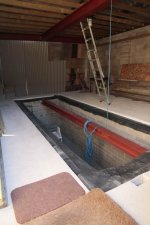
With my height restrictions there is no way for me to put a car lift inside. So I decided to include a pit. Not just any pit either - I decided to build it big, 5.5m long and 2m wide, 6 foot deep! I would put an I-Beam down the middle and cast part of the garage floor over half of it. Check out later in the pictures.
There was also several problems with my site:
1) The rear access road is around 4 feet higher than the garden. This meant building up quite a bit of clockwork before I'd even be at floor height :/ Still I meant that I would not have to dig down so far to put in a 6 foot deep pit.
2) I also had to demolish the old single garage.
3) Nowhere to store any rubble/skip etc. This meant I had to pile it all up and get a 'grab truck' to come along and scoop it up. This cost about $150 a go and I had to have it come ten times!
Here is the plan as I drew it in cad:


Here is the old single garage before I knocked it down:

Knocking it all down


A big pile of rubble to be taken away.

Finally I can get a mini digger in and level the site = good fun

I'd dug the foundation trenches, put mesh up on the vertical wall of earth held by 5 foot lengths or rebar driven in, and I'd started scooping out where the pit would be. At this stage I had not thought of making the pit twice as wide and flooring over half of it.


I was almost ready to put rebar in the trenches and pour the concrete BUT something bad happened.
I hammered four wooden posts in the corner of the site, with the intention of marking them with a rotary laser so I had some decent levels. I was putting the last post in, hit it and it shot into the ground and disappeared.
Where I live used to have a heavy coal mining industry back in Victorian times, quite a few shafts have opened up in peoples gardens... I could feel cold air coming out the hole to post disappeared into. Excited, I decided to excavate it out a little to see if I did indeed have a mine shaft. I didn't.
Instead I had some kind of irrigation waterway build from pieces of flat stone all laid dry, which I worked out came across my property at a slight angle, and exited right under the corner of my proposed garage. Bad news was that it was still carrying water. One day we had torrential rain and the whole site flooded, pit n all. I had to reveal this waterway, put a structural land drainage pipe in, fill around it with clean stone chippings, ram it all then I could continue.


Lots of rebar mesh in and the concrete being poured.


This is when i decided to double the width of the pit. You can see how far I've dug down compared to the garage behind mine! With more rain coming my dad and I quickly built a wooden frame covering the pit area and put a huge tarp over it so we could continue to work. I also had to put cornet over the mesh that was retaining the access road as it was starting to dry out and crumble.


Here's the rebar in the pit. I decided it best to tank the outside of the pit what with the irrigation waterway. What I did was to cast a slab at the bottom, blind it, then lay my membrane in and build the wall up off of that. I cast a 3" floor inside the clockwork after. I used the same membrane they use for creating artificial lakes and reservoirs, the membrane weighed 150kg!
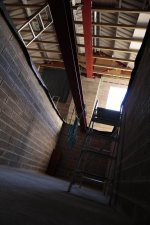
I was then able to build up the pit walls. I laid the blocks flat for strength - whole pit has taken around 500 blocks.


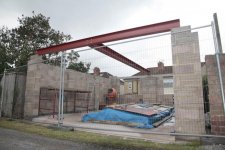
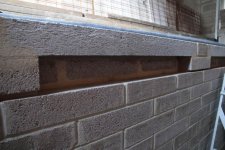
Last pic for now (I had a bit of a photo break) I took two weeks off work and built the main walls unto floor height around the perimeter. Much quicker & easier laying concrete blocks edge on rather than flat! :thumb up:

The next step is to use civil engineering polystyrene blocks (8x4x3 foot) to backfill the site. I decided on this because if I did it the traditional way and had 5 feet deep of compacted granular sub base backfill, there would be massive lateral loading on the walls. A huge amount of effort - I would have to compact 12 inches at a time with maybe 6 lorry loads on separate days. Plus the fact that the eps blocks will cost less and are cut to size to fit perfectly in the voids.
More pics in the coming months! Thanks for reading
Jay
---
Let me just say that I look at some of the build threads on this forum and am in awe! Some really amazing ideas and skill.
I've always been into making things and learning to do things myself. I'm a model maker by trade (large model cars funnily enough.) So I decided it would be a good idea to build a garage/workshop at the end of the garden. The house belonged to my parents but they have retired into a smaller property that I pay for, leaving me with the old house. Nice.
Planning the garage, I wanted to get as much space as possible. In England we are allowed to build pretty much anything we want upto 30m2 footprint without involving 'planning permission' and 'building regulations' Thirty square meters is a bit small though, ok I guess for a single car but not two. I decided on 23x20 feet. 20 being the width between the two neighbouring properties.
I had to submit my plans to the local authority, which took 3 months to approve because I tried it as a two storey with a barn/gambrel type roof with a room in the attic space. This was flatly refused with restrictions on the pitch apex and the eaves height. I had to revise it to a simple pitched roof. In order for my building to sit on the boundary line between properties it also has to be of 'substantially non-combustable construction' which means bricks and mortar basically.
With my height restrictions there is no way for me to put a car lift inside. So I decided to include a pit. Not just any pit either - I decided to build it big, 5.5m long and 2m wide, 6 foot deep! I would put an I-Beam down the middle and cast part of the garage floor over half of it. Check out later in the pictures.
There was also several problems with my site:
1) The rear access road is around 4 feet higher than the garden. This meant building up quite a bit of clockwork before I'd even be at floor height :/ Still I meant that I would not have to dig down so far to put in a 6 foot deep pit.
2) I also had to demolish the old single garage.
3) Nowhere to store any rubble/skip etc. This meant I had to pile it all up and get a 'grab truck' to come along and scoop it up. This cost about $150 a go and I had to have it come ten times!
Here is the plan as I drew it in cad:
Here is the old single garage before I knocked it down:
Knocking it all down
A big pile of rubble to be taken away.
Finally I can get a mini digger in and level the site = good fun
I'd dug the foundation trenches, put mesh up on the vertical wall of earth held by 5 foot lengths or rebar driven in, and I'd started scooping out where the pit would be. At this stage I had not thought of making the pit twice as wide and flooring over half of it.
I was almost ready to put rebar in the trenches and pour the concrete BUT something bad happened.
I hammered four wooden posts in the corner of the site, with the intention of marking them with a rotary laser so I had some decent levels. I was putting the last post in, hit it and it shot into the ground and disappeared.
Where I live used to have a heavy coal mining industry back in Victorian times, quite a few shafts have opened up in peoples gardens... I could feel cold air coming out the hole to post disappeared into. Excited, I decided to excavate it out a little to see if I did indeed have a mine shaft. I didn't.
Instead I had some kind of irrigation waterway build from pieces of flat stone all laid dry, which I worked out came across my property at a slight angle, and exited right under the corner of my proposed garage. Bad news was that it was still carrying water. One day we had torrential rain and the whole site flooded, pit n all. I had to reveal this waterway, put a structural land drainage pipe in, fill around it with clean stone chippings, ram it all then I could continue.
Lots of rebar mesh in and the concrete being poured.
This is when i decided to double the width of the pit. You can see how far I've dug down compared to the garage behind mine! With more rain coming my dad and I quickly built a wooden frame covering the pit area and put a huge tarp over it so we could continue to work. I also had to put cornet over the mesh that was retaining the access road as it was starting to dry out and crumble.
Here's the rebar in the pit. I decided it best to tank the outside of the pit what with the irrigation waterway. What I did was to cast a slab at the bottom, blind it, then lay my membrane in and build the wall up off of that. I cast a 3" floor inside the clockwork after. I used the same membrane they use for creating artificial lakes and reservoirs, the membrane weighed 150kg!
I was then able to build up the pit walls. I laid the blocks flat for strength - whole pit has taken around 500 blocks.
Last pic for now (I had a bit of a photo break) I took two weeks off work and built the main walls unto floor height around the perimeter. Much quicker & easier laying concrete blocks edge on rather than flat! :thumb up:
The next step is to use civil engineering polystyrene blocks (8x4x3 foot) to backfill the site. I decided on this because if I did it the traditional way and had 5 feet deep of compacted granular sub base backfill, there would be massive lateral loading on the walls. A huge amount of effort - I would have to compact 12 inches at a time with maybe 6 lorry loads on separate days. Plus the fact that the eps blocks will cost less and are cut to size to fit perfectly in the voids.
More pics in the coming months! Thanks for reading
Jay
---
Last edited:



.jpg)
.jpg)
.jpg)
.jpg)
.jpg)

.jpg)
.jpg)
.jpg)
.jpg)
.jpg)
.jpg)
.jpg)
.jpg)
.jpg)
.jpg)
.jpg)
.jpg)
.jpg)
.jpg)

