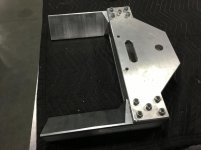
I recently installed a car lift in my garage and, besides the conventional way a lifting a car, I wanted to come up with an easy method to lift a car by the tires. I thought this would make many maintenance tasks easier and also give the ability to store the car like it was a four post lift. I like all kinds of tools and in addition to a CAD/CAM system and lots of design experience I happen to have a horizontal machining center.
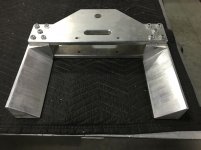
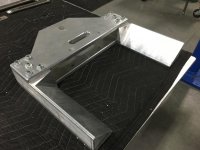
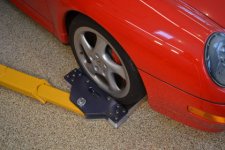
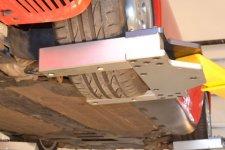
Now there are one or two lift manufacturers that offer wheel-engaging adaptors as an option. But they are not very elegant, being heavy and ugly steel weldments and they don’t fit the tires on my sports cars very well. So I made these out of aluminum, 6061-T6 and anodized them. Everything is CNC machined and there is no welding. They were designed to have maximum tire contact to minimize the possibility of flat spots from prolonged storage. Each tire is supported by the two forks of the adaptors and so the tires have about twice the support area that they would have sitting on the ground.
Not wanting to drop an expensive car I did a finite element analysis which verified my initial calculations that they were very strong. The use of them results in somewhat more stress on the lift arms (because there is a twisting component) so the lift should be de-rated to about 50-60% of the normal capacity. My lift is 10,000 lbs., so that means I can use these to lift at least 5,000 lbs., which, while I won’t be lifting dump trucks, is more than enough for the sports cars they were designed for.
I like them so much that they have become the normal way I lift a car if I don’t have to take the wheels off. They have two big advantages:
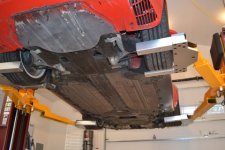
1) The whole underside is accessible which makes removing undertrays and side panels fast and easy.
2) I can store a car with the weight on its tires just like a four post lift, but the two post takes up much less room.
I almost bought an in-ground lift, but for my garage I’m really glad I got a two-post. I have two cars in this garage, but also a motorcycle and I do some woodworking, too. The ability to leave a car in the air and park the other under it gives me a lot of room for the other things I want to do.
Now there are one or two lift manufacturers that offer wheel-engaging adaptors as an option. But they are not very elegant, being heavy and ugly steel weldments and they don’t fit the tires on my sports cars very well. So I made these out of aluminum, 6061-T6 and anodized them. Everything is CNC machined and there is no welding. They were designed to have maximum tire contact to minimize the possibility of flat spots from prolonged storage. Each tire is supported by the two forks of the adaptors and so the tires have about twice the support area that they would have sitting on the ground.
Not wanting to drop an expensive car I did a finite element analysis which verified my initial calculations that they were very strong. The use of them results in somewhat more stress on the lift arms (because there is a twisting component) so the lift should be de-rated to about 50-60% of the normal capacity. My lift is 10,000 lbs., so that means I can use these to lift at least 5,000 lbs., which, while I won’t be lifting dump trucks, is more than enough for the sports cars they were designed for.
I like them so much that they have become the normal way I lift a car if I don’t have to take the wheels off. They have two big advantages:
1) The whole underside is accessible which makes removing undertrays and side panels fast and easy.
2) I can store a car with the weight on its tires just like a four post lift, but the two post takes up much less room.
I almost bought an in-ground lift, but for my garage I’m really glad I got a two-post. I have two cars in this garage, but also a motorcycle and I do some woodworking, too. The ability to leave a car in the air and park the other under it gives me a lot of room for the other things I want to do.



 Please don't.. I cant speak for the Longhorn MaxJax Copy.