jtbinvalrico
Well-known member
*I've updated this thread with much more information and detail in post #4 after a member here asked me about it.*
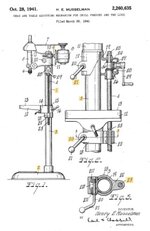
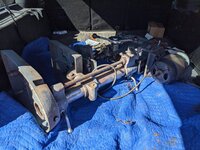
A recent find......It was missing one of the original collar clamp handles and the miter gear that is supposed to be attached to the other side of the crank handle:

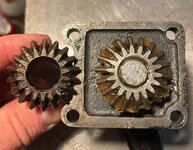
I did some figuring and determined what miter gear was needed to make it work. The gear already had the correct bore and was a perfect match for the other original gear....all I had to do was shorten it some to make it mesh with the other one:
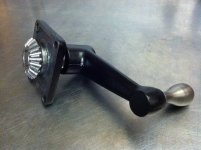
With that and a corrected clamp handle, I was in business.....or so I thought. I put the thing together and it worked. I knew the one original gear was iffy.......I don't know if it was made out of some **** metal or if it had been severely abused in another life - but the one original gear I had was "crumbly", as if it was going to just fall apart. It was, however, enough to let me learn about these miter gears and pitch and faces, etc. In a few turns the old gear gave up and the teeth sheared off:
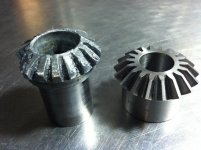
So I ordered a mate for my other gear. This one was an odd fit though. It wanted a 3/4" bore, keyed, and about a 2" overall height. That wasn't going to happen except on a custom order. So I received the second gear and decided I would push my limited machining abilities a bit further. I cut off the business end of the old miter gear and saved the lower sleeve which was already dimensioned and keyed to fit on the shaft. I took my new gear and widened the bore from 5/8" to 3/4", and shortened it accordingly:

I then welded the gear to the old sleeve and carefully smoothed it out so it would turn in the bore in the housing:
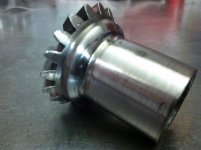
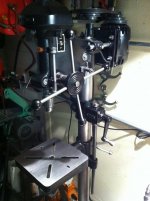
Fortunately, the miter gear assembly in this case is hand-cranked/low speed, so any imperfections in my gear mating really aren't an issue. Something tells me that if I ran my fabbed gear up to a few thousand rpms I'd fully recognize my need for some real milling and machining gear. The end product runs smoothly and functions as designed:

A recent find......It was missing one of the original collar clamp handles and the miter gear that is supposed to be attached to the other side of the crank handle:
I did some figuring and determined what miter gear was needed to make it work. The gear already had the correct bore and was a perfect match for the other original gear....all I had to do was shorten it some to make it mesh with the other one:
With that and a corrected clamp handle, I was in business.....or so I thought. I put the thing together and it worked. I knew the one original gear was iffy.......I don't know if it was made out of some **** metal or if it had been severely abused in another life - but the one original gear I had was "crumbly", as if it was going to just fall apart. It was, however, enough to let me learn about these miter gears and pitch and faces, etc. In a few turns the old gear gave up and the teeth sheared off:
So I ordered a mate for my other gear. This one was an odd fit though. It wanted a 3/4" bore, keyed, and about a 2" overall height. That wasn't going to happen except on a custom order. So I received the second gear and decided I would push my limited machining abilities a bit further. I cut off the business end of the old miter gear and saved the lower sleeve which was already dimensioned and keyed to fit on the shaft. I took my new gear and widened the bore from 5/8" to 3/4", and shortened it accordingly:
I then welded the gear to the old sleeve and carefully smoothed it out so it would turn in the bore in the housing:
Fortunately, the miter gear assembly in this case is hand-cranked/low speed, so any imperfections in my gear mating really aren't an issue. Something tells me that if I ran my fabbed gear up to a few thousand rpms I'd fully recognize my need for some real milling and machining gear. The end product runs smoothly and functions as designed:
Last edited: