To avoid these ads, REGISTER NOW!

1952 Craftsman "100" DP resto

jtbinvalrico

Well-known member
Joined
Jan 2, 2010
Messages
1,375
Location
Tampa FL
Here goes the resto:

Bearings and actions are smooth. Everything is there except for the engine-turned "headband" around the top. I've been wanting to do one of these in "power bronze", and I'll be fabricating the headband to complete it.

I disassembled it today.....I want to thank the person who assembled this 60-odd years ago, your proper use of lubricant made disassembly a breeze. I never thought I'd see a column I could simply loosen and lift out! The motor ran fine, but I disassembled it anyway and found one of the bearings choked with debris and the other one shot......ordered two new bearings today.

Here's some pics:

Despite the careful assembly way back when, it seems the seller's grandfather was the last person who took care of this DP....seems the rest of the family left it to rust:

IMG_1372.jpg

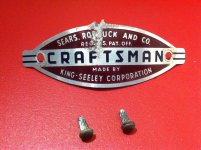
It took at least one knock on the head.....hopefully this tag can be rebuilt and touched up:

IMG_1378.jpg

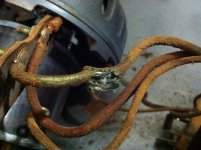
A good reason to open up a motor even if it runs......plus it had the original two-prong ungrounded plug:
IMG_1423.jpg

Between stretches of grinding off rust and muck, I like to take a few parts and renew them........some before and after pics:

IMG_1437.jpg

IMG_1438.jpg

IMG_1429.jpg

IMG_1432.jpg

I'll update as it progresses.

:beer:
 
Last edited:
To avoid these ads, REGISTER NOW!
OP
J

jtbinvalrico

Well-known member
Joined
Jan 2, 2010
Messages
1,375
Location
Tampa FL
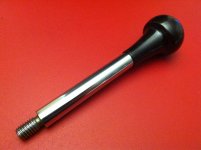
As a rule, any part of a resto that is round and can spin in the lathe, gets resto'd on the lathe. Knobs, rods, levers get the following treatment: Chuck the piece in and get some sandpaper. Run it at 1500-2000 rpm. On this particular knob I started with 100gr, then progressed through 150, 220, 400, 600, 800, and 1000. I continued turning the knob while I applied some metal polish (in this case, Mother's aluminum) and then buffed it out with a cloth as it was spinning.

Make sure that you use the 100gr enough to get out any imperfections, pitting, or dings before progressing. You may need to start with 60gr for really banged up pieces. I'm planning on doing the same thing for the column, although that's going to take a bit of rigging.

The odd parts like the quill and chuck start on the wire wheel then are done by hand with metal polish......a buffing wheel would work nicely too.
:beer:
 
OP
J

jtbinvalrico

Well-known member
Joined
Jan 2, 2010
Messages
1,375
Location
Tampa FL
Here's a link to a video I made showing the polishing of one of the feed levers:

Before:
IMG_1466.jpg

(2018 edit: over 4100 views!!!....LOL...:3gears:)

After:
IMG_1468.jpg
 
Last edited:

dieselmike

Well-known member
Joined
Mar 18, 2011
Messages
802
Location
BC
how did you clean up the plastic? if you turn the column to get out the pitting, its OD will be too small to properly fit the base, head, etc..
 
OP
J

jtbinvalrico

Well-known member
Joined
Jan 2, 2010
Messages
1,375
Location
Tampa FL
Thanks guys......I find that the key to getting good looking plastic is to buy good looking plastic :lol:. Seriously, as long as they are in good shape to begin with, like these handles were, you can "turn" them. By good shape, I mean no cracks, structurally sound, etc. You can get worn handles to look really nice by turning them and using a cloth with an abrasive polish. I used a dab of Mother's since it was handy. If they are in worse shape, you'll have to start with a rougher grit.
The same applies to the column....sorta. You have to start with one that's got only surface rust. You're right, going deep enough to get out deep pitting would compromise the fit. I'll take a negligible amount off to polish this column.

The nameplate is in pretty bad shape:

IMG_1492.jpg

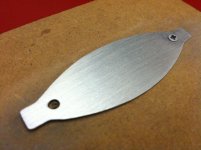
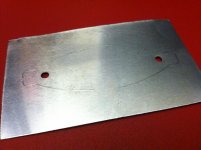
I'm going to keep a long-term eye out for another nameplate, but in the meantime I'll build a new nameplate. Starting with a sheet of aluminum:

IMG_1496.jpg

Secured to a board and put through the grits, ending at 1000gr wet and some metal polish:

IMG_1499.jpg

IMG_1500.jpg

IMG_1501.jpg

A new decal placed over it to create a new name plate:

IMG_1797.jpg

I continue to work on the smaller bits as I complete a steady-rest for my lathe so I can polish the column. Things will move pretty quickly once the column is polished and back in the base. Hoping to do some painting next week.
 
Last edited:

kc-steve

Well-known member
Joined
Jun 22, 2010
Messages
4,240
Location
Kansas City
Thanks jt. Nice to read about tips like that.

I accidentally found that when you use a worn out flap disk and grinder it also tends to polish metal instead of sand it. :)

Steve
 
OP
J

jtbinvalrico

Well-known member
Joined
Jan 2, 2010
Messages
1,375
Location
Tampa FL
amaes......That guy's work is impressive. I dare say my emblem reproduction is tame compared to that. :beer:

Progression of an aluminum part that was originally plated:

IMG_1521.jpg


After the wire wheel.....note the casting line across the part:
IMG_1522.jpg


Casting line smoothed off.....100gr:
IMG_1525.jpg


150gr:
IMG_1526.jpg


220gr:
IMG_1527.jpg


400gr wet:
IMG_1528.jpg


600gr wet:
IMG_1529.jpg


800gr wet:
IMG_1530.jpg


1000gr wet:
IMG_1531.jpg


After metal polish......a can of Mother's and a rag. Bolted up to the depth stop:
IMG_1532.jpg


Cleaned up a few other pieces and started paint. The "done" pile is growing:

IMG_1541.jpg
 

ckadams00

Well-known member
Joined
Sep 12, 2011
Messages
1,273
Location
Seattle, WA
Hey JT your work is putting my restos to shame (stop it man, the chicks are gonna notice) - on the sandpaper progression how are you doing that - hand, grinder, wheel, what?
 
OP
J

jtbinvalrico

Well-known member
Joined
Jan 2, 2010
Messages
1,375
Location
Tampa FL
ckadams00.......the progression begins on the wire wheel to remove rust, corrosion, or a trashed old plated finish. Next is hand sanding 100-1000gr, then hand polishing with Mother's metal polish. Admittedly, the process could be sped up by using cloth wheels on a bench grinder, but I've got all these grits on hand and I'm not in a big rush.
:pimpflash
 
OP
J

jtbinvalrico

Well-known member
Joined
Jan 2, 2010
Messages
1,375
Location
Tampa FL
This is a basic, average-guy motor assembly using only basic tools. I used a very basic bearing puller for disassembly. I got the new motor bearings in and ran a bench test. Here's the reassembly:

The parts, with the end caps painted:
IMG_1544.jpg


End cap (not containing the switch) with the air cone bolted in to the inside of it. Set this part aside for now:
IMG_1545.jpg


Other end cap (will contain the switch):
IMG_1546.jpg


Start by mounting the overload protector:
IMG_1547.jpg


Next, set the switch shield into the end cap over the screw holes:
IMG_1548.jpg


Then set the piece of switch insulation over the shield:
IMG_1550.jpg


Place the switch over the insulation and shield and screw them into the end cap:
IMG_1551.jpg


At this point, you are going to have bring the stator assembly in closer to the end cap because the lengths of wire are shorter. Continue by mounting the terminal bar to the endcap:
IMG_1552.jpg


While mounting the terminal bar, you may have to turn the stator assembly on its side and reach through with a long screwdriver to tighten the screws:
IMG_1553.jpg


Be sure to pull these two wires through the opening (you should have marked them for proper attachment during disassembly):
IMG_1554.jpg


Stand the stator assembly on its end and place the end cap over it. Some considerations....the metal tabs on the edge of the cap locate it correctly on the stator assembly, but you need to make sure that the bolt holes line up with the cut-outs on the side of the assembly; be sure to route the wires carefully - the rotor needs to be able to spin unimpeded in that space; as the wires come out of the end cap, make sure they aren't going to be pinched during reassembly:
IMG_1555.jpg


Rotor assembly:
IMG_1556.jpg


Carefully flip the end cap / stator assembly over and place it on something you can pass things through, in this case I used a partially opened vise:
IMG_1573.jpg


Place the rotor assembly into the stator assembly so that the governor will be in contact with the motor switch mounted in the end cap:
IMG_1574.jpg


Place the other end cap over the stator assembly, again being careful to line up the bolt holes. Then install a couple of the through-bolts to keep everything together and lined up:
IMG_1575.jpg


Place one of the bearings over the shaft and locate it on the machined bore of the end cap. Find a socket that is the same diameter as the machined bore; the idea is to put the pressure on the outermost edge of the bearing. Use some sockets and some light, square taps with a hammer to set the bearing in. This should not take a whole lot of banging to get done:
IMG_1577.jpg


This end of the motor gets the bearing spring. Situate it on the bearing and install the bearing cover:
IMG_1578.jpg


IMG_1579.jpg


Do the same thing on the other end of the motor:
IMG_1581.jpg


Set the motor on the bench, tighten the bearing covers down, install the remaining through bolts, and spin the motor shaft by hand to check for smooth, unimpeded movement:
IMG_1582.jpg


Wire up a plug and bench test....be careful, it might jump a little when it comes on:
IMG_1583.jpg


That's the motor bench test. This one is silky smooth and ready for another 60 years of service. The original decorative metal band was corroded and the finish was shot. I'll be making a new one with an engine-turned finish, then I'll complete the motor base assembly.

Obviously, the availability and use of proper tools and presses can make this job easier. I found disassembly to be straightforward....remove the motor from its base, remove the bearing cover plates, and remove the four through bolts. I used one of my pullers to remove the non-switch end cap, and then the bearing after that (they may come off in a different order, depending on their condition). You want to do your best not to beat up the wiring inside. By now, you can partially separate the other end cap from the stator. I then use a long-handled screwdriver to reach in and loosen the six screws used to mount the overload protector, terminal plate, and switch assembly. After doing this, tension will come off the wires and you can finish pulling the thing apart and get at the final bearing.......Again, this is just a layman's way of getting it done.
 
To avoid these ads, REGISTER NOW!
OP
J

jtbinvalrico

Well-known member
Joined
Jan 2, 2010
Messages
1,375
Location
Tampa FL
More progress......The base definitely looks 60 years old. I like to grind the plate surface on the base. Although the catalogs depict a machined surface on the base plates, a good number of them appear to have not been machined at all. The plate surface on this one was quite rough and had to be ground down. That's original paint covering the entire surface:

76419432.jpg


After the belt sander, paint, and a column test fitting:

46f42442.jpg


The table has one errant hole made sometime in the past 60 years. Overall, not in bad shape; the rust was mostly of the surface variety:

b9d344bc.jpg


Easily smoothed out using my old 6 X 48 Craftsman sander:

82ecf9bf.jpg


Done, alongside the freshly painted head unit wearing it's new name plate:

a3562a2f.jpg
 

Omphaloskeptic

Well-known member
Joined
Oct 11, 2008
Messages
2,346
Location
Ultima Ratio, Wa.
Man, what a slick and thrifty rig to do the post polishing! That machine is going to be better than new. Although my Craftsman Floor DP is nowhere near the classic yours is, I'm thinking I need to get out to the shop with the emery cloth, elbow grease, paste wax and get busy. lol
 

Steevo

Well-known member
Joined
Aug 18, 2009
Messages
8,738
Location
43.49600, -112.04300
I love these old Craftsman drill presses for their Art Deco styling and timeless design and functionality. Your restoration is a "better than new" example of how one can be brought back and beyond, showcasing its architectural design and securing its place in the American workshop.
Kudos.
 
OP
J

jtbinvalrico

Well-known member
Joined
Jan 2, 2010
Messages
1,375
Location
Tampa FL
Thanks for all the words and support guys.....Admittedly, I'm going a bit further on this resto than I did on my 1942, and that's probably because I find myself having to make the "engine turned" decorative bands around the head and motor; I figured that if I had to make a piece that pretty to go on a DP, I was going to go a tad nuts with the rest of it.

Here's an example of something I thought was worth addressing. I find the downward sloping nose on the front of this DP to be one of its defining design aspects:

6b5ea9f3.jpg


After a couple coats of paint, I looked at it and thought its rough casting could be cleaned up, while of course leaving the rest of the head unit alone. A quick smoothing over followed by paint:

78eca098.jpg


6a25680c.jpg


Same thing with the rather jagged edge on the casting above the name plate; I'll be touching it up with a Dremel to make it round instead of sloppy and squared.

I took a look at the table as well. All things considered, it's not that bad: one larger divot, and two tiny ones to the left. I did some research and looked into a number of ways to address this. Since this divot is really only cosmetic, I decided that it really just needed filling, as opposed to a structural fix. I experimented first with an epoxy laced with cast iron shavings. It worked, and it smoothed out nicely.....but it was a very poor color match, and not any better than simply leaving the divot. So I removed it and was left with the divot:

b64b486f.jpg


I don't have an arc welder, but I do have MIG. Ideally, I could have filled the divot using the proper rod for cast iron. Using what I had, I decided to do a quick hit with the MIG and see how it would turn out:

70955ef4.jpg


I then flipped it over and resurfaced it on my 6 X 48 belt sander. It turned out well. You have to get right up on it to see the difference. There's three repairs on this table:

e99b2b24.jpg


eea6f0e3.jpg


a40bf2ac.jpg


I do recommend a properly welded fix for broken tables.....but for a cosmetic fix, this worked out nicely.
 

Stuart in MN

Well-known member
Joined
Sep 8, 2005
Messages
22,995
Location
Minneapolis
As long as you're making a new engine turned cover for the motor, you should make a piece for the head that goes in the area I crudely highlighted below:

attachment.php


They came from the factory with this piece, depending on the age of the press (I know mine has one.) I think it would help dress it up. You can see it in the photo of my drill press below.

attachment.php
 

Attachments

  • untitled.JPG
    untitled.JPG
    41 KB · Views: 2,591
OP
J

jtbinvalrico

Well-known member
Joined
Jan 2, 2010
Messages
1,375
Location
Tampa FL
Yup, that's on the list too. Interestingly, there's a two year period in the catalogs that show these without the headband....which makes me wonder if they shipped without the headband or merely oversimplified the catalog picture. I doubt it's the latter because they often used the same picture from year to year when there were no changes.

Regardless, I'd add it anyway just because it's so derned cool looking. By the time I'm done, I guess I'll know how to do engine turning.
:beer:
 

Mavawreck

Well-known member
Joined
Jan 30, 2011
Messages
1,835
Location
Durham NC
I think it looks great, reminds me of an old Mercury except you're dealing with steel rather than aluminum.

Not 'my' Mercury, but the same model.

attachment.php
 
OP
J

jtbinvalrico

Well-known member
Joined
Jan 2, 2010
Messages
1,375
Location
Tampa FL
Have you thought about just leaving the defining castings polished?

You know, I really thought about doing that, and I think the idea has merit. But I was afraid I'd overshoot the classic "power bronze" DP I was after. If had a stable full of these, I'd do that with one......polish the smooth surfaces, polish the leading edges.....paint it black......
 

Enkidu

Member
Joined
Apr 13, 2012
Messages
5
Location
Seattle, WA
The polished parts you're posting here look amazing. Its definitely making me think hard about how I want my "new" 150 to look when I'm done!

I like your motor reassembly sequence too. I haven't decided if I want to do a simple quick-and-dirty respray on mine or if I need to give it the full monty, so I think I'll be looking at that post very closely.

Nice work!
 
Last edited:
OP
J

jtbinvalrico

Well-known member
Joined
Jan 2, 2010
Messages
1,375
Location
Tampa FL
Mavawreck.....that's a beautiful motor. I know squat about marine motors, but the lettering suggests a nice vintage.

Enkidu....these old motors seem to go on forever. It's definitely tempting to leave the motor as-is, maybe tape off the shafts, paint it and get it back to work. I can offer a few examples that illustrate the merits of disassembling that old motor for a check-up:

1) The motor for this particular resto seemed to run smooth. The shaft even seemed to turn freely. However, upon disassembly, and with no mass on the bearings, I was able to spin the bearings in my hand and feel the resistance of the grit inside them.....failure somewhere on the horizon. Replaced them for about $16.00 shipped.

2) The most serious example was the frayed open wire I found inside the motor housing. The wire was completely exposed....just waiting to touch the motor housing. It included the original two-prong non-grounded plug.

3) Many of the soldered connections are going to be frayed, with maybe just a few strands of wire making the connection. These need to be redone on these old motors.

The disassembly is worth doing. The trick is to keep all the connections inside the motor intact so you don't get lost on reassembly.

I have to say that the "fun" part of this resto is the aluminum.....it's just so rewarding to clean up. Here's a few parts I got done before shutting down the shop for the day:

5095fb5e.jpg


51af1d69.jpg


These were chucked into the lathe, rough parts sanded out.....finished with Mother's:

1f195f8e.jpg


b012fab9.jpg


dfe5d7df.jpg

:beer:
 
OP
J

jtbinvalrico

Well-known member
Joined
Jan 2, 2010
Messages
1,375
Location
Tampa FL
In between the big parts that can represent significant steps forward, the smaller parts require attention too....in this case the back side of the feed handle hub. On this DP that hub sticks out far enough from the head unit so that the back side can be seen, so it requires a proper cleaning...and that cleaning is killing my fingers. Even with the Dremel and small brushes, I still have to cramp my fingers in there to get it done right....so I decided to give my mitts a break and play with the lathe some more.

My research on polishing a column that happens to be way longer than your lathe revealed two approaches: 1) The steady rest, and 2) an extension of the tail stock. In this case, the steady rest gave me very good results. However, I wanted a couple things that the steady rest (at least the one I hacked together) couldn't give me. First, I didn't want to have to stop, flip the thing around, and otherwise accommodate the wheel and the marks it left 2/3 of the way down the pole. Second, since I built mine on the super-cheap, I was limited to the lowest speed on my lathe, 575 rpm.

So, I took some extra parts I had lying around, picked up two ten inch bolts from the store, and built my version of a lathe tail stock extension. I wanted to test a couple of ideas. First, it was nice to be able to work the column all at once. Second, I was able to run this setup up to 1560 rpm, significantly affecting and enhancing my efforts with the 400 and 600 grit sandpaper, and even more so with the metal polish. I'm of the opinion that if someone is going to polish a DP column, the superior approach would be to build a tail stock extension. It would have cut my work time by about 1/3.

To build it, first an end cap must be made to fit into the end of the column. I used a bit of 2 X 4 cut down to size, but a higher quality wood would wear better. Chuck it up on the lathe and turn it down to a supersized cork:

685baff5.jpg


Next, find a bearing. In this case I used one that would play nice with the end of a 1/2" bolt:

3b97d0b7.jpg


Using the lathe, cut out a hole that allows a snug fit of the bearing:

fd921aaa.jpg


Press the bearing into the end cap and fit it into the end of the column. It doesn't need to be super tight at this point:

d22f93e6.jpg


Here's the bed extension. It's two 2 X 4 's bolted to the lathe stand, extending toward the end. The vertical is another 2 X 4 bolted up between the two extensions. Two turnbuckles permit minor adjustments to the angle and brace the structure:

2f4c4cc8.jpg


A half-inch bolt goes through the vertical to support the tail end of the column. A bolt on the left side allows tensioning against the column:

59923e75.jpg


I simply rounded off the end of the bolt so it would mate with the bearing bore....nothing fancy:

43dfadf9.jpg


This was a fun experiment, and it resulted in a DP column a bit more shiny than it was before:

3c7a199e.jpg

:beer:
 

Slow Gray Mule

Well-known member
Joined
Feb 23, 2010
Messages
68
Location
MS Gulf Coast
What would be a good price to pay for one of these? I saw one some what local to me and have been wanting a floor standing DP. It us unrestored of course, but appears to have been taken care of. Any general rule of thumb as to what they are going for and what are some problematic things to look for that could be a deal breaker?
 
OP
J

jtbinvalrico

Well-known member
Joined
Jan 2, 2010
Messages
1,375
Location
Tampa FL
What would be a good price to pay for one of these? I saw one some what local to me and have been wanting a floor standing DP. It us unrestored of course, but appears to have been taken care of. Any general rule of thumb as to what they are going for and what are some problematic things to look for that could be a deal breaker?

A key factor is location, as that dictates supply. Some places are loaded up with these things, in others they are exceedingly rare. Additionally, you are bound to run into the occasional seller who thinks their DP is cast out of pure gold. So, when I say my price range on one of these is $75 - $125, I'm talking about the Tampa / Central Florida market. Additionally, being willing to drive a couple hours widens my options.

I like the old Craftsman tools, in part because there is a reasonable amount of documentation via the catalog base throughout the 1900's. Go to OWWM.com and browse the photo index to get an idea of what's out there and what a complete machine looks like......then reconcile that with what's available in your market.

Here's what I'd look for in any DP: Is it complete? A $100 deal can become a cash pit if you end up spending another $100 locating key parts. If it's missing multiple key parts, like handles and return springs, I'm not going to bother with it. An exception to this rule would be where you might be able to get two incomplete machines, make one unit, and sell the extra parts off.

Is there catastrophic damage? Such as bent spindles, broken castings, rust so severe that it leaves pitting on close-tolerance parts. You would have to factor in the replacement of these parts.....and if it's a particularly rare machine, getting those parts fabricated could be a deal breaker.

Does it turn on and run? I don't bother with machines that don't work. I at least need to see some functionality so that I can figure out how far my resto is going to have to go. Totally seized machines, tools that doubled as boat anchors?.....maybe for parts.

When you look at it you are going to want to check for play in the spindle. Grab the lower end and the top pulley and move them to feel for play. If possible, check for runout. Chuck in a bit and drill a hole. Look for wobbling pulleys. Look for belts flopping around. Look for funky vibrations. Look for evidence that the seller used this DP as a mill....too much of that side-to-side force over the years can wreck one of these machines.

What is acceptable? Some play in 60 year old bearings can be expected. I've been able to reuse some of these old bearings because the machines weren't abused......But replacing bearings is an accepted and normal part of these restos and shouldn't be a deal breaker. Nasty old paint is normal. A divot or two in the table isn't unusual.....but it shouldn't look like the surface of the moon. Surface rust is to be expected where the DP was not used regularly.

I think the biggest factor that can determine success is the prior owner. One of mine came from a retired machinist. The guy used his gear, but didn't abuse it. Another was original to the grandfather, who had passed it on to a disinterested grandson......the last person to use it was the grandfather, who also did not abuse it. I'm very interested in the back-story....it speaks volumes about the life of the machine. If possible, I like to see the shop it came out of.

So....$75 in my area gets you a 1940's to 1950's DP that is far from pretty and runs. At that price it may be missing two or more parts, such as a feed handle, lever, or pulley guard. There's a lot of broken quill return springs in that price range. Good chance that the motor is non-original. Expect to replace bearings.

I paid $125 for each of mine. At that price I expect it to be fully functional, but ugly. I don't mind replacing one knob, but everything else is there. I expect to have to redo the electrical. Original motor is mandatory. Runout should be minimal.

If you find something you like, don't quibble over $25.....Post up some pics of your prospects.....
:beer:
 

Outlawmws

Well-known member
Joined
Aug 9, 2011
Messages
39,105
Location
The Badlands
In addition to what was said above, it also depends on what "extras" come with it if any. The second set of pulleys adds value, as now it can do both metal and wood instead of wood and small holes in generally sort metals. Then there is the even more rare table lifter. An XY, or rotary table and/or period correct DP vise is another rarity.

The third pulley snd table riser (54 catalog):
attachment.php


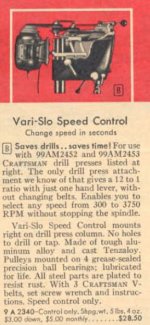
A fancier speed adjuster from the 59 catalog:
attachment.php


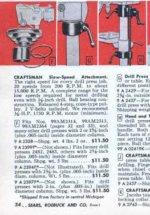
Other DP accessories, again from 59:
attachment.php
 

Attachments

  • DP accessories2.jpg
    DP accessories2.jpg
    42.6 KB · Views: 2,419
  • DP accessories1.jpg
    DP accessories1.jpg
    51.3 KB · Views: 2,437
  • DP accessories.jpg
    DP accessories.jpg
    104.6 KB · Views: 2,468
OP
J

jtbinvalrico

Well-known member
Joined
Jan 2, 2010
Messages
1,375
Location
Tampa FL
There's two pieces that need to be fabricated from scratch: The engine turned band around the DP head, and the band around the the motor. Having done some research into engine turning, I'm ready to jump in. One of the videos I saw featured a guy using a wooden dowel and some valve grinding compound (a creamy sort of abrasive). I thought I'd try my hand at it and see how I could do:

I whittled this dowel down to about 5/16"....that's what my estimation of the diameter of the turned circles of the headband is:

1353007d.jpg


39095924.jpg


First tries with the wooden dowel. Progressing from left to right I learned some things about pressure and dwell time:

08a4616c.jpg


I kept ending up with circular striations in my circles. Maybe my dowel is too soft of a wood and is getting grit stuck in it?

d7117df5.jpg


I decided to try something different, a pencil eraser.....I actually got better results:

57405c5f.jpg


ea377114.jpg


dea4dd16.jpg


I've got a ways to go on learning this. The process is interesting and I can see how getting it right would be quite rewarding. I'm going to experiment with a wire brush next. Also, this was on aluminum. I may need to try some steel.
:beer:
 
To avoid these ads, REGISTER NOW!
Top Bottom