

blasto9000
Well-known member
The astonishing setups people have chronicled here inspired me to revamp my tool chest setup. Three of the 42-inch HF tool cabs have replaced my old setup of a 42-inch Craftsman Quiet Glide tool chest combo and a Costco 48-inch workbench with drawers. I never liked that Craftsman... it was just really poorly made and very expensive. Every time I looked at it I felt ripped off.
Sorry about the mess but it's still a work in progress. The cabs are mounted to a frame I made out of 80/20 extrusions. My floor has a steep slope to it -- the three cabs total about 11 feet in length, and the slope is over two inches. So on the original casters the cabs were all crooked and were prone to drift around the floor a bit when slamming the drawers open and closed, even with the wheels locked.
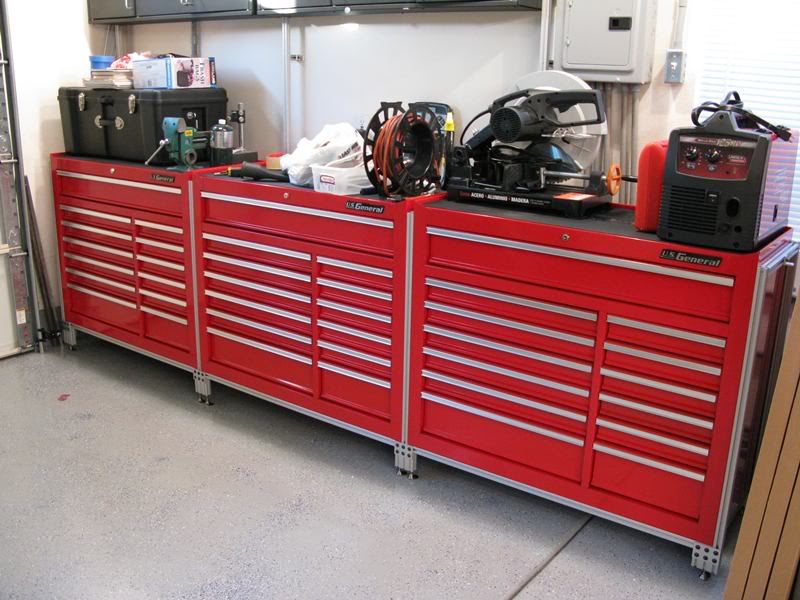
The legs were all cut at different lengths (from 1.5 inch to 4.0 inch) to match the contour of the floor. 80/20 brand leveling feet provide fine adjustment. I used two feet between cabs to minimize torque load on the legs with unevenly weighted cabs. I KNEW I should have peeled the rubber pads off the feet first...

The cabs and frame are all tied together using the holes where the original handles are supposed to go. Inserted the head of an M6 cap screw into the T-slot to accomplish this. There are four holes on both sides of the cabs, the inner holes are threaded M6x1.0, and the outer holes are just thru-holes in the sheet metal. I used the thru-holes backed up with fender washers and nuts on the other side. (My use of an M6 cap screw was incidental and not intended to be the same thread as the handle holes.) For some reason 80/20 doesn't offer a USS T-slot stud for this particular extrusion.

Everything is super-tightly fitted and stable. SO nice to yank a heavy drawer and not have the cab roll into my car! (The verticals are short on purpose -- to accommodate the worktops. I've already designed the 80/20-to-butcher-block interface but haven't built it yet.)

Sorry about the mess but it's still a work in progress. The cabs are mounted to a frame I made out of 80/20 extrusions. My floor has a steep slope to it -- the three cabs total about 11 feet in length, and the slope is over two inches. So on the original casters the cabs were all crooked and were prone to drift around the floor a bit when slamming the drawers open and closed, even with the wheels locked.
The legs were all cut at different lengths (from 1.5 inch to 4.0 inch) to match the contour of the floor. 80/20 brand leveling feet provide fine adjustment. I used two feet between cabs to minimize torque load on the legs with unevenly weighted cabs. I KNEW I should have peeled the rubber pads off the feet first...
The cabs and frame are all tied together using the holes where the original handles are supposed to go. Inserted the head of an M6 cap screw into the T-slot to accomplish this. There are four holes on both sides of the cabs, the inner holes are threaded M6x1.0, and the outer holes are just thru-holes in the sheet metal. I used the thru-holes backed up with fender washers and nuts on the other side. (My use of an M6 cap screw was incidental and not intended to be the same thread as the handle holes.) For some reason 80/20 doesn't offer a USS T-slot stud for this particular extrusion.
Everything is super-tightly fitted and stable. SO nice to yank a heavy drawer and not have the cab roll into my car! (The verticals are short on purpose -- to accommodate the worktops. I've already designed the 80/20-to-butcher-block interface but haven't built it yet.)


 , but no worries. These cabs are outstanding in quality vs. cost. They aren't a KRL series box, but they are quite good and less than 10% the cost. For daily heavy industrial use, they might not cut it (although, I'm sure they would hold up in most auto shop/stereo shop applications) but for home shop/garage use they are outstanding!