Jim Stabe
Well-known member
E-tek sent me a nice PM asking me to post a thread about how I powered my modified HF beadroller so here goes.
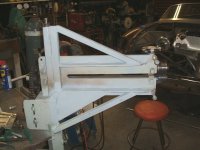
Before I get to the motor part there are a couple things you need to do the bead roller itseld to make it usable. The frame is too flexible vertically but especially horizontally to be able to roll steel any thicker than 20 ga and it is marginal on that. You need to reinforce the frame, I used 2" square tubing welded to the 1/2" HF frame and some additional triangulating pieces wouldn't hurt either. It needs to be stiff in both directions so that the dies stay aligned perfectly in a vertical plane and the gap between them can't expand as the frame deflects from the load.
The winch I used was the smallest 12 volt HF unit that used to go on sale all the time for $49. I noticed that HF no longer has this exact winch but has replaced it with a similar one. Not sure if all the steps I did would apply to this new winch or not. Northern Tool carries the same winch as what I used but it slightly more $$ http://www.northerntool.com/shop/tools/product_200365241_200365241 The winch comes with the same hand held controller that I used to make the foot control that allows reversing.

The winch has a handle on the end that when pulled out disengages the cable spool from the drive so you can pull cable quickly off the spool. This feature also allows you to disengage the motor so you can turn the bead roller with a steering wheel or crank.
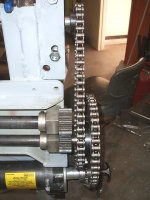
You need to gear the motor down about 3:1 so the travel is slow enough to manage. I used 40 pitch sprockets from Surplus Center that are 15 teeth on the motor and 29 teeth on the roller shaft giving a reduction of 2:1 and it runs just a little fast and the chain size is way overkill. They sell the chain also. I'm going to recommend that you use 35 pitch chain and 26 tooth 1 1/4" bore winch sprocket and a 72 tooth 7/8" roller shaft sprocket that will give you a 2.76:1 reduction. The 7/8" bore is .009" larger than the metric 22 mm shaft and I took up the slack with shim stock but it would probably work fine if you just tightened down the set screw.
https://www.surpluscenter.com/sort.asp?keyword=PH35&catname=powerTrans&PAGELEN=20&PageNo=4
Take the winch apart and the cable spool slips off. Chuck it up in a lathe and trim off the outboard flange of the spool. You need to turn down the diameter of the spool to 1.25" so the sprocket will slip on. If you want to have the machine run even slower you can turn the spool down to 1.00" and use a 22-25 tooth sprocket with a 1" bore (I believe there is enough stock in the spool to do that but you should check before you do it).
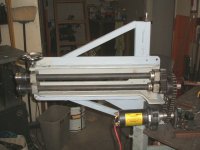
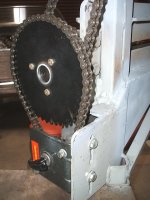
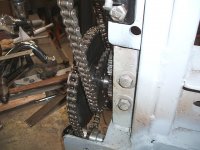
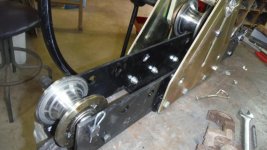
You now need to mount the motor to your roller frame and you need some adjustment to be able to tension the chain properly. Here is how I mounted mine. Make sure where you put it you can get the sprockets to align.
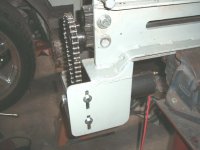
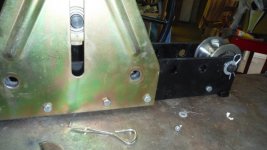
After you have the sprockets aligned with each other tighten down the set screw on the winch sprocket to mark to spool. Move the sprocket out of the way and drill a hole in the spool for the set screw to go into and prevent rotation. This is what the spool and sprocket will look like.

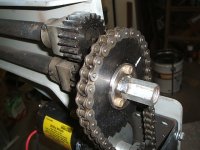
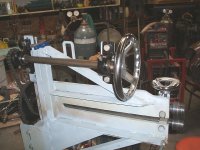
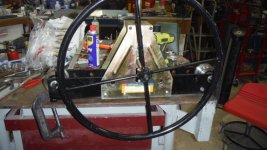
To be able to turn the machine with a steering wheel with the motor disengaged I welded a 1/2" coupler nut to a flange and bolted it to the upper sprocket. I welded a 3/4" socket to an old steering wheel so it will slip on whenever I need it and I can turn the machine by hand. This is a nice feature when you have a sharp corner to go around or some other intricate detail to do. When you get around the corner you reengage the motor and you are back to powered operation.


It is a good idea to make a chain guard because getting anything cauget in the drive would not be good.
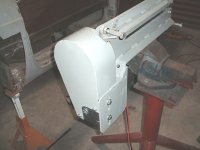
To run the unit I use one of the HF jump starting units that is on sale right now for $47 http://www.harborfreight.com/12-volt-jump-start-and-power-supply-38391.html
Before I get to the motor part there are a couple things you need to do the bead roller itseld to make it usable. The frame is too flexible vertically but especially horizontally to be able to roll steel any thicker than 20 ga and it is marginal on that. You need to reinforce the frame, I used 2" square tubing welded to the 1/2" HF frame and some additional triangulating pieces wouldn't hurt either. It needs to be stiff in both directions so that the dies stay aligned perfectly in a vertical plane and the gap between them can't expand as the frame deflects from the load.
The winch I used was the smallest 12 volt HF unit that used to go on sale all the time for $49. I noticed that HF no longer has this exact winch but has replaced it with a similar one. Not sure if all the steps I did would apply to this new winch or not. Northern Tool carries the same winch as what I used but it slightly more $$ http://www.northerntool.com/shop/tools/product_200365241_200365241 The winch comes with the same hand held controller that I used to make the foot control that allows reversing.
The winch has a handle on the end that when pulled out disengages the cable spool from the drive so you can pull cable quickly off the spool. This feature also allows you to disengage the motor so you can turn the bead roller with a steering wheel or crank.
You need to gear the motor down about 3:1 so the travel is slow enough to manage. I used 40 pitch sprockets from Surplus Center that are 15 teeth on the motor and 29 teeth on the roller shaft giving a reduction of 2:1 and it runs just a little fast and the chain size is way overkill. They sell the chain also. I'm going to recommend that you use 35 pitch chain and 26 tooth 1 1/4" bore winch sprocket and a 72 tooth 7/8" roller shaft sprocket that will give you a 2.76:1 reduction. The 7/8" bore is .009" larger than the metric 22 mm shaft and I took up the slack with shim stock but it would probably work fine if you just tightened down the set screw.
https://www.surpluscenter.com/sort.asp?keyword=PH35&catname=powerTrans&PAGELEN=20&PageNo=4
Take the winch apart and the cable spool slips off. Chuck it up in a lathe and trim off the outboard flange of the spool. You need to turn down the diameter of the spool to 1.25" so the sprocket will slip on. If you want to have the machine run even slower you can turn the spool down to 1.00" and use a 22-25 tooth sprocket with a 1" bore (I believe there is enough stock in the spool to do that but you should check before you do it).
You now need to mount the motor to your roller frame and you need some adjustment to be able to tension the chain properly. Here is how I mounted mine. Make sure where you put it you can get the sprockets to align.
After you have the sprockets aligned with each other tighten down the set screw on the winch sprocket to mark to spool. Move the sprocket out of the way and drill a hole in the spool for the set screw to go into and prevent rotation. This is what the spool and sprocket will look like.
To be able to turn the machine with a steering wheel with the motor disengaged I welded a 1/2" coupler nut to a flange and bolted it to the upper sprocket. I welded a 3/4" socket to an old steering wheel so it will slip on whenever I need it and I can turn the machine by hand. This is a nice feature when you have a sharp corner to go around or some other intricate detail to do. When you get around the corner you reengage the motor and you are back to powered operation.
It is a good idea to make a chain guard because getting anything cauget in the drive would not be good.
To run the unit I use one of the HF jump starting units that is on sale right now for $47 http://www.harborfreight.com/12-volt-jump-start-and-power-supply-38391.html
Last edited: