
To avoid these ads, REGISTER NOW!

Gearwrench 120 ratchet internals

Stuey

Well-known member
Joined
Jan 8, 2008
Messages
11,034
Location
28m above sea level
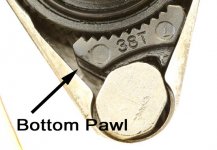
Took apart a new Gearwrench 3/8" 120-position ratchet.

People have asked about the strength of the ratchet, seeing as how it has 2 pawls. Feels plenty strong to me, but I figured disassembly might reassure some of you.

More images are via TG: http://toolguyd.com/gearwrench-120xp-dual-pawl-ratchet-disassembled/

<iframe width="560" height="315" src="http://www.youtube.com/embed/IjJpfA0ALIw?rel=0" frameborder="0" allowfullscreen></iframe>
 

Attachments

  • Gearwrench-120XP-Ratchet-Bottom-Pawl.jpg
    Gearwrench-120XP-Ratchet-Bottom-Pawl.jpg
    42.8 KB · Views: 73
To avoid these ads, REGISTER NOW!

03protege

Well-known member
Joined
Sep 13, 2012
Messages
3,104
Location
Louisiana
That is very interesting, I wonder if the selector and pawls would swap into the Craftsman Thin profile, it appears to be the same 60 Tooth setup.

Although, I don't know if I would like what is essentially less than 50% of the pawl contact area than what the 60 tooth has but I guess time will tell if it makes a difference.
 
OP
S

Stuey

Well-known member
Joined
Jan 8, 2008
Messages
11,034
Location
28m above sea level
Thanks - any idea on the price? Guess I should've grouped my questions into one post ha.
List price is $38 and change for the 1/4", and I saw street prices of ~$43 for the 3/8" and $46 for the 1/2".

That is very interesting, I wonder if the selector and pawls would swap into the Craftsman Thin profile, it appears to be the same 60 Tooth setup.

Although, I don't know if I would like what is essentially less than 50% of the pawl contact area than what the 60 tooth has but I guess time will tell if it makes a difference.

I'll try to do a comparison if I have the chance. Maybe will pry open an 84-tooth GW ratchet if I can get my hands on one.
 

03protege

Well-known member
Joined
Sep 13, 2012
Messages
3,104
Location
Louisiana
I'll try to do a comparison if I have the chance. Maybe will pry open an 84-tooth GW ratchet if I can get my hands on one.

Do you have a caliper? If you can take a measurements of the selector switch I will do the same on my 60t Craftsman.

Although I feel it may be a moot point because I do not think you can order Gearwrench rebuild kits.
 
OP
S

Stuey

Well-known member
Joined
Jan 8, 2008
Messages
11,034
Location
28m above sea level
Do you have a caliper? If you can take a measurements of the selector switch I will do the same on my 60t Craftsman.

Although I feel it may be a moot point because I do not think you can order Gearwrench rebuild kits.
I can, but with something like this measurements can be misleading. I also don't think rebuild kits are available.

Which Craftsman ratchet did you want me to check, the thin profile?
 

03protege

Well-known member
Joined
Sep 13, 2012
Messages
3,104
Location
Louisiana
I can, but with something like this measurements can be misleading. I also don't think rebuild kits are available.

Which Craftsman ratchet did you want me to check, the thin profile?

http://www.sears.com/craftsman-3-8-...p-00944995000P?prdNo=4&blockNo=4&blockType=G4

I just looked at mine and can't help but get the feeling it would work, the Craftsman gear would have to be reused due to the quick release.

I don't want to cause you too much trouble I just thought it was pretty neat, I may pick one up for myself and try this out.
 

CWP1616L

Banned
Joined
Aug 31, 2012
Messages
3,297
Location
USA
Wow, that's the shortest YouTube video I've ever seen. I had to play it about 30 times to see what's going on. :D
 

Hiball

Well-known member
Joined
Apr 30, 2009
Messages
14,027
Location
Missery
So How many Clicks do you get on a Full Revolution? 60 or 120? Im assuming its like a Dual Paw Round head where you have 1 paw sitting in Limbo while the other one is working?
 

TwoInch

Well-known member
Joined
Mar 29, 2012
Messages
2,828
Location
NW INDIANA
i would imagine it would still be plenty strong, considering how much contact even just "half" a pawl of that design has. im sure it has been tested, they wouldnt want to release a ratchet that they will be warrantying all the time.

as for the tooth count, it is a bit excessive in my eyes. 84t or 88t is already about as good as someone could need, and above that point, you dont gain much at all when it comes to swing improvement. very little actually
 

TwoInch

Well-known member
Joined
Mar 29, 2012
Messages
2,828
Location
NW INDIANA
essentially it has gone from 4.3 degrees of swing of the 84t, to 3 degrees of swing with the 120t.
 

03protege

Well-known member
Joined
Sep 13, 2012
Messages
3,104
Location
Louisiana
88 Tooth is roughly 4 degrees per click where the 120 tooth is 3 degrees per click.

NVM looks like you posted before I refreshed.
 
OP
S

Stuey

Well-known member
Joined
Jan 8, 2008
Messages
11,034
Location
28m above sea level
Wow, that's the shortest YouTube video I've ever seen. I had to play it about 30 times to see what's going on. :D

The full video I took is about 2-minutes long, but not a lot going on there.

lol, those 7 seconds took about 10 minutes to produce. Do you know how hard it is to illuminate the inside of a ratchet good enough for the gearing to show up on video? The photos took another half hour.

So How many Clicks do you get on a Full Revolution? 60 or 120? Im assuming its like a Dual Paw Round head where you have 1 paw sitting in Limbo while the other one is working?

30 clicks for roughly 90°, so 120 clicks for 360°.
 
To avoid these ads, REGISTER NOW!

TwoInch

Well-known member
Joined
Mar 29, 2012
Messages
2,828
Location
NW INDIANA
for such a small decrease in swing, im thinking it would be better to have a full pawl and 4.3* than half the pawl contact and 3*...

not sayin the 120 wont be strong enough... just thinkin.
 

Hiball

Well-known member
Joined
Apr 30, 2009
Messages
14,027
Location
Missery
30 clicks for roughly 90°, so 120 clicks for 360°.

Thanks for the Review Stuey, I actually think the 60 tooth ratchets are stronger than the 84/88 in regards to Paw contact. I guess my only question about this design is how much smaller are the paws compared to the older 60 tooth Rats? Is it half the Thickness to accomidate both of them? If so i can see that being a weakness for such little gain.. Although im just spitballing, Im sure GW tested this design before Marketing it.
 

TwoInch

Well-known member
Joined
Mar 29, 2012
Messages
2,828
Location
NW INDIANA
they claim the 84t is 25% stronger than the 60t design... probably because of the added contact of the smaller teeth.

i havent tested to confirm.. i just remember them claiming that.
 
OP
S

Stuey

Well-known member
Joined
Jan 8, 2008
Messages
11,034
Location
28m above sea level
I'm sure the ratchets passed all of GW's torque standards for ratcheting tools. I haven't tested them too thoroughly yet, but I'm confident in their strength.

And TwoInch is right, GW says their 84-tooth ratchets are 25% stronger than the 60-tooth ratchets.
 

rmsg0040

Well-known member
Joined
Feb 15, 2012
Messages
2,635
Location
Toronto
Seen the pics on the other site.

How was it putting it all back together?

Looks a little tough
 

Hiball

Well-known member
Joined
Apr 30, 2009
Messages
14,027
Location
Missery
they claim the 84t is 25% stronger than the 60t design... probably because of the added contact of the smaller teeth.

i havent tested to confirm.. i just remember them claiming that.

I think its alot of "Smoke and Mirrors" Personally, The way i see things is that if you take Coarse tooth paw that has 5% contact and a Fine tooth that has the same 5% of Contact with the Gear you are simply reducing the Strength. There is No doubt in My mind that a fine tooth ratchet can be as strong as a Coarse tooth one, But you need to increase the Surface area of the Paw to Gear which i dont believe the Danaher/Apex Design does. Again.. Im just spitballing.
 

TwoInch

Well-known member
Joined
Mar 29, 2012
Messages
2,828
Location
NW INDIANA
more smaller teeth have more contact surface are than the coarse teeth though. lets say the 60t has 8 teeth on the pawl, and the 84t has 14 teeth(examples), you will get more contact with the 14 teeth, even though the teeth are smaller, and spread over the same 10% of the gear circumference.

you have smaller teeth, but many more of them. with the 120t, you have the same number of coarse pawl teeth, but now half of each tooth(out of sync pawls) not in contact with the gear. now that will certainly weaken the mechanism. but by how much, i dont know.

edit - similar concept as a 6pt bolt head, and a 12pt bolt head. you can exert more torque onto the 12pt with out the head rounding than you could with a 6pt, and a 6pt being able to handle more than a square head.. even though the loads are still spread over the whole head(360*). more, although smaller, contact points = but more contact surface.
 
Last edited:

Hiball

Well-known member
Joined
Apr 30, 2009
Messages
14,027
Location
Missery
more smaller teeth have more contact surface are than the coarse teeth though. lets say the 60t has 8 teeth on the pawl, and the 84t has 14 teeth(examples), you will get more contact with the 14 teeth, even though the teeth are smaller, and spread over the same 10% of the gear circumference.

you have smaller teeth, but many more of them. with the 120t, you have the same number of coarse pawl teeth, but now half of each tooth(out of sync pawls) not in contact with the gear. now that will certainly weaken the mechanism. but by how much, i dont know.

I dont think that is quite how it works, Not Arguing.. but If you make the teeth smaller and dont increase the Contact path you are essentially weakening the Design IMO.. Only.. I havent put any of this theory to test, Im sure these companies are complying with ANSI standards.

edit - similar concept as a 6pt bolt head, and a 12pt bolt head. you can exert more torque onto the 12pt with out the head rounding than you could with a 6pt, and a 6pt being able to handle more than a square head.. even though the loads are still spread over the whole head(360*). more, although smaller, contact points = but more contact surface.

Now your speaking my Language, Yes.. If you increase Contact area the Strength increases, But a 60 tooth paw is the same size as a 88 tooth paw (only with finer teeth). This is why 32 spline Axle shafts are much stronger than 27 or 10, In regards to 360 degree contact.
 
Last edited:
OP
S

Stuey

Well-known member
Joined
Jan 8, 2008
Messages
11,034
Location
28m above sea level
Seen the pics on the other site.

How was it putting it all back together?

Looks a little tough

I got the hang of it after a while. Staples are my friend. =)

It is tough, though. Hooks and shims don't work, so I had to improvise. There's probably a special tool to better handle the double pawls.
 
Last edited:

TwoInch

Well-known member
Joined
Mar 29, 2012
Messages
2,828
Location
NW INDIANA
I dont think that is quite how it works, Not Arguing.. but If you make the teeth smaller and dont increase the Contact path you are essentially weakening the Design IMO.. Only.. I havent put any of this theory to test, Im sure these companies are complying with ANSI standards.


Now your speaking my Language, Yes.. If you increase Contact area the Strength increases, But a 60 tooth paw is the same size as a 88 tooth paw (only with finer teeth). This is why 32 spline Axle shafts are much stronger than 27 or 10, In regards to 360 degree contact.

but if you have 25 splines over 360* or 32 or 360*. what are you increasing? smaller, but more splines. same concept. but you are putting smaller, but more teeth in only a percentage of the 360*. which equates to more teeth in contact, spread over the same amount of gear face.

25 splines over 360* is weaker than 32 splines over 360*. same axle diameter. you have 31 smaller splines in contact at one time.
8 teeth is weaker over 20*, than 14 teeth over 20*. same gear diameter. you have 14 teeth in contact at one time.... when a gear fails, the teeth generally shear off... when you have 14 teeth sharing the load, instead of 8 larger teeth sharing the load, you have more contact area and load distribution.

the smaller tooth is weaker compared one to one with the larger tooth, but since you get to put many more of them in that same space, it tends to be stronger. you absolutely do increase contact area between the two surfaces, even though you arent increasing actual total circumference contact of the two parts. think treads on a tire
 

TwoInch

Well-known member
Joined
Mar 29, 2012
Messages
2,828
Location
NW INDIANA
I got the hang of it after a while. Staples are my friend. =)

It is tough, though. Hooks and shims don't work, so I had to improvise. There's probably a special tool to better handle the double pawls.

how does the spring work. since there are two pawls stacked. im trying to figure out what is making it much harder than the single pawl of the same design. did you try a dab of grease to make the two pawls stick together while dropping everything in?
 

TwoInch

Well-known member
Joined
Mar 29, 2012
Messages
2,828
Location
NW INDIANA
Now your speaking my Language, Yes.. If you increase Contact area the Strength increases, But a 60 tooth paw is the same size as a 88 tooth paw (only with finer teeth). This is why 32 spline Axle shafts are much stronger than 27 or 10, In regards to 360 degree contact.


by your own theory, how would adding a couple splines add strength to a axle shaft, when both 10 splines, and 32 splines contact the same 100% of the shaft circumference? 100% is 100%, same as 10% is 10%. 32 splines add more surfaces to spread load. same as 14 teeth instead of 8 teeth add surface to spread load.

maybe im wrong. seems to be very similar in theory to me.

edit - im not intending to sound argumentative either. i could very well have a flawed understanding of contact and distribution.
 
Last edited:

Hiball

Well-known member
Joined
Apr 30, 2009
Messages
14,027
Location
Missery
but if you have 25 splines over 360* or 32 or 360*. what are you increasing? smaller, but more splines. same concept. but you are putting smaller, but more teeth in only a percentage of the 360*. which equates to more teeth in contact, spread over the same amount of gear face.

25 splines over 360* is weaker than 32 splines over 360*. same axle diameter. you have 31 smaller splines in contact at one time.
8 teeth is weaker over 20*, than 14 teeth over 20*. same gear diameter. you have 14 teeth in contact at one time.... when a gear fails, the teeth generally shear off... when you have 14 teeth sharing the load, instead of 8 larger teeth sharing the load, you have more contact area and load distribution.

the smaller tooth is weaker compared one to one with the larger tooth, but since you get to put many more of them in that same space, it tends to be stronger. you absolutely do increase contact area between the two surfaces, even though you arent increasing actual total circumference contact of the two parts. think treads on a tire

We will just have to Agree to disagree... I don't have the info here In front of me but I'm sure someone knows what the actual "tooth contact" is on the 60/84/88 ratchets but I'm sure the difference isnt much. The way those ratchets are designed, you don't get a full paw contact in either direction, I suspect the actual paw contact is very minimal compared to the paw size between the sizes.
 

Hiball

Well-known member
Joined
Apr 30, 2009
Messages
14,027
Location
Missery
by your own theory, how would adding a couple splines add strength to a axle shaft, when both 10 splines, and 32 splines contact the same 100% of the shaft circumference? 100% is 100%, same as 10% is 10%. 32 splines add more surfaces to spread load. same as 14 teeth instead of 8 teeth add surface to spread load.

maybe im wrong. seems to be very similar in theory to me.

edit - im not intending to sound argumentative either. i could very well have a flawed understanding of contact and distribution.

I'm not versed on the "engineering" aspect of why, all I know is that High spline counts are far superior in regards to lower spine counts in regards to strength when talking about 360 degree contact.

No worries, Good discussion.@
 

03protege

Well-known member
Joined
Sep 13, 2012
Messages
3,104
Location
Louisiana
more smaller teeth have more contact surface are than the coarse teeth though. lets say the 60t has 8 teeth on the pawl, and the 84t has 14 teeth(examples), you will get more contact with the 14 teeth, even though the teeth are smaller, and spread over the same 10% of the gear circumference.

you have smaller teeth, but many more of them. with the 120t, you have the same number of coarse pawl teeth, but now half of each tooth(out of sync pawls) not in contact with the gear. now that will certainly weaken the mechanism. but by how much, i dont know.

I believe this theory is flawed, partially.

You are basing that on the assumption (maybe a fact, I am no expert ratchet designer) that more teeth equals more contact area. I believe you are also forgetting to factor in that each tooth of a coarse ratchet offers more surface area than a fine tooth ratchet. In short using more teeth on a fine tooth simply gets you back to square one (assuming it is using the same exact 60T gear).

Basically we do not know enough of the nitty-gritty to be able to say for one is better other than just looking at it if we are comparing two different types of ratchet.

Pawl design
Number of teeth engaged
Actual circumference of the gear
Height of the actual tooth (effects angle of tooth which has an effect on stoutness or perceived "smoothness")
Width of the gear

I feel pretty confident saying this has less than 50% gear: pawl contact area than the 60T models. I cannot say for sure not know the gear/pawl dimensions but even if they are bigger the pawls are still way smaller.

My simpleton brain tells me this would hold %50 or less than the torque over the 60t models.

Does anyone know how many teeth is on the 3/8" thin profile ratchet? (just realized I only have the 1/2" in thin profile Cman lol)
 
Last edited:
OP
S

Stuey

Well-known member
Joined
Jan 8, 2008
Messages
11,034
Location
28m above sea level
how does the spring work. since there are two pawls stacked. im trying to figure out what is making it much harder than the single pawl of the same design. did you try a dab of grease to make the two pawls stick together while dropping everything in?

With one pawl, you need a small shim that reaches down maybe halfway. With this, you have to reach all up in there. It's not really harder to reassemble, I just had to be more creative in my choice of pawl/spring depressor shim.
 

sk farmer

Well-known member
Joined
Mar 4, 2009
Messages
5,556
Location
nd
we need mrholeshot for another ratchet strength shoot out!

no we don't.

if stuey says this thing is good i trust him, he has always been honest and impartial with no bs. not always the case with that other guy.:willy_nil

i am anxious to try one. do we need it? probably not but in some instanes it may make the differance. i have been impressed with the fine tooth ratchets from gearwrench (60 and over) and see no reason not to think this one will be on par.:D
 
Last edited:

TwoInch

Well-known member
Joined
Mar 29, 2012
Messages
2,828
Location
NW INDIANA
With one pawl, you need a small shim that reaches down maybe halfway. With this, you have to reach all up in there. It's not really harder to reassemble, I just had to be more creative in my choice of pawl/spring depressor shim.

i have these ratchets in 60t and 84t models, you need nothing but snap ring pliers to take em apart and reassemble. no shims of any sort. you put the selector assembly and pawls in place, then angle the pawl and gear slightly when putting them back in, and it all slides together easily. one of the easiest ratchet designs i have ever re-assembled.
 

TwoInch

Well-known member
Joined
Mar 29, 2012
Messages
2,828
Location
NW INDIANA
I believe this theory is flawed, partially.

You are basing that on the assumption (maybe a fact, I am no expert ratchet designer) that more teeth equals more contact area. I believe you are also forgetting to factor in that each tooth of a coarse ratchet offers more surface area than a fine tooth ratchet. In short using more teeth on a fine tooth simply gets you back to square one (assuming it is using the same exact 60T gear).

Basically we do not know enough of the nitty-gritty to be able to say for one is better other than just looking at it if we are comparing two different types of ratchet.

Pawl design
Number of teeth engaged
Actual circumference of the gear
Height of the actual tooth (effects angle of tooth which has an effect on stoutness or perceived "smoothness")
Width of the gear

I feel pretty confident saying this has less than 50% gear: pawl contact area than the 60T models. I cannot say for sure not know the gear/pawl dimensions but even if they are bigger the pawls are still way smaller.

My simpleton brain tells me this would hold %50 or less than the torque over the 60t models.

Does anyone know how many teeth is on the 3/8" thin profile ratchet? (just realized I only have the 1/2" in thin profile Cman lol)

thin pros are 60t ratchets. same mechanism.

the top explanation makes no sense tho. you cant have finer pawl teeth with the same 60t gear. the whole argument is the fact that you are increasing the number of the teeth on the gear AND pawl, but decreasing the size of those teeth. i already mentioned that on a per tooth basis, the smaller teeth will have less surface contact, and be less strong... but, you get more teeth in contact with the higher tooth count design, even though the pawl is the same actual overall size. this increases the surface contact between the gear and pawl, and distributes the load more evenly.

edit - in bold

i confused what i was talking about previously, with your response. my apologies. i was talking about the single pawl 60t and the 84/88t models, and the added tooth count affecting strength, not the dual pawl design. i have never handled the dual pawl design, so i cant comment on the actuals of that ratchet. although i agree with your assumptions on being 50% the strength of the full pawl design, if the gear is the same "thickness". i was comparing the 60t and the 84/88t models.
 
Last edited:
To avoid these ads, REGISTER NOW!
Top Bottom