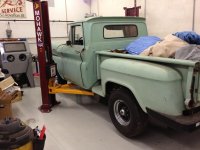
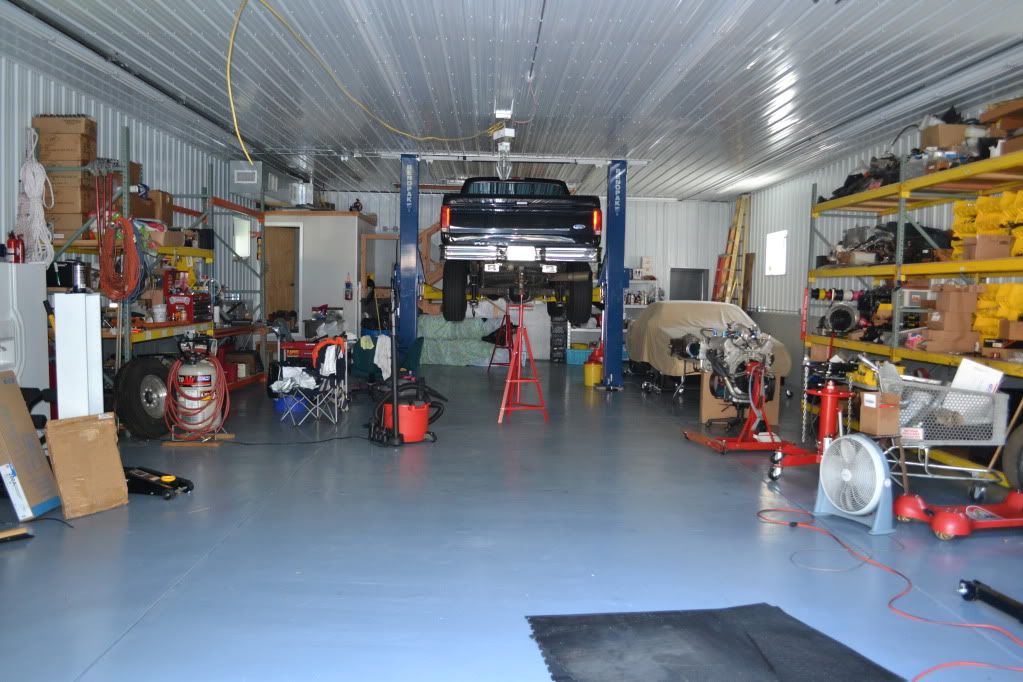
I use this analogy all the time with my customers..Which way do you want to be inconvenienced?
In most shops, over 60% of your customer base is automotive (car), not truck. That is what an asymmetric lift is designed for and that is why the vast majority of 2 post lifts that are sold are asymmetric. When you do need to pick up a truck, it will be an inconvenience, but you can do it with an asymmetric lift (that is properly rated for the load). In this situation, you are going to be inconvenienced when you pick up trucks, but it won't affect your business as much as buying a lift that's not designed to do what you need it to MOST of the time.
In some shops, the vast majority of the work being done is on trucks, not cars. In that case, it makes sense to buy a symmetric lift in lieu of an asymmetric. If you're inconvenienced on the rare car (less than 40% of your business), it won't affect you as much and you will work happier and hopefully make more $$.
The "Versymmetric" theory is a sales pitch, nothing more. That style of lift is what is also referred to as a "poor man's asymmetric" because it's a cheaper way to build a lift. A "true" asymmetric lift has columns that are rotated approx. 30 degrees to face the vehicle's center of gravity when it is lifted. A versymmetric has symmetrical columns but asymmetric arms. If you load it asymmetrically (30% in front of the lift and 70% behind the lift) the load center is sitting a substantial distance behind the supporting structures (columns). The "bearings" (slider blocks) that support the load in the column are now "twisting" to try and support the load. After enough use, the blocks are either worn down and need to be repaired or they simply pop out of the columns. Not an ideal situation in either case. Granted, if you are just using the lift for home use, the chances of wearing out the slider blocks is slim to none, but in a busy shop environment where a lift is going up and down 20 times a day, that style of lift doesn't last long.
Last, but not least...PLEASE keep in mind that two post lifts are rated by ARM strength, not overall capacity!!! Each arm on a 2 post lift is rated for 1/4 of the total capacity...(ie. 10K capacity lift has 4 arms that can lift 2,500 lbs. each.) Most trucks are substantially unbalanced loads (especially if they are loaded, but not ONLY when they are unloaded). You not only need to know how much the vehicle weighs, but ALSO how that load is distributed. If your rear axle weight is 5,000 lbs (or more), a 10,000 pound lift is too small to pick up the truck, even if the empty truck is only 8,000 lbs!
There have been cases, several right here in IL, where people have decided to pick up extended trucks (F350's and similar) and ended up damaging the lift and or not going home at all due to improperly lifting them. I hate to see it happen to anyone else!
Hope you all have a great and SAFE New Year!