To avoid these ads, REGISTER NOW!

Steel frame building - 2000 sq ft - cleanup

dantm

Active member
Joined
Jun 12, 2009
Messages
28
Location
Boston MA
Hello,

I am trying to clean-up a 2000 sq ft building -- it's a 40 x 50 steel frame structure with three bay doors (12, 14, and 12 ft, respectively) and a side-entry metal door.

The building was erected approx. 30 years ago and it has insulation on the inside which has actually ripped in places. The metal roof is not leaking yet but I assume it's rusted quite a bit and should be repaired.

My ultimate goal is to turn this into a garage which would be temperature controlled to some extent (at least heated above freezing in the winter and kept dry in the summer).

Right now there's only electrical service, no water/gas/etc. I'd like to put in a water source (maybe some holding tanks that can be externally filled on a regular basis).

I'm trying to learn from this forum:

(1) what systems I need to install/etc. in order to match the required sq. ft. of the building;

(2) what order the repairs should go in

I will hire appropriate people as needed but I'd like to oversee the entire project and learn as much as possible.

Can anybody point me to some useful threads to read up on to start?

Thanks.
 
To avoid these ads, REGISTER NOW!
OP
D

dantm

Active member
Joined
Jun 12, 2009
Messages
28
Location
Boston MA
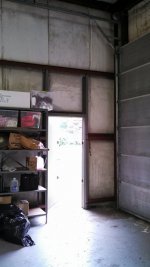
So I have the following on the interior of the garage -- I'd like to drywall this up -- any suggestions on the easiest way?


Also what would you do about the roof section?


Thank you.
 

W-Cummins

Well-known member
Joined
Jan 9, 2006
Messages
1,639
Location
Iowa
I would use metal liner panels, but if you are set on drywall then put up some metal studs on the wall girts. The purlans may be close enough to provide the required support, with only additional studs at the sheet edges. William.......
 
OP
D

dantm

Active member
Joined
Jun 12, 2009
Messages
28
Location
Boston MA
I would use metal liner panels, but if you are set on drywall then put up some metal studs on the wall girts. The purlans may be close enough to provide the required support, with only additional studs at the sheet edges. William.......

Thanks for the advice -- I'm not set on drywall, was not aware of the metal liner option -- any links of what kind of panels and options there are?

Best regards.
 

WNYflyer

Well-known member
Joined
Sep 13, 2009
Messages
2,119
Location
Lockport, NY
Thanks for the advice -- I'm not set on drywall, was not aware of the metal liner option -- any links of what kind of panels and options there are?

Best regards.

V-P Buildings/Varco-Pruden link.


http://vp.com/LinkClick.aspx?fileticket=BPGfB_ye3lo=&tabid=90


This is the type of panel we specify all the time for the interior of metal buildings. Typically we would only run them up 2 girt spacings to protect the insulation from whatever was going on in the building.

V-P is top of the line commercial stuff and I am sure there are many other manufacturer's out there with similar panels for less $$$. In particular note the profile, gauge of material and coating/paint system when comparing different manufacturers so you are comparing apples to apples when looking at the $$$ of different manufacturers panels.

In particualar panels used as liners will be the higher gauge (thinner steel) material because they are essentially non-structural since they see minimal to no wind loading being on the interior.
 
Last edited:
OP
D

dantm

Active member
Joined
Jun 12, 2009
Messages
28
Location
Boston MA
Thanks for the link -- I also saw that there are fiberglass options for the interior as well?

The building will be used for storage primarily and also some light mechanical work (cars), so I assume that the interior steel protection is not needed?

Regardless, I think these panels are better options to the drywall as they may allow easier removal in case there needs to be any work done to the insulation.

Finally -- since the building has insulation underneath the slanted roof, would it make sense to use these panels up on the roof as well or is there another solution?

Thank you once again.
 

motormitch

Well-known member
Joined
Aug 27, 2012
Messages
636
Location
Austin TX
Thanks for the link -- I also saw that there are fiberglass options for the interior as well?

The building will be used for storage primarily and also some light mechanical work (cars), so I assume that the interior steel protection is not needed?

Regardless, I think these panels are better options to the drywall as they may allow easier removal in case there needs to be any work done to the insulation.

Finally -- since the building has insulation underneath the slanted roof, would it make sense to use these panels up on the roof as well or is there another solution?

Thank you once again.

I recently used and plan to use again just good old corrugated metal panels from Home Depot or Lowes. They go up easy, come down easy if you want to change something in the infrastructure in the walls like electrical or water and are fairly inexpensive.
 
OP
D

dantm

Active member
Joined
Jun 12, 2009
Messages
28
Location
Boston MA
I recently used and plan to use again just good old corrugated metal panels from Home Depot or Lowes. They go up easy, come down easy if you want to change something in the infrastructure in the walls like electrical or water and are fairly inexpensive.

Can you provide a link to the Home Depot panels, I have not been able to see what you're recommending?

Thank you.
 
To avoid these ads, REGISTER NOW!

WNYflyer

Well-known member
Joined
Sep 13, 2009
Messages
2,119
Location
Lockport, NY
Thanks for the link -- I also saw that there are fiberglass options for the interior as well?

The building will be used for storage primarily and also some light mechanical work (cars), so I assume that the interior steel protection is not needed?

Regardless, I think these panels are better options to the drywall as they may allow easier removal in case there needs to be any work done to the insulation.

Finally -- since the building has insulation underneath the slanted roof, would it make sense to use these panels up on the roof as well or is there another solution?

Thank you once again.

Instead of steel there is also FRP (Fiberglass Reinforced Plastic) corrugated panels out there that are sometimes used, probably other materials as well. If you do not want to add any additional sub-framing such as metal studs, furring members, sub-girts etc and just want to put up a panel and connect them to the existing horizontal girts then you typically need a corrugated panel whether steel or FRP or other. The corrugations give the panel strength and keep it form sagging, deflecting, etc. The flat panel sheets you see around need an back-up system since the girt spacing on a metal building is typically too large and the panel would be too flexible if just connected to the girts.

Yes they put panels in the inside of the roof though I have never specified them since I never saw the need what with bright white insulation. I also don't know if they would have any affect on ventilation/condensation.

Your interior steel I would not think would need any additional protection given your intended use. Some folks may want to add concrete/block curbing at the base to protect the steel when washing down stuff, banging into it etc. but doesn't sound like you would need that.

The panels motormitch mention would probably work fine also, just comes down to typically the $$$$ and the "look" you want. The simple corrugated "wave" sheets have a more industrial look to me that some of the other panels available but again for most of us it seems to usually depend on the $$$$.
 
OP
D

dantm

Active member
Joined
Jun 12, 2009
Messages
28
Location
Boston MA
Thanks guys -- how's this for a plan. Since the building will be used for light garage/mechanical work, I'd like to be able to wash the floors easily and have the bottom pretty much sealed.

So I'm thinking of scrubbing down under the lowest metal beam, there's about 2" spacing there which goes all the way to the outside. That area would be nice to be filled in with something, I'm thinking maybe an expandable foam that would seal the bottom of the building from rodents, bugs, and any other intruders? One idea I had before was some quick-mix concrete, but maybe it's not the best?

After, I'm thinking one layer of cinder blocks (or suggestions?) that would line the first few inches of the bottom perimeter, such that the future corrugated panels would actually sit on top of the blocks and be fixed to the metal frame all around?

The insulation and building were put up in the early 1980s so the outer insulation has some rips and is generally looking tired, which I'd like to clean up if possible?

However, the corrugated panels are a winner because they allow future work in terms of installing a heater/central cooling (or dehumidifier system), etc.

Any suggestions?

Thank you.
 

Charles (in GA)

Well-known member
Joined
Jan 11, 2006
Messages
12,489
Location
50 mi south of Atlanta
You probably want a metal somewhat like that used on the "carolina carports" you see everywhere. It is not near as heavy as what is on the outside of your building, but will do fine on the inside. It is a 5 rib per 3 ft wide section, many different colors available.

It looks like the bottom wall girt is an inverted C channel. Most metal buildings use a 2x2 or 2x3 steel angle nail gunned to the floor to attach the outside sheet metal. Buildings made with the inverted C channel at the bottom are the "Cadillac" of metal buildings.

You just need to measure from the floor to the top of the wall girt at about 7 ft and then from the bottom of that wall girt to the top of the girt at the eave. Or measure the full distance. A good metal supplier, like one that supplies the metal for all of the metal roofs you see being installed, can measure or tell you how to measure, and pre cut the panels for you. Literally, you slap them up, use a long level to make sure they are vertical, and screw them to the wall girts. All you are doing is skinning the inside of the building, like the outside, but using a lighter weight steel with much smaller ribs. Add more insulation if you like before you skin, and make sure the ends are closed so critters cannot get inside the walls. fit the panels tight to the floor, and lay a bead of sealer at the joint.

Its money, no rocket science.

Do your wiring AFTER you skin it, use conduit. If you try to run the conduit in the walls and then skin it, you will be making a lot of work for yourself, with many extra bends, and a lot of work to flush boxes to the metal. Just do surface mounted steel boxes and Electrical Metallic Tubing (EMT) conduit and it will look "industrial" and be easy to install and modify later if needed.

Just gonna have to search around and find your local metal supplier. The one near me went out of business, He had quoted me for the metal to do from the floor to the top of the girt at 7 ft, and I put off doing it and now will have to search out someone else. They were going to have it cut to my measurements and deliver it. About $1300 three years ago to do about 170 linear ft of wall with 7 ft high panels, plus 3x4 base angle to anchor to the slab to secure the bottom to. Probably double that now. To do the inside of that building (you don't say how high the eave is or the roof pitch) will be several thousand in materials and you will need scaffolding or a scissor lift.

Go to your control panel on GJ and update your profile to at least tell us what province or state you are in, so we have some idea of what kind of weather you will be encountering, and tell us more. Is public water available? What about a well? If the climate is moderate, you could get away with running the water pipe out of the ground and then thru the wall. I did this and then insulated and jacketed it outside where it was exposed. Otherwise you are looking at sawing part of the slab at the edge to get plumbing in place, depending on what kind of slab it is.

Charles
 
Last edited:

Charles (in GA)

Well-known member
Joined
Jan 11, 2006
Messages
12,489
Location
50 mi south of Atlanta
Thanks guys -- how's this for a plan. Since the building will be used for light garage/mechanical work, I'd like to be able to wash the floors easily and have the bottom pretty much sealed.

So I'm thinking of scrubbing down under the lowest metal beam, there's about 2" spacing there which goes all the way to the outside. That area would be nice to be filled in with something, I'm thinking maybe an expandable foam that would seal the bottom of the building from rodents, bugs, and any other intruders? One idea I had before was some quick-mix concrete, but maybe it's not the best?

After, I'm thinking one layer of cinder blocks (or suggestions?) that would line the first few inches of the bottom perimeter, such that the future corrugated panels would actually sit on top of the blocks and be fixed to the metal frame all around?

The insulation and building were put up in the early 1980s so the outer insulation has some rips and is generally looking tired, which I'd like to clean up if possible?

However, the corrugated panels are a winner because they allow future work in terms of installing a heater/central cooling (or dehumidifier system), etc.

Any suggestions?

Thank you.

Can you actually see daylight under the bottom wall girt? The outside sheetmetal should be fitted to the slab. Either into a notch in the slab, as mine was done, or with a formed metal piece that runs along the bottom of the outside sheet, that seals it to the slab.

Here is how my building was done. 60x60 building so the slab was made 60' 3" x 60' 3" and 1½" x 1½" wood (like the piece in the pic) was nailed inside the forms, and this formed the notch the sheet metal sits into. The sheet metal is outside the "building line" which is the imaginary surface that is the exact dimension of the building and which the sheet metal is attached to.

attachment.php


standard_base_angle.gif


Other methods are to make the slab the exact dimensions of the building, and overhang the slab with pieces to seal the bottom of the outside skin.

Here are examples of how this is done.

base_trim.gif


deluxe_base_trim.gif


ib-base-closure.png


Remember, GOOGLE is your friend. A little Googling finds sites such as

http://www.ironbuiltbuildings.com/building-features/

Which will help you greatly in learning the lingo of steel buildings, and various ways they are made.

Charles
 

brownbagg

Well-known member
Joined
Mar 20, 2006
Messages
5,208
drywall and metal building are not good companions. any moisture and drywall not dry no more. metal bldg move, so drywall be cracking like crazy. every time you touch it, you be poking a hole in it, just plywood it, walls and ceiling, run all you new electrical and air etc, in conduit on top of the plywood. drywall not going hold new electrical and air. its a garage shop for god sakes, its not suppose to be pretty, its suppose to be practical. and no stripes on the walls, that tacky like fanny packs, tacky
 
OP
D

dantm

Active member
Joined
Jun 12, 2009
Messages
28
Location
Boston MA
Here are a few more pictures illustrating the interior and the exterior construction. The open door is 84" for reference.
 

Attachments

  • IMG_20130710_173150_246.jpg
    IMG_20130710_173150_246.jpg
    97 KB · Views: 44
  • IMG_20130710_172545_831.jpg
    IMG_20130710_172545_831.jpg
    80.2 KB · Views: 42
  • IMG_20130710_171317_069.jpg
    IMG_20130710_171317_069.jpg
    100.7 KB · Views: 45

TechnoMayor

Well-known member
Joined
Feb 13, 2012
Messages
149
Location
Fort Worth, TX
I like the clean look of the white metal liner panels. However, I'm leaning towards the galvanized panels in the picture below for my 40'x60' shop.
 

Attachments

  • IMG_2061.JPG
    IMG_2061.JPG
    99.4 KB · Views: 54
To avoid these ads, REGISTER NOW!
Top Bottom