I'm starting this thread to document the rebuild and restoration of a Quincy X2 I sourced recently from Craigslist. I've been looking for a little while for an X8 (or any smaller Quincy compressor - simply to build a portable), but when I spotted this compressor, labeled as '110 air compressor', I knew right away what it was. One phone call later, and with very little haggling (~50% off), and I arranged to pick it up the next day. I've noticed a trend that people tend to always go with way more air than is necessary to get smaller jobs done - don't get me wrong, I have a pair of QR-25 Model 240s in my garage currently (one close to full restoration, and the other virtually scrap), a Model 325 ROC 7 awaiting rebuild, and a QT-7.5 that's destined to be the workhorse; despite that, I'm still after a smaller portable unit.. just because.
Here's the original ad (with the seller's identifying information removed):

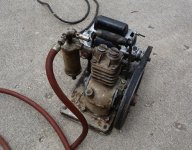
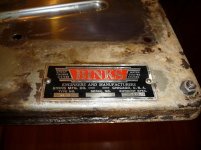
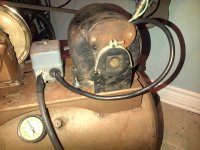
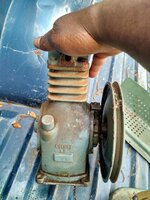
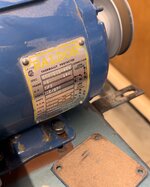
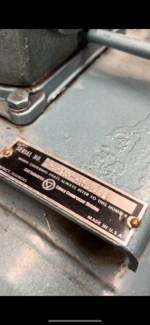
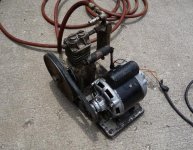
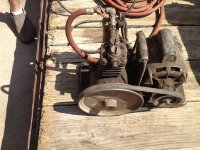
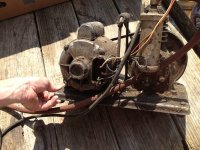
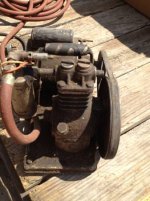
And the original photos:


I'll admit that when I saw it, it looked very, very rough, but it sounded good and turned very smooth. I didn't bother plugging it in as there were multiple nicks/cuts/lacerations in the power cable that looked like they might bring about undesirable results.
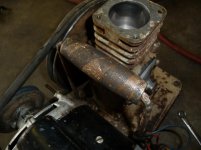
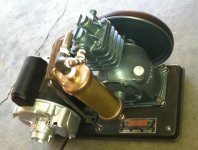
So, on the way home, I took it by a car wash and pressure washed and scrubbed it, being mostly careful to avoid the motor. Here are the results thereafter.
Here are a few shots:


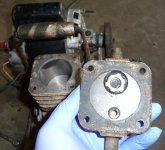
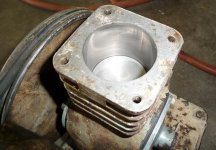
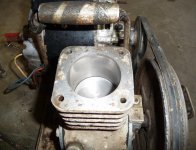
When I got home, I couldn't help myself - I had to see what the internals looked like. The results astounded me. This says 'X2 - 88' on the crank case; however, it has sleeved bearings internally, of which the only record I could find, documentation-wise, was from 1950. Has this compressor really been running since then with only this little wear to its piston and cylinder walls? All I did was wipe some crud off the top of the piston with a paper towel soaked in acetone - seriously, nothing more.


So, without further ado, the plans are to cut new gaskets for the crank end caps, inspection plate (bottom), and head, clean up the valves/lap the seats/discs, and thoroughly clean the internals. I'm not going to even bother disassembling the piston, wrist pin, or connecting rod to the crank - it simply works too well to necessitate any updates, in my humble opinion.
Oh, and before I forget, specifications using a 3/4 HP motor turning the pump at 900 RPM, it should produce 1.83 CFM @ 100 PSI, maxing out at 150 PSI. I'm planning to clean up its original tote-mount, and maybe find something that will let me transform it to fill a tank and roll with a handle. As-is, it was still spitting air out the air chuck at the end of the hose.
So, let the rebuild commence!
P.S. Thanks, GJ, for fueling my compressor/vise/<insert_tool_here> addiction. Seriously.
Here's the original ad (with the seller's identifying information removed):
And the original photos:
I'll admit that when I saw it, it looked very, very rough, but it sounded good and turned very smooth. I didn't bother plugging it in as there were multiple nicks/cuts/lacerations in the power cable that looked like they might bring about undesirable results.
So, on the way home, I took it by a car wash and pressure washed and scrubbed it, being mostly careful to avoid the motor. Here are the results thereafter.
Here are a few shots:
When I got home, I couldn't help myself - I had to see what the internals looked like. The results astounded me. This says 'X2 - 88' on the crank case; however, it has sleeved bearings internally, of which the only record I could find, documentation-wise, was from 1950. Has this compressor really been running since then with only this little wear to its piston and cylinder walls? All I did was wipe some crud off the top of the piston with a paper towel soaked in acetone - seriously, nothing more.
So, without further ado, the plans are to cut new gaskets for the crank end caps, inspection plate (bottom), and head, clean up the valves/lap the seats/discs, and thoroughly clean the internals. I'm not going to even bother disassembling the piston, wrist pin, or connecting rod to the crank - it simply works too well to necessitate any updates, in my humble opinion.
Oh, and before I forget, specifications using a 3/4 HP motor turning the pump at 900 RPM, it should produce 1.83 CFM @ 100 PSI, maxing out at 150 PSI. I'm planning to clean up its original tote-mount, and maybe find something that will let me transform it to fill a tank and roll with a handle. As-is, it was still spitting air out the air chuck at the end of the hose.
So, let the rebuild commence!
P.S. Thanks, GJ, for fueling my compressor/vise/<insert_tool_here> addiction. Seriously.
Attachments



Last edited: