To avoid these ads, REGISTER NOW!

Compressor circuit

jack bacon

Well-known member
Joined
Oct 21, 2006
Messages
98
Location
Loretto, MN
I'll be getting a Puma compressor for Chirstmas which requires 240v &15A. We have a gas dryer so the 30A breaker in the panel for an electric dryer that is unused. Can I run #10 wires from that 30A breaker to the to the correct outlet plug in the garage?

Thanks

Jack
 
To avoid these ads, REGISTER NOW!

2ManyProjects

Well-known member
Joined
Jul 18, 2013
Messages
757
I'll be getting a Puma compressor for Chirstmas which requires 240v &15A.

Which one, exactly?

We have a gas dryer so the 30A breaker in the panel for an electric dryer that is unused. Can I run #10 wires from that 30A breaker to the to the correct outlet plug in the garage?

Probably. But it's not quite as simple as a flat "Yes" or "No".

1. - What would the COMBINED TOTAL run length of the wire from the breaker panel to the existing dryer outlet AND from there to your location out in the garage work out to? If it's very long, you may be setting yourself up for excessive voltage drop at the end of the line.

2. - There are code restrictions on how many "outlets" may be put on higher-capacity circuits. I think those restrictions start at 30 Amps; but someone with a code book handy can confirm/deny that point. So if you do this, you will probably need to remove the dryer receptacle itself, make your connections (presumably via wire nuts) inside the box, then cover the box with a blank plate. (This would be good practice in any event, required or not; if nothing else, it lets a future owner/installer/whatever know that the dryer circuit is no longer available for such service.)

3. - In the context of a 30A circuit (which is what we're talking about here), that "correct outlet plug in the garage" would be a 6-30R (or L6-30R, if a twist-lock type is desired). But if your new compressor REALLY only requires 15A, odds are it will NOT have that style plug. The RIGHT way to handle this would be via an adapter, with a 6-30P plug and a 6-20R socket, such as:

http://www.lockingpowercords.com/Products/144-l6-30p-to-6-1520r-power-cord-adapter.aspx
L630_to_620_BODYIMAGE.jpg


You might be tempted to simply install a 6-20R outlet in the garage; but this would in turn REQUIRE that you also replace the breaker with one rated at no more than 20 Amps.

 
OP
J

jack bacon

Well-known member
Joined
Oct 21, 2006
Messages
98
Location
Loretto, MN
It's the Puma 6060V that has great reviews. I would be disconnecting the wiring from the dryer so the compressor would be the only load on the 30A breaker. It would be roughly 30' from the panel to the garage outlet.

Also there already is a welder circuit already run with #8. it was never hooked into a breaker but the wires are coiled up next to the panel. I could probably just use that as I probably will never have a welder. Would that work hooking up the #8 wires to the 30A dryer breaker and changing to the proper outlet in the garage?

Jack
 
To avoid these ads, REGISTER NOW!

Norcal

Well-known member
Joined
Mar 16, 2008
Messages
13,769
^ yes.

Personally I'd install a disconnect near the compressor, lose the plug, and hard-wire it.

If that is done you have to lose the cord as well & use sealtite or flex, flexible cord cannot be used in place of permanent wiring, as soon as the plug is cut off, it's permanent wiring.
 
OP
J

jack bacon

Well-known member
Joined
Oct 21, 2006
Messages
98
Location
Loretto, MN
Okay, we will use the existing 30A breaker with the #8 wires already running to the garage using a disconnect near the compressor and flex running to the compressor connection. Thanks for the help!!

Best regards,

Jack
 

GYPSY400

Well-known member
Joined
Mar 21, 2013
Messages
517
Location
Naughton Ontario
#8 wire may not fit into the 30A breaker.. but if it does, might as well use it.. then your wire is overkill for the circuit, which is good as problems would arise from the easy to change breaker rather than the wiring.

OR: RUN the appropriate 10gauge wire for compressor and leave the welder wiring for next years Christmas present... never say you don't need a welder. . Because you do!

Sent from my SGH-I747M using Tapatalk
 
Last edited:

Norcal

Well-known member
Joined
Mar 16, 2008
Messages
13,769
Unless you use conduit you cannot use 8AWG, NEC art 250.122(B) requires the grounding conductor be increased in size & 8/2 NM cable has a 10 AWG grounding conductor.

(B) Increased in Size. Where ungrounded conductors are
increased in size, equipment grounding conductors, where
installed, shall be increased in size proportionately according
to the circular mil area of the ungrounded conductors.

Copy & pasted from the 2008 NEC, need to reload the 2011.
 

2ManyProjects

Well-known member
Joined
Jul 18, 2013
Messages
757
I'll be getting a Puma compressor for Chirstmas which requires 240v &15A.

Which one, exactly?

It's the Puma 6060V that has great reviews.

As I suspected... Despite the bogus advertising claims, that is NOT a "3HP" compressor. It can't be, given the "15 Amps" claim. A real 3HP compressor REQUIRES at least a 25-Amp circuit (which in practice generally means 30A, which also helps avoid nuisance trips at start-up). And for ca. $600+, you can indeed get any number of REAL 3HP compressors; for example:

http://www.lowes.com/pd_36_0__?productId=3354166

I would be disconnecting the wiring from the dryer so the compressor would be the only load on the 30A breaker. It would be roughly 30' from the panel to the garage outlet.

OK, at that distance, voltage drop is not a concern.

Also there already is a welder circuit already run with #8. it was never hooked into a breaker but the wires are coiled up next to the panel. I could probably just use that as I probably will never have a welder. Would that work hooking up the #8 wires to the 30A dryer breaker and changing to the proper outlet in the garage?

With the potential exception of that niggling code issue raised by Norcal, yes. But now that we have "The Rest Of The Story" (am I dating myself, or what?), I would suggest leaving that be and using the dryer circuit as previously discussed. Not only will this side-step the code issue, you MAY change your mind about wanting that welder (or some other high-draw tool).


Yes it will. Here is a chart and calculator if you would like to see the numbers for yourself or if a similar question pops up. Make sure your hands are dry :shocking:

Now, THERE'S one of the most useless AWG charts I've ever seen... "rated ampacities are just a rule of thumb", indeed! :shocking:

Better to use:

http://en.wikipedia.org/wiki/American_wire_gauge#Tables_of_AWG_wire_sizes

Or even:

http://www.engineeringtoolbox.com/awg-wire-gauge-circular-mils-d_819.html


Kevin C

Well-known member
Joined
Aug 4, 2011
Messages
1,653
Location
Portland OR
As I suspected... Despite the bogus advertising claims, that is NOT a "3HP" compressor. It can't be, given the "15 Amps" claim. A real 3HP compressor REQUIRES at least a 25-Amp circuit (which in practice generally means 30A, which also helps avoid nuisance trips at start-up). And for ca. $600+, you can indeed get any number of REAL 3HP compressors; for example:

The Lowes amperage is a typo, the actual draw on that compressor is 14.7 Amps.

http://www.grainger.com/product/INGERSOLL-RAND-Electric-Air-Compressor-4YW09

It still goes back to this... 745 watts per hp. 230 volts ~ V*A=W (assuming the current is in phase with the voltage) you will need:

(745W * 3 HP)/230= 9.73 Amps

A 100% efficient, 3 hp 230 V motor with the current draw in phase with the voltage requirs amps at 230 volts.

Since the current will be out of phase with the voltage, the apparent power will be higher.

For a power factor of .82 the amperage will be 12.14 Amps. Again, thats for a 100% efficient motor.

Real world, figure 80% efficiency... That gets you to about 15 amps of full load draw. Pretty close to the published specs. The lower the power factor, the lower the current.

Look up almost any 3 hp 230 V 3450 RPM motor and you will find that its name plate rating is around 15 amps.

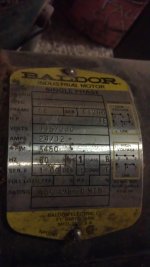
Two, 3HP motors that have a name plate rating of 12 and 15 amps. The machines they are installed on both came with 20 amps plugs, and run on 20 amp breakers without any tripping.
 

Attachments

  • IMAG1743.jpg
    IMAG1743.jpg
    126.7 KB · Views: 3
  • IMAG1718.jpg
    IMAG1718.jpg
    129.3 KB · Views: 4
Last edited:
To avoid these ads, REGISTER NOW!
Top Bottom