To avoid these ads, REGISTER NOW!

how do you figure up lighting?

jethrob

Well-known member
Joined
Nov 30, 2012
Messages
208
I'm having a 30 x 48 x 12 built and trying to figure out what kind of lighting to put in it.
It's primary purpose will be a mechanical garage.
I plan on putting up a light gray colored metal ceiling. Hopefully it won't darken the place up to much. I'm afraid of white because engine's will be ran indoors and think it will get dirty looking in a hurry.

How do you figure lumens, fixtures, spacing, etc?
 
Last edited:
To avoid these ads, REGISTER NOW!

jlckmj

Well-known member
Joined
Dec 7, 2009
Messages
732
Location
SE Wiscosin
The light grey ceiling should not be a problem, it will still be shiny enough to reflect the lighting. I have white tin in my new shop, and in my old shop I had the same for 15 years without noticing any discoloring or issues with the white color.

Her is a link to a good thread about an alternative to the expensive florescent lighting fixtures most use.

http://www.garagejournal.com/forum/showthread.php?t=38658

jim
 

2ManyProjects

Well-known member
Joined
Jul 18, 2013
Messages
757
I'm having a 30 x 48 x 12 built and trying to figure out what kind of lighting to put in it.
It's primary purpose will be a mechanical garage.

Like most folks, the odds are very strong that your best choice will be the ubiquitous twin-tube fluorescent fixtures using F32T8 tubes.

How many of them, and where exactly they should be put, will depend on the specifics of your shop layout.

I plan on putting up a light gray colored metal ceiling. Hopefully it won't darken the place up to much.

Shouldn't be a huge problem. You'll just lose a bit of lighting efficiency due to the reduced reflectivity.

I'm afraid of white because engine's will be ran indoors and think it will get dirty looking in a hurry.

With a suitably even coating of soot, the white will be light grey -- just like you're planning to start out with. ;)

How do you figure lumens, fixtures, spacing, etc?

Ideally, you look at the photometric data for whatever fixtures you're considering, and go from there. But in practice, you can make some generalized assumptions without getting all that deep into the math. The first thing to keep in mind is that, the lower the ceiling (and thus, presumably, the mounting height), the closer the spacing between each each fixture must be to maintain even illumination at working height. Conversely, the higher the fixtures are mounted, the (relatively) brighter each must be in order to provide adequate intensity down at working height. With a 12-foot (or less, by the time you account for insulation & sheathing) ceiling, you're more in the former category than the latter, which is the main reason I'm wagering on F32T8s.

From there, it becomes a matter of how many lights to cover how much space (but, as noted above, as influenced by the actual layout of the shop, your equipment, storage, etc.). The usual "rule of thumb" is that you want about 100 lumens/ft.^2 at working height, for a "serious" garage/shop. A standard F32T8 tube puts out approximately 2,800 lumens, when new (and when driven off an "ideal" ballast). So, for (30 x 48 =) 1,440 ft.^2, you'll want at least 52 tubes.


You don't need to spend money on a third-party software package. If push comes to shove, there are online lighting calculators you can use. But really, I've already given you essentially all the useful information they would provide, at least at this stage in the game. Beyond that, as I said, it all depends on the specific layout of the shop.

The light grey ceiling should not be a problem, it will still be shiny enough to reflect the lighting. I have white tin in my new shop, and in my old shop I had the same for 15 years without noticing any discoloring or issues with the white color.

I agree that white really should not be a problem. But if he wants to go grey, that's OK too, as long as its a fairly LIGHT grey. FWIW, per my current plans the upper half (or so) of my walls will be covered with grey SlatWall; the top foot or so and the ceiling will remain white. I'm not expecting "inadequate light" problems.

Her is a link to a good thread about an alternative to the expensive florescent lighting fixtures most use.

How do you figure "expensive" in the context of standard-issue F32T8 fluorescents? Fixtures can be had for around $20.00 (sometimes less); and the tubes themselves are typically about $3.00 each -- which is a WHALE of a lot cheaper than any equivalent-output CFL or MH. They're also at least as cheap (usually cheaper) to operate.

 
Last edited:
OP
J

jethrob

Well-known member
Joined
Nov 30, 2012
Messages
208
Ok lost some time looking at the over hyped CFL's. They don't seem practical unless you are getting them subsidized.

Anyways called up Menards and they have 8' long (4 bulb) T8 fixtures for $40 and 4 foot 2 bulb fixtures for $23. Bulbs are $30 per dozen. Both have electronic ballasts and no reflectors. I guess I should go with a white ceiling-just afraid it's going to look like shart in a hurry.

The shop is layed out as a single long bay, split slider in the 30' end wall.

56 bulbs seems like a lot of fixtures!

It would be fourteen 8 footers----sure this isn't overkill?

If I did three rows of 8' 2 bulb fixtures spaced evenly going longways(48' side) you could do 3 rows (7.5 foot from walls) consisting of 3 8' fixtures with 6 foot of spacing between the fixtures would only be 9 fixtures or 32 bulbs.

I could stagger the middle and it would cut it back to 8 fixtures. You think this would be insufficient?
 

hidollartoys

Well-known member
Joined
Jul 15, 2008
Messages
594
Location
K. C. Metro area
As suggested the 100 lumens / ft is a target. This amount of light is described for "precision" work. You could reduce this to as low as 50 lumens / ft but then you might need "work" light at the point of the activities. There are sources for lighting level recommendations on the "net", just do a search.

EDIT: Check out IESNA.ORG
 
Last edited:

JoeFin

Well-known member
Joined
Sep 13, 2013
Messages
717
Location
NorCal - where the Rednecks Race
Hopefully it won't darken the place up to much. I'm afraid of white because engine's will be ran indoors and think it will get dirty looking in a hurry.

How do you figure lumens, fixtures, spacing, etc?

As others have stated you could use an On-line calculator to layout your lighting

1 word of caution - Most of the calculators suggest you use a "Reflectivity" rating of 80% for your ceilings and that is based off of a smooth surfaced "White" ceiling. Add Texture the reflectivity decreases. Add a little soot, cobwebs, grinding grit, or any thing else commonly found in a working shop - and that reflectivity rating can be rapidly decrease to 40%

Now before "Whats his Name" gets back on here and claims he is the only source of knowledge you need to consult, do some thing he won't - at least google it and see for yourself. There are few Real Engineers discussing it on the web that could lead you in the right direction

While 100 lumens/foot is target for precision work - do you need that / want to pay that electric bill for your entire shop? Or just dedicated areas like work benches ? Do you need "Color Correction" in all areas of your shop or just "Inspection Areas"

As others have said - needs change and so should your lighting requirements
 

cparcell

Well-known member
Joined
Nov 21, 2013
Messages
77
Location
hillsboro ohio
On our old 60x40 we ran twin tubes all the way down about 15 feet from the wall I each side for 60 feet. Our ceilings were 15 ft and we had drop tin in the ceiling. Lighting was great
 

2ManyProjects

Well-known member
Joined
Jul 18, 2013
Messages
757
Ok lost some time looking at the over hyped CFL's. They don't seem practical unless you are getting them subsidized.

That time was not a total waste. At least you learned that CFLs are indeed over-hyped, and consistently under-perform vis-a-vis linear fluorescents.

Anyways called up Menards and they have 8' long (4 bulb) T8 fixtures for $40 and 4 foot 2 bulb fixtures for $23. Bulbs are $30 per dozen. Both have electronic ballasts and no reflectors.

The four-foot fixtures will give you much more flexibility in terms of both placement, and -- especially important -- switching. More than worth the very modest premium, IMCO.

That said, there's more to choosing a fixture than just the tube count and "electronic ballast". Even just within the realm of "electronic ballast" there is a wide variety of different choices, some far preferable to others.

I guess I should go with a white ceiling-just afraid it's going to look like shart in a hurry.

In practice, it really won't make that much difference, as long as whatever "grey" you choose is a relatively light tone. And as noted above, after while, even a pure white ceiling WILL become "grey" from accumulated dirt, etc.

The shop is layed out as a single long bay, split slider in the 30' end wall.

When I spoke of "shop layout", I was referring primarily to things like where vehicles will be worked on, where the workbenches, major machines, and toolchests will be located, etc.

56 bulbs seems like a lot of fixtures!

It would be fourteen 8 footers----sure this isn't overkill?

Not even close. ;)

If I did three rows of 8' 2 bulb fixtures spaced evenly going longways(48' side) you could do 3 rows (7.5 foot from walls) consisting of 3 8' fixtures with 6 foot of spacing between the fixtures would only be 9 fixtures or 32 bulbs.

I am quite confident you would not be happy with that.

First, 7.5 feet is rather far from the walls to do a decent job of lighting up whatever shelving, cabinetry, storage, etc., may be located on that wall. With a mounting height of ~12 feet (or less), I'd probably want to keep that spacing to no more than maybe four feet or so.

Far more ominously, the six-foot end-to-end gaps between each fixture will create major voids in the lighting pattern, resulting in very noticeable dim/shadowy areas down at working height. If nothing else (and please understand, I'm NOT really recommending this as an "final" layout), if you were to use the same number of tubes, but split them up into four-foot fixtures, the gaps between those fixtures would shrink to about three feet -- MUCH better, if still far from ideal.

I could stagger the middle and it would cut it back to 8 fixtures. You think this would be insufficient?

Very much so.


As suggested the 100 lumens / ft is a target. This amount of light is described for "precision" work.

But it is also a recommended MINIMUM; and "precision" is a term which should be taken somewhat loosely in this context. Just as importantly (if not more so), that "rule of thumb" is in the context of "at working height". So far, we've only been discussing SOURCE lumens (and with fresh tubes, at that). He'll have some significant losses by the time the light travels to where he's actually working. I daresay, 100 source lumens/ft.^2 may well prove inadequate.


As others have stated you could use an On-line calculator to layout your lighting

With the understanding that at least most such calculators take an over-simplified approach to layout, and invariably produce simplistic symmetrical "rank & file" arrays of lights which completely ignore what may actually be happening on the shop floor.

1 word of caution - Most of the calculators suggest you use a "Reflectivity" rating of 80% for your ceilings and that is based off of a smooth surfaced "White" ceiling. Add Texture the reflectivity decreases. Add a little soot, cobwebs, grinding grit, or any thing else commonly found in a working shop - and that reflectivity rating can be rapidly decrease to 40%

Well... 40% might be a bit extreme; but your general point is well-taken.

Now before "Whats his Name" gets back on here and claims he is the only source of knowledge you need to consult, do some thing he won't - at least google it and see for yourself. There are few Real Engineers discussing it on the web that could lead you in the right direction

F.U., too. :bitchslap

I never said I was the sole source of knowledge; only that AT THIS VERY EARLY STAGE IN THE PLANNING, the info I already gave him is sufficient to point him in the right direction. And at least as importantly, I pointed out what OTHER factors would need to be considered in the process of designing the actual lighting layout.

While 100 lumens/foot is target for precision work - do you need that / want to pay that electric bill for your entire shop?

That's where an intelligently designed switching scheme comes in.

Or just dedicated areas like work benches ? Do you need "Color Correction" in all areas of your shop or just "Inspection Areas"

Which is yet another way that (as I said earlier) the final lighting plan is dependent on the layout of the shop and exactly what usage each area within that shop will get.

As others have said - needs change and so should your lighting requirements

Bottom Line: We just don't (yet) have enough information to PROPERLY design a final layout.


hidollartoys

Well-known member
Joined
Jul 15, 2008
Messages
594
Location
K. C. Metro area
We just don't (yet) have enough information to PROPERLY design a final layout.


OK. Just exactly what information is needed to PROPERLY design a layout. I understand that there are "engineering variables" but for the uneducated could you please provide a list or at least provide a "recipe" for the OP.
 

rburke65

Well-known member
Joined
Nov 10, 2007
Messages
12,349
Location
Canfield, Ohio
I just put up a 32'x56 with 13' ceilings. I have three rows of 8', four lamp t8 fixtures. Love, love, love my lights. Each row is on a separate switch and I do utilize the separate switching. Come in 4' from each end, and run the fixtures end to end....3 rows of five and you will never complain. Good luck!
 

2ManyProjects

Well-known member
Joined
Jul 18, 2013
Messages
757
OK. Just exactly what information is needed to PROPERLY design a layout. I understand that there are "engineering variables" but for the uneducated could you please provide a list or at least provide a "recipe" for the OP.

Among other things, a good description of the type of work which will (primarily) be done in that shop; and for larger shops, specifically WHERE within the space each major task will take place, including such things as workbenches and storage areas. A reasonably detailed floor plan wouldn't hurt, either. Also, more details on how the space will be finished & furnished could be useful. For example, he mentioned his plans for the ceiling, but not the walls & floor. Even such "trivial" things as the wall cabinets can make a significant difference. For example, a wall full of black/dark-grey shelving/cabinets, such as:

http://www.craftsman.com/craftsman-28inch-wide-wall-cabinet-black-platinum/p-00910135000P?prdNo=8
Craftsman-ultimate-garage-cabinet.jpg

Craftsman-wall-cabinet-RedBlack.jpg


will provide MUCH different reflectivity than one made from, say, white Formica:

2ddcaf6c-0001-4734-b96a-b343d7b8e978_1000.jpg


modern-.jpg


or light-toned birch:

TraditionalGarCabinets4.jpg


In short, the more we know about the space, and especially about how it will be used, the better able we are to suggest suitable lighting (or other electrical systems, or pretty much ANYTHING, for that matter).

 
OP
J

jethrob

Well-known member
Joined
Nov 30, 2012
Messages
208
Boy did I have an adventure!

Menards, Home Depot, Lowes, Etc are all at least a 45 minute drive from here.

I had to run to my local walmart supercenter(3 miles away) and browsed the lighting.

I found T8 fixtures (4 foot, 2 bulb) for $10. The T8 bulbs there are roughly $4 each.


Started looking around and they have CFL's subsidized from Amerin for less than a buck each. 100 watt equivelant is the brightest they come in.


They also had GE branded "long life" for a little over a buck each.


Walked out with a box of the el cheapo's and am now experimenting with the CFL's.

Biggest hangup now is amount of fixtures that would been to be rigged up for these.
 
OP
J

jethrob

Well-known member
Joined
Nov 30, 2012
Messages
208
Layout is going to be with a single bay down the middle. I work on watercraft from 20-35 foot. Test tank is going to take up 10 foot by 4 feet in the back middle.

I imagine I'll have all kinds of **** down the walls. Main work area will be in the back half. Primarly work on boats, shop is going to have a drive in test tank in the back, and a work bench in the back.

I'm leaning towards setting it up with 50 lumens(or less) per square foot and adding a extras over the work bench and over the test tank area where engine work and diagnosis will take place.

I'm leaning towards CFL's for the shops general lighting after seeing how cheap I can get them, $2 each for a fixture and bulb, at 1600 lumens.
 
OP
J

jethrob

Well-known member
Joined
Nov 30, 2012
Messages
208
Also I was shying away from a white ceilling because two strokes engines friggin smoke something terrible. Also I'm in the country and we have plenty of bugs and dirt so figure it would look like shart in a hury. I'm a grease monkey and generally don't like anything that is white.

I'm feeling like a white ceiling is going to be a must to make use of efficient lighting.
 

2ManyProjects

Well-known member
Joined
Jul 18, 2013
Messages
757
Boy did I have an adventure!

Menards, Home Depot, Lowes, Etc are all at least a 45 minute drive from here.

I had to run to my local walmart supercenter(3 miles away) and browsed the lighting.
Walked out with a box of the el cheapo's and am now experimenting with the CFL's.

{sigh}

I guess you didn't learn your lesson about CFLs after all. And do NOT be surprised when those "el cheapo" CFLs start dropping like flies, long before their "rated" life-expectancy. They're kind'a infamous for that.

Biggest hangup now is amount of fixtures that would been to be rigged up for these.

That's only one of their problems.

Layout is going to be with a single bay down the middle. I work on watercraft from 20-35 foot. Test tank is going to take up 10 foot by 4 feet in the back middle.

I imagine I'll have all kinds of **** down the walls. Main work area will be in the back half. Primarly work on boats, shop is going to have a drive in test tank in the back, and a work bench in the back.

I'm still having a somewhat difficult time envisioning this; but that may well be my failing. How do you get the boats into the tank? Is this building really what I'd call a "boat shed", where the building is partially on land and partially over a slip?

I'm leaning towards setting it up with 50 lumens(or less) per square foot and adding a extras over the work bench and over the test tank area where engine work and diagnosis will take place.

Do you really LIKE working in a dim, dingy environment?

I'm leaning towards CFL's for the shops general lighting after seeing how cheap I can get them, $2 each for a fixture and bulb, at 1600 lumens.

That is a false economy; and you need only look at either the $/lumen or watts/lumen figures to see that.

A run-of-the-mill F32T8 tube will cost well under $3.00 (often less than $2.00, when bought "right"; see http://www.1000bulbs.com/search/?fi...=F32T8&filter[lumens+initial(int)]=2500..3000). And for this paltry sum, it will produce approximately 2,800 lumens. That's nearly twice the output of your $2.00 CFL, for (worst-case) well less than half-again the cost. So by the time you put in enough of either to produce the same TOTAL light output, the CFLs are significantly more expensive.

Further (and perhaps even more importantly), CFLs are more expensive to operate. Those "100 watt equivelant" CFLs each consume 23 watts. So at 1,600 initial lumens, that's about 69.5 lumens/watt. Compare that to a standard F32T8 tube: 2,800 lumens on 32 watts == 87.5 lumens/watt. So again, to produce the same TOTAL light output, the CFLs will require about 26% MORE energy.

If you have the ceiling height to properly take advantage of them, F54T5HO tubes are even more efficient AND more cost-effective. Typically about 5,000 lumens on 54 watts (i.e., about 92.6 lumens/watt), for around $2.50-3.00 per tube (or about 0.05-0.06 cents/lumen): http://www.1000bulbs.com/search/?q=F54T5HO.

And finally, regardless of the numbers, CFLs simply produce ****-QUALITY light. By virtue of their being a single point-source, you need to either space them insanely close together, or put up with spotty, uneven lighting.

Also I was shying away from a white ceilling because two strokes engines friggin smoke something terrible. Also I'm in the country and we have plenty of bugs and dirt so figure it would look like shart in a hury. I'm a grease monkey and generally don't like anything that is white.

I'm feeling like a white ceiling is going to be a must to make use of efficient lighting.

It doesn't work that way.

No matter how efficient or cost-effective your light sources are (or are not) in and of themselves, the lighter and whiter the interior surfaces, the more effective (hence efficient) the USE of those light sources will be. By comparison, dark or dirty surfaces will simply require MORE OUTPUT from whatever the sources are, in order to produce the same lighting intensity at the work surface. Either way, this has nothing to do with the efficiency of the light sources themselves.

 
OP
J

jethrob

Well-known member
Joined
Nov 30, 2012
Messages
208
ok,ok,ok. I'll ditch the cfl idea. $2 per 1600 lumens (fixture and bulb) sounded very attractive! Even thought of double up the fixtures per location (to make it 3200 for $4) to brighten it up a bit or getting 4 way splitters.


What do you think about the $10 walmart T8 fixtures? They are half the price of the direct wire.

Walmart's bulbs are higher though.

I've been hemorrhaging money and need to keep costs down if practical.
 
To avoid these ads, REGISTER NOW!

2ManyProjects

Well-known member
Joined
Jul 18, 2013
Messages
757
ok,ok,ok. I'll ditch the cfl idea. $2 per 1600 lumens (fixture and bulb) sounded very attractive!

At the end of the day, the operating costs will prove to be the overwhelming factor.

Take any of those F32T8 tubes I pointed to earlier (BTW, I just noticed that the link I posted earlier got screwed up; I'll try again: {BAD LINK DELETED}) [EDIT: Nope. That didn't work. You'll have to start at http://www.1000bulbs.com/category/light-bulbs/, then select "F32T8" under "Bulb Type".] Anyway... Typical rated life is anywhere from 20,000 to 36,000 hours. Using even the worst-case figure, that's approximately 640,000 watt-hours over the life of the tube. At $0.12 per kW-Hour, that comes out to more than $75 in power costs to operate the tube over its full lifetime. That rather swamps any worries about the cost of the tubes themselves (or even the cost of the fixtures, as long as you don't go completely crazy on that front).

Even thought of double up the fixtures per location (to make it 3200 for $4) to brighten it up a bit or getting 4 way splitters.

That would just make a bad situation (spotty, uneven lighting) that much worse.

The brighter any one light source is, the fewer such sources you need to maintain the same average illumination level. So by "doubling up" the CFLs (and/or simply using more powerful ones), you will naturally be tempted to use fewer fixtures, spaced further apart. BUT... the correct spacing for any given application is determined (mostly) by the mounting height; and the lower the fixtures are mounted, the closer they MUST be to each other to maintain even illumination at working height. Conversely, brighter sources need to be mounted higher, so that their output can spread out sufficiently over a wider area by the time you get down to working height. But your maximum mounting height is already fixed by your ceiling height. So your only REAL choices would then become either still-spottier and more uneven light, or more overall brightness than you want or need.

What do you think about the $10 walmart T8 fixtures? They are half the price of the direct wire.

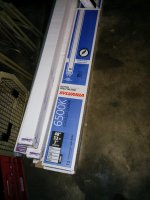
No experience with that particular brand. But based on the general type (and a few clues from what's printed on the box in your photo), I'm not optimistic...

First, they are plug-in "shop lights"; which means, by code, the outlets they plug into would need to be GFCI-protected. That not only adds cost, it makes operational reliability a very "iffy" proposition -- fluorescent lights and GFCIs often do NOT "play nicely" with each other.

Second, the mention of "HANGING CHAIN KIT (Included)" implies that these are NOT rated for direct ceiling contact (presumably for heat reasons). That means your maximum mounting height is lower still -- which, with only 12 feet to start with, is the last thing you need.

Finally, the built-in sheet-metal reflectors may or may not be desirable, depending mostly on how your ceiling is finished. With a reasonably reflective flat ceiling, reflectors on the fixtures themselves are counterproductive, as they limit the ability of the light to spread out over a wider area -- which again brings us back to needing still more fixtures than would otherwise be required, in order to maintain even, well-distributed illumination at working height. Now, IF your ceilings are open rafters/trusses, then on-fixture reflectors are something of a necessary evil. But even so, I suspect that the ones on those $10 fixtures are simply white-painted sheet metal, which is not very efficient (as such things go).

Walmart's bulbs are higher though.

So don't buy your tubes at WalMart.

I've been hemorrhaging money and need to keep costs down if practical.

I understand. But you also need to look at the REAL long-term costs, and not just at what is initially cheapest. That's the fundamental difference between "price" and "value".

 
OP
J

jethrob

Well-known member
Joined
Nov 30, 2012
Messages
208
I think I'm going to have to zone light.

It's going to cost to much to light the whole thing up to 100 lumens a square foot.

I'll try and sketch out my work area.
 

2ManyProjects

Well-known member
Joined
Jul 18, 2013
Messages
757
I think I'm going to have to zone light.

It's going to cost to much to light the whole thing up to 100 lumens a square foot.

At 30'x48', your shop will be large enough that zoning MAY be useful. But what will really pay big dividends in terms of operational cost savings is to set up your switching so as to permit varying the intensity of the illumination on an as-needed basis. For example, you won't ALWAYS need full-brightness when just doing relatively casual/easy work; and in those cases, you might get by with maybe half the main lighting on -- as long as it is the RIGHT half (i.e., still relatively evenly distributed over the work area). Similarly, you won't need as much lighting when working with the doors open on a bright sunny day, as when working in the back of the shop on a cold rainy day with the doors closed.

But by the same token, sometimes you WILL want/need all the light you can get. And as I (hopefully) illustrated in my previous post, in the long run the cost of the hardware is NOT the major factor; the operating cost is. Or, to put it another way, it would be penny-wise and pound-foolish to cut back excessively on the amount of lighting you actually install, as long as you ALSO install a switching system capable of letting you properly CONTROL that lighting.

So in short, it will behoove you to put some serious thought into breaking up the lights into multiple "banks", even within each main work area. The cost of an extra toggle switch or three is trivial, compared to the cost or operating a lot more lights than you will (sometimes) need.

I'll try and sketch out my work area.

Good move.

 
OP
J

jethrob

Well-known member
Joined
Nov 30, 2012
Messages
208
Although I loathe white, I'm starting to think I should line the interior of the building with the "bright white" panels.

Went to lowes over the weekend. Bought 10 fixtures 8 foot long(four T8 bulbs), a 4 bulb 4 foot fixture (for over the work bench), and 40 "daylight" bulbs.
 

2ManyProjects

Well-known member
Joined
Jul 18, 2013
Messages
757
Although I loathe white, I'm starting to think I should line the interior of the building with the "bright white" panels.

As previously discussed, white vs. light grey really won't make all that much difference, especially once both get a bit dirty.

Went to lowes over the weekend. Bought 10 fixtures 8 foot long(four T8 bulbs),

Pray tell, WHY?!?

After all the discussion regarding how four-foot fixtures give you more placement and switching flexibility, and particularly how this in turn means less operational cost over the long haul, and how operational costs completely overwhelm initial purchase price anyway... Whatever possessed you to buy 8-foot fixtures?

a 4 bulb 4 foot fixture (for over the work bench),

Possibly a bit on the overkill side, but no big deal.

and 40 "daylight" bulbs.

By whose definition of "daylight"? The degrees-Kelvin "Color Temperature" and CRI ("Color Rendering Index") ratings are the only meaningful designations.

 
OP
J

jethrob

Well-known member
Joined
Nov 30, 2012
Messages
208
Figured the 8 footers would be less wiring and more light. I bought three switches.

I may add more 8 footers but am going to start out with this. I spent $1500 on electrical stuff that is plenty for the moment.

Bulbs were the brightest they had. Picture attached.
 
OP
J

jethrob

Well-known member
Joined
Nov 30, 2012
Messages
208
hang on will try the picture again
 

Attachments

  • IMG_20131220_165001.jpg
    IMG_20131220_165001.jpg
    134.6 KB · Views: 20
OP
J

jethrob

Well-known member
Joined
Nov 30, 2012
Messages
208
How do I figure how many square feet each light will illuminate well.

I have 2550 lumens per bulb.

2550 x 4 = 10200

10,200/100 102 square feet?
 

jaker10

Well-known member
Joined
Sep 18, 2011
Messages
371
Location
Bartonvillle Illinois
I have a 30x48 and put up 25 4 FT. twin tube T8 $10.00 Wal Mart cheap lights. 5 rows of lights with 5 lights in each row. The 5 lights are spaced evenly along 30 feet. and the rows are spaced 8 ft. I couldn't be happier. It comes out to around 96 lumens per foot if I remember right.
 
Last edited:
OP
J

jethrob

Well-known member
Joined
Nov 30, 2012
Messages
208
I have a 30x48 and put up 25 4 FT. twin tube T8 $10.00 Wal Mart cheap lights. 5 rows of lights with 5 lights in each row. The 5 lights are spaced evenly along 30 feet. and the rows are spaced 8 ft. I couldn't be happier. It comes out to around 96 lumens per foot if I remember right.

How did you fasten to the ceiling and wire in?

Are they hanging by the chains?
 

jaker10

Well-known member
Joined
Sep 18, 2011
Messages
371
Location
Bartonvillle Illinois
Yes they are hanging by chains. I put up outlets . They are just hooked to truses with J hooks, when it's time to finish I can just unplug and put them back up after ceiling is done.
 

Attachments

  • DSC01068 (640x480).jpg
    DSC01068 (640x480).jpg
    83.8 KB · Views: 55
Last edited:

bczygan

Well-known member
Joined
Nov 4, 2009
Messages
22,002
Location
DETROIT! Arsenal of Scrappers
I love it when an OP gets the best advice possible, from repeated and detailed posts, by 2ManyProjects. And this is good information, with good judgement and reasons why.

......AND THEN JUST IGNORES IT ALL!!!

WTF?

The mere fact that a person asks for advice should indicate that they don't have the answers.
Logic would suggest that, when expert advice is given, it should be taken.
But then again, if you don't have the answers, how would you even recognize expert advice...

Oh well, it's just me.
 

JoeFin

Well-known member
Joined
Sep 13, 2013
Messages
717
Location
NorCal - where the Rednecks Race
I love it when an OP gets the best advice possible, from repeated and detailed posts, by 2ManyProjects
.

While it is good advice I in no way would consider it to be "Expert" or remotely considered "best Possible" or any thing close to professional

......AND THEN JUST IGNORES IT ALL!!!

An intelligent man is going to ask the questions. Its only the Fool who thinks he knows it all

While 2Many does take the time to help these guys he certainly doesn't know very much about lighting, ecstatic's, uses, or engineering for that matter. and I say this from my experience with Energy Management Engineering, countless "Energy Audits" and conducting 3rd party CBO Commercial Construction Reports too numerous to remember during the early to mid 90s.

He does however have a descent "1 size fits all" approach he picked up some where along the way.

However if you want some thing that differs slightly from his "One size fits all" approach, that's when he starts with his pervasive arguments liken to a recent "Dale Carnegie Course" attendee. Even to the point of being demeaning to the Op.

Is it what the Op wants - No
Is it the best possible scenario - No
Is it even slightly reminiscent of best Engineering practices - No

So where is the "Expert" in that equation ?

Expert or Engineering would be making a difficult design work and at least by advising the customer and using his consent to design a "Best Possible" workable solution
 
Last edited:

jaker10

Well-known member
Joined
Sep 18, 2011
Messages
371
Location
Bartonvillle Illinois
While it is good advice I in no way would consider it to be "Expert" or remotely considered "best Possible" or any thing close to professional


An intelligent man is going to ask the questions. Its only the Fool who thinks he knows it all

While 2Many does take the time to help these guys he certainly doesn't know very much about lighting, ecstatic's, uses, or engineering for that matter. and I say this from my experience with Energy Management Engineering, countless "Energy Audits" and conducting 3rd party CBO Commercial Construction Reports too numerous to remember during the early to mid 90s.

He does however have a descent "1 size fits all" approach he picked up some where along the way.

However if you want some thing that differs slightly from his "One size fits all" approach, that's when he starts with his pervasive arguments liken to a recent "Dale Carnegie Course" attendee. Even to the point of being demeaning to the Op.

Is it what the Op wants - No
Is it the best possible scenario - No
Is it even slightly reminiscent of best Engineering practices - No

So where is the "Expert" in that equation ?

Expert or Engineering would be making a difficult design work and at least by advising the customer and using his consent to design a "Best Possible" workable solution

I wish there was a like button
 
OP
J

jethrob

Well-known member
Joined
Nov 30, 2012
Messages
208
The bulbs were picked by staring at them lighted up in a fixture at the store. The ones selected appeared to be the brightest.
I'm thinking about returning them before even trying because of all the negative things I've been reading about them has me concerned.


If you are running those 8 footers in rows anyone have suggestions on spacing?
Please don't worry about how many fixtures are needed for the building. I'm not going to do the whole thing to 100 lumens a foot.
 
OP
J

jethrob

Well-known member
Joined
Nov 30, 2012
Messages
208
Yes they are hanging by chains. I put up outlets . They are just hooked to truses with J hooks, when it's time to finish I can just unplug and put them back up after ceiling is done.

Looks well lit and I like how you can change the fixtures out easily.

Also being able to take them down without much effort when it's time to do the ceiling is slick.

The price is a good plus for these fixtures too.
 

JoeFin

Well-known member
Joined
Sep 13, 2013
Messages
717
Location
NorCal - where the Rednecks Race
Actually I am using the same 8' 4 lamp fluorescent fixture you purchased and I've "Frenched" them / boxed them up in the ceiling and they are working beautifully so far.

I have yet to get my closure inspection for the walls so I don't have the full reflectance of the walls. But the boxing of the fixtures allows plenty of direct light to shine down on the work while eliminating most of the glare on my glasses
 
To avoid these ads, REGISTER NOW!
Top Bottom