To avoid these ads, REGISTER NOW!

lithonia LED High bay lighting from Home Depot Does anyone have them up?

snowman1981

Well-known member
Joined
Feb 28, 2011
Messages
144
Location
Crownsville maryland
http://www.homedepot.com/p/Lithonia...ay-Light-IBH-11L-MV/203812710?N=c7buZ1z0ur8l#
I finally got power up to my new garage and have started looking at lighting options and ran across the high bay LED lights offered at home depot. I talk with a few friends that have t5's and t8's and both said they liked them but ballast tend to burn out with in a year or so. the bulbs for the t5's are expensive. looking at never needing to change bulbs and last longer and use less electicity. my shop is 40ft by 90ft with 16ft sides and 20ft center. figure 8 to 10 LED would do. just want to see some pics if anyone has them of the light pattern and how bright they are.
 
To avoid these ads, REGISTER NOW!

2ManyProjects

Well-known member
Joined
Jul 18, 2013
Messages
757
Subject: lithonia LED High bay lighting from Home Depot Does anyone have them up?

http://www.homedepot.com/p/Lithonia...ay-Light-IBH-11L-MV/203812710?N=c7buZ1z0ur8l#
I finally got power up to my new garage and have started looking at lighting options and ran across the high bay LED lights offered at home depot.

Keep looking. They are very expensive for what they do, and they don't do it all that well. Despite all the "LED is the Ne Plus Ultra of efficiency" hype, they actually cost MORE to run than decent linear fluorescent fixtures of comparable output.

I talk with a few friends that have t5's and t8's and both said they liked them but ballast tend to burn out with in a year or so.

They must have bought some REALLY crappy fixtures. But even so, a new QUALITY ballast costs maybe $15-25 (cf. http://www.1000bulbs.com/category/t8-ballast-2-lamp-programmed-start/), and you certainly SHOULD expect far more than a year out of it (more like 10-20 years, at minimum).

the bulbs for the t5's are expensive.

Really? How do you figure? $220 for the "LED Wonder", vs. maybe three bucks each for standard F54T5HO tubes (cf. http://www.1000bulbs.com/search/?q=F54T5HO).

looking at never needing to change bulbs and last longer

Is 30,000 hours not enough for you? Even if you left the lights on 24/7/365, that would be almost 3-1/2 years between bulb changes. Presuming a somewhat more reasonable average of, say, 4 hours per day, you're looking at more than 20 years.

and use less electicity.

Wrong. As repeatedly discussed previously in this forum:

http://www.garagejournal.com/forum/showpost.php?p=3489902&postcount=2
http://www.garagejournal.com/forum/showpost.php?p=3575659&postcount=5
http://www.garagejournal.com/forum/showpost.php?p=3549685&postcount=2

...that Lithonia LED-based fixture uses MORE power to produce each lumen than a standard F54T5HO fluorescent tube does.

my shop is 40ft by 90ft with 16ft sides and 20ft center. figure 8 to 10 LED would do

Not even close.

At 11,200 lumens each, ten of them would produce a total of 112,000 lumens (at the sources; significantly less than that at "working height"). Spread that out over 3,600 ft.^2, and you'll have barely 31 lumens/ft.^2. Plus, even that inadequate level of the lighting will likely be spotty and uneven, due to there being too few sources spread out over too large an area.

In a word: Yuck!

If you are bound and determined to use those LED fixtures, figure on at least 40 of them to produce the commonly accepted minimum average illumination level of 100 lumens/ft.^2 at working height (and even this presumes decently reflective walls, etc.). So... $220/fixture * 40 fixtures = $8,800.

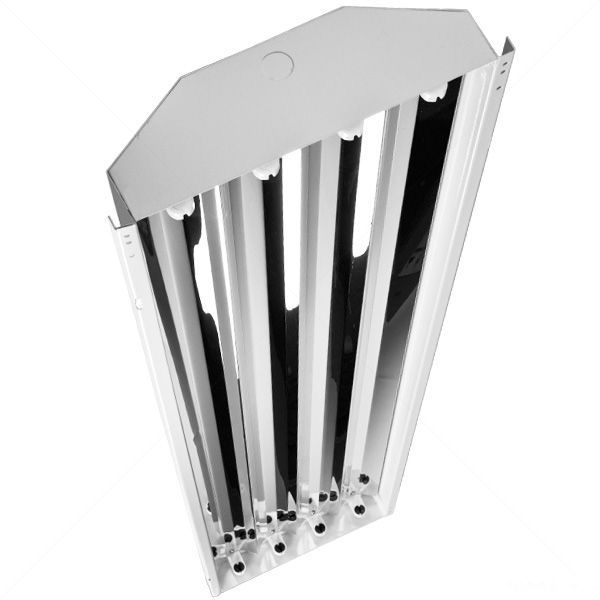
Meanwhile, approximately half as many of these:

http://www.1000bulbs.com/product/93811/BSS-HB4T5.html
93811_a3a27e0aa9283898b927884b1859c8cc174f6c37_original_x_600_1372489330.jpg


will produce approximately the same average illumination levels when properly installed, and cost less than $2,000.

But even this pales by comparison to the difference in the operating costs. The Lithonia LED fixture produces approximately 75 lumens/watt, whereas the fluorescents do about 93 lumens/watt. So for equivalent lighting power, your monthly electric bill will be about 25% higher with the LEDs. And with as much lighting power as you're going to need to properly illuminate that size shop, this WILL be significant. Going back to that 4 hours/day average, and assuming that enough of either is installed to produce roughly 100 lumens/ft.^2 at working height, and figuring $0.12/kW-hour... we get:

Code:
$62.21/month to run the fluorescents

$86.40/month to run the LEDs.

Over a year, that's a $290 difference.

 
OP
S

snowman1981

Well-known member
Joined
Feb 28, 2011
Messages
144
Location
Crownsville maryland
wow thanks for the detailed response really helped out:beer: . by any chance you don't happen to have the lighting you recommended do you? I really like to see what the light given off by them looks like. I don't know a whole lot on lighting so I just really going off of what im told. im going to be installing these my self so I am open for any suggestions. Btw thanks again
 
To avoid these ads, REGISTER NOW!

Charles (in GA)

Well-known member
Joined
Jan 11, 2006
Messages
12,489
Location
50 mi south of Atlanta
Visual shows 35 fixtures in a 5 x 7 row pattern to give 104 fc. This is for a 40x90x16 with a reflectance of 75% ceiling/50% walls/20% floor, using the photometrics for a IBH 12L. As usual Home Depot gives a Lithonia number that Lithonia does not show on their site. However the specs on the 11L and 12L appear to be the same or very close.

100 fc at a 2 ft working height is pretty standard. I cannot imagine having much less if you intend to do work in the building.

Get some T5HO strips and install them. Fancy fixtures cost money. If you want more than the strips, get the I beam fixtures from Lithonia. It will take, with 4 bulb fixtures, anywhere from 21 to 45 fixtures depending on which one is chosen. Uplighting, and wide light dispersion requires more, while narrow light distribution and no up light takes the least, to achieve 95 to 105 fc at a two foot working height.

At work we have 8 bulb high bay I beams (T5HO) and while there have been a few ballast failures among the thousand or more installed, they are very few. One or two bulbs have failed but again, thats among several thousand bulbs. They are headed into their fourth year of operation, 24/7/365.

Current crop of LEDs isn't going to come close to this.

Probably the cheapest alternative is 26 of the Lithonia 4 bulb strips T5HO (two and two in tandem), common open strip. No reflector, etc. $70 at Home Depot. Visual program shows it will take about 26 of them in four rows to achieve 99 fc. $1800 worth of fixtures, bulbs from HD are expensive (but good quality Phillips) but can be had much cheaper elsewhere. You need 104 bulbs, thats about $300 plus shipping for four cases and four odd ones, from 1000 bulbs. For comparison, a 15 pack of the Phillips from HD is $80, so $560 from HD.

Less than $2500 will get you the same light (T5HO) as $7000 will get you with the LEDs and less fixtures to wire also.

Charles
 
Last edited:

Charles (in GA)

Well-known member
Joined
Jan 11, 2006
Messages
12,489
Location
50 mi south of Atlanta
I really like to see what the light given off by them looks like.

Most Home Depots currently have the 4 bulb T5HO tandem open strip and also the 4 bulb T5HO I beam fixture, both on display in the lighting section lit up. I have seen them in several of the Atlanta area stores. I have to assume the displays are pretty similar in all stores.

Charles
 

2ManyProjects

Well-known member
Joined
Jul 18, 2013
Messages
757
wow thanks for the detailed response really helped out:beer: .

You're welcome. ;)

by any chance you don't happen to have the lighting you recommended do you?

No. They would be highly inappropriate for my typical-tract-house 2-car garage with its ~10-foot ceiling.

I really like to see what the light given off by them looks like. I don't know a whole lot on lighting so I just really going off of what im told. im going to be installing these my self so I am open for any suggestions.

Fluorescent tubes are fluorescent tubes. The fixture itself (and the way it is installed) will determine the lighting pattern & coverage, and secondarily influence the overall brightness down at working height; but in general, the only thing that will significantly influence the QUALITY of the light is the Color Temperature and CRI of whatever tubes you install. That is an important (if somewhat personal) choice in terms of being happy with the final result, but it doesn't really have much/any impact on the number & type of fixtures you need in a given space.

One tip in the DIY vein, tho' you're not really "there" yet: When you do settle on a type of fixture and a basic layout, make sure to figure on wiring them up in AT LEAST three separately switched banks (probably even more than this, considering the large space). One switch loop (with physical switches located at EVERY possible entrance point) should operate your "walk-through" lighting -- a very minimal number (perhaps a half-dozen or so, but it depends somewhat on the layout) of fixtures distributed throughout the space, whose sole purpose is to keep you from tripping over stuff as you initially enter the building and maneuver through it (such as to grab a tool or other "short term" need). The rest of the lights should be broken up into at least two banks (or two banks "per zone", if you are also doing zoning -- which in that size space, is probably also worthwhile) on a "more or less every other fixture" basis, so that you can control the intensity of the light produced at any given moment. If these two banks are somewhat unequal in terms of the tube/fixture count, so much the better; that will give you that much more flexibility. Another way to accomplish essentially the same thing is to use fixtures with two ballasts each, so that you can operate half of the tubes in each fixture independently of the other half. Understand: Charles' (and my) recommendation for at least 100 lumens/ft.^2 at working height is definitely valid; but you won't ALWAYS need this level of illumination. So when you're only doing (let's call it) "casual" work, you don't need to be single-handedly funding your local PoCo's annual dividend. In the long run, this will save you WAY more money than either "cheaping-out" on the fixtures/tubes or using too few of them.


Visual shows 35 fixtures in a 5 x 7 row pattern to give 104 fc. This is for a 40x90x16 with a reflectance of 75% ceiling/50% walls/20% floor, using the photometrics for a IBH 12L.

That sounds about right -- EXCEPT for the 75% ceiling reflectance. I don't think he can count on anything like that.

As usual Home Depot gives a Lithonia number that Lithonia does not show on their site. However the specs on the 11L and 12L appear to be the same or very close.

I did find the 11L specs on Lithonia's site at one point, but can't lay my hands on the URL at the moment. In any event, you are correct: They're close, but not QUITE the same. The 12L is rated at 12,000 lumens; the 11L at 11,000 (Home Despot says 11,200). So within 10% in any event.

100 fc at a 2 ft working height is pretty standard. I cannot imagine having much less if you intend to do work in the building.

I largely agree.

Get some T5HO strips and install them. Fancy fixtures cost money.

I would be very leery of simple open-strip fixtures in an application such as the OP's. I'm guessing this is an open-truss situation; so without any reflectors, much of the tubes' output would be wasted lighting up the underside of the roof, without much/any "gain" (at more useful heights) from ceiling reflectance.

If you want more than the strips, get the I beam fixtures from Lithonia. It will take, with 4 bulb fixtures, anywhere from 21 to 45 fixtures depending on which one is chosen. Uplighting, and wide light dispersion requires more, while narrow light distribution and no up light takes the least, to achieve 95 to 105 fc at a two foot working height.

Not to disparage Lithonia's products; but they seem a bit pricey for what they do. A quick Google check on the IBZ-454L (4-tube F54T5HO version) shows them mostly selling for ~$240-275 each. One outfit (ZORO Tools) is asking $142; but that seems suspiciously like an outlier in light of the others.

Similarly, I don't make any particular claims for that fixture from 1000bulbs.com I cited (I picked it simply as an example of the genre); but under $100 including the tubes seems a LOT more reasonable to me.

Current crop of LEDs isn't going to come close to this.

Very much agree with you on that one.

Probably the cheapest alternative is 26 of the Lithonia 4 bulb strips T5HO (two and two in tandem), common open strip. No reflector, etc. $70 at Home Depot. Visual program shows it will take about 26 of them in four rows to achieve 99 fc. $1800 worth of fixtures,

Again, the problem here is lack of ceiling reflectance. Run that "Visual" calculation again, but using something less than 10% for that value, and see how many open-strip fixtures he'd need. For the ~20% extra the ones I cited cost, they would surely produce a LOT more light (half-again? maybe closer to double?) down at working height. Seems like a no-brainer, to me.

Less than $2500 will get you the same light (T5HO) as $7000 will get you with the LEDs and less fixtures to wire also.

Exactly!

Most Home Depots currently have the 4 bulb T5HO tandem open strip and also the 4 bulb T5HO I beam fixture, both on display in the lighting section lit up. I have seen them in several of the Atlanta area stores. I have to assume the displays are pretty similar in all stores.

Probably so. But as I've said before, attempting to make light-quality judgements -- or worse, brightness judgements -- from typical in-store displays is HIGHLY problematic, at best.

 
To avoid these ads, REGISTER NOW!
Top Bottom