To avoid these ads, REGISTER NOW!

Here's a weird one - chop saw tripping breaker(s) but not on extension cord

5mall5nail5

Well-known member
Joined
May 23, 2010
Messages
1,174
Location
Bucks County, PA
Ok so I have to do more testing to confirm some things, but what I have is that my Milwaukee chop saw (120v) is on a 20A circuit and is the only thing plugged into said circuit. It's a new circuit I put in with #12/2 NM-B and new 20A receptacles as part of my garage re-wire. I have two separate circuits one is nearest the breaker box wall, the other is the opposite wall of the garage, both 20A separate circuits with 20A receptacles.

I had been using my new Bosch miter saw on the suspect circuit without issue (Bosch 5312 12" glider). I went to cut some metal with my Milwaukee chop saw, and I pull the trigger (everything else is unplugged on this circuit) and the saw starts for like 250 msec and stops. Breaker tripped. Weird. So, out of frustration I ran an extension cord from the other wall (different circuit) and it runs fine. Things I've tried:

  • Different circuit breaker to eliminate actual breaker as faulty
  • Removing all but the first receptacle from the circuit in case there's a short/draw
  • Replace first receptacle with another in case the first is faulty
  • Run extension cord across garage to other circuit - works

So, in all my testing the saw ran off the suspect circuit once - thought I had fixed it but got lucky, as it tripped the breaker another half dozen times. So, one would think something is up with the motor in the chop saw but when I plug it in across the garage via 50ft extension cord, that circuit does not trip after repeated use. So, I can come up with two possible reasons - 1) the extension cord offers voltage drop and therefore the saw cannot pull the same amount of current and it works 2) there's something wrong with the romex between the first receptacle and the breaker panel (hard to believe as I used nail plates and all).

I haven't tried plugging the chop saw in directly to the circuit that is allowing it to work on an extension cord (cluttered shop right now). I also haven't plugged any other semi-high current devices into the suspect circuit because I have the first receptacles out and romex disconnected (breaker off) whilst testing. So I thought i'd post and get some ideas before I continue to figure this out.

So, what do you guys think?
 
Last edited:
To avoid these ads, REGISTER NOW!

mrjaw14

Well-known member
Joined
May 22, 2012
Messages
1,958
Location
Nashville, TN
hum, that is an odd one! You could take some spare romex and wire up the same receptical to the same breaker from outside the panel and see what happens. If it works fine there you know you might have a problem with the romex feeding that first receptical.

If you have an amp clamp, you could measure how much amperage you're drawing, and that might tell you what's going on as well. I'd take readings on the current circuit and the test circuit I spoke of above.

I think you need to try the saw on a different circuit, as well.
 

Jawn

Well-known member
Joined
Jul 29, 2011
Messages
3,594
Location
Stuck in traffic, GA
1) the extension cord offers voltage drop and therefore the saw cannot pull the same amount of current and it works
I'd suspect this. What size extension cord (gauge / length)? Also, anything else on this circuit? What's the plate on the chop saw say the current draw is?
 

Kevin C

Well-known member
Joined
Aug 4, 2011
Messages
1,653
Location
Portland OR
1) the extension cord offers voltage drop and therefore the saw cannot pull the same amount of current and it works

That would be my theory... Until the motor develops a back EMF the start up current is really high. Peak current draw can be hard to capture with an amp clamp. I would still try. It depends on how long the peak is and the meters sampling rate.

Any binding in the saws bearings or gears that would increase the start-up time?
 

sberry

Banned
Joined
Jun 18, 2005
Messages
35,747
Location
Brethren, Michigan
Its close to the panel on a big wire, its a heavy motor, big wire allows for huge current inrush. Add some lighter extension cord, see how it works. I have one, I run a wire from the panel to an outlet and put a 30 on it just for the saw.

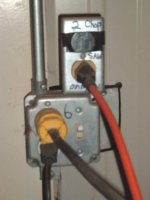
I see the switch cover got installed backwards. Its sposed to have the switch under the pipe going out the top to a light.
 

Attachments

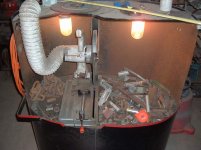
  • chop saw pile.JPG
    chop saw pile.JPG
    104.5 KB · Views: 137
  • chop saw only.JPG
    chop saw only.JPG
    30.3 KB · Views: 128
Last edited:

sberry

Banned
Joined
Jun 18, 2005
Messages
35,747
Location
Brethren, Michigan
Little comps and these saws are famous for this, no good way around it other than tailored circuit. On a job I simply add some cord or have a smaller saw.
These 2 and welders are about the onlyist things that cause on a common 20A circuit. Especially when the tool ages a little. They are useless on a 15A circuit, not so much that it cooks the 14 wire but the breaker trips. A horsepower will run fine from a 14 but unless its a special circuit cant overcurrent protect it (like you may within an appliance where there is no receptical for the user to add load) ,,,, you are running it on a general use circuit, there is the potential for combined load on a part of the circuit.
 

raddksn

Well-known member
Joined
Oct 3, 2011
Messages
1,304
Location
south central upper peninsula michigan
Is the breaker that it works on a time delay type? A time delay breaker allows a fighter current at startup if a motor load.

I had same trouble with the same saw I borrowed from a friend, had to run it from 20 amp outlet on the back of my welder.
 

sberry

Banned
Joined
Jun 18, 2005
Messages
35,747
Location
Brethren, Michigan
Small grinders, hand held equipment is about half the power, that stuff will even function on a 15, there is probably lawn care stuff I forgot,, some of it not the Black and Decker and commercial floor cleaning equipment need 20A service but all the stuff common to this crowd is fitted with a 15A cord and plug.

When we calculate length and voltage drop often quote it at 20,,, yes but there is a huge difference in the actual applied by the user of 13 tops and in the case of a drill or 4 1/2 grinder half again.
They turned up the voltage from days of old, it all runs better.

An AC buzzer for example, a machine whos installation instructions havnt been changed in 50 yrs, when it was 220, then 230 and now 240+ and the coating on a 10 Romex is far superior to a cable of the day. As we own more pieces we use more but its often at lighter loads across a slightly longer duty cycle.

As we retire the buzz box we add a small mig or replace with an inverter, in some cases we add bigger but we wire or upgrade service for it,,, but,,,, the mig, takes half the power, twice as long but the peak load is only 50% of the buzzer and we could now add 2 and considering the duty cycles of these affect the load and a bunch of other gibberish.

Got battery powered tools, need half the wire, dont even need service in many cases, carry lights and all.
 
OP
5

5mall5nail5

Well-known member
Joined
May 23, 2010
Messages
1,174
Location
Bucks County, PA
hum, that is an odd one! You could take some spare romex and wire up the same receptical to the same breaker from outside the panel and see what happens. If it works fine there you know you might have a problem with the romex feeding that first receptical.

If you have an amp clamp, you could measure how much amperage you're drawing, and that might tell you what's going on as well. I'd take readings on the current circuit and the test circuit I spoke of above.

I think you need to try the saw on a different circuit, as well.

Yeah plan on making a sort of temporary romex run outside of the panel for testing the initial run and validating that it does or does not matter that the in-wall romex is used. Would REALLY hate to take my new drywall down if something stupid happened, or didn't happen and I needlessly ruined my drywall.

I don't have an amp clamp but I have a feeling it'd be hard to measure it accurately because of how quickly it shuts down. I get about 1/32nd of a rotation out of the blade before it trips. A mere 250 msec or so I'd bet.

I'd suspect this. What size extension cord (gauge / length)? Also, anything else on this circuit? What's the plate on the chop saw say the current draw is?

Yeah that's the way I am leaning especially since my miter saw working in this circuit for many cuts... though that is probably a higher current motor too - unsure. Though, it was also plugged in further down the row, so maybe the voltage drop of like 6 receptacles ahead of it helped?

The cord is ~50ft its standard green outdoor style so its probably 14 gauge. I am not near the motor so I will check tonight.

That would be my theory... Until the motor develops a back EMF the start up current is really high. Peak current draw can be hard to capture with an amp clamp. I would still try. It depends on how long the peak is and the meters sampling rate.

Any binding in the saws bearings or gears that would increase the start-up time?

No binding at all. Its a dirty tool very similar to this model:

http://www.amazon.com/dp/B0058KIGQM/?tag=atomicindus08-20

I bet it's rated 15A and surges north of that on start up for sure. It could have dirt in it, though it's not used a TON. I think it might have tripped the breaker on my power strip at my old location though I don't remember for sure.

Is the breaker that it works on a time delay type? A time delay breaker allows a fighter current at startup if a motor load.

I had same trouble with the same saw I borrowed from a friend, had to run it from 20 amp outlet on the back of my welder.

The breaker is a Square D 20A tandem, not time delay I don't think.
 

Highlux

Well-known member
Joined
Dec 5, 2013
Messages
298
Location
Ofallon, MO.
Id check your wiring to the other outlet. Could be a bad breaker as well. Even new ones can be bad. Swap the to see.

Also...the barrel grinding/chopsaw station is awesome. can we get more pics of that? genius.
 
OP
5

5mall5nail5

Well-known member
Joined
May 23, 2010
Messages
1,174
Location
Bucks County, PA
I did move the suspect circuit to another breaker and it tripped on that as well. Both a new Square D tandem 20A and an older Square D single circuit.
 

PRH44

Well-known member
Joined
Dec 25, 2009
Messages
563
Location
Indiana
I did move the suspect circuit to another breaker and it tripped on that as well. Both a new Square D tandem 20A and an older Square D single circuit.

Square D has the fastest acting breakers on the market. Not to say another brand will make a difference in your case. Do you have QO or HOM type? I would agree with previous posters the inrush is to great for the inverse time breaker.

We actually use reduced voltage starters to start large motors, this allows for the motor to start without damaging equipment, or forcing you to provide extremely large gear and cable. So when you add cord for voltage drop you in are essence providing a reduced voltage start, or what is know as a soft start


Paul
 

larry_g

Well-known member
Joined
Apr 28, 2007
Messages
16,872
Location
oregon
  • Different circuit breaker to eliminate actual breaker as faulty
  • Removing all but the first receptacle from the circuit in case there's a short/draw
  • Replace first receptacle with another in case the first is faulty
  • Run extension cord across garage to other circuit - works


So, what do you guys think?

I think you need to plug the extension cord into the suspect socket.

The extension cord is acting like an inductor reducing the inrush current I think.

lg
no neat sig line
 
OP
5

5mall5nail5

Well-known member
Joined
May 23, 2010
Messages
1,174
Location
Bucks County, PA
Square D has the fastest acting breakers on the market. Not to say another brand will make a difference in your case. Do you have QO or HOM type? I would agree with previous posters the inrush is to great for the inverse time breaker.

We actually use reduced voltage starters to start large motors, this allows for the motor to start without damaging equipment, or forcing you to provide extremely large gear and cable. So when you add cord for voltage drop you in are essence providing a reduced voltage start, or what is know as a soft start


Paul

Thats interesting to know thanks - I am used to some items having a soft start on motors

I think you need to plug the extension cord into the suspect socket.

The extension cord is acting like an inductor reducing the inrush current I think.

lg
no neat sig line

Yeah I will do that tonight and see whats up. I do honestly think the extension cord is acting to help the situation.
 

rlitman

Well-known member
Joined
Oct 18, 2010
Messages
24,580
Location
Long Island
Square D has the fastest acting breakers on the market. Not to say another brand will make a difference in your case. Do you have QO or HOM type? I would agree with previous posters the inrush is to great for the inverse time breaker.

SquareD QO is a hybrid thermal/magnetic breaker.
The time curve for a 20A single phase QO is published here:
http://products.schneider-electric.us/technical-library/?event=detail&oid=0900892680117fff

According to that curve, the magnetic "instantaneous" trip will not kick in until somewhere between 120A and 200A, and that will clear a fault within 1 cycle (that's pretty damn good BTW).

At double the rated current (40A, which is going to be a cap for the starting current of your motor acting normally), the thermal should trip somewhere between 8 and 35 seconds. Not in 1/4 second. If it trips in 1/4 second (assuming your judgement of that short interval of time is correct), the starting current has to be over 110A. That's not good.

Either your saw has a big problem (most likely answer if this happened on more than one breaker), or you have a bad breaker.
 
Last edited:

MrMark

Well-known member
Joined
Jan 25, 2010
Messages
4,626
Location
Southern Cal.
I think you need to plug the extension cord into the suspect socket.

The extension cord is acting like an inductor reducing the inrush current I think.

lg
no neat sig line

This makes the most sense. .
 
Last edited:

C96

Well-known member
Joined
Nov 30, 2013
Messages
1,251
My opinion is the saw itself is having issues, or its the wiring in the wall :shocking:
 

laser3kw

Well-known member
Joined
Nov 17, 2012
Messages
7,276
Location
northen IL
attachment.php


somebody installed the box outside the lines :thumbup:
 
OP
5

5mall5nail5

Well-known member
Joined
May 23, 2010
Messages
1,174
Location
Bucks County, PA
My opinion is the saw itself is having issues, or its the wiring in the wall :shocking:

Here's the thing though - its a solid #12/2 romex from the panel to the first receptacle. It's a 3 - 4' run with nail plates. I have my verizon fios power supply on that wall and I can plug that in just fine. If it were the wire in the wall, I'd suspect that I'd have issues as soon as I flip the breaker on regardless of any device plugged in. My FIOS box works fine. No issues. Its the saw causing trouble. I wish I had a fast enough current clamp or a scope that could handle this kind of amperage just to find out for sure what's going on.

I will tinker today and get some videos so you guys can see what's happening exactly.
 
To avoid these ads, REGISTER NOW!

sberry

Banned
Joined
Jun 18, 2005
Messages
35,747
Location
Brethren, Michigan
Run that sucker till its broke. It isn't in the 35-40 start range its 65-70, maybe more. They barely don't kick a breaker when they are perfect, only slightly. You could work on it, inspect till you are retired and not find anything worth a pinch of **** wrong, the guy moved to a new close circuit and now it trips,,, a common problem to anyone that has ever actually seen one used for more than one cut.

If a guy wants to use this saw regular like where it is there is one real solution, own circ with a heavier breaker, no good way around this no how and if he gets a fussy little air comp could use the same for that or possibly welding from if he had to.

As the side note,,, this becomes a special circuit not available to other general equipment designed to be plugged in to 20A, grinders, drills, lights etc. My saw does it too, the one I had before this did also. Never did from poor old service and long runs, move to new place next to the panel and big wire, wham, every few starts especially
 
Last edited:

C96

Well-known member
Joined
Nov 30, 2013
Messages
1,251
I still think the problem is within your saw itself, but it is possible if the wires in the wall are damaged, (say the hot was severed, but still making contact enough to complete the circuit) your Verizon box or any other miniscule load consuming device would possibly not notice this problem. The minute you plug something in that is a current hog (especially a high amp motor driven saw) the damaged conductor will start to arc (like an arc welder) causing all kinds of havoc on the circuit. The circuit breaker senses the pulsating inrush currant and arcing as multiple short circuits and thus trips.

Just my 2 cents

Good Luck :thumbup:
 

jkwilson

Well-known member
Joined
Dec 5, 2012
Messages
758
Location
SW Indiana
SquareD QO is a hybrid thermal/magnetic breaker.
The time curve for a 20A single phase QO is published here:
http://products.schneider-electric.us/technical-library/?event=detail&oid=0900892680117fff

According to that curve, the magnetic "instantaneous" trip will not kick in until somewhere between 120A and 200A, and that will clear a fault within 1 cycle (that's pretty damn good BTW).

At double the rated current (40A, which is going to be a cap for the starting current of your motor acting normally), the thermal should trip somewhere between 8 and 35 seconds. Not in 1/4 second. If it trips in 1/4 second (assuming your judgement of that short interval of time is correct), the starting current has to be over 110A. That's not good.

Either your saw has a big problem (most likely answer if this happened on more than one breaker), or you have a bad breaker.

I agree with this. You are tripping way, way too fast for anything but an enormous overload. This is not a GFCI breaker, correct?
 

teamextreme

Well-known member
Joined
Aug 10, 2013
Messages
867
Location
Lakewood, CO
This is normal and I experience it about 50% of the time with my Ryobi 14" metal chop saw. The inrush amps are not double, like suggested above, they are more like 6 to 10 times, which can indeed trip a breaker if the FLA load is already close to the max, like a large saw. The fact that it doesn't trip with the extension cord is further proof of this due to the reduced current draw as a result of increased wire impedence, as excellently explained above by DRH44. My circuit was a dedicated, 20A, only 10 feet long and I got sick of the tripping breakers, so I just replaced the 20A with a 30A. I know, I'm going to hell for that, and I'm sure I'll be chastized by the Code Nazi's, but what other solutions are there, short of some type of motor starter setup, which is silly for a cord and plug connected saw. The way I see it, I'm considering that circuit a motor load and I'm increasing the breaker size per NEC 430, although there are no overloads to make it truly legit.
 

mm08822

Well-known member
Joined
Jan 13, 2012
Messages
5,860
Location
NJ
Try the simple solution first as Larry G suggested - plug the 50' cord into the receptacle that the cb is tripping. If the cb holds, then the cord is limiting the inrush current due to the added resistance in the circuit. If not, then check your connections in that circuits.

Here is the exerpt from a previous post I did to explain a similar problem with an air compressor:
"Upon start-up of the motor, while it is not rotating, the only current limiting component is the resistance of the circuit - building wiring, a/c lead cord, and the motor windings. So here's an example for this case - lets say you have 2 ohms total in the above circuit. 120 volts/2 ohms = 60 amps initially at startup. As the motor starts to rotate, inductive reactance builds and the 60 amps reduces to ~12amps. This case only happens if the time-curve of the cb will provide enough time before opening the breaker.

Now lets add the extension cord into the circuit and maybe even go to a different receptacle -further away from a panel and even wired with #14. So this overall circuit has maybe 1 ohm more. 120 volts/ (2+1 ohms) = 40 amps. As the motor starts to rotate, inductive reactance builds and the 40 amps reduces to ~12 amps. This case happens because the time-curve of the cb provides enough time going from 40 to 12, so the breaker doesn't open while the circuit is reducing the start-up current."

Let us know what your results are.
 

sberry

Banned
Joined
Jun 18, 2005
Messages
35,747
Location
Brethren, Michigan
Something to add to this, As I recall,,, best I can, that "they" as in collectively that know more than I do suggest keeping the 12 wire with the larger breaker on motor loads.
I think I used 10 at the time for mine,,,, because I have a couple big spools and had a big pipe, was adding 22 ft so there was some length, blah blah but the idea of adding a couple extra cycles to the start of intermitant loads over a lifetime of wear and tear is pointless and you don't want everything tearing *** as fast as possible, a little lag is a good thing, your kitchen faucet is limited, you don't try to "dump" water as fast as absolutely possible to every device, spreading the start current out at 40 allows for multiple loads from small service. Same with plumbing restriction at point of use.
 

sberry

Banned
Joined
Jun 18, 2005
Messages
35,747
Location
Brethren, Michigan
The point of it all is to plug it in and use it not to make a life of mental masturbator if you take a couple life cycles out of decades of service and that is all purely speculative and circumstantial.

A common miter saw uses a pinch less on starts but the chops and the comps are designed to apply the max legal load to a 20A general circuit.
This is part of what I was trying to splain to ding a ling on the torpedo heater and changing it from its 16 to a 12 and why it had nothing to do with the problem and why a guy didn't size the whip on it for 300 ft.

I like how above mm makes a point the applied run load isn't 20 cause you have a 20A circuit, it isn't even 15, the voltage drop during the run on a 20A wire is minimal, you can use 150 ft of wire for a common circ saw and the user is unaware the circuit is that long.
 
Last edited:

600SL

Well-known member
Joined
Apr 26, 2012
Messages
1,794
Location
Connecticut
While this problem seams kind of strange it is what I would expect from a bad motor. The Milwaukee chop saw like my Dewalt operates on the hairy edge of a 20 amp circuit under load. I can trip any 20 amp breaker with my Dewalt if I push it too hard. But yours is a start up issue, I hope I am assuming no load. I would expect these motors to pull in the neighborhood of ~ 50 amps on startup for a few milliseconds. You should be able to see it with an AMP clamp. although it will probably read abit lower unless you have an amp clamp on a scope. It your bearings worn or grinding metal is wedged in there causing resistance on the blade during startup or grinding metal is in the motor you will have these kinds of problems.

I would start by cleaning out the saw.

John
 

2Big2Ride

Well-known member
Joined
Oct 24, 2010
Messages
258
Location
d/FW, Texas - more FW than D
Try the simple solution first as Larry G suggested - plug the 50' cord into the receptacle that the cb is tripping. If the cb holds, then the cord is limiting the inrush current due to the added resistance in the circuit. If not, then check your connections in that circuits.

Here is the exerpt from a previous post I did to explain a similar problem with an air compressor:
"Upon start-up of the motor, while it is not rotating, the only current limiting component is the resistance of the circuit - building wiring, a/c lead cord, and the motor windings. So here's an example for this case - lets say you have 2 ohms total in the above circuit. 120 volts/2 ohms = 60 amps initially at startup. As the motor starts to rotate, inductive reactance builds and the 60 amps reduces to ~12amps. This case only happens if the time-curve of the cb will provide enough time before opening the breaker.

Now lets add the extension cord into the circuit and maybe even go to a different receptacle -further away from a panel and even wired with #14. So this overall circuit has maybe 1 ohm more. 120 volts/ (2+1 ohms) = 40 amps. As the motor starts to rotate, inductive reactance builds and the 40 amps reduces to ~12 amps. This case happens because the time-curve of the cb provides enough time going from 40 to 12, so the breaker doesn't open while the circuit is reducing the start-up current."

Let us know what your results are.
Was thinking about staring a new thread and ask what was the science behind this situation, but thought I should search before asking. After spending way too much time searching the great big interweb for the answer I found the answer right here in this older thread.

Have a similar problem with my older D-brand 34-670, 120V, 15A table saw tripping the breaker on start up when connected directly to a 20A, 12 AWG circuit, but not with my 100', 12 AWG extension cord between the saw and outlet.

Will be ordering a 20A HM rated breaker for that particular circuit.
 

LS6 Tommy

Well-known member
Joined
Dec 27, 2013
Messages
26,162
Location
Northern NJ
I'd suspect this. What size extension cord (gauge / length)? Also, anything else on this circuit? What's the plate on the chop saw say the current draw is?

That's backwards. An undersized cord causing a voltage drop would INCREASE the amperage draw.

Is it a GFI breaker?

Tommy
 

yeldogt

Well-known member
Joined
Jan 2, 2012
Messages
18,184
I think it has to do with the initial arc -- full resistance. The whole circuit tales that hit ... it like a short hose and a long hose.

I'm sure the old GE breakers would never trip

I remember seeing a demonstration around why it's actually less safe to wire a whole house with 12g and 20map circuits vs on with 14g and 15amp. The recommendation was to return the 12g wire to 15amps where not required by code.
 

2Big2Ride

Well-known member
Joined
Oct 24, 2010
Messages
258
Location
d/FW, Texas - more FW than D
Was thinking about staring a new thread and ask what was the science behind this situation, but thought I should search before asking. After spending way too much time searching the great big interweb for the answer I found the answer right here in this older thread.

Have a similar problem with my older D-brand 34-670, 120V, 15A table saw tripping the breaker on start up when connected directly to a 20A, 12 AWG circuit, but not with my 100', 12 AWG extension cord between the saw and outlet.

Will be ordering a 20A HM rated breaker for that particular circuit.
Finally received and installed the 20A High Magnetic (HM) circuit breaker. Start up problem with the old table saw solved!
 

mm08822

Well-known member
Joined
Jan 13, 2012
Messages
5,860
Location
NJ
Finally received and installed the 20A High Magnetic (HM) circuit breaker. Start up problem with the old table saw solved!

That’s a great find. :bowdown:
I wasn’t aware of this feature being available in a residential product line up. After searching for these, I found SQ D QO’s come in the HM (high magnetic) series - but only for 1P 15A and 20A cb’s.
Not sure if you are using SQ D or something else. If something else, I'd like to know what mfr.

The magnetic trip curve for a standard SQ D QO 1P 20A is 6.0X – 11.0X rated current while the SQ D QOHM 1P 20A is 11.0X – 42.0X rated current.

I also found Graybar with the lowest price - $12.20 each.
 

2Big2Ride

Well-known member
Joined
Oct 24, 2010
Messages
258
Location
d/FW, Texas - more FW than D
That’s a great find. :bowdown:
I wasn’t aware of this feature being available in a residential product line up. After searching for these, I found SQ D QO’s come in the HM (high magnetic) series - but only for 1P 15A and 20A cb’s.
Not sure if you are using SQ D or something else. If something else, I'd like to know what mfr.

The magnetic trip curve for a standard SQ D QO 1P 20A is 6.0X – 11.0X rated current while the SQ D QOHM 1P 20A is 11.0X – 42.0X rated current.

I also found Graybar with the lowest price - $12.20 each.

Yes, Square D, but Homeline. 20A HOM120HM
 
Last edited:
To avoid these ads, REGISTER NOW!
Top Bottom