To avoid these ads, REGISTER NOW!

Blackhawk SJ-2 Floor Jack - The Conclusion

paulsomlo

Well-known member
Joined
Jul 16, 2013
Messages
3,871
Location
Northern Colorado
Back in January, I started a rebuild thread on this jack, a $20 CL purchase:
View media item 98844
The original thread was a bit scant on info, a bit scattered, and basically never went anywhere:
(http://www.garagejournal.com/forum/showthread.php?t=232242&highlight=blackhawk).

There have been many excellent rebuild threads here on GJ and the SJ-2 hydraulics are very basic, so I'll focus on the pieces of the rebuild that I think may prove interesting, knowing that some of this may only appeal to floor jack "junkies".

After purchasing a seal kit locally, the jack was still leaking down roughly 1/4" every two hours or so, and leaking from the tank nut oring, as well. After tearing the jack apart twice, I decided I'd had enough of the leather piston cup. Now, I'm not condemning leather, as I've found out there are many reasons that it makes an excellent material for a piston cup, even in light of more modern materials, but I wasn't about to buy another $30 kit, and I didn't know if I could buy a single cup. At this point, I had basically lost faith. So, I set out to make an adapter to allow the use of a loaded polyurethane ucup, essentially an off the shelf item, costing about three dollars and change. Here's the original piston rod, very typical, with a 1/2-20 threaded stud to secure the original piston cup, which had completely disintegrated:
View media item 98845
Here's the solution that I came up with, turned from mild steel on the lathe, with wrench flats for installation:
View media item 98846Here's the rod, having taken a skim cut to clean up the surface that the adapter mates with:
View media item 98847
And here's the adapter on the rod, with some anaerobic gasket maker applied to both the threads and the mating surface on the rod, to eliminate leaking around the adapter:
View media item 98848
Finally, here's the rod with both adapter and loaded ucup, secured with a snap ring:
View media item 98849
I tested the jack, lifting both front wheels of my vehicle off the ground just an inch or so, figuring, that from a leverage standpoint, this was the most challenging condition for the hydraulics. After 12 hours, the leak down was roughly 1/32", as measured by a yard stick leaning up against my front bumper, or about the width of one of the "tick" marks on the ruler - certainly good enough, considering that, other than tire changes, I never work without jack stands.

Now, the assumption was that when the leak down problem was fixed, the leak from the tank nut oring would go away - didn't happen. And I had replaced the original tank nut oring with a quad ring, hoping for better results. But now, every time I lifted the vehicle, a puddle formed almost immediately, with the rod dripping wet. So, I pulled the hydraulics apart again and examined the tank nut, which had a fair amount of wear, due to the rod rubbing against it. In fact, there was so much wear, that I thought the oring groove had been machined off center, as the oring appeared to be protruding from the slot far more on one side than the other. I've now got the hydraulics apart for the third time and I was intent on not making it a fourth. So, on to the tank nut.

Here's the tank nut fixtured on the lathe, using a galvanized pipe ****** from the big box store, both ends cut off, one end rethreaded on the lathe to match the tank nut:
View media item 98850
Here's the nut being bored to eliminate the wear:
View media item 98851
I ended up opening the diameter by 0.028" to get past all the wear and get back to concentricity. At this point, I had to walk away and come up with a viable design to reclaim the tank nut. Now, when I started this ordeal back in January, I didn't even have a basic understanding of how a floor jack worked, so every step included lots of "research", which included a read of the Parker Oring Handbook (http://www.parker.com/literature/ORD%205700%20Parker_O-Ring_Handbook.pdf), everything you wanted to know about orings and more.

I chose a design that included two pieces, an inner part and an outer part. The advantage to this approach was that I didn't have to machine an internal groove for the new tank nut oring and the two pieces allow removal of the rod without removing the tank nut, which was a consideration, after having taken apart the hydraulics three or four times now.

Here's the nut, after machining:
View media item 98852
Here are the two "adapters", again, turned from mild steel (12L14). These will bring back the nut bore to the rod diameter:
View media item 98853
The threads are 36 tpi, to ensure adequate thread engagement over the 0.25" span that I had available for threads.

The inner adapter sits against the shoulder formed by the old oring slot and is a slip fit in the new nut bore, just 0.001" over, to ensure concentricity.
View media item 98854
Here's the outer adapter, fitted with the quad ring on it's ID, which will seal the rod and an oring on its OD, which will seal the adapter to the tank nut bore:
View media item 98855
I used an oring "calculator" from Apple Rubber to help in sizing the orings: http://www.applerubber.com/oring-gland-calculator/

Here are the adapters installed in the nut:
View media item 98856
And with the hydraulic unit back together again:
View media item 98857
The dimple in the face of the outer adapter is from a 3/32" drill bit, which will allow removal of the adapters for seal replacement, using the same size drill bit as a sort of bastardized face spanner.

So, how did the story end? The rod is bone dry now, no more leaks, no more leak down, a jack that works the way it's supposed to. I still need a set of casters, as at some point the present ones were overloaded, bending the frames such that they hit the jack's sideplates when they swivel. And yes, I put a ridiculous amount of effort into saving an old jack whose best days had come and gone, but it was never about just getting a working floor jack. A few mouse clicks, $350, and five days later, I could have had a shiny new Hein Werner sitting on my doorstep, and lived happily ever after. Behind the scenes, were many PMs with both Edgar and Hiball, whose posts here, along with other members, inspired me to save this old beast, and learn everything I could in the process.

In addition to what I've shown here, although I won't go into detail, I did fill the "rash" on the piston rod with JB Weld, regrind the seats with valve grinding compound and shopmade tools, and make a vented plug for the tank. I modified my original method of removing the tank nut slightly to make it more convenient, using a steel bar, some magnets, and two pieces of 1/4" round steel. I know you guys are fond of pictures:

View media item 98858
View media item 98859
View media item 98860
View media item 98861
 
Last edited:
To avoid these ads, REGISTER NOW!

Hiball

Well-known member
Joined
Apr 30, 2009
Messages
14,027
Location
Missery
Impressive... :)

After looking at the pictures, are you using the correct Sized Ucup for the bore? Maybe its the angle but the OD doesn't seem to match the Oem guide.
 
Last edited:

ffast65

Well-known member
Joined
Mar 8, 2014
Messages
159
Location
Columbia Station, OHIO
That's determination if I ever saw to make as many parts as you did.
Nice work.

I also have the same model needing a rebuild.
Did you have to bore and rebush the pivot for the main lift arm?
Mine needs it.
 

Bull

Super Moderator
Joined
Dec 12, 2005
Messages
16,189
Location
MA
If I had the skills and the patience to do this kind of work, I would feel like Hephaestus.
 
OP
P

paulsomlo

Well-known member
Joined
Jul 16, 2013
Messages
3,871
Location
Northern Colorado
Impressive... :)

After looking at the pictures, are you using the correct Sized Ucup for the bore? Maybe its the angle but the OD doesn't seem to match the Oem guide.

Good question - probably not.

The bore measures 1.545" and the only specs I could find for the ucup that I used were a bore tolerance of something like 0.001 over nominal size, which would be 1.501". The heel of the cup I used measures 1.499". Currently, the cup is slightly snug, not tight by any means, but I can't imagine inserting it into a bore of 1.501". It's also possible that I misinterpreted the ucup spec - I never could find a website that related nominal size to range of acceptable bore diameter. Or at least one that made sense to me. I looked at metric, but I think the next size was 39mm or 1.535", which I was thinking might have been too tight. The Oem guide is 1.536", by the way.

I did cheat on the ID of the ucup and sized the adapter about 0.008" over where I interpreted the spec, which, being a loaded cup, forced the OD out as well. With the ucup in my hand, not on the adapter, the lips were a fairly loose fit in the bore, so I'm not sure if ucups depend on having their ID expanded or not, or if I'm just cheating.
 
Last edited:
OP
P

paulsomlo

Well-known member
Joined
Jul 16, 2013
Messages
3,871
Location
Northern Colorado
Actually, looking at ucup sizes again, the next standard metric size seems to be 40mm, which I don't think would fit.
 
Last edited:
OP
P

paulsomlo

Well-known member
Joined
Jul 16, 2013
Messages
3,871
Location
Northern Colorado
I also have the same model needing a rebuild.
Did you have to bore and rebush the pivot for the main lift arm?
Mine needs it.

No, it was worn and scored, but not to the point where I would bore it out. It would have to get pretty loose before I'd consider that, because fixturing it to bore it out would be fairly time consuming.
 

CRTDI

Well-known member
Joined
Jan 11, 2010
Messages
1,533
Man, that's a lot of effort and work you put into that. Nice save...:thumbup:
 

123Go

Well-known member
Joined
Oct 7, 2012
Messages
199
Always happy to see an extra frogy GJ member. I've never had this much determination and/or pinned up anger to redo mine yet..lol
I have the green Sears version on my to do list, really glad your finally happy with yours.
 

ALTEREGO

Well-known member
Joined
May 15, 2018
Messages
420
Location
@HOME
Back in January, I started a rebuild thread on this jack, a $20 CL purchase:
View media item 98844
The original thread was a bit scant on info, a bit scattered, and basically never went anywhere:
(http://www.garagejournal.com/forum/showthread.php?t=232242&highlight=blackhawk).

There have been many excellent rebuild threads here on GJ and the SJ-2 hydraulics are very basic, so I'll focus on the pieces of the rebuild that I think may prove interesting, knowing that some of this may only appeal to floor jack "junkies".

After purchasing a seal kit locally, the jack was still leaking down roughly 1/4" every two hours or so, and leaking from the tank nut oring, as well. After tearing the jack apart twice, I decided I'd had enough of the leather piston cup. Now, I'm not condemning leather, as I've found out there are many reasons that it makes an excellent material for a piston cup, even in light of more modern materials, but I wasn't about to buy another $30 kit, and I didn't know if I could buy a single cup. At this point, I had basically lost faith. So, I set out to make an adapter to allow the use of a loaded polyurethane ucup, essentially an off the shelf item, costing about three dollars and change. Here's the original piston rod, very typical, with a 1/2-20 threaded stud to secure the original piston cup, which had completely disintegrated:
View media item 98845
Here's the solution that I came up with, turned from mild steel on the lathe, with wrench flats for installation:
View media item 98846Here's the rod, having taken a skim cut to clean up the surface that the adapter mates with:
View media item 98847
And here's the adapter on the rod, with some anaerobic gasket maker applied to both the threads and the mating surface on the rod, to eliminate leaking around the adapter:
View media item 98848
Finally, here's the rod with both adapter and loaded ucup, secured with a snap ring:
View media item 98849
I tested the jack, lifting both front wheels of my vehicle off the ground just an inch or so, figuring, that from a leverage standpoint, this was the most challenging condition for the hydraulics. After 12 hours, the leak down was roughly 1/32", as measured by a yard stick leaning up against my front bumper, or about the width of one of the "tick" marks on the ruler - certainly good enough, considering that, other than tire changes, I never work without jack stands.

Now, the assumption was that when the leak down problem was fixed, the leak from the tank nut oring would go away - didn't happen. And I had replaced the original tank nut oring with a quad ring, hoping for better results. But now, every time I lifted the vehicle, a puddle formed almost immediately, with the rod dripping wet. So, I pulled the hydraulics apart again and examined the tank nut, which had a fair amount of wear, due to the rod rubbing against it. In fact, there was so much wear, that I thought the oring groove had been machined off center, as the oring appeared to be protruding from the slot far more on one side than the other. I've now got the hydraulics apart for the third time and I was intent on not making it a fourth. So, on to the tank nut.

Here's the tank nut fixtured on the lathe, using a galvanized pipe ****** from the big box store, both ends cut off, one end rethreaded on the lathe to match the tank nut:
View media item 98850
Here's the nut being bored to eliminate the wear:
View media item 98851
I ended up opening the diameter by 0.028" to get past all the wear and get back to concentricity. At this point, I had to walk away and come up with a viable design to reclaim the tank nut. Now, when I started this ordeal back in January, I didn't even have a basic understanding of how a floor jack worked, so every step included lots of "research", which included a read of the Parker Oring Handbook (http://www.parker.com/literature/ORD 5700 Parker_O-Ring_Handbook.pdf), everything you wanted to know about orings and more.

I chose a design that included two pieces, an inner part and an outer part. The advantage to this approach was that I didn't have to machine an internal groove for the new tank nut oring and the two pieces allow removal of the rod without removing the tank nut, which was a consideration, after having taken apart the hydraulics three or four times now.

Here's the nut, after machining:
View media item 98852
Here are the two "adapters", again, turned from mild steel (12L14). These will bring back the nut bore to the rod diameter:
View media item 98853
The threads are 36 tpi, to ensure adequate thread engagement over the 0.25" span that I had available for threads.

The inner adapter sits against the shoulder formed by the old oring slot and is a slip fit in the new nut bore, just 0.001" over, to ensure concentricity.
View media item 98854
Here's the outer adapter, fitted with the quad ring on it's ID, which will seal the rod and an oring on its OD, which will seal the adapter to the tank nut bore:
View media item 98855
I used an oring "calculator" from Apple Rubber to help in sizing the orings: http://www.applerubber.com/oring-gland-calculator/

Here are the adapters installed in the nut:
View media item 98856
And with the hydraulic unit back together again:
View media item 98857
The dimple in the face of the outer adapter is from a 3/32" drill bit, which will allow removal of the adapters for seal replacement, using the same size drill bit as a sort of bastardized face spanner.

So, how did the story end? The rod is bone dry now, no more leaks, no more leak down, a jack that works the way it's supposed to. I still need a set of casters, as at some point the present ones were overloaded, bending the frames such that they hit the jack's sideplates when they swivel. And yes, I put a ridiculous amount of effort into saving an old jack whose best days had come and gone, but it was never about just getting a working floor jack. A few mouse clicks, $350, and five days later, I could have had a shiny new Hein Werner sitting on my doorstep, and lived happily ever after. Behind the scenes, were many PMs with both Edgar and Hiball, whose posts here, along with other members, inspired me to save this old beast, and learn everything I could in the process.

In addition to what I've shown here, although I won't go into detail, I did fill the "rash" on the piston rod with JB Weld, regrind the seats with valve grinding compound and shopmade tools, and make a vented plug for the tank. I modified my original method of removing the tank nut slightly to make it more convenient, using a steel bar, some magnets, and two pieces of 1/4" round steel. I know you guys are fond of pictures:

View media item 98858
View media item 98859
View media item 98860
View media item 98861
Hi Paul,

Amazing job! Not sure how I never came across your thread before (or maybe I did and I forgot?). Anyways, I recently bought a Blackhawk SJ23 that I will be disassembling next winter and if everything looks good (can't afford to spend $800 on it) I will rebuild. Rebuild kits for that model are quite expensive so I'm going to try to piece out the kit.

I was wondering if you perhaps have a video or could explain your steel bar + magnets + round steel tool/method on the last picture. I recently tried (and failed) to make a tool to remove the thank nut of a Hein-Werner WS and had to have my uncle help me make one and still didn't work very well. Ended up hitting the nut until it came loose and then used the tool lol. Is the nut on the Blackhawk as tight as it is in the Hein-Werner? Will your tool/method work with a Hein-Werner nut?

Am I correct to assume that the tool can also be used as a "face spanner" for high torqued packing nuts?

Please let me know, thank you in advance Paul!

View media item 98861
 
Last edited:
OP
P

paulsomlo

Well-known member
Joined
Jul 16, 2013
Messages
3,871
Location
Northern Colorado
The steel bar and the three magnets are just there to hold the two round pieces of steel in place, so that I can position the pipe wrench. The pipe wrench bears on the two round steel pieces, to keep the tank nut from getting chewed up. Really, any way you can find to keep the steel rounds in place works. And you can use 1/4" steel dowels from the hardware store as well. I finally got a 3 foot pipe wrench, still needs a cheater bar. Yes, this will work on the Hein-Werner nut as well. And I would expect the Blackhawk and HW nuts to be tightened with similar torque. All of these designs that rely on a metal to metal seal for the reservoir and going to be insanely tight.

For a face spanner, I would just take a metal bar, drill two holes and insert two screws. Or you could spring for the Facom tool that's adjustable and has interchangeable tip sizes.

Big pipe wrenches are easy to come by on the used market - I got a 3' Ritco for $20 off CL.

Hard to believe I first posted about this jack 7 years ago.
 

ALTEREGO

Well-known member
Joined
May 15, 2018
Messages
420
Location
@HOME
The steel bar and the three magnets are just there to hold the two round pieces of steel in place, so that I can position the pipe wrench. The pipe wrench bears on the two round steel pieces, to keep the tank nut from getting chewed up. Really, any way you can find to keep the steel rounds in place works. And you can use 1/4" steel dowels from the hardware store as well. I finally got a 3 foot pipe wrench, still needs a cheater bar. Yes, this will work on the Hein-Werner nut as well. And I would expect the Blackhawk and HW nuts to be tightened with similar torque. All of these designs that rely on a metal to metal seal for the reservoir and going to be insanely tight.

For a face spanner, I would just take a metal bar, drill two holes and insert two screws. Or you could spring for the Facom tool that's adjustable and has interchangeable tip sizes.

Big pipe wrenches are easy to come by on the used market - I got a 3' Ritco for $20 off CL.

Hard to believe I first posted about this jack 7 years ago.
Paul,

Yes, 7 years, wow! I found another thread and asked the OP about the tools he made but that one is old as well so I'm not sure he is ever going to answer, but I was glad to find YOUR thread, I knew you would answer.

How is the rebuilt jack holding up? Would you do it again in retrospect? Anything you would have done differently?

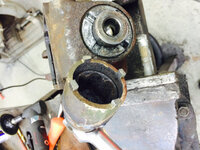
That's exactly what I needed to know, I missed the pipe wrench part of the equation lol! So basically the updated method is an improvement on the first method in the first picture below? And this is done to avoid the damage to the nut shown in the second picture that results from using the pipe wrench by itself, correct?

What did you use to remove the packing nut (not sure if that's the correct name) on the third picture below? I doubt I can make the tool shown in that picture, I would probably destroy 10' of pipe before I get it right or give up, most likely the latter! As much as I would love a Facom face spanner like the one Hiball uses, that is unfortunately way above my budget. I do have a big enough pipe wrench, not 3' but big enough. I guess is time to look for 3' one for $20 like yours!

I absolutely love the vented plug, did you make that? Was the difference from the original plug very noticeable? I actually LOVE all the parts you made, I wish I had that skill!

Did you buy the kit as whole or did you source the seals that you needed individually? Please let me know, thanks again for all your help!

method1.JPG

BHthank nut_LI.jpg

BHPackingNut.jpg
 
Last edited:
To avoid these ads, REGISTER NOW!
OP
P

paulsomlo

Well-known member
Joined
Jul 16, 2013
Messages
3,871
Location
Northern Colorado
I'm still using the rebuilt jack, has never skipped a beat.

Yep, the two methods are equivalent - any way you can get the round pieces to stay put is valid. And yes, the round pieces are to keep the pipe wrench from chewing up the tank nut.

The SJ2 doesn't have a packing nut like the one shown - it uses an oring that sits in a groove in the tank nut's ID to seal the rod.

Yes, I made the vented plug, don't even remember what the original looked like, I think it was just a hex head bolt.

I originally bought a kit, but ended up abandoning most of it and making an adapter so that I could use a $3 off the shelf polyurethane ucup. After posting this, I did modify the pump to use orings and backup, vs. the rare and expensive pump cup, which seemed to cause air to be ingested. I'm pretty sure I posted on that, but it must be in a separate post.
 

ALTEREGO

Well-known member
Joined
May 15, 2018
Messages
420
Location
@HOME
I'm still using the rebuilt jack, has never skipped a beat.

Yep, the two methods are equivalent - any way you can get the round pieces to stay put is valid. And yes, the round pieces are to keep the pipe wrench from chewing up the tank nut.

The SJ2 doesn't have a packing nut like the one shown - it uses an oring that sits in a groove in the tank nut's ID to seal the rod.

Yes, I made the vented plug, don't even remember what the original looked like, I think it was just a hex head bolt.

I originally bought a kit, but ended up abandoning most of it and making an adapter so that I could use a $3 off the shelf polyurethane ucup. After posting this, I did modify the pump to use orings and backup, vs. the rare and expensive pump cup, which seemed to cause air to be ingested. I'm pretty sure I posted on that, but it must be in a separate post.
Sounds great!

I just remembered mine is a SJ23, hopefully I can manage to remove the packing nut somehow.

Let me know if you find the post about the modified pump cup. I'm sure I cannot make the parts like you did, but I would love to learn about it. Thanks again Paul!
 

jacahull

Member
Joined
Aug 29, 2023
Messages
8
Paul,
I just found your thread. I have the samembalckhaekmjackmthst I've rebuilt but I can't get the ram to stay up and oil coming out the top. I replaced the main ram seal but had to heat it up to get it in and then had to have the ram pipe honed out cusse I ovaled it a bit with the pipemwrench trying to get it off. Had to get the the screen in the bottom and replace cause was all messed up. Any other idea except for put another seal on the ram to get it to push? When I put it all back together originally it worked real good even under a load. I used the same idea with the pins to get the tank nut off. I think I might just fab a tool this time though. I know a guy with the an original nut wrench for these jacks. It's sweat but can't find one anywhere. I'll try and load a pic of it.Screenshot_20240118_064627_Message+.jpg
 

Attachments

  • Screenshot_20240118_064634_Message+.jpg
    Screenshot_20240118_064634_Message+.jpg
    244.4 KB · Views: 41
OP
P

paulsomlo

Well-known member
Joined
Jul 16, 2013
Messages
3,871
Location
Northern Colorado
Paul,
I just found your thread. I have the samembalckhaekmjackmthst I've rebuilt but I can't get the ram to stay up and oil coming out the top. I replaced the main ram seal but had to heat it up to get it in and then had to have the ram pipe honed out cusse I ovaled it a bit with the pipemwrench trying to get it off. Had to get the the screen in the bottom and replace cause was all messed up. Any other idea except for put another seal on the ram to get it to push? When I put it all back together originally it worked real good even under a load. I used the same idea with the pins to get the tank nut off. I think I might just fab a tool this time though. I know a guy with the an original nut wrench for these jacks. It's sweat but can't find one anywhere. I'll try and load a pic of it.
So, you put it back together with the new ram seal and it worked fine, then it didn't? Regarding the flat spot - did you actually have it honed, or did you have it bored? Honing is generally a surface treatment and doesn't remove much material. Generally, installing those leather cups involves soaking them in oil overnight and then using a funnel shaped device to resize them temporarily, although heating sounds plausible. When you say "oil coming out the top", from exactly where? I'm assuming you've got enough fluid in and you've bled all the air out.

Yeah, that's a nice tool to have - I've thought of making something similar, but I'm not in my jack enough to justify it.
 

jacahull

Member
Joined
Aug 29, 2023
Messages
8
So, you put it back together with the new ram seal and it worked fine, then it didn't? Regarding the flat spot - did you actually have it honed, or did you have it bored? Honing is generally a surface treatment and doesn't remove much material. Generally, installing those leather cups involves soaking them in oil overnight and then using a funnel shaped device to resize them temporarily, although heating sounds plausible. When you say "oil coming out the top", from exactly where? I'm assuming you've got enough fluid in and you've bled all the air out.

Yeah, that's a nice tool to have - I've thought of making something similar, but I'm not in my jack enough to justify it.
Hey Paul,
Yes it was just honed. And yes I bled the system and all that jazz. It was leaking up around the gland nut. I did order a new seal and put it in a works good again. I rolled the seal on the end of ram on angle in oil like they suggest and got it in the main tube..I hope it all holds. If the main tank nut wasnt so interesting it would be easier to open these up and repair them but blackhawk had to make them all special with special tools to open them. But i got er. Thank
 
OP
P

paulsomlo

Well-known member
Joined
Jul 16, 2013
Messages
3,871
Location
Northern Colorado
Leaking around the gland nut would either be the oring that seals the ram or the metal to metal interface of the nut and reservoir. If the two surfaces are free of dings and scratches, some Loctite 518 should help, along with lots of torque (400-600ftlbs).

In days of old, jack manufacturers didn't want "amateurs" messing around inside their equipment - nowadays, they don't care, because they know that most people are just going to toss the jack and buy a new one.
 

jacahull

Member
Joined
Aug 29, 2023
Messages
8
I have new seals on the top under the gland nut. Also put pipe wrench with 3ft cheater on to tighten up the tank nut. I think its pretty tight!
 
Last edited:

jacahull

Member
Joined
Aug 29, 2023
Messages
8
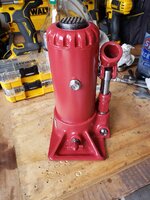
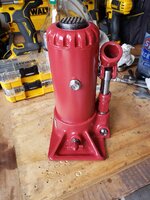
Is that a picture your red jack? That is gorgeous.
Thank you!
Yes! Yes it is. I tore it all apart, stripped all the paint. I even took off the main cylinder from the base to get to screen and replaced it..that was something..and trying to find the rights parts..oh boy. Put a brand new seal in it..I love my little blackhawk hawk 5ton. Hopefully can hand it down to my kids someday
 

Attachments

  • Screenshot_20240221_071352_Messenger.jpg
    Screenshot_20240221_071352_Messenger.jpg
    325.4 KB · Views: 17
  • Screenshot_20240221_071517_Messenger.jpg
    Screenshot_20240221_071517_Messenger.jpg
    300.6 KB · Views: 13
  • Screenshot_20240221_072758_Messenger.jpg
    Screenshot_20240221_072758_Messenger.jpg
    212.4 KB · Views: 14
  • received_1643019932890771.jpeg
    received_1643019932890771.jpeg
    224.5 KB · Views: 16
Last edited:

Goerge

Member
Joined
Feb 18, 2024
Messages
5
Wow wee, I wish I can produce work like that. With proper care they can pass it on to their kids as well. But lets pray you have many, many more decades of life ahead of you. Great work, thanks for sharing.
 
To avoid these ads, REGISTER NOW!
Top Bottom