
tmcdonal
Well-known member
I just posted a lengthy review on Amazon, but thought I'd share it here, since I didn't see any references to the unit here before I purchased it.
I'm in the process of building a climate controlled workshop out of two bays of a detached four car garage. Total area is 16'x22'. I'm pretty handy, but hemmed and hawed on this purchase, debating on trying this DIY solution, or hiring a pro. Finally pulled the trigger and bought it through Amazon affiliate AppliancesConnection.com on 4/8/2014. The final mile trucking company delivered it on 5/9/2014.
I had previously watched the installation video, read the install instructions, and read every review for tips. On Saturday, I decided to start unboxing it, and see how far I could get along without assistance. I'm happy to report that I was able to install this completely by myself. There's one step where a helper would have been handy - final tubing bend and attaching to the wall.
Total install time was 4 hours. However, probably half that time was spent wrestling with the wall mount and the poorly designed/stupid hose routing. (More later.)
First step, remove the mounting bracket. Trying to be overly cautious, I aligned the mounting bracket on the provided paper template, only to find that the holes didn't line up. It appeared that the 3" hole location is what's really critical, so I just traced the actual hole locations on the paper template. Not a big deal. However, all of the holes measure 15" across. What? Wall studs are 16" on center. If you have a good stud finder and are really careful, you can hit them on the 15" measurements. I added a couple of extra screw to be on the safe side.
I decided to use the recommendation of an Amazon review from August 1, 2013, to cut a second hole next to the first one to help with hose routing. I bought a cheapie 3" hole saw solely for this project. Despite the mixed reviews, it worked great on the two cuts through drywall, but struggled a bit on the exterior cut through hardiplank. However, all clean cuts.
I unrolled the cable (Freon line) and figured this is where I would need help. However, I strapped the inside unit to a rolling chair and slowly fed the line through the hole. The cable had a natural curve to it, so I fed that part facing down. Every few feet I would go around to make sure nothing was kinking. Got it within a foot of the wall and rested it on top of a ladder. Here's where things got interesting.
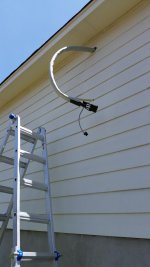
The cable holds the Freon line, wiring, and condensate drain hose. From the right side of the unit, it travels down and makes a 90 degree turn to the left. The 3" hole is on the left, so the through wall option is supposed to make a fairly sharp 90 degree turn through the wall. However, you can't make a 90 degree turn. There's a bending shape to use, but it's for gradual turns, like 6" diameter.
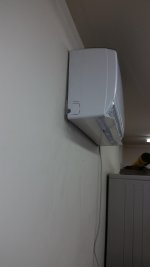
Cutting the second interior hole was helpful here, but there was zero chance of getting this unit to sit flush to the wall. The main problem is that space where the cable runs from right to left is extremely tight. Even without the hole through the wall, the cable bulk protruded from the back of the unit 1/2-3/4". No amount of force could get this the cable fully into the space provide. The power cord can route on either side, so I ran that out the right side to give as much clearance as possible.
As I'm wrestling with getting this mounted, I'm thinking of more than a few ways that this could have been better engineered:
- extend the unit housing by an additional inch in the back and lengthen the mounting plate catches
- or instead of running the cable 90 degrees from the right to the left, run it 90 degrees straight out of the back of the unit
On top of this, the inside unit rests on the top mounting clips by gravity and then is supposed to snap into place on the bottom mount with plastic clips from the above. What in fact happens is the cable pushes the unit from the wall on the bottom, slightly moving the whole unit upward. Even if you could get it mashed against the wall, there's no positive pressure on the bottom clips. The clips should snap from the bottom side at the least.
I had read a review about someone not getting it to sit flush, so they finished it with trim. I was planning on doing this and was mentally looking at the curves, then it hit me. This is for a garage shop. What do I care if it's flush to the wall? I added a small bracket to the top wall above it and secured to the mounting bracket. If this was in a house where it would be plainly seen, I would be very unhappy.
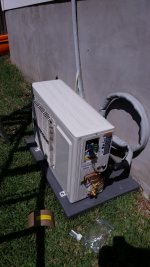
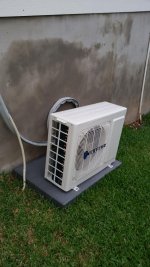
This install was on top of an 8' wall. Outside, there's a good 6' of foundation, so not a ton of excess line. I ran it outside to the left for a couple of feet, then down, and back to the right. Where it turns back to the right, I cut out the condensate drain line. I ended up doing a single 18" loop behind the unit and used the attachment clips to secure this to the outside wall. Attaching the Freon line didn't go as smoothly as shown in the video, but after a few tries, I could hear the slight "hiss" as it engaged.
The outside unit is heavy and I used a dolly to get it into place. When I set it on top of the mounting pad, the pre drilled holes didn't align. The pad is plastic, so not a big deal. Final step is to attach the electrical cord retention bracket and outside cover. Each of these is supposed to be mounted with #8 x 3/4" screws. I don't know what size holes were drilled, but no amount of force could get these screws started. I finally broke out a tap and die kit and enlarged the holes.
Operation - the whole time I'm working with this, my biggest fear was that I'd inadvertently kink the Freon line. I started it up and was doing a few things before I realized it was blowing, but not cooling. I went around back and the outside unit was running. My heart sank. I went back inside to find it blowing cool air. There's apparently a couple of minutes delay between starting the unit and the cooling starting. It happened between my trips outside.
It's mentioned in other reviews how quiet this is. It's crazy quiet. I was a little concerned about installing this and having rear neighbors complain about the outside unit. It's extremely quiet as well. Maybe about the level of a box fan on medium. Very pleased with that.
This garage project is missing a wall, so I can't test how fast it knocks down the temperature. Using an infrared thermometer, I was getting readings of 86 degrees ambient temperature and the air coming out of the A/C was 50-55 degrees. I plugged it into a Kill-A-Watt meter and let it run for three hours. It used 2.75 kwh during that time, running constantly. We pay about 10¢/kwh, so running non-stop for three hours was about 28¢. The Energy Guide says it costs $78/year to run and I believe this will prove true once it's in an enclosed, insulated room.
While finalizing the install, I took the cover off of the outside unit and found a significant about of condensation (typical humid day). It didn't click in my mind when I made the line connection, but there's several inches of copper Freon lines without insulation. They were cold to the touch and dripping with water. I'll be adding some foam insulation here. This is where the maintenance is accessed, so no spray in foam insulation.
Final verdict - Can't speak for longevity yet, but all in all a good buy. If I was installing this inside a house, I would plan on having to add trim around the unit to cover the gap. Despite the install difficulties I mentioned, I'm happy with the unit for the relatively low price. However, if you keep a swear jar, the cursing you do during the install might offset the savings.
Purchased from: http://www.appliancesconnection.com/friedrich-breeze-br0412w1a-i265902.html
-Tom
I'm in the process of building a climate controlled workshop out of two bays of a detached four car garage. Total area is 16'x22'. I'm pretty handy, but hemmed and hawed on this purchase, debating on trying this DIY solution, or hiring a pro. Finally pulled the trigger and bought it through Amazon affiliate AppliancesConnection.com on 4/8/2014. The final mile trucking company delivered it on 5/9/2014.
I had previously watched the installation video, read the install instructions, and read every review for tips. On Saturday, I decided to start unboxing it, and see how far I could get along without assistance. I'm happy to report that I was able to install this completely by myself. There's one step where a helper would have been handy - final tubing bend and attaching to the wall.
Total install time was 4 hours. However, probably half that time was spent wrestling with the wall mount and the poorly designed/stupid hose routing. (More later.)
First step, remove the mounting bracket. Trying to be overly cautious, I aligned the mounting bracket on the provided paper template, only to find that the holes didn't line up. It appeared that the 3" hole location is what's really critical, so I just traced the actual hole locations on the paper template. Not a big deal. However, all of the holes measure 15" across. What? Wall studs are 16" on center. If you have a good stud finder and are really careful, you can hit them on the 15" measurements. I added a couple of extra screw to be on the safe side.
I decided to use the recommendation of an Amazon review from August 1, 2013, to cut a second hole next to the first one to help with hose routing. I bought a cheapie 3" hole saw solely for this project. Despite the mixed reviews, it worked great on the two cuts through drywall, but struggled a bit on the exterior cut through hardiplank. However, all clean cuts.
I unrolled the cable (Freon line) and figured this is where I would need help. However, I strapped the inside unit to a rolling chair and slowly fed the line through the hole. The cable had a natural curve to it, so I fed that part facing down. Every few feet I would go around to make sure nothing was kinking. Got it within a foot of the wall and rested it on top of a ladder. Here's where things got interesting.
The cable holds the Freon line, wiring, and condensate drain hose. From the right side of the unit, it travels down and makes a 90 degree turn to the left. The 3" hole is on the left, so the through wall option is supposed to make a fairly sharp 90 degree turn through the wall. However, you can't make a 90 degree turn. There's a bending shape to use, but it's for gradual turns, like 6" diameter.
Cutting the second interior hole was helpful here, but there was zero chance of getting this unit to sit flush to the wall. The main problem is that space where the cable runs from right to left is extremely tight. Even without the hole through the wall, the cable bulk protruded from the back of the unit 1/2-3/4". No amount of force could get this the cable fully into the space provide. The power cord can route on either side, so I ran that out the right side to give as much clearance as possible.
As I'm wrestling with getting this mounted, I'm thinking of more than a few ways that this could have been better engineered:
- extend the unit housing by an additional inch in the back and lengthen the mounting plate catches
- or instead of running the cable 90 degrees from the right to the left, run it 90 degrees straight out of the back of the unit
On top of this, the inside unit rests on the top mounting clips by gravity and then is supposed to snap into place on the bottom mount with plastic clips from the above. What in fact happens is the cable pushes the unit from the wall on the bottom, slightly moving the whole unit upward. Even if you could get it mashed against the wall, there's no positive pressure on the bottom clips. The clips should snap from the bottom side at the least.
I had read a review about someone not getting it to sit flush, so they finished it with trim. I was planning on doing this and was mentally looking at the curves, then it hit me. This is for a garage shop. What do I care if it's flush to the wall? I added a small bracket to the top wall above it and secured to the mounting bracket. If this was in a house where it would be plainly seen, I would be very unhappy.
This install was on top of an 8' wall. Outside, there's a good 6' of foundation, so not a ton of excess line. I ran it outside to the left for a couple of feet, then down, and back to the right. Where it turns back to the right, I cut out the condensate drain line. I ended up doing a single 18" loop behind the unit and used the attachment clips to secure this to the outside wall. Attaching the Freon line didn't go as smoothly as shown in the video, but after a few tries, I could hear the slight "hiss" as it engaged.
The outside unit is heavy and I used a dolly to get it into place. When I set it on top of the mounting pad, the pre drilled holes didn't align. The pad is plastic, so not a big deal. Final step is to attach the electrical cord retention bracket and outside cover. Each of these is supposed to be mounted with #8 x 3/4" screws. I don't know what size holes were drilled, but no amount of force could get these screws started. I finally broke out a tap and die kit and enlarged the holes.
Operation - the whole time I'm working with this, my biggest fear was that I'd inadvertently kink the Freon line. I started it up and was doing a few things before I realized it was blowing, but not cooling. I went around back and the outside unit was running. My heart sank. I went back inside to find it blowing cool air. There's apparently a couple of minutes delay between starting the unit and the cooling starting. It happened between my trips outside.
It's mentioned in other reviews how quiet this is. It's crazy quiet. I was a little concerned about installing this and having rear neighbors complain about the outside unit. It's extremely quiet as well. Maybe about the level of a box fan on medium. Very pleased with that.
This garage project is missing a wall, so I can't test how fast it knocks down the temperature. Using an infrared thermometer, I was getting readings of 86 degrees ambient temperature and the air coming out of the A/C was 50-55 degrees. I plugged it into a Kill-A-Watt meter and let it run for three hours. It used 2.75 kwh during that time, running constantly. We pay about 10¢/kwh, so running non-stop for three hours was about 28¢. The Energy Guide says it costs $78/year to run and I believe this will prove true once it's in an enclosed, insulated room.
While finalizing the install, I took the cover off of the outside unit and found a significant about of condensation (typical humid day). It didn't click in my mind when I made the line connection, but there's several inches of copper Freon lines without insulation. They were cold to the touch and dripping with water. I'll be adding some foam insulation here. This is where the maintenance is accessed, so no spray in foam insulation.
Final verdict - Can't speak for longevity yet, but all in all a good buy. If I was installing this inside a house, I would plan on having to add trim around the unit to cover the gap. Despite the install difficulties I mentioned, I'm happy with the unit for the relatively low price. However, if you keep a swear jar, the cursing you do during the install might offset the savings.
Purchased from: http://www.appliancesconnection.com/friedrich-breeze-br0412w1a-i265902.html
-Tom



 )
)