To avoid these ads, REGISTER NOW!

Use of terminal blocks

600SL

Well-known member
Joined
Apr 26, 2012
Messages
1,794
Location
Connecticut
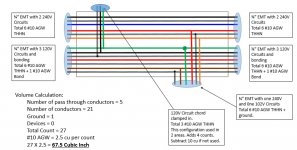
I will be running conduit around the perimeter of my building and placing large junction boxes 90 cu and 111 cu along the ceiling where conduit will drop down from the ceiling to feed a receptacle. 12 #10 conductors consisting of 2 three wire 240V circuits and 3 two wire 120V circuits will pass through each box and up to 7 conductors may be tapped out for power (one box will have up to 17 conductors tapped out to feed a partition wall as well as the receptacle).

I know that wire nuts are a suitable solution in these boxes but I would also like to consider terminal blocks especially in that partition wall box. I believe it would be a lot cleaner solution.

The only problem is I have never seen anyone do this and am not sure if it would be a code violation.

I have found below a 12 circuit terminal block that seems to do the job perfectly. All 5 circuits will be on 30 amp breakers.

Can anyone comment on its use.

1) Would this count as a device for volume calculations?
2) Is it OK to put up to three leads under one screw using loop connectors?
3) If I used two 6 circuit terminal blocks is that 2 devices?

http://www.mcmaster.com/#5566t41/=tur0f0
 

Attachments
  • Untitled.jpg
    Untitled.jpg
    114.7 KB · Views: 129
Last edited:
To avoid these ads, REGISTER NOW!

irritant

Member
Joined
May 10, 2014
Messages
12
Location
Monticello or Tallahassee (awake or asleep)
http://www.wago.us/products/termina...trips-witth-cage-clamp-s-connection/overview/


although these may not be rated for the load you have in mind, they are really nice and I have used a bunch of them. I don't believe terminal blocks will count as devices, but you need to make sure you pay attention to keep all voltage ratings the same. You would also need to pull a ground in all of your power carrying conduits and bond this ground to any junction box it passes through.

Rather than loading up individual screws for multiple drops, consider using bridge clips to jumper adjacent screw posts
 

rockwithjason

Well-known member
Joined
Jan 8, 2006
Messages
2,633
Location
Las Vegas
The only problem is I have never seen anyone do this and am not sure if it would be a code violation.

if the product you use is rated for the voltage and current of the circuit and ul listed then you are good

I have found below a 12 circuit terminal block that seems to do the job perfectly. All 5 circuits will be on 30 amp breakers.
30a circuits are generally only used for special purpose circuits. general purpose circuits are 15 or 20a. there are special rules for this in the code
Can anyone comment on its use.

1) Would this count as a device for volume calculations?
yes
2) Is it OK to put up to three leads under one screw using loop connectors?
no, use jumpers to add more terminals

3) If I used two 6 circuit terminal blocks is that 2 devices?
you must calculate the volume of the device and then apply it to the box fill
http://www.mcmaster.com/#5566t41/=tur0f0
this would work
 
OP
6

600SL

Well-known member
Joined
Apr 26, 2012
Messages
1,794
Location
Connecticut
Can anyone comment on its use.

2) Is it OK to put up to three leads under one screw using loop connectors?
no, use jumpers to add more terminals

Thanks for the reply

I can actually do this job with 2 leads under one screw, but my goal was to keep the lines feeding the boxes on one side of the terminal block so that I never touch that side again and let the devices get hooked up on the other.

If I use jumpers I do not gain a screw terminal unless I can put a loop with a screw required for the jumper, which seems to be the same as two loops under one screw? Is a jumper and 1 loop under a screw OK or perhaps limit each screw to 2 loops?

As far as 30 amps that is nice to have but not necessary.
 

alfredeneuman

Well-known member
Joined
Mar 3, 2011
Messages
4,580
Location
Fullerton, CA
.....my goal was to keep the lines feeding the boxes on one side of the terminal block so that I never touch that side again and let the devices get hooked up on the other.

The load wires will still be energized. I don't know why that makes a difference.

My brother, a Union Journeyman, tried that method on a service change with a generator panel. It was a very neat job. The inspector turned it down because of the fact that the terminal block was not UL listed, only recognized as a component for machines that would be listed, and the attached wires could not extend for 3" outside of the box.

He finally ended up pulling the existing wires out and using wire nuts, having learned that it's not better to "reinvent the wheel".
 

Kevin C

Well-known member
Joined
Aug 4, 2011
Messages
1,653
Location
Portland OR
The part is UL recognized, not UL listed. Basicly, the recognized matters when you are getting an entire assembly listed (tested). You submit the paperwork for the device and they don't need to test that component. They still need to test the assembly and verify the ratings on each component.

My take is that unless there is a specific approval for the part to be used for this specific application, its not code compliant. That doesn't mean it wont work or could would not pass certification test, but you would have to have your entire assembly tested.
 

justsam

Well-known member
Joined
Aug 20, 2010
Messages
1,267
Location
Penngrove, California
Trying to wire local distribution with 10AWG is going to be a pain. Connectors such as WAGO are readily available to gang up to eight conductors, but only up to 12 AWG. You are going to have the same issue when it comes to terminating outlets, lighting, etc.

I would strongly consider establishing a subpanel, or otherwise re-routing such that your wire runs and conduit conductor count de-ratings do not require the use of 10 AWG unless it is required for a specific singular device such as compressor, welder, etc.
 
OP
6

600SL

Well-known member
Joined
Apr 26, 2012
Messages
1,794
Location
Connecticut
The load wires will still be energized. I don't know why that makes a difference.

My brother, a Union Journeyman, tried that method on a service change with a generator panel. It was a very neat job. The inspector turned it down because of the fact that the terminal block was not UL listed, only recognized as a component for machines that would be listed, and the attached wires could not extend for 3" outside of the box.

He finally ended up pulling the existing wires out and using wire nuts, having learned that it's not better to "reinvent the wheel".

This is exactly why I'm here asking the question. Thanks.
 
OP
6

600SL

Well-known member
Joined
Apr 26, 2012
Messages
1,794
Location
Connecticut
The part is UL recognized, not UL listed. Basicly, the recognized matters when you are getting an entire assembly listed (tested). You submit the paperwork for the device and they don't need to test that component. They still need to test the assembly and verify the ratings on each component.

My take is that unless there is a specific approval for the part to be used for this specific application, its not code compliant. That doesn't mean it wont work or could would not pass certification test, but you would have to have your entire assembly tested.

Thanks see my reply to alfredeneuman.
 
OP
6

600SL

Well-known member
Joined
Apr 26, 2012
Messages
1,794
Location
Connecticut
Trying to wire local distribution with 10AWG is going to be a pain. Connectors such as WAGO are readily available to gang up to eight conductors, but only up to 12 AWG. You are going to have the same issue when it comes to terminating outlets, lighting, etc.

I would strongly consider establishing a subpanel, or otherwise re-routing such that your wire runs and conduit conductor count de-ratings do not require the use of 10 AWG unless it is required for a specific singular device such as compressor, welder, etc.

These are strictly for 120v and 240v outlets. Sub panel or not to eliminate derating will require 4 conduits which is just too ugly and they would ultimately end up in the same boxes unless I put in more boxes with conduits going all over the place. In the end the wire nut count ends up the same. Only in one case would I be twisting 4 wires together but there will be about five 4 wire twist and seven 3 wire twist in that one 110 cu box required to feed the partition wall. I believe Mike Holt has pictures of all that wire stuffed into a 30 cu box.

This solution is clean, elegant and very flexible but the price is paid in copper. The other reason to use 10ga is because of the long run of up to 145' in some cases. I have also been reviewing my voltage drop issues of such a long run on another thread and find with 10 ga this will not be an issue. Pigtails coming out of the boxes to the receptacles can and probably will actually be 12 ga.

So a lot of complexity of subpanels and large amounts of conduit get reduced by going from 12 to 10 ga and taking the derating.
 
OP
6

600SL

Well-known member
Joined
Apr 26, 2012
Messages
1,794
Location
Connecticut
Looks like a rail of 12 of these will do a neat job by my partition wall.

http://www.grainger.com/product/SCHNEIDER-ELECTRIC-Trmnl-Blk-23NY13?s_pp=false&picUrl=//static.grainger.com/rp/s/is/image/Grainger/23NY13_AW01?$smthumb$
 
To avoid these ads, REGISTER NOW!

alfredeneuman

Well-known member
Joined
Mar 3, 2011
Messages
4,580
Location
Fullerton, CA
Looks like a rail of 12 of these will do a neat job by my partition wall.


These ones aren't listed either.

"Help ensure the quality and operational availability of equipment, and optimizes installation set up and operation.
UL Recognized and CSA Certified.
Product content provided by supplier"

You'd be hard pressed to find one that is. My brother was unable to.
 
Last edited:
OP
6

600SL

Well-known member
Joined
Apr 26, 2012
Messages
1,794
Location
Connecticut
These ones aren't listed either.

"Help ensure the quality and operational availability of equipment, and optimizes installation set up and operation.
UL Recognized and CSA Certified.
Product content provided by supplier"

You'd be hard pressed to find one that is. My brother was unable to.

Here's a 2 post model but it has the same specs. These ones I can jump without giving up a screw terminal. So 2 of these and a jumper is half the price of the 4 screw ones.

Are these the certifications I need?
 

Attachments

  • NSYTRV42.jpg
    NSYTRV42.jpg
    78.1 KB · Views: 32
OP
6

600SL

Well-known member
Joined
Apr 26, 2012
Messages
1,794
Location
Connecticut
12 wire nuts in a 111 cu box?

Well if it comes down to not being able to use a terminal strip it still wont be this bad.
 

Attachments

  • overfull.jpg
    overfull.jpg
    59.3 KB · Views: 50

Charles (in GA)

Well-known member
Joined
Jan 11, 2006
Messages
12,489
Location
50 mi south of Atlanta
I know you want a "clean" look and think that one conduit, or few conduits is the way to go, but in the end, you are going to have a cluster f--k with all that wire and one or two conduits and junctions. I won't put more than two circuits in a conduit, and that is enough of a mess.

Charles
 
OP
6

600SL

Well-known member
Joined
Apr 26, 2012
Messages
1,794
Location
Connecticut
I know you want a "clean" look and think that one conduit, or few conduits is the way to go, but in the end, you are going to have a cluster f--k with all that wire and one or two conduits and junctions. I won't put more than two circuits in a conduit, and that is enough of a mess.

Charles

I actually have 5 circuits in 2 conduits, 2 are 3 wire 240V 2 are 2 wire 120V and on is a dedicated 120V that happens to be going in that direction to power dehumidifiers.

Most of these boxes will have three to 5 connections. The picture I presented in the original text is kind of a worst case scenario with the exception of the box at the partition wall. The reason for two of each circuit is just to stagger outlets like what is required in kitchens.

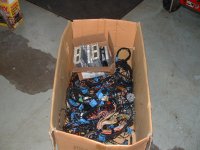
I'm very accustomed to this kind of stuff. Shown are pictures of the main harness from a Mercedes SL600 with me getting ready to install it. The car has been running beautifully for 8 years now.
 

Attachments

  • DSCF0012.jpg
    DSCF0012.jpg
    147.5 KB · Views: 34
  • DSCF0014.jpg
    DSCF0014.jpg
    143.9 KB · Views: 32
  • DSCF0020Rotated.jpg
    DSCF0020Rotated.jpg
    80.2 KB · Views: 35

wyliesdiesels

Well-known member
Joined
Aug 14, 2012
Messages
19,994
Location
Modesto, CA
FYI- u can share 1 EGC for multiple circuits. Needs to be sized based on largest breaker. Or u could use the conduit and make sure to use bonding rings. This may help u on your fill capacities and overall ease of install!
 

teamextreme

Well-known member
Joined
Aug 10, 2013
Messages
867
Location
Lakewood, CO
FYI- u can share 1 EGC for multiple circuits. Needs to be sized based on largest breaker. Or u could use the conduit and make sure to use bonding rings. This may help u on your fill capacities and overall ease of install!

Why the bonding ring (ground bushing?) requirement? I always understood they were only required on concentric knockouts.
 
OP
6

600SL

Well-known member
Joined
Apr 26, 2012
Messages
1,794
Location
Connecticut
FYI- u can share 1 EGC for multiple circuits. Needs to be sized based on largest breaker. Or u could use the conduit and make sure to use bonding rings. This may help u on your fill capacities and overall ease of install!

Yes that is the way the schematic in my first post shows it. I will me using a # 10 ground but I also understand that I could use a #12. I also could leave it out all together. It really is overkill with EMT and boxes mounted to steel walls on a steel frame building.
 

wyliesdiesels

Well-known member
Joined
Aug 14, 2012
Messages
19,994
Location
Modesto, CA
Yes that is the way the schematic in my first post shows it. I will me using a # 10 ground but I also understand that I could use a #12. I also could leave it out all together. It really is overkill with EMT and boxes mounted to steel walls on a steel frame building.

What is the size of the largest breaker that the EGC would be on? Did u upsize any conductors?
 
OP
6

600SL

Well-known member
Joined
Apr 26, 2012
Messages
1,794
Location
Connecticut
What is the size of the largest breaker that the EGC would be on? Did u upsize any conductors?

What is an EGC. Conductors are upsized for EMT fill. Largest breaker will be 20 amps or 25 amps if they allow it. These will all be 20 amp outlet circuits either 3 wire 240V or 115V duplex.
 
To avoid these ads, REGISTER NOW!
Top Bottom