To avoid these ads, REGISTER NOW!

Electric Bass Place-Single size

wasfast

Well-known member
Joined
Apr 10, 2014
Messages
874
Location
San Diego CA
First post but have been reading the forum non-stop recently. Such diverse places and excellent information.

I built a very small woodworking shop at a condo we lived in in the mid 90's. Once constructed, I decided to build a 5 string electric bass. I played guitar in bands for many years as well as built some component guitars. I'm a mechanical engineer by trade and also have lots of machining and construction experience.

My wife decides she wants a "real" house so we bought a new house in the late 90's in North Albany, Oregon. 1/4 acre lot was nice but zero landscaping in the back and minimal in the front. It did give me a big enough spot to build a standalone shop.

Foundation is a monoslab but 6" thick. I knew I'd want to have some larger machinery so the slight extra cost was worth it for insurance. Other than the actual concrete pour (with line pump), I did all the work myself.
 

Attachments

  • foundation.jpg
    foundation.jpg
    45.5 KB · Views: 89
  • framed.jpg
    framed.jpg
    29.2 KB · Views: 88
  • almostdone.jpg
    almostdone.jpg
    27.1 KB · Views: 97
  • finished.jpg
    finished.jpg
    32.2 KB · Views: 143
To avoid these ads, REGISTER NOW!
OP
W

wasfast

Well-known member
Joined
Apr 10, 2014
Messages
874
Location
San Diego CA
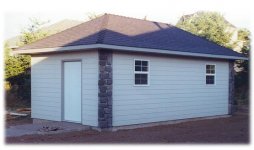
The external appearance seems a bit overkill but this is a higher end area so I wanted the shop to match the front of the house and seem like it was planned originally. It also keeps the neighbors happier since it's in view of most neighbors(no fences which is unique). The full hip roof, 4/12 pitch, is also to match the existing house.

The size is 13' x 26' w/ 8' ceiling. The size was mostly determined by how big I could go without it being too far out of scale with the lot size. Oh, and how big the wife was willing to tolerate. You look directly at it from the living room through large windows so aesthetics again mattered. One lesson there which I should have known better is that making a stick framed building and odd dimension 13' vs 12' or 14' doesn't make for efficient use of materials.

I was concerned about emitted noise since 20K rpm routers are really noisy as are other aspects (exhaust fan, table saw, chop saw etc). I used Z channel on all the walls and ceilings to hang the drywall, triple paned windows (they're small), and made sure there were no air leaks anywhere.

I debated on having a roll up door and ultimately decided against it as I needed all the wall space I could get. I did use a 42" door however and that turned out to be wise.
 
Last edited:
OP
W

wasfast

Well-known member
Joined
Apr 10, 2014
Messages
874
Location
San Diego CA
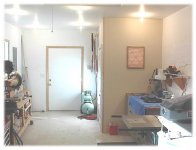
The interior was all painted white with white Armstrong floor tiles. Lighting is just ceramic bases with 200w bulbs. It was bright!

The first photo is looking from the entrance door. The second is the right side under the windows. Last is a shot the opposite direction. That funky thing in the corner is the spray booth.
 

Attachments

  • southwallnew.jpg
    southwallnew.jpg
    45.1 KB · Views: 281
  • westwall.jpg
    westwall.jpg
    36.5 KB · Views: 245
  • northwallnew.jpg
    northwallnew.jpg
    33.5 KB · Views: 227
OP
W

wasfast

Well-known member
Joined
Apr 10, 2014
Messages
874
Location
San Diego CA
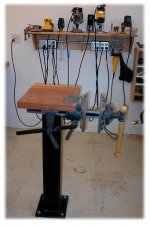
I was building only neck through body (one piece) basses in the beginning and that made for some unique needs. I had a buddy weld up what I called a pedestal bench. It's a 1/2" thick steel base with a 6 x 6 x 3/8" center post. I made a 18" square top out of scrap bubinga. It's the 4th photo in the attachments.

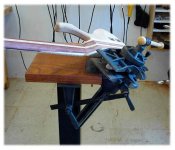
The pickup cavities and perimeters were cut with templates and a pattern bit in the router. The second photo shows the setup. The small work surface allows clamping on all 4 sides as needed.

Most of the neck shaping, transition of the neck to body, and the top contours were done with Surforms, files and ultimately sanding. You end up wanting to have the bass in all sorts of strange angles to make leverage better. Enter the pattern makers vice.

Original examples of these were very dear dollar wise then and probably even more so now. These were used by pattern makers for doing masters for casting. This is a Chinese made "alternative" that was 1/5 the price. I wasn't collecting the vice; I was intending on using it. They are truly an amazing invention. You can see just one example of a position you can create with it in the 2nd photo.

Best of all, that pedestal is super stout so you can really lay into it with the tools and it's rock solid.

The 3rd photo is a home built tracing machine. It started life as a 2 axis PCB router. I milled a new mount for my router, a Z axis and the extension arm w/follower tip.

The follower runs over the master pattern (on the right) and the router follows suit on the part clamped underneath it. The router has a 1/2" 2 flute HSS ball end mill and roughs in the shape. There's an air cylinder that acts as an air spring to counter act the weight of the router and Z axis. I mounted a regulator right on the cylinder so I could fine tune the amount of lift as needed. Having it always retract the router if you let go was advantageous.
 

Attachments

  • pgraph.jpg
    pgraph.jpg
    23.9 KB · Views: 155
  • clamp.jpg
    clamp.jpg
    41.6 KB · Views: 161
  • router.jpg
    router.jpg
    39.1 KB · Views: 165
  • pedbench.jpg
    pedbench.jpg
    26.1 KB · Views: 167
Last edited:
OP
W

wasfast

Well-known member
Joined
Apr 10, 2014
Messages
874
Location
San Diego CA
One other simple invention was the "electric shelf" that you can see behind the pedestal in photo 4 above. I got really tired of having to store routers, sanders, etc. It not only took time but also required another place to keep them.

This is nothing more than a bunch of receptacles mounted to a shelf with built in braces and back. The whole thing mounts to the wall with a few 3" screws.

What's really nice is that anytime you want to use a tool, you just grab it and away you go. I had 3 routers (2 plunge and a laminate router) then and was about to buy a few more. I'd just set them up with a specific bit and no more tool changing. It's simple but it really works well.
 
OP
W

wasfast

Well-known member
Joined
Apr 10, 2014
Messages
874
Location
San Diego CA
Instrument building is a strange intersection of woodworking and machining. Many of the details and fits require precision that woodworking doesn't do simply. Likewise, most machining tools aren't design for wood (things like coolant, grease, oil etc).

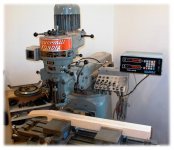
I got a great deal on this old 2 axis mill from a buddy at a local machine shop. He included 2 vices and a matching rotary table plus the 2 axis DRO w/ 0.0005" resolution glass scales.

I used the mill A LOT. Once the neck blank was glued up, I'd rough in the top surface for the fingerboard with a flycutter. There are then 3 long grooves that house the truss rod and 2 carbon fiber reinforcement strips.

I bought fingerboards with fret slots precut (Luthier's Mercantile). These got glued up to the neck blank.

I'd then put the rotary table on the mill and the rotate the neck blank to cut the edges of the fingerboard. This allowed very precise cutting of the reference surfaces.
 

Attachments

  • bridgeport.jpg
    bridgeport.jpg
    32.4 KB · Views: 109
OP
W

wasfast

Well-known member
Joined
Apr 10, 2014
Messages
874
Location
San Diego CA
The small size of the shop meant having most things on casters. You can casters on just about everything in the first photo. Many of the common woodworking tools like the tablesaw, chop saw, drill press, belt sander etc only had occasional uses. I'd generally do batch roughing in of body wings, neck blanks etc.

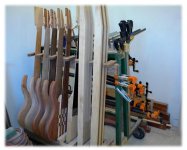
I found this rolling rack (photo 3) at a auction. It worked great to store clamps on one side and work in process on the other. Ultimately, it took up more space than benefit but it was somewhat useful.
 

Attachments

  • southwallnew.jpg
    southwallnew.jpg
    45.1 KB · Views: 108
  • partslist.jpg
    partslist.jpg
    27.9 KB · Views: 104
  • Therack.jpg
    Therack.jpg
    33.2 KB · Views: 148
OP
W

wasfast

Well-known member
Joined
Apr 10, 2014
Messages
874
Location
San Diego CA
Having a single room for all the operations began to show it's problems. There are really 3 division of operations:

1) all the rough cutting and sanding
2) spraying
3) fine details and assembly

No matter how much you try, a wood shop is covered in dust of some kind. That's not compatible with #2 and #3.

I briefly thought about putting in a vinyl curtain on the end where the pedestal bench and mill were but ultimately, it was just not practical.

The spray booth did work out pretty well, despite being a kludge. I bought a 3200cfm explosion proof fan from an auto body supply place. It was cut directly through the back side of the rear wall in the booth. The basic framing was just that, studs and drywall. The door was a French door I bought at a surplus materials place locally. I liked having the glass so I could visually see how things were drying without having to open the door.

I've done lot of of automotive type spraying in my life (bicycles, cars, motorcycles, refrigerators(!), guitars etc.) and lighting is a huge benefit to see how the material is laying down. I've found that having the light source behind where you're looking a very useful thing. In the booth, there was a single 4' fluorescent fixture on the ceiling and another one mounted to the back wall. The booth is just big enough for me and the 4' long bass. That meant the rear light was every close to the work, a very good thing.

Once thing about having that big of a fan was supply air. The building was very sealed (remember the noiseproofing in the first post?). That meant causing a big pressure resistance on the fan. With that much CFM, it didn't really load the motor but it did reduce the flow.

I had an electric wall heater for the shop in the winter but if I opened the windows or door to reduce the supply pressure, all the heat was instantly gone out the fan.

That might have been ok if there was a heated air supply (as in a commercial spray booth) but obviously there wasn't.

Many builders spray instrument with them hanging by the tuner holes. I've done this in the past and it *****. You can see what you're doing, constantly turning the instrument, it's easy to get runs and it usually requires you to keep the instrument from swinging with your free hand. That usually means you touch a wet spot by accident and then have to fix it etc.

All my instrument had 2 strap buttons on the **** end of the body. This isn't my idea, it's Tom Andersons but it's a hugely practical one. Playes often lean their instrument against the amp or wall. That provides a excellent pivot point if it's a single strap button and the guitar falls over.

I made a poor mans fixture to hold the body by the 2 strapbutton holes. There's a block with a matching bore mounted to the wall. It allows the body to rotate easily. The neck end is just sitting on an outboard roller support (like for a table saw). Only the body section gets sprayed so the neck area is free to be handles and offer support.

Best of all, you can really lay down the final coat which is usually cut quite a bit to make it self level better. If a run starts, you can just flip the body over a few times until it flashes enough stay put.

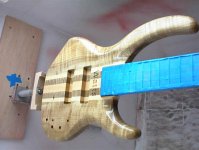
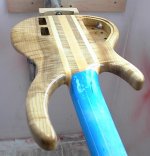
You can see the basic idea in the photos attached. That is an early 5 string in figured myrtle and hard maple.
 

Attachments

  • sprayedfront1.jpg
    sprayedfront1.jpg
    49.1 KB · Views: 88
  • sprayedback.jpg
    sprayedback.jpg
    58.8 KB · Views: 88
OP
W

wasfast

Well-known member
Joined
Apr 10, 2014
Messages
874
Location
San Diego CA
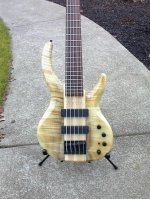
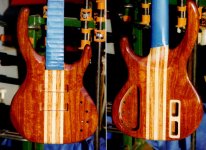
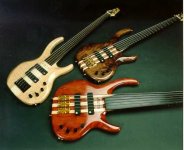
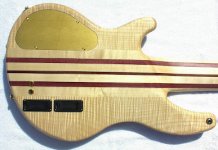
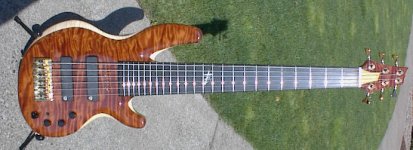
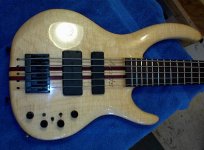
Here's a few of the photo I saved of some basses. I build only extended range basses (5 and 6 string), 35" scale. There's a single exception; 4 string that a friend bugged me for so long to do that I finally just built it to shut him up:)

The first commissioned bass was a full width 6 string. I called it the aircraft landing strip because the fingerboard was so side (4" at the body). It's bubinga and maple. Needless to say it weighs a ton but man does it have a full range sound. I also built the same guy a matching fretless.

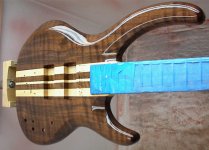
There a common theme of having eastern hard rock maple in the necks but the alternating woods were bubinga, figured myrtle, figured maple, spalted maple, figured black walnut, and lacewood.

This is just to give a general idea of the neck through body bases.
 

Attachments

  • DSC00003.jpg
    DSC00003.jpg
    153.1 KB · Views: 78
  • lacewoodfinishfront.jpg
    lacewoodfinishfront.jpg
    34.9 KB · Views: 74
  • bodyrearoutdoors.jpg
    bodyrearoutdoors.jpg
    25.8 KB · Views: 68
  • chrisbass.jpg
    chrisbass.jpg
    97.7 KB · Views: 81
  • trio1.jpg
    trio1.jpg
    16.6 KB · Views: 73
  • MMlogoshot.jpg
    MMlogoshot.jpg
    27.4 KB · Views: 71
  • MMstrapbuttons.jpg
    MMstrapbuttons.jpg
    36 KB · Views: 70
OP
W

wasfast

Well-known member
Joined
Apr 10, 2014
Messages
874
Location
San Diego CA
A few more images.
 

Attachments

  • MMcloseback.jpg
    MMcloseback.jpg
    26.1 KB · Views: 28
  • MMfullback.jpg
    MMfullback.jpg
    16.5 KB · Views: 28
  • MMfullfront.jpg
    MMfullfront.jpg
    38.8 KB · Views: 35
  • indoorsfront.jpg
    indoorsfront.jpg
    31.7 KB · Views: 33
  • flame_black_walnut_spraybooth.jpg
    flame_black_walnut_spraybooth.jpg
    100.8 KB · Views: 32
  • flame_black_walnut_detail.jpg
    flame_black_walnut_detail.jpg
    28.2 KB · Views: 27
OP
W

wasfast

Well-known member
Joined
Apr 10, 2014
Messages
874
Location
San Diego CA
As with all these sorts of things, there's a backstory. All this construction, landscaping (you don't want to know that story), working full time, playing live several times a month and still being married isn't easy. My wife was also very sick, at times bedridden, for 2 years. The pressure was mounting and it was challenging to figure out what was going to give.

The bass business was growing far faster than I could keep up with. The methods were fine for building a few basses but not scaleable. You can start hiring labor but that has it's own set of challenges. Automation was fast becoming a reality if this was to become sustainable. Sustainable is the key word.

Along the way, I tried subbing out much of the areas that could be done with CNC. I worked with 3 different shops and it really didn't work out. That's back to the fact that it's not machining and it's not woodworking. Machine shops are used to just getting another piece of aluminum off the shelf if they make a mistake. The amount of time invested and the on-off nature of the woods meant disaster if there was a mistake.

I was selling everything I could make and had a small backlog of orders the entire time. I was charging $2000 per bass at the time and selling direct. The late 90's were a time of exaggerated economics, just preceding the "dot bomb" crash. I didn't know it at the time but the free money older guys had to buy instruments would soon dry up considerably.

I had several options. 1) Raise my prices, some or a whole bunch. That would decrease the quantity and still provide just as much, or nearly so, a return. 2) Hire more labor. 3) Invest heavily in tooling and facility.

I had no ability to expand at my home (a good thing for the neighbors!) which meant getting a commercial space. That meant overhead instantly. I really needed to get a OSHA approved spray booth ($25K at the time), 3 phase power to run larger machines like a 3 axis CNC machining center ($50-75K for something like a Haas)etc.

Of course to pay for all that, I needed to sell more instruments. That means having a sales channel besides direct. 50% margin means I'd have to sell twice as many basses just to break even. Break even looked like 10 instruments a month VS the 4-5/month I was doing already.

I had created a monster in a manner of speaking. Many would say this is a good thing but there's also the longer term view. What was the 5 year plan? How much would it need to grow? What was the exit strategy? Is it really scaleable longer term?

In the midst of all this, we decided that as nice as the new house was, the debt wasn't so nice. If we gathered up all our pennies, we should be able to build a smaller, new home and exit debt free. The timing was good overall as it allowed the bass business to be put on hold while I figured out what I was going to do with it.

We did build the house and I decided that I really didn't want to be that exposed financially.

Meanwhile, I'm making very good money as an engineer and could continue to do so with ZERO overhead or exposure. I've gone over the decision many times but looking back, it was the right thing to do.
 
Last edited:

Zeke

Well-known member
Joined
Aug 13, 2009
Messages
17,176
Location
Long Beach CA, the sewer by the sea.
So, following along I guess you are still making basses on an order by order basis as you go forward. To me, it sounds like keeping the bass business as strictly a home based (sorry) enterprise/hobby is the way to go. Aside from the fantastic work space I think you ought to focus on the unusual instruments like the 6 string. Sort of a bespoke guitar business niche.

Love the duplicator you built. You could also sell those, I think.
 
To avoid these ads, REGISTER NOW!
OP
W

wasfast

Well-known member
Joined
Apr 10, 2014
Messages
874
Location
San Diego CA
No basses after 2002. We moved 2 more times, currently in San Diego in a 55+ community. To say it's quite is an understatement. Current garage is an oversized single and we have 2 cars.

I am intending on a separate thread on the current garage. It's somewhat done but lots of room for improvement. More on that later.
 

Zeke

Well-known member
Joined
Aug 13, 2009
Messages
17,176
Location
Long Beach CA, the sewer by the sea.
So the mill and all the nice equipment is all just history? That's sorta too bad but I guess it was fun while it lasted. I'm not sure I get the point of bringing up an old shop that hasn't been in operation in 20 years. But, damn, it was nice. Especially for the size you got all of that in.

Bet you wish you could have just picked it up and moved it with you. Understand the restrictions of living in a 55+ community. Do they have a communal shop? I couldn't live there w/o someplace to work.
 
OP
W

wasfast

Well-known member
Joined
Apr 10, 2014
Messages
874
Location
San Diego CA
Yes, it was a while ago but the point with many of the garages seems to be organization ideas, tools, tricks etc. That was the reason.

There is a communal wood shop. I don't have much time these days to make things. I'm still part of a startup company (3 years so far) and working full time as well. I'll post a separate thread for my current garage. Among other things I have a Stratasys SE+ 3D printer.
 
Last edited:

Nodak7mm

Member
Joined
Apr 14, 2007
Messages
6
Location
MSP North Metro
Ahhwww. Sorry to hear that awesome shop is no longer. Great thread and inspiring. I too live in suburbia (really can't get away in my field) and with limited space, looking to move in future. Your past shop and projects are very similar. Got my eye on a friends Rockwell mill and want to clear coat projects too.. Dang nice, thanks for sharing.

Rod
 

Terranova

Well-known member
Joined
May 12, 2008
Messages
854
Location
Grove City, OH
That little shop was slick! I always like when there's a well organized space that's truly dialed in to a specific process. Sometimes to much planned flexibility leads to wasted space and loss of direction/intent/purpose and that can lead to loss of motivation.

Do you find yourself missing that time working with your hands and direction/motivation in your life? I only ask because I'm isolated from my tools currently and when I get back to them, I find my self realizing how much I miss them.
 
OP
W

wasfast

Well-known member
Joined
Apr 10, 2014
Messages
874
Location
San Diego CA
Re: Basses I kept. None actually. In early 2004, I found myself playing either guitar or bass 7 nights a week for a month, then 5 nights a week for the next month. It was exhausting and after 20 years of playing, I "got a divorce" from music. I've not played since. I have a Super Strat that I've had for 25 years now but it sits in the case in the closet.

Re: working with my hands. I still do projects at home (more later on that in a new thread) but spend most of my time doing design work.

Velocipede: couldn't help but notice your screen name. I've been riding/racing road bicycles the last 11 years. Kindred spirits.
 

HSpencer

ALLIANCE MEMBER
Joined
Nov 28, 2010
Messages
2,854
Location
South Central US
Welcome!! You have shown us a super neat woodshop and some of your excellent work. Your shop there looks really easy and handy to work in. I like the size and tool layout. You also have some very heavy duty equipment. That shop looks exactly like I would think a woodworking shop should be. Not too large, not too small. I think it is great and the set ups you show in there are very well done. Interesting that you have that large milling(?) machine in there. Few people I know have one of those.
Thanks for posting. I really enjoyed the shop and the products you show.

Best Regards
Herb Spencer
 
OP
W

wasfast

Well-known member
Joined
Apr 10, 2014
Messages
874
Location
San Diego CA
I'm pretty active on GJ (like reading daily) but haven't shown much of my current garage. It's a oversized single in a retirement community so pales in comparison to many here.
 

Bib Overalls

Well-known member
Joined
Dec 4, 2006
Messages
3,318
Location
Jonesboro, Arkansas
Great story about a great shop. I suspect it is full of yard tools, patio furniture, and the like. Self reliant guys like us on the Garage Journal are few and far between out there in reality land.
 
To avoid these ads, REGISTER NOW!
Top Bottom