To avoid these ads, REGISTER NOW!

Champion R15B Air Compressor Rebuild Info, Photos, Tips (Long)

Kevski

Well-known member
Joined
Apr 19, 2010
Messages
62
Location
Seattle
After rebuilding two Champion R15B pumps over the past two years I felt it was time to share what I learned, in the hope that I can save others some time and effort.

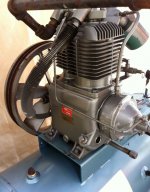
Basics: The Champion R15B pump is a two-cylinder, two-stage, splash lubricated design, utilizing a cast iron crankcase and a cast aluminum integral cylinder and head assembly, with non-replaceable steel liners. Design power range is 3-5 hp, with a nominal air delivery at 175 psi of 9.7 cfm at 440 rpm (3hp) and 16.5 cfm at 710 rpm. The crankshaft is cast iron, supported by tapered roller bearings. Rods are aluminum, with replaceable needle bearings on the small ends. There are no big-end bearings. Oil slingers are provided in the form of steel roll pins pressed into the bottom of the rods. The first stage has a 4 5/8” bore and uses an aluminum piston. Second stage bore is 2 ½”, with a steel piston. Both pistons use three compression rings and one oil control ring. The valves are stainless steel disc assemblies, which can be easily replaced by removing the inlet/outlet fittings. They can also be disassembled for cleaning. A centrifugal unloader is provided to relieve pressure from the high pressure cylinder on startup. Flyweights bolted to the crankshaft will extend once the pump is on speed, withdrawing a pin in the valve assembly, allowing a ball to move to the closed position, blocking the flow air from the unloader tube to the vent fitting. An oil breather tube is also provided to vent oil vapors in the unloader housing to the inlet fitting. Some pumps for HVAC applications may be fitted with head unloaders in the outlet fittings, which will open both first and second stage exhaust valves using external pilot pressure, to reduce discharge pressure. A pressure-lubricated version is also available, which uses different unloader housing, incorporating an oil pump driven off the end of the crankshaft.

Misc Info:
-The military used a version of this pump and the manual for that (with specs, drawings, and nominal dimensions) is available online. Search for TM 5-4310-350-14

-Overhaul/parts kits sold on eBay and elsewhere all seem to be made by the same (overseas) supplier. Quality seems pretty close to OE. I get my parts here: http://www.compressorpartsstore.com/R15-p/tuneup-r15b.htm

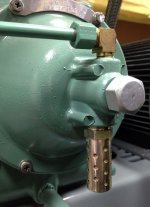
-The bottom of the unloader cover has a threaded discharge port (directly below the valve) which may or may not have a plastic restrictor plug or a felt ‘filter’. I recommend installing a small ½ npt air muffler (McMaster 9835K43). This quiets the thing down quite a bit when the unloader opens as the pump kicks off.

-The compressor outlet/discharge fitting uses an unusual thread, 1”-18. This is sized for a ¾ tube flare nut. If you want to use something different (such as a stainless flex hose as I do), you’ll need a ¾ tube compression fitting (McMaster 5220K84). Remove and discard the compression nut, and thread that end into the compressor outlet. The other end is ¾ npt.
 

Attachments
  • IMG_4113.jpg
    IMG_4113.jpg
    138.8 KB · Views: 717
  • IMG_1160.jpg
    IMG_1160.jpg
    132.4 KB · Views: 734
Last edited:
To avoid these ads, REGISTER NOW!
OP
K

Kevski

Well-known member
Joined
Apr 19, 2010
Messages
62
Location
Seattle
Maintenance:
Little maintenance is required, beyond routine oil changes and valve cleaning. Champion recommends this every 500 hours. Oil capacity is 2 quarts, and any 30W oil designed for reciprocating compressors is satisfactory (I recommend Mobil Rarus 427, Zoro #G2706541).

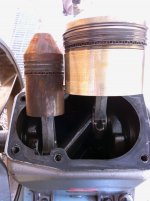
To access the valves, loosen the intercooler tube flare nuts and the outlet line flare nuts, remove as required. Remove the two 3/8” bolts on each inlet/outlet fitting and remove the fitting. There is a copper washer between the valve and the fitting which will often be difficult to remove. The washer and valve can be pried out with a pick or screwdriver (I use a cotter key remover). Note the orientation of each valve prior to removal. There will be an aluminum washer between the valve and the head; it’s best to leave this in place unless you are replacing it. When the valves are out, inspect each cylinder and piston for damage and corrosion. If any scoring, galling, or rust is observed on the cylinder walls, plan on re-ringing the pistons and honing the bores. Some carbon buildup, especially on the low pressure piston, is acceptable. Light rust on the head on the second stage piston is also acceptable.

Valve disassembly is accomplished by removing the bolt that holds the pieces together. Pay careful attention to how the discs and springs fit together. Clean with solvent, and lap the disc and retainer contact surfaces with fine sandpaper as required. I use a small surface plate and silicon carbide paper, starting with 400 grit and finishing with 2000. If the springs are weak or rusty, or if the valve seating surfaces are pitted from heat and rust, replace the assemblies. I recommend putting a drop of red Loctite on the threads of the valve screws when they are put back together. If the intercooler tube was removed, it is a good idea to flush it out with solvent prior to reinstallation.
Installation is reverse of removal. Valves are all different diameters so it’s impossible to put one in the wrong position, but it’s easy to put one in upside down. Pay attention to the orientation prior to removal, and if you forget, remember that the intake valves should be closed and the exhaust valves open when the piston is moving up. Copper washers can be re-used after heating red hot and quenching in water. Torque the inlet/outlet fitting bolts to 230 in/lbs.
 
OP
K

Kevski

Well-known member
Joined
Apr 19, 2010
Messages
62
Location
Seattle
Overhaul:
Should the cylinder inspection reveal any unacceptable condition, or the serviceability of the bottom end is in question, a complete overhaul is recommended. If the pump is mounted to a tank, leave it attached for now.
For a simple ring/hone job, remove the 7/16” cylinder base bolts and lift the cylinder off. I prefer a 180 grit bottle brush type, but really anything from the cheap auto parts store 3-stone type to some scotchbrite hand pads can do the job adequately. After all, it’s an air pump operating at 700 rpm, not an F1 engine.

Pistons and rods can remain attached. Remove and replace the rings with normal automotive piston ring pliers. Clean pistons (as required) with scotchbrite and coat lightly with compressor oil (not assembly lube, it will gum up the valves). Now is a good time to clean the sludge out of the bottom of the crankcase, clean the back side of the sight glass, and check the crank end play, which should be .002” or less.
Spray your new base gasket with Permatex High Tack (or similar) and stick it to the crankcase. A ring compressor is not required to reinstall the cylinder (the end of the sleeve has a nice taper), but it makes the job easier. Putting it all back together is a little tricky, and it helps to have an assistant hold/rotate the flywheel while you slide the cylinder on. Torque the bolts to 540 in/lbs.

For a complete overhaul, the flywheel should be removed before the cylinder, while the pump is still bolted to the tank. The easiest way to pull the flywheel is to remove the bolt, spray some Kroil onto the crank, heat flywheel with a torch, hammer a wedge into the gap, and pull off. A large 3-jaw puller can be used as well, but it’s a pain.

Next, remove the cylinder as previously described. Remove the rod caps and the piston/rod assemblies, paying careful attention to the orientation of each. Pull the circlips and wrist pins, and inspect the needle bearings.

To remove the unloader and crankshaft, disconnect the unloader and vent tubes, and remove the #10 screws that hold the cover on. Pull off the cover, and ensure that the pin and spring in the unloader valve (which is threaded into the cover) don’t get lost. Remove the four socket head cap screws that hold the unloader housing to crankcase, and pull out the crank along with the unloader housing and flyweight assembly. Try not to damage the gaskets that go between the unloader housing and crankcase, as these set the main bearing preload/crank end play. Unless the bearings are excessively worn (or you install new ones) the gasket thickness should not need to be changed. Overhaul kits include a new gasket set.

Once the crankshaft is out, clean the crud out of the inside of the crankcase, clean up the bearing races with scotchbrite (as required), and replace the oil seal.

Remove the flyweights from the crankshaft end fitting by driving the roll pins out. There is a piston and spring inside, mind that it doesn’t go flying across the shop. A bolt inside retains the end fitting to the crank; it may be reverse threaded, depending on the age of the pump.

Clean the roller bearings with solvent and inspect, replace if any galling or corrosion is noted. Both pumps I overhauled had been used and abused, but the bearings were just fine. Polish the crankpins with crocus cloth, and file/sand/polish any burrs out of the flywheel side on the crank snout. Knock down the sharp edges on the keyway to keep from cutting the oil seal when crank is installed.

The crank can either be installed by itself, or built up with the unloader housing and flyweights first. If endplay needs to be adjusted, install crank and unloader cover without flyweights, tighten bolts, and check endplay. Add/remove gaskets under unloader housing as required. When the unloader piston is reinstalled, drop an appropriate sized flat washer in to sit between the spring and the head of the bolt in the crank. Some older pumps may not have this washer. Reinstalling the flyweights can be tricky; I like to do it after the crank is back in, and use a Knipex plier wrench to install the roll pins.
Assembly is the reverse of removal… once the crankshaft and unloader are reinstalled, attach the rods and torque to 300 in/lbs. See previous section on assembly of cylinder and valves.
 
OP
K

Kevski

Well-known member
Joined
Apr 19, 2010
Messages
62
Location
Seattle
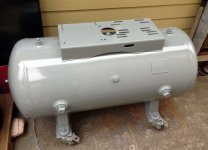
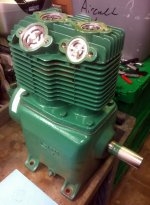
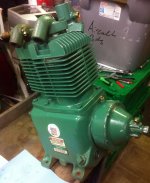
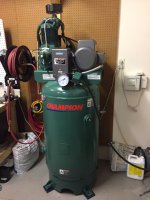
Here’s the first of these pumps I overhauled. Came from an auction of a machine shop that had long ago closed its doors. It was seized up; the high pressure piston had rusted to the cylinder wall. I removed the valves and filled the cylinder with kroil, and after a week of sitting was able to remove the piston without damage to the liner. Honed the bores and cleaned the remaining rust with a wire wheel on a die grinder and it was good as new. The rest of the project was simple cleaning and painting. I pulled a 3hp motor and magnetic starter out of the parts bin and put it all together. This is my daily use compressor, for now.
 

Attachments

  • IMG_5519.JPG
    IMG_5519.JPG
    112.2 KB · Views: 602
  • IMG_5492.JPG
    IMG_5492.JPG
    103.4 KB · Views: 481
  • IMG_4982.JPG
    IMG_4982.JPG
    128.4 KB · Views: 484
  • IMG_1221.jpg
    IMG_1221.jpg
    89.7 KB · Views: 576
  • IMG_1188.jpg
    IMG_1188.jpg
    112.4 KB · Views: 580
  • IMG_1155.jpg
    IMG_1155.jpg
    108.9 KB · Views: 533
  • DSC02327.JPG
    DSC02327.JPG
    130.9 KB · Views: 548
OP
K

Kevski

Well-known member
Joined
Apr 19, 2010
Messages
62
Location
Seattle
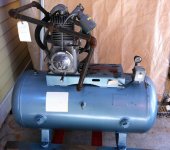
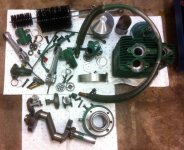
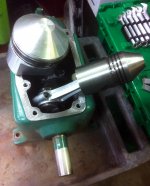
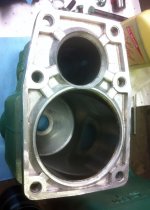
The second one came as a complete compressor (not pictured) on an old rusty tank, purchased from a service station. The pump and motor were newer, but clearly nobody ever changed the oil or replaced the filter. It was full of carbon and gunk, but there was little wear. Due to the condition I disassembled it completely, but was able to re-use the valves and rings. Put it another 80 gallon horizontal tank I had (which came with an HP15 reed-valve, pressure lubricated pump, to be covered in a future thread) and installed a 5hp motor. Sold this setup to a friend.
 

Attachments

  • IMG_4111.jpg
    IMG_4111.jpg
    126.7 KB · Views: 529
  • IMG_4109.jpg
    IMG_4109.jpg
    130.7 KB · Views: 473
  • IMG_3684.jpg
    IMG_3684.jpg
    128.1 KB · Views: 537
  • IMG_4098.jpg
    IMG_4098.jpg
    126.1 KB · Views: 566
  • IMG_4104.jpg
    IMG_4104.jpg
    112.1 KB · Views: 485
  • IMG_4106.jpg
    IMG_4106.jpg
    122.3 KB · Views: 505
  • IMG_4108.jpg
    IMG_4108.jpg
    127.3 KB · Views: 499

fatrhino

Well-known member
Joined
May 3, 2006
Messages
156
Location
Rochester
Good info, thanks :beer:


-The bottom of the unloader cover has a threaded discharge port (directly below the valve) which may or may not have a plastic restrictor plug or a felt ‘filter’. I recommend installing a small ½ npt air muffler (McMaster 9835K43). This quiets the thing down quite a bit when the unloader opens as the pump kicks off.

Have any pictures of this installed?
 
OP
K

Kevski

Well-known member
Joined
Apr 19, 2010
Messages
62
Location
Seattle
I mentioned in a previous post that some of these pumps had head unloaders installed - 'forks' attached to pistons on top of the valve manifolds, operated by pilot pressure, which press directly on the intake valve discs to hold them open a certain amount while the piston is moving up, reducing discharge pressure. For normal use, i.e. an electrically powered compressor which cycles on and off based on tank pressure, these valves are unnecessary and a potential source of problems.

To remove, simply disconnect and remove the pilot valve and associated tubing, remove the threaded cap/fork assembly from the intake valve manifold fittings, remove the fork, seals, and pipe fitting from the threaded cap (I don't have a photo of the inside of these), install a 1/8 NPT plug in the top of the threaded cap, and reinstall.
 

Attachments

  • unloader.jpg
    unloader.jpg
    57.9 KB · Views: 411
  • IMG_7414.JPG
    IMG_7414.JPG
    80.2 KB · Views: 368
  • IMG_7415.JPG
    IMG_7415.JPG
    91.6 KB · Views: 351

Trey T

Well-known member
Joined
Aug 3, 2011
Messages
3,749
Location
Houston, TX
Awesome info. This is my favorite pump and I believe it's the most efficient pump out there, in terms of weight, output, and reliability. In my area, mroe than 50% of the work trucks out there use these pumps; not quincy and not saylor.
 

jonemark401

Member
Joined
Aug 31, 2014
Messages
24
As the owner of a Champion compressor with the R15a pump I appreciate your taking the time to post this information!
 

ffast65

Well-known member
Joined
Mar 8, 2014
Messages
159
Location
Columbia Station, OHIO
Having just finished rebuilding a R15B, this would have been helpful. Additionally, If you need a internal dimensions for the crank side clearances etc, I have received those directly from gardner denver.
 

Eaton inside

New member
Joined
Apr 24, 2015
Messages
3
Hey Kevski...great info in the overhaul..I'm in the process of rebuild an older R30 pump but I can't find any kind of torque specs for the rods and such...you wouldn't happen to have anything that would help me out there would you?
 

bkerr001

New member
Joined
Aug 17, 2011
Messages
1
Great writeup!

I am in the midst of a full overhaul of an r15A which seems to be very similar minus the different sized valves.
Before I removed the flyweights I made sure to mark and take pictures to ensure proper reinstallation. When reinstalling them I noticed that one of the flyweights hits the cylinder (that contains the spring/washer) before the other, leading to them being misaligned. If I press on the cylinder they realign but there is still some slack in one of the weights.

Here is some more info/what I have investigated:
-Gasket between housing and crankcase intact/not removed. Bearings remain the same.
-Bolt with lock washer tightened so that lock washer flat (and then some)
-Washer between bolt and spring containing cylinder mic'd and is flat within 0.010
-Weights changed to opposite position, same thing happens.
-Although unlikely that cast would bend from me knocking the pins out the piece that the weights connect to have been mic'd and are within 0.010 ID.
-When spring placed on flat surface the top is parallel to the bottom.

* There is quite a bit of play between the spring containing cylinder and the wall of the piece that the weights connect to but I can't imagine this if from wear as there are no signs of that much metal being shaved off.
-When tension is placed on the spring/cylinder with my finger, the other weight has about the same amount of play around the pin.

This seems to leave me with a few things.
1) I am crazy and they are going to balance out once the motor starts running.
2) The pins are bent or misaligned, they are available from Grainger.


Any input? Did you have a similar experience?
 

finn

Well-known member
Joined
Mar 27, 2005
Messages
16,190
Location
The UP, God's country
I picked up a 3 hp version, but will need to speed it up to provide enough air to run a blast cabinet.

The pump was allegedly gone thru a couple of years ago. The tank is a little "iffy", with a circa 1972 or so build date.

Am I correct in assuming that only the motor and motor pulley will have to be upgraded to 5 hp and ***" diameter?
 
Last edited:

vehicular

New member
Joined
Apr 30, 2016
Messages
4
I hate to bump this from the depths, but I'm in the process of refreshing my old R15 (the tank is dated 1983, and it looks like it is original with the pump), and can't figure out what the small valves threaded into the valve manifolds are. My pump only has one on the high pressure cylinder inlet manifold, and it's frozen up solid with corrosion.

I think it's an overpressure valve, but I don't know why they would have put one between the cylinders. I'm hesitant to just take it off and plug the hole, but as gummed up as it is now I don't think it's doing anything other than plugging the hole as it is...

Thoughts?
 

vehicular

New member
Joined
Apr 30, 2016
Messages
4
I picked up a 3 hp version, but will need to speed it up to provide enough air to run a blast cabinet.

The pump was allegedly gone threw a couple of years ago. The tank is a little "iffy", with a circa 1972 or so build date.

Am I correct in assuming that only the motor and motor pulley will have to be upgraded to 5 hp and ***" diameter?

I swapped my motor years ago from a 5hp lower rpm 3 phase motor to a similar power higher rpm single phase motor that I had laying around. I bought a pulley from Granger to match the effective rpm of the older motor, new belts, and bolted it right up. It's been running like that for ~3 years.
 
To avoid these ads, REGISTER NOW!

md21722

Well-known member
Joined
Nov 30, 2015
Messages
1,840
Location
Mt Juliet, TN
I hate to bump this from the depths, but I'm in the process of refreshing my old R15 (the tank is dated 1983, and it looks like it is original with the pump), and can't figure out what the small valves threaded into the valve manifolds are. My pump only has one on the high pressure cylinder inlet manifold, and it's frozen up solid with corrosion.

I think it's an overpressure valve, but I don't know why they would have put one between the cylinders. I'm hesitant to just take it off and plug the hole, but as gummed up as it is now I don't think it's doing anything other than plugging the hole as it is...

Thoughts?

Dual stage pumps usually have a safety blow off valve between the low and high pressure cylinder. On the R15 I believe its 50 psi. It's there because it WILL blow when the valves aren't working correctly. They've been using them for decades, long before yours was made.
 

jbfrancis3

Member
Joined
Oct 9, 2013
Messages
5
Just wanted to say thanks to Kevski for his post and info. It helped when I completed an overhaul (some might say over-overhauled..) to a VR5-8 I have.

Also, a big thanks to Pacific Air Compressors (https://www.pacificaircompressors.com/) for being the source of replacement parts and being a technical resource when needed. They are extremely helpful and couldn't be nicer.
 

Attachments

  • image5.jpg
    image5.jpg
    136.4 KB · Views: 304
  • image4.jpg
    image4.jpg
    145.3 KB · Views: 269
  • image3.jpg
    image3.jpg
    134.8 KB · Views: 290
  • image2.jpg
    image2.jpg
    138.3 KB · Views: 300
  • image1.jpg
    image1.jpg
    136.2 KB · Views: 300
Last edited:

jbfrancis3

Member
Joined
Oct 9, 2013
Messages
5
Dual stage pumps usually have a safety blow off valve between the low and high pressure cylinder. On the R15 I believe its 50 psi. It's there because it WILL blow when the valves aren't working correctly. They've been using them for decades, long before yours was made.

Yes, called the interstage pressure relief valve - factory set for 75PSI.
 

F3X

New member
Joined
Nov 12, 2015
Messages
3
Location
Chino, CA
Just wanted to say thanks to Kevski for his post and info. It helped when I completed an overhaul (some might say over-overhauled..) to a VR5-8 I have.

Also, a big thanks to Pacific Air Compressors (https://www.pacificaircompressors.com/) for being the source of replacement parts and being a technical resource when needed. They are extremely helpful and couldn't be nicer.

Any before pics?
Where did you get the new stickers (if they are new) from?
I am doing and old R15B unit soon.
Also does anyone know a color code for the Champion Green?
 

josh_m

Member
Joined
Nov 9, 2015
Messages
14
Just wanted to say thanks to Kevski for his post and info. It helped when I completed an overhaul (some might say over-overhauled..) to a VR5-8 I have.

Also, a big thanks to Pacific Air Compressors (https://www.pacificaircompressors.com/) for being the source of replacement parts and being a technical resource when needed. They are extremely helpful and couldn't be nicer.


I picked up one of these last week, minus the motor and starter. Do you have specs on the motor? What frame and what rpm is it? Thx
 

sberry

Banned
Joined
Jun 18, 2005
Messages
35,747
Location
Brethren, Michigan
I should service mine. It works, has 1000s of hrs on it since it has been worked on. I have real 3 up on it, 18a run and I like this or rural lines. Can't see the start or flutter in lights. I use 200 gallons of tanks.
 

michjacket

Well-known member
Joined
Apr 27, 2016
Messages
72
Location
SE Michigan
About a month ago I bought up an unidentified nonworking compressor off CL for $60 that I wanted for the tank. When I picked it up I discovered it was not functioning because the flywheel was broken. There were no labels on the motor, pump or tank but I was able to figure out it was a Champion R15. Not sure if it is an A or B. I pulled off the manifolds and peaked in the cylinders and was surprised to see the cylinder walls looked great, with near perfect cross hatch. I decided I would hunt for a flywheel and put a wanted ad on CL. Last week a guy contacted me and offered a whole pump with a bad rod bearing but good flywheel for $50. Today I tore the pump down and found the bottom end looks very good also. So I am going to clean everything up and throw in some new gaskets.
Any suggestions on how to identify the exact pump model I have?
 

michjacket

Well-known member
Joined
Apr 27, 2016
Messages
72
Location
SE Michigan
Here are some pictures of the compressor in question:
 

Attachments

  • IMG_2409.jpg
    IMG_2409.jpg
    143.7 KB · Views: 202
  • IMG_2408.jpg
    IMG_2408.jpg
    143.2 KB · Views: 213
  • IMG_2407.jpg
    IMG_2407.jpg
    140.4 KB · Views: 220
  • IMG_2406.jpg
    IMG_2406.jpg
    142.6 KB · Views: 217
  • IMG_2405.jpg
    IMG_2405.jpg
    142 KB · Views: 224
  • IMG_2404.jpg
    IMG_2404.jpg
    131.9 KB · Views: 195
  • compressor1.jpg
    compressor1.jpg
    47.6 KB · Views: 214

michjacket

Well-known member
Joined
Apr 27, 2016
Messages
72
Location
SE Michigan
That's an 'A' model; you can tell by the rounded cylinder head fins.

Thanks Kevski!

I noticed some other differences between my original pump and the one I received on Friday with the bad rod journal. My block has an access panel on the bottom of the block. It also has rod cap bolts that attach from the bottom and thread into the rod like on a car engine, on the other they attach from the top and thread into the cap. I guess without the access panel on the bottom it would be difficult to unbolt the rod caps so they changed the design.
 

michjacket

Well-known member
Joined
Apr 27, 2016
Messages
72
Location
SE Michigan
Does anyone know the name of the green paint used on the Champion pumps? Is there a Rustoleum equivalent? Did not see anything close at HD.
 

md21722

Well-known member
Joined
Nov 30, 2015
Messages
1,840
Location
Mt Juliet, TN
That's an 'A' model; you can tell by the rounded cylinder head fins.

Not sure what clued you in 'A' based on the fins?

'A' had squared fins.

R15 -> R15A -> R15B.

The air filter is a giveaway, as are the rounded fins, and old style intake manifolds. If the interstage cooler is a simpler oval shape then its another example of an older pump. I'd estimate this to be an original R15 from the mid 1970s. Normally there is a serial number plate held in by the upper two screws of the centrifugal unloader but that does not appear to be present in this pump.
 
Last edited:

michjacket

Well-known member
Joined
Apr 27, 2016
Messages
72
Location
SE Michigan
I don't have the greatest eye for color, but Krylon's "Safety Green" looks like a pretty good match, no?
 

Attachments

  • KrylonSafetyGreen.jpg
    KrylonSafetyGreen.jpg
    1.8 KB · Views: 150

erik carstens

Member
Joined
Jan 1, 2016
Messages
12
After rebuilding two Champion R15B pumps over the past two years I felt it was time to share what I learned, in the hope that I can save others some time and effort.

Basics: The Champion R15B pump is a two-cylinder, two-stage, splash lubricated design, utilizing a cast iron crankcase and a cast aluminum integral cylinder and head assembly, with non-replaceable steel liners. Design power range is 3-5 hp, with a nominal air delivery at 175 psi of 9.7 cfm at 440 rpm (3hp) and 16.5 cfm at 710 rpm. The crankshaft is cast iron, supported by tapered roller bearings. Rods are aluminum, with replaceable needle bearings on the small ends. There are no big-end bearings. Oil slingers are provided in the form of steel roll pins pressed into the bottom of the rods. The first stage has a 4 5/8” bore and uses an aluminum piston. Second stage bore is 2 ½”, with a steel piston. Both pistons use three compression rings and one oil control ring. The valves are stainless steel disc assemblies, which can be easily replaced by removing the inlet/outlet fittings. They can also be disassembled for cleaning. A centrifugal unloader is provided to relieve pressure from the high pressure cylinder on startup. Flyweights bolted to the crankshaft will extend once the pump is on speed, withdrawing a pin in the valve assembly, allowing a ball to move to the closed position, blocking the flow air from the unloader tube to the vent fitting. An oil breather tube is also provided to vent oil vapors in the unloader housing to the inlet fitting. Some pumps for HVAC applications may be fitted with head unloaders in the outlet fittings, which will open both first and second stage exhaust valves using external pilot pressure, to reduce discharge pressure. A pressure-lubricated version is also available, which uses different unloader housing, incorporating an oil pump driven off the end of the crankshaft.

Misc Info:
-The military used a version of this pump and the manual for that (with specs, drawings, and nominal dimensions) is available online. Search for TM 5-4310-350-14

-Overhaul/parts kits sold on eBay and elsewhere all seem to be made by the same (overseas) supplier. Quality seems pretty close to OE. I get my parts here: http://www.compressorpartsstore.com/R15-p/tuneup-r15b.htm

-The bottom of the unloader cover has a threaded discharge port (directly below the valve) which may or may not have a plastic restrictor plug or a felt ‘filter’. I recommend installing a small ½ npt air muffler (McMaster 9835K43). This quiets the thing down quite a bit when the unloader opens as the pump kicks off.

-The compressor outlet/discharge fitting uses an unusual thread, 1”-18. This is sized for a ¾ tube flare nut. If you want to use something different (such as a stainless flex hose as I do), you’ll need a ¾ tube compression fitting (McMaster 5220K84). Remove and discard the compression nut, and thread that end into the compressor outlet. The other end is ¾ npt.


I have several of these pumps and was in need of making a new discharge pipe. The existing threads of the discharge manifold and compression nut is 1"-16 TPI. not 1"-18 . It is a real oddball size to find. I believe I read that it is solely a Champion specification. The Champion part number for the nut is SE541. The 3/4" OD copper tube slips through it and uses a compression sleeve or ferrule to seal against manifold seat. I have tried 1"-18 and only turns maybe 1 turn before it starts to cross. I am still in the process for a good solution but in the meantime, the Champion SE541 nut will do. They cost about $7.
 

erik carstens

Member
Joined
Jan 1, 2016
Messages
12
After rebuilding two Champion R15B pumps over the past two years I felt it was time to share what I learned, in the hope that I can save others some time and effort.

Basics: The Champion R15B pump is a two-cylinder, two-stage, splash lubricated design, utilizing a cast iron crankcase and a cast aluminum integral cylinder and head assembly, with non-replaceable steel liners. Design power range is 3-5 hp, with a nominal air delivery at 175 psi of 9.7 cfm at 440 rpm (3hp) and 16.5 cfm at 710 rpm. The crankshaft is cast iron, supported by tapered roller bearings. Rods are aluminum, with replaceable needle bearings on the small ends. There are no big-end bearings. Oil slingers are provided in the form of steel roll pins pressed into the bottom of the rods. The first stage has a 4 5/8” bore and uses an aluminum piston. Second stage bore is 2 ½”, with a steel piston. Both pistons use three compression rings and one oil control ring. The valves are stainless steel disc assemblies, which can be easily replaced by removing the inlet/outlet fittings. They can also be disassembled for cleaning. A centrifugal unloader is provided to relieve pressure from the high pressure cylinder on startup. Flyweights bolted to the crankshaft will extend once the pump is on speed, withdrawing a pin in the valve assembly, allowing a ball to move to the closed position, blocking the flow air from the unloader tube to the vent fitting. An oil breather tube is also provided to vent oil vapors in the unloader housing to the inlet fitting. Some pumps for HVAC applications may be fitted with head unloaders in the outlet fittings, which will open both first and second stage exhaust valves using external pilot pressure, to reduce discharge pressure. A pressure-lubricated version is also available, which uses different unloader housing, incorporating an oil pump driven off the end of the crankshaft.

Misc Info:
-The military used a version of this pump and the manual for that (with specs, drawings, and nominal dimensions) is available online. Search for TM 5-4310-350-14

-Overhaul/parts kits sold on eBay and elsewhere all seem to be made by the same (overseas) supplier. Quality seems pretty close to OE. I get my parts here: http://www.compressorpartsstore.com/R15-p/tuneup-r15b.htm

-The bottom of the unloader cover has a threaded discharge port (directly below the valve) which may or may not have a plastic restrictor plug or a felt ‘filter’. I recommend installing a small ½ npt air muffler (McMaster 9835K43). This quiets the thing down quite a bit when the unloader opens as the pump kicks off.

-The compressor outlet/discharge fitting uses an unusual thread, 1”-18. This is sized for a ¾ tube flare nut. If you want to use something different (such as a stainless flex hose as I do), you’ll need a ¾ tube compression fitting (McMaster 5220K84). Remove and discard the compression nut, and thread that end into the compressor outlet. The other end is ¾ npt.

In regards to the head unloaders, They are not on the exhaust side. They are on the intake manifolds and hold the intake valves open for continuous run mode. They are commonly used for gasoline driven pumps like ones on construction sites. It keeps you from starting your gas engine every time pumps up to operating pressure setting. They are also used for electrical motor driven pumps with pressure switches. You open a valve to the pilot valve which is set a couple pounds less than the pressure switch, and it will open the intake valves until the pressure drops to a preset psi. at which point closes which allows it to pump up again. This keeps the electric motor running so it doesn't start and stop too often and heat up from inrush current each time it cuts on. Also , when it is free wheeling, the flywheel cools the pump. If you are using a lot of air, continuous run is good. If not, you close the valve to the pilot valve and the unit goes back to pressure switch control. I have added head unloaders to several pumps for this reason and love how they work! I rebuild these for extra cash and love working on them. Champion and Quincy are my favorite to work on. I often get them with 3 phase motors and it lead me to read and build a Rotary Phase Converter. That was a fun project. The actual motor I could not run was the main component in building a RPC.

There is a lot of good information on this site. I just thought I'd clear up a couple things that were incorrect as to not confuse someone.
 

Matt's Shop

New member
Joined
Jan 1, 2017
Messages
1
If you want the exact same color as the original you need to call these guys: http://www.rileypaint.com/ Riley Paint Company. They are the ones that manufacture the paint for Gardner Denver. They will ship you the exact paint used on these pumps/tanks. It is called "Champion Green". That's what I did.

Do not try to color match it based off of your eye. You will never get it right and all of the stuff at the big box stores in spray cans is no where near the same color!
 

Kbach

Active member
Joined
Dec 28, 2017
Messages
33
Good info here!! I picked up a Champion a while ago with a seized rod so the hunt begins for a good used part if I can find one.

If somebody has one laying around feel free to contact me!!
 

Casualone

New member
Joined
Mar 11, 2018
Messages
1
Location
Richmond, VA
Don't need to go nearly as deep into the rebuild, but trying to find the answer to an R15B head replacement question. Original head reed valve failed. Got lucky and found a new R15B head on ebay for less than $500. Brand new (probably a couple years old, but never used), factory painted and skidded - looks good. However, there is an open port that it is attached to a junction with a safety valve and then runs to the top of both of the compression cylinders. The old one does not have this appendage. The old one does have an oil monitor, which I can otherwise attach to the new head in a similar manner as it was configured for the old head, but that still does not address the open port on the new head. Have searched around and not been able to find any reference to this port and its purpose or what to do with it. Don't want to destroy my new head before I get to use it for incorrectly connecting or not connecting this port. Any insight would be greatly appreciated.
 

jbfrancis3

Member
Joined
Oct 9, 2013
Messages
5
If you want the exact same color as the original you need to call these guys: http://www.rileypaint.com/ Riley Paint Company. They are the ones that manufacture the paint for Gardner Denver. They will ship you the exact paint used on these pumps/tanks. It is called "Champion Green". That's what I did.

Do not try to color match it based off of your eye. You will never get it right and all of the stuff at the big box stores in spray cans is no where near the same color!

Completely agree with everything mentioned. I purchased the Champion Paint (made by Riley) from Pacific Air Compressors https://www.pacificaircompressors.com/
It's not cheap but produces an excellent finish after multiple coats following the instructions. You need about 4-5 coats. It sprays very thin. Don't try to force it and lay it on heavy.
 
To avoid these ads, REGISTER NOW!
Top Bottom