
You are using an out of date browser. It may not display this or other websites correctly.
You should upgrade or use an alternative browser.
You should upgrade or use an alternative browser.
Murdoch's War-Machine MkIII research thread
- Thread starter Murdoch
- Start date


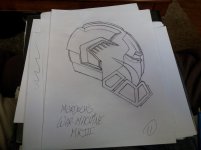
These are 2 renders that I had come up with based on the WM MkI.
Now I had made a few angles of this and had sent it off to a 3D modeler in Germany. From the modeler the file went to a 3D printer in Baltimore, once it was printed the helm was sent to me.
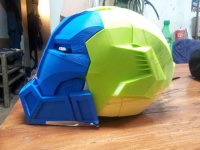

Behold a 3D printed original War-Machine MKIII helm. Now 3 copies were made the other 2 copies went to the printer and the modeler.
So now I need to tweet it to be unique. Oh and I was going to cast the helm in an epoxy resin called Onyx but that's just not good enough. Steel is too heavy, maybe 80lbs complete armour with animatronics and so on. Aluminum is how I want to do it. I don't know how to weld so I thought what about braze welding...GM

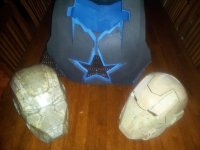
This is a sample of my first attempt at braze welding. I have to learn to weld aluminum to get this going forward. Now I want this to be fully automated with animatronics light and sound with a bitchin paint job. Any thoughts please chime in. Thanx for looking...GM
Last edited:
I guess a bit of history on this is required. I am a member of a prop building site, now usually armours are made of paper coated with fiberglass resin inside and out. Then the inner part that no one sees has fiberglass added for rigidit, then once the outer shell is sanded smooth a coat of Rondo is added. Now Rondo is 50/50 mix of hondo and fiberglass resin along with their hardening agents. The paper part is printed off a pdo file called Pepakura, which is Japanese for paper craft. Now a couple of people have made metal armours with steel or sheet aluminum but I want to go with a thicker aluminum...GM


ijuslikefords
Active member
- Joined
- Feb 4, 2010
- Messages
- 29
So, your saying there is gonna be another Ironman movie?
longlivepunk
Well-known member
Just making this for personal interest? Are you saying you're planning on using the 3D-printed model to make yourself a casting?
countryroad82
Well-known member
Awesome! I've wanted to get into making a few props for myself, mainly a proton pack from Ghostbusters to take for Halloween and hang up in my cave for a conversation piece, but sheesh I can get too deep into details...... So I have put that on my back burner lol!
Murdoch, please keep posting about your amour project. This is definitely on the fringe of what is typically talked about on here but totally badass and interesting.
There are 3D metal printing machines, but have no clue to how much $ and accessible they are?
It may be that you have to do a combo of machining the more intricate pieces and then perhaps learn to bend and braze larger less complex pieces?
Awesome.
There are 3D metal printing machines, but have no clue to how much $ and accessible they are?
It may be that you have to do a combo of machining the more intricate pieces and then perhaps learn to bend and braze larger less complex pieces?
Awesome.
http://www.therpf.com/showthread.php?t=88027&highlight=Proton+pack+pep+fileAwesome! I've wanted to get into making a few props for myself, mainly a proton pack from Ghostbusters to take for Halloween and hang up in my cave for a conversation piece, but sheesh I can get too deep into details...... So I have put that on my back burner lol!
A gift for you my friend. Pepakura files for your own Ghostbusters proton pack. You will need to download software from Tamas oft to print it. Good luck...GM
Far too rich for my blood $25000. At least...GMMurdoch, please keep posting about your amour project. This is definitely on the fringe of what is typically talked about on here but totally badass and interesting.
There are 3D metal printing machines, but have no clue to how much $ and accessible they are?
It may be that you have to do a combo of machining the more intricate pieces and then perhaps learn to bend and braze larger less complex pieces?
Awesome.
dr_clyde
Well-known member
I was wondering if you were an rpf guy. Interesting stuff. Not your typical GJ conversation but interesting nonetheless.
countryroad82
Well-known member
http://www.therpf.com/showthread.php?t=88027&highlight=Proton+pack+pep+file
A gift for you my friend. Pepakura files for your own Ghostbusters proton pack. You will need to download software from Tamas oft to print it. Good luck...GM
Sweet!!!! Thanks man!!!
I was wondering if you were an rpf guy. Interesting stuff. Not your typical GJ conversation but interesting nonetheless.
RPF guy, **** they sought me out. Yes I'm that guy. I had to go outside the box for more education. Some info I just can't find there, I belong to a few forums in search of knowledge. I don't mention outside forums because I don't wish to distract from the forum I'm on...GM
RPH
Well-known member
Sweet work. Please keep it coming as you are working the tip of spear. I used to ride that tip but now older, I'm more like the dull edge on the back of the blade!
Keep up the work and please keeps us informed.
Keep up the work and please keeps us informed.
Sweet work. Please keep it coming as you are working the tip of spear. I used to ride that tip but now older, I'm more like the dull edge on the back of the blade!
Keep up the work and please keeps us informed.
Well thanks RPH I fully intend on finishing this. I joined this fine place to gain knowledge. Right now I am slowly acquiring tools. I picked up a simple bench brake, some hammers a small anvil. I would love to get my grubby mits on a english wheel...GM
Hi guy's just wanted some info on aluminum welding vs brazing. Now in the 4th post of this thread I have a pic of my first attempt at brazing, using an aluminum brazing rod. Now I have tried to pull it apart by hand and I have had a lot of my friends try and it holds just fine. Now in the opinions of the masters here, is this strong enough for my project or do you think I need incorporate some aluminum welding also. I think the brazing will hold just fine with the exception of the boots due to the constant pressure placed on them. Any thoughts, let me know and thanx in advance...GM
RickP
Well-known member
Awesome project! Wow, that is a lot to take on for your first aluminum fab learning trial... but it sounds like you're up for the task.
I'm still learning welding myself, so I've looked at a ton of websites about it. Based on that, I'd really recommend you pick up a small TIG welder and learn to weld Al sheet with it. You could do your project with brazing but the speed and control you'd get with the TIG would make your life so much easier.
Here's a guy who taught himself MIG and TIG welding to build a boat with 8 mm Al plate: Sailing Website
Although that's a lot thicker than your sheet metal, his learning process on the welding might be helpful to you :
http://weldingweb.com/showthread.php?29094-alu-sailboat-buliding
Good luck!
I'm still learning welding myself, so I've looked at a ton of websites about it. Based on that, I'd really recommend you pick up a small TIG welder and learn to weld Al sheet with it. You could do your project with brazing but the speed and control you'd get with the TIG would make your life so much easier.
Here's a guy who taught himself MIG and TIG welding to build a boat with 8 mm Al plate: Sailing Website
Although that's a lot thicker than your sheet metal, his learning process on the welding might be helpful to you :
http://weldingweb.com/showthread.php?29094-alu-sailboat-buliding
Good luck!
Last edited:
longlivepunk
Well-known member
If you're going to weld aluminum I think you'll need either an AC/DC TIG welder or a MIG welder with a spool gun. I don't know of any other ways to weld it. Are you a machinist? What do you plan on using the grinders for?
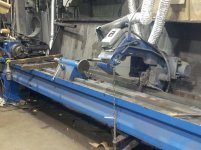
I am a hard chrome electroplater and the pics are some of the equipment that we have. Now I know that this equipment cannot be used for aluminum with exception to the polisher. But I cannot make the whole armour of aluminum, so I'll need to use steel for some joints for movement and I plan to replicate an M134 gatling gun that needs to be functional. Absolutely in no way real, just a prop...GMIf you're going to weld aluminum I think you'll need either an AC/DC TIG welder or a MIG welder with a spool gun. I don't know of any other ways to weld it. Are you a machinist? What do you plan on using the grinders for?
Hey thanks for the tip man. I'm going to try my hand at Mig to see where I can go with it and see where my skill level is at...GMIf you're going to weld aluminum I think you'll need either an AC/DC TIG welder or a MIG welder with a spool gun. I don't know of any other ways to weld it. Are you a machinist? What do you plan on using the grinders for?
Guster
Well-known member
You may find it a little easier to maintain the cosmetic features of the material when using TIG. Definitely takes a little more time to become competent but eventually TIG welds require less cleanup and grinding and easier to do the really fine work required for costuming. I have both arc , MIG and TIG and rarely use anything but TIG when making props and costume pieces for people. The only time I had a request to make anything similar to an arc weld bead was on a plastic costume piece and ended up using a silicone mold of a weld in my workshop and transferring it to hot glue to get the look. 
If you plan to do a lot of aluminium sheet metal shaping you will need an oxy acetylene set with a rosebud torch to anneal the material. Makes it softer and less prone to cracking. Also consider a pneumatic plannishing hammer and jeny/swage for getting deep bowl shapes and crisp edges or creases. English wheel is nice for large smooth contours but in the end what you are making is like body armor to a degree. For the material you'll be using most you will likely benefit from owning a beverly shear too. A lot of the rough shaping and stretching can also be done with a teardrop HDPE mallet and a sand or shot bag.
Then watch as much Ron Covell and Lazze metalshaping youtube videos you can. There are plenty more but those will get you started. Also ton of medieval armor tutorials to teach you some of the techniques.
If you plan to do a lot of aluminium sheet metal shaping you will need an oxy acetylene set with a rosebud torch to anneal the material. Makes it softer and less prone to cracking. Also consider a pneumatic plannishing hammer and jeny/swage for getting deep bowl shapes and crisp edges or creases. English wheel is nice for large smooth contours but in the end what you are making is like body armor to a degree. For the material you'll be using most you will likely benefit from owning a beverly shear too. A lot of the rough shaping and stretching can also be done with a teardrop HDPE mallet and a sand or shot bag.
Then watch as much Ron Covell and Lazze metalshaping youtube videos you can. There are plenty more but those will get you started. Also ton of medieval armor tutorials to teach you some of the techniques.
Hi guy's just wanted some info on aluminum welding vs brazing. Now in the 4th post of this thread I have a pic of my first attempt at brazing, using an aluminum brazing rod. Now I have tried to pull it apart by hand and I have had a lot of my friends try and it holds just fine. Now in the opinions of the masters here, is this strong enough for my project or do you think I need incorporate some aluminum welding also. I think the brazing will hold just fine with the exception of the boots due to the constant pressure placed on them. Any thoughts, let me know and thanx in advance...GM
Some thoughts in semi-random order...
re: welding aluminum
First off, some but not all aluminum alloys are weldable.
Some aluminum alloys are considered non-weldable (via arc welding process, such as SMAW, GMAW aka MIG, GTAW aka TIG).
Much more so than with steel alloys, you have to know exactly what aluminum alloy you are working with.
Both for the possible welding as well as the bending and forming steps.
Some aluminum alloys can be bent/formed relatively easily, others can be annealed to improve their formability, and others are not really formable.
re: brazing aluminum
Brazing can sometimes be used successfully with aluminum alloys. But successful manual brazing is usually a bit more fussy or finicky or flat-out difficult because the melting point of aluminum alloys and the brazing filler are sometimes not that far apart.
As well as the 'fussy' aspect that there is not visual indication that the part being heated is getting 'hot' like there is when heating steel to 'red hot'. Aluminum pretty much just sits there looking the same to your eye as you heat it and then if you apply just a little too much heat, it just melts.
re: strength
The needed 'strength' of your prop depends a lot on just how much bumping or bashing or jostling the prop may get.
For some parts of your prop, plastics as the material and some sort of adhesive may be plenty 'strong'.
Other parts may be just fine with brazed aluminum.
For other parts, you may need welded steel.
If the parts only have to withstand pretty much some pulling them apart by hand (or the equivalent), then your brazed aluminum joints should be fine (based on you and some friends trying to pull those brazed joints apart by hand).
Cool project though.

You may find it a little easier to maintain the cosmetic features of the material when using TIG. Definitely takes a little more time to become competent but eventually TIG welds require less cleanup and grinding and easier to do the really fine work required for costuming. I have both arc , MIG and TIG and rarely use anything but TIG when making props and costume pieces for people. The only time I had a request to make anything similar to an arc weld bead was on a plastic costume piece and ended up using a silicone mold of a weld in my workshop and transferring it to hot glue to get the look.
If you plan to do a lot of aluminium sheet metal shaping you will need an oxy acetylene set with a rosebud torch to anneal the material. Makes it softer and less prone to cracking. Also consider a pneumatic plannishing hammer and jeny/swage for getting deep bowl shapes and crisp edges or creases. English wheel is nice for large smooth contours but in the end what you are making is like body armor to a degree. For the material you'll be using most you will likely benefit from owning a beverly shear too. A lot of the rough shaping and stretching can also be done with a teardrop HDPE mallet and a sand or shot bag.
Then watch as much Ron Covell and Lazze metalshaping youtube videos you can. There are plenty more but those will get you started. Also ton of medieval armor tutorials to teach you some of the techniques.
Thanks Guster for the info. Are you a prop builder and can you send me a link for me to check out? GM
That's quite a bit to take in. What would you recommend as far as the grade of aluminum to use for mig welding. To be honest I thought all aluminum was weldable. I was thinking about brazing a lot but with main support pieces that I would weld. I would use some steel, but just for fastenings and other pieces. Your input would be appreciated though. This is why started the thread, research. I value any input from all of you folks and again thanks...GMSome thoughts in semi-random order...
re: welding aluminum
First off, some but not all aluminum alloys are weldable.
Some aluminum alloys are considered non-weldable (via arc welding process, such as SMAW, GMAW aka MIG, GTAW aka TIG).
Much more so than with steel alloys, you have to know exactly what aluminum alloy you are working with.
Both for the possible welding as well as the bending and forming steps.
Some aluminum alloys can be bent/formed relatively easily, others can be annealed to improve their formability, and others are not really formable.
re: brazing aluminum
Brazing can sometimes be used successfully with aluminum alloys. But successful manual brazing is usually a bit more fussy or finicky or flat-out difficult because the melting point of aluminum alloys and the brazing filler are sometimes not that far apart.
As well as the 'fussy' aspect that there is not visual indication that the part being heated is getting 'hot' like there is when heating steel to 'red hot'. Aluminum pretty much just sits there looking the same to your eye as you heat it and then if you apply just a little too much heat, it just melts.
re: strength
The needed 'strength' of your prop depends a lot on just how much bumping or bashing or jostling the prop may get.
For some parts of your prop, plastics as the material and some sort of adhesive may be plenty 'strong'.
Other parts may be just fine with brazed aluminum.
For other parts, you may need welded steel.
If the parts only have to withstand pretty much some pulling them apart by hand (or the equivalent), then your brazed aluminum joints should be fine (based on you and some friends trying to pull those brazed joints apart by hand).
Cool project though.
Amitygravel
Well-known member
Murdoch ,
This is some really neat stuff !
Good luck with jumping into to the metal working aspect with you project.
Now I've got to pick your brain.
Any resins available that are clear and will dry hard enough that they can be sanded and then buffed to take a high shine ?????
In the mean time keep showing your work !
This is some really neat stuff !
Good luck with jumping into to the metal working aspect with you project.
Now I've got to pick your brain.
Any resins available that are clear and will dry hard enough that they can be sanded and then buffed to take a high shine ?????
In the mean time keep showing your work !
Yeah but what is it for? If you don't mind me asking...GMMurdoch ,
This is some really neat stuff !
Good luck with jumping into to the metal working aspect with you project.
Now I've got to pick your brain.
Any resins available that are clear and will dry hard enough that they can be sanded and then buffed to take a high shine ?????
In the mean time keep showing your work !
Try Smooth-on.com
A clear epoxy resin then start sanding with 800, 1500, 2000, 3000. Should be like glass...GM
Last edited:
Amitygravel
Well-known member
Mosaic pins. They go through knife handles to dress them up.
Pull resin through the tube and let it harden.
So pieces get cut off and are then put through the handles in the rough and then that whole assembly is contoured by sanding and then given a final polish on the buffing wheel.
So , It needs to get hard enough to take a true polish without smearing.
Also on occasion the resin gets dyed.
Thanks for the input !
Pull resin through the tube and let it harden.
So pieces get cut off and are then put through the handles in the rough and then that whole assembly is contoured by sanding and then given a final polish on the buffing wheel.
So , It needs to get hard enough to take a true polish without smearing.
Also on occasion the resin gets dyed.
Thanks for the input !
Attachments

Those are really cool...GMMosaic pins. They go through knife handles to dress them up.
Pull resin through the tube and let it harden.
So pieces get cut off and are then put through the handles in the rough and then that whole assembly is contoured by sanding and then given a final polish on the buffing wheel.
So , It needs to get hard enough to take a true polish without smearing.
Also on occasion the resin gets dyed.
Thanks for the input !
Guster
Well-known member
Thanks Guster for the info. Are you a prop builder and can you send me a link for me to check out? GM
I have some acquaintances who work in the entertainment industry. Some who specialise in concept show reels. I often used to get a call to ask if I have time to help out with an ‘order’ and get home to find a non-descript box of materials, product description and an NDA for whatever I am working on. I’ve had to cut back on my commitments due to kids and having a full time job. Prefer to work on the specialist filming rigs and rig repairs than the props these days. Industry is not what it used to be. Some creative demands became a little ridiculous and CNC capability replaced the need for custom sculpting and fab work.
It was fun and helped pay for a lot of my machinery and tooling. These days it is more for friends and acquaintances into costuming or cosplay or helping with casting and composite builds. Though my kids benefit from an endless supply of toys as a result. Always seem to have the right greeble for something.I’m on RPF too but more from a keeping in touch and see what others are up to point of view.
Just have to google Ron Covell or Lazze Metal shaping. Baileigh’s industrial also has a lot of info to get you started.
https://www.google.co.nz/search?q=r...rg.mozilla:en-US:official&channel=nts&tbm=vid
I was given Ron Covell’s TIG welding DVD and since watched a lot of his other vids.
http://www.covell.biz/dvds.html
So , It needs to get hard enough to take a true polish without smearing.
Also on occasion the resin gets dyed.
Thanks for the input !
Acrylic resin may cure a little harder though many epoxies take a long time to cure to full hardness at room temperature. Many benefit from a post-cure cycle at a slightly higher temperature. Best to check with the manufacturer or the info supplied with the epoxy. The stuff I regularly use, advise to follow the initial cure cycle with another at 60degC for +8 hours. Treat it just like any other plastic after that. Any heat produced as part of an abrasive process will soften it so while it can be polished, care should be taken not to melt the surface in the process.
As for welding aluminium… some general info:
www.thefabricator.com/article/aluminumwelding/weldable-and-unweldable-aluminum-alloys
Amitygravel
Well-known member
Guster ,
Thanks for your input as well !
I've been using Bondo fiberglass resin.
Easy to find and not excessively expensive.
Its worked out ok and it will take dyes even though in liquid state its an almost coffee color. I swear this stuff USED to be clear years ago. Maybe not.
Regardless , it would be nice to have something with a longer working time before it kicks and I like having options so I'm not stuck on one thing and suddenly its no longer available.
Thanks for the info fellas !
Thanks for your input as well !
I've been using Bondo fiberglass resin.
Easy to find and not excessively expensive.
Its worked out ok and it will take dyes even though in liquid state its an almost coffee color. I swear this stuff USED to be clear years ago. Maybe not.
Regardless , it would be nice to have something with a longer working time before it kicks and I like having options so I'm not stuck on one thing and suddenly its no longer available.
Thanks for the info fellas !
Guster
Well-known member
If it is normal epoxy then the older it gets the browner it becomes. That is due to the amines breaking down into ammonia and brown nitrogen oxide if I recall. You'll also smell more ammonia than the usual urea(like urine) kinda smell. Usually means it has been on the shelf or exposed to UV or heat for too long. Some actually have a best before date because of this.
Epoxy may also yellow with time. Especially in the presence of UV. Post curing greatly reduces this. Most other brands supply slow and even extra slow hardeners to use in heated or vacuum assisted resin transfer processes where quality and consistency is more critical than time. Provided I keep the temperature down while working and working in a shallow dish to reduce exotherming, even the standard West Systems hardener will give you about 30minutes working time.
BTW I found the best dye to use with epoxy is straight dry pigment like acrylic powder paints(kids powder paint) as there is little in it to inhibit the epoxy strength or curing reaction. You just have to mix them really well to prevent any lumps which may mean having to de-gass the mixture in vacuum pot to remove bubbles. Graphite and aluminium oxide is also a great complement to epoxy if you want a strong hard wearing object in black or grey.
Epoxy may also yellow with time. Especially in the presence of UV. Post curing greatly reduces this. Most other brands supply slow and even extra slow hardeners to use in heated or vacuum assisted resin transfer processes where quality and consistency is more critical than time. Provided I keep the temperature down while working and working in a shallow dish to reduce exotherming, even the standard West Systems hardener will give you about 30minutes working time.
BTW I found the best dye to use with epoxy is straight dry pigment like acrylic powder paints(kids powder paint) as there is little in it to inhibit the epoxy strength or curing reaction. You just have to mix them really well to prevent any lumps which may mean having to de-gass the mixture in vacuum pot to remove bubbles. Graphite and aluminium oxide is also a great complement to epoxy if you want a strong hard wearing object in black or grey.
That's quite a bit to take in. What would you recommend as far as the grade of aluminum to use for mig welding. To be honest I thought all aluminum was weldable. I was thinking about brazing a lot but with main support pieces that I would weld. I would use some steel, but just for fastenings and other pieces. Your input would be appreciated though. This is why started the thread, research. I value any input from all of you folks and again thanks...GM
Read the web article on TheFabricator that Guster posted about weldable and unweldable aluminum alloys.
Good link Guster.

Like I mentioned in my last reply, brazing your aluminum pieces may be strong enough.
It all depends on just how 'strong' things have to be.
As to the welding, as mentioned by someone else earlier, for 'control' and 'finesse' of welds, especially on small(er) pieces, GTAW aka TIG is really the way to go.
Assuming a 'competent' welder, that is.

Although the weldable aluminum alloys may be welded (and are welded) with GMAW aka MIG, the nature of the process (and the equipment used) don't give the same ability to 'adjust' the weld parameters in mid-weld like a skilled welder can with GTAW using an amperage adjustment (via foot pedal or hand control).
Guster
Well-known member
It is a good summary of its weldability though basic and doesn't provide much information on what is required to 'work' the material afterwards. While TIG and gas welding/brazing reduces the effect of the heat affected zone, many structural aluminium alloys form a semi crystalline region in the HAZ which is hard and brittle. Softer alloys like the 3xxx and 4xxx range to a lesser extent hence why they are so common. They often require post heat treatment to normalise or anneal it for working with it. Some also work harden and age harden, hence good to anneal it when doing any shaping.
For costuming the 3xxx range is readily available and more than sufficient. It is good to get in the habit of annealing any work or age hardening materials before bending or shaping. They are so much easier to work with and saves time having to remake or weld a part that cracked.
One tool I forgot to add was a shrinking/stretching tool. Mostly the shrinking tool. You can substitute using the tucking method though you really need an oxy acetylene set to make it easier to work. The shrinking tool also leaves less waste on the edges to clean and is more of a consistent/controlled process compared to tucking. Alternative would be to remove material in slits and weld it shut which is usually the only option in thicker material anyway.
For costuming the 3xxx range is readily available and more than sufficient. It is good to get in the habit of annealing any work or age hardening materials before bending or shaping. They are so much easier to work with and saves time having to remake or weld a part that cracked.
One tool I forgot to add was a shrinking/stretching tool. Mostly the shrinking tool. You can substitute using the tucking method though you really need an oxy acetylene set to make it easier to work. The shrinking tool also leaves less waste on the edges to clean and is more of a consistent/controlled process compared to tucking. Alternative would be to remove material in slits and weld it shut which is usually the only option in thicker material anyway.
Last edited:
It is a good summary of its weldability though basic and doesn't provide much information on what is required to 'work' the material afterwards. While TIG and gas welding/brazing reduces the effect of the heat affected zone, many structural aluminium alloys form a semi crystalline region in the HAZ which is hard and brittle. Softer alloys like the 3xxx and 4xxx range to a lesser extent hence why they are so common. They often require post heat treatment to normalise or anneal it for working with it. Some also work harden and age harden, hence good to anneal it when doing any shaping.
For costuming the 3xxx range is readily available and more than sufficient. It is good to get in the habit of annealing any work or age hardening materials before bending or shaping. They are so much easier to work with and saves time having to remake or weld a part that cracked.
One tool I forgot to add was a shrinking/stretching tool. Mostly the shrinking tool. You can substitute using the tucking method though you really need an oxy acetylene set to make it easier to work. The shrinking tool also leaves less waste on the edges to clean and is more of a consistent/controlled process compared to tucking. Alternative would be to remove material in slits and weld it shut which is usually the only option in thicker material anyway.
I fully intend to anneal the metal, when I tool a goldsmithing course annealing was always done. But shrinking & stretching tool, what the name of that? You also mentioned tucking, have you more info on that as well. Thanks for the help...GM
Guster
Well-known member
Here is where it helps to watch a few sheetmetal pros in action and see what it takes to make a complex shape out of flat sheet metal. Stretching material to dish it is fairly self-explanatory though it has limits like when material gets too thin to be usable. To deepen that shape you often need to start shrinking the material in the periphery. This is also often the case for when putting a flange on curved material too. There are a couple of ways to ‘gather’ material in order to shrink it. The shrinker/stretcher I referred to are like these:
http://www.eastwood.com/welders/shrinker-stretcher.html
http://metal.baileighindustrial.com/metalworking/metal-forming-and-shaping/shrinker-stretchers
This can also be done in a power hammer, pneumatic planishing hammer or metal worker with the right jaws and anvil installed and obviously much more expensive to set up though capable of working thicker material in cases. There are some examples of DIY shrinker/stretcher jaws for planishers and arbor presses to be found online too.
Tucking on the other hand involves twisting and corrugating the material, heating it up and flatting it with a hammer to ‘gather’ the corrugation in order to shrink the material. Robert’s thread http://garagejournal.com/forum/showthread.php?t=182565 has some great examples of this technique along with some tucking tools he made for it. Other than a hammer, OA torch and tucking tool you also need some hammer dollies or miscellaneous pieces of steel to use as shaping anvils. While it is also a much cheaper process from a tooling perspective it takes a bit of practise and experience to know how much to tuck to shrink the material compared to the shrinker tool above which does it very gradual and controlled by comparison. I’ve only every used the tucking method and my results still vary based on my experience with it and will take me a long time to perfect it to the point where I am confident enough to use it other than in hidden flange joints or exposed bodywork.
http://www.eastwood.com/welders/shrinker-stretcher.html
http://metal.baileighindustrial.com/metalworking/metal-forming-and-shaping/shrinker-stretchers
This can also be done in a power hammer, pneumatic planishing hammer or metal worker with the right jaws and anvil installed and obviously much more expensive to set up though capable of working thicker material in cases. There are some examples of DIY shrinker/stretcher jaws for planishers and arbor presses to be found online too.
Tucking on the other hand involves twisting and corrugating the material, heating it up and flatting it with a hammer to ‘gather’ the corrugation in order to shrink the material. Robert’s thread http://garagejournal.com/forum/showthread.php?t=182565 has some great examples of this technique along with some tucking tools he made for it. Other than a hammer, OA torch and tucking tool you also need some hammer dollies or miscellaneous pieces of steel to use as shaping anvils. While it is also a much cheaper process from a tooling perspective it takes a bit of practise and experience to know how much to tuck to shrink the material compared to the shrinker tool above which does it very gradual and controlled by comparison. I’ve only every used the tucking method and my results still vary based on my experience with it and will take me a long time to perfect it to the point where I am confident enough to use it other than in hidden flange joints or exposed bodywork.