To avoid these ads, REGISTER NOW!

Copper Air Line Questions

DC73

Well-known member
Joined
Dec 27, 2014
Messages
1,627
Location
Lubbock TX
EDIT: This thread is not about PVC. If you want to discuss PVC, start your own thread.

Planning the air lines for my new shop. I've pretty much settled on copper lines but after searching and reading for a couple of hours tonight I have a few questions.

Currently I have a cheap 120V compressor but future plans calls for a 240V unit of probably 5 HP capacity. Compressor will be located in a mechanical room next to the main shop area. I'll install two (maybe three but no more) drops in the main shop. The furthest drop from the compressor would require about 45' of pipe. The best location for a 2nd drop would require about 20' of pipe and would be teed into the main run.

Questions:

1) It seems most folks who use copper go with 3/4" lines. That seems like overkill which doesn't necessarily bother me but I'm wondering "Why not 1/2" lines?". Is there a known length limit or other reason for choosing 3/4" over 1/2"?

2) I plan to run the lines through the attic and inside the walls before insulating and installing the drywall. I like the idea of having the lines hidden but could live with them surface mounted. Surface mounting will require 60' of pipe for the main line and 25' for the 2nd drop, so, about 20' more pipe than through the attic/walls. Are there any known issues with installing copper air lines inside insulated walls? Any benefits to surface mounting vs inside walls?

3) Ground the lines? Seems like a good idea and would be easy to do. Any reason not to?

Thanks,

DC
 
Last edited:
To avoid these ads, REGISTER NOW!

SALIV8

Well-known member
Joined
Dec 11, 2008
Messages
2,114
Location
chicago and s/w michigan
I have black pipe in my garage exposed.

That being said, I would use copper in the walls without hesitation. And go with 3/4" (all I've seen).

My system is grounded, thanks to chicago electrical code I followed using emt. I would ground it, why not, you have an electric motor on there that could fail...
 

CGT80

Well-known member
Joined
Aug 29, 2014
Messages
862
Location
IE, SoCal, USA
1/2" would work just fine. That is what I used and it is inside an insulated wall with drywall over the top. You will gain far more air storage with another tank, than with bigger lines. The bigger pipe may lead to less pressure drop, but your runs will not be that long. Have you ever run 100+ feet of 3/8" air hose to power a tool? It has worked fine for me. The 1/2" copper is bigger than 3/8" air hose.

I didn't compare the cost of using 3/4" instead of 1/2", but I did go with the thicker pipe (I don't recall the letter designation). This particular air setup is used mostly for blow guns to clean or dry parts. Sometimes a die grinder gets used on the end of the run, and it has no issues. The compressor sits in another building and has a 50' 3/8" hose to feed this garage. I didn't bother with the condensation legs either, since moisture was not much of a concern. They could always be added outside the wall if needed.

The other garage is a single car. I used cheap 3/8" air hose to my water separator and paper filter (M60, IIRC) and drops. I use 1/4" flexeel hose from the drop to the tools, and for my hose reel. I need to try 3/8" hose with the die grinders to see if there is any noticeable difference, but 1/4 seems to be doing the job.

The first shop has a 4hp 20 gal Cman oil lube compressor. The single car garage had a 5hp 60 gallon sanborn, but now runs on a 5hp 20gal cman. Those are advertised HP, not actual. I would like to upgrade to a Salor Beall 5hp 80 gallon two stage for the single car, but that is a big chunk of money.
 

Kiwi Canuck

Well-known member
Joined
Dec 13, 2014
Messages
156
Location
Langley BC
I used 3/4" Copper because it gives a bit more capacity and the cost wasn't that much more than 1/2".
Copper is easy to install if you can braze (or Sweat) joints, black iron (or galvanized pipe is OK but if you don't have a threading machine it's difficult to make complex runs that have a lot of corners without spending a lot on multiple short pipes and connectors.

I did use some black iron when I went into and out of the filters, and for some shutoffs but mostly copper for the main runs.
I will be running a paint gun that needs about 8-10CFM so went with 3/4" so it would give me the best airflow without getting into the more expensive copper, 1" and bigger.
I've seen shops with 1/2" and it works but if you have tools that require a lot of air, then 3/4" is better.

One friend put the copper lines in the wall but ended up adding surface mounted lines as the air didn't cool down until it came out of the wall and he wanted the water to have condensed out and run back to the water trap before it exited the wall.

If I was doing it again I would consider the aluminium pipe that has the blue lining, quite a bit more expensive to buy but about half the time to install, and I took way longer than I expected to install about 100' of pipe.

Some suggest running a loop and tee the drops off it (from the top), I didn't because by the time I got to the end of my last drop I was almost out of pipe and I couldn't be bothered going back and dropping another $300 on supplies but mostly I was out of time, as it took me 12-16 hours to plan and install the 3 runs I did as it was.

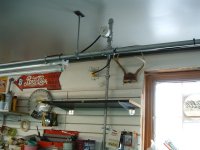
A couple of pictures.


I have never had any water or moisture come out of this drain, I sloped the pipe back toward the tank and one of the other drains gets a little bit of moisture but most drains back into drain just near the tank, I put in 3 drops and 3 drains.

If I was following the "correct" protocol I would have taken the drop upwards about 6" first and then connected the hose, rather than downward like I did.
 
Last edited:

sberry

Banned
Joined
Jun 18, 2005
Messages
35,747
Location
Brethren, Michigan
1/2 is plenty, the reason people use 3/4 is just because, personally like one size and on circuits less than 100 ft it is moot in all but truck shops. Any metal in a shop should be grounded.
 

G_P

Well-known member
Joined
Jul 11, 2010
Messages
7,135
Location
Central CT
Definitely ground the piping. You should have a flexible line between the compressor and hard pipe, so there wont be a direct ground to the compressor and if the pipe somehow becomes energized you dont want to find out when you go to attach a hose and get zapped.
 

metalmagpie

Well-known member
Joined
Nov 1, 2011
Messages
796
Location
Seattle
Copper tubing normally comes in thin/medium/thick. These are indicated by type (K/L/M) and the color of the ink on the tube (red/blue/green). For air line, most advise to stay away from type K (red ink) pipe and go with type L (blue ink). Nothing wrong with type M but it's extra money for no additional value.

metalmagpie
 

G_P

Well-known member
Joined
Jul 11, 2010
Messages
7,135
Location
Central CT
Copper tubing normally comes in thin/medium/thick. These are indicated by type (K/L/M) and the color of the ink on the tube (red/blue/green). For air line, most advise to stay away from type K (red ink) pipe and go with type L (blue ink). Nothing wrong with type M but it's extra money for no additional value.

metalmagpie

RED ink is thin wall type M and is mainly used in hydronic heating systems and household plumbing.
BLUE ink is type L which is thicker than type M and is mainly used for general household plumbing.
GREEN ink is type K and is the thickest and typically comes in rolls and is intended for underground burial.

M or L will work just fine for compressed air. K will work too, but its much more expensive and you just dont need the added thickness for air.

http://www.copper.org/publications/pub_list/pdf/copper_tube_handbook.pdf
 
Last edited:

c4cruiser

Well-known member
Joined
Oct 8, 2012
Messages
359
Location
Lacey WA
RED ink is thin wall type M and is mainly used in hydronic heating systems and household plumbing.
BLUE ink is type L which is thicker than type M and is mainly used for general household plumbing.
GREEN ink is type K and is the thickest and typically comes in rolls and is intended for underground burial.

M or L will work just fine for compressed air. K will work too, but its much more expensive and you just dont need the added thickness for air.

http://www.copper.org/publications/pub_list/pdf/copper_tube_handbook.pdf
What about fittings and solder? Are fittings graded like the pipe and is there any particular solder to use at the fittings that can handle something like 150 psi??
 

G_P

Well-known member
Joined
Jul 11, 2010
Messages
7,135
Location
Central CT
Fittings are the same for L and M. K too IIRC. You can sweat solder them just like a water line, but brazing is stronger.
I have normally soldered copper on my compressor and even with the heat right at the head, it's never given me any problems.
 

Firebird 1

Well-known member
Joined
Mar 11, 2015
Messages
624
Location
Maryland
Ive got 1/2 copper in my woodshop and black iron in the garage. 1/2 has worked fine for me for years now. I would have used it in the garage too but the iron is cheaper and I have a threader.
 

ford33

Well-known member
Joined
Feb 26, 2011
Messages
2,118
Location
Chicago, IL. USA
I used 3/4 dia. medium thickness and installed on the exterior of the drywall. The larger diameter provides greater flow capacity which you may not need but for the small additional money was why I went larger diameter. It was easy to install and allows for changes in the future. Slope the lines so water drains to one or more low points and then put a ball valve for a drain valve.

If you install it behind drywall just make sure you look for leaks before applying the drywall.
 

RAYJAY

Well-known member
Joined
May 29, 2006
Messages
2,638
Location
UNION DALE PA


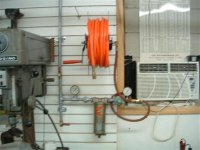
bull .......... have black pipe for years never had or will have a problem

i did have a problem with copper, thats why i ripped it out and went to black pipe,

and yes i run a blast cabinet, and paint car parts all the time no water problems no dryer

one thing most people do that wrong is they tap the air line from the bottom alway go up and over then back down with a drip leg on each drop

and pitch back to the compressor with a drain leg at the start of the line
 

Attachments

  • AIR COMPRESSOR 007 (Medium).jpg
    AIR COMPRESSOR 007 (Medium).jpg
    63.7 KB · Views: 619
  • AIR COMPRESSOR 005 (Medium).jpg
    AIR COMPRESSOR 005 (Medium).jpg
    46 KB · Views: 540
  • AIR COMPRESSOR 008 (Medium).jpg
    AIR COMPRESSOR 008 (Medium).jpg
    63.4 KB · Views: 583
Last edited:
OP
D

DC73

Well-known member
Joined
Dec 27, 2014
Messages
1,627
Location
Lubbock TX
Lotta good info provided in this thread. Thanks everyone.

So, 1/2" will work and 3/4" is a good option as well. 3/4" Type L is about $10 more per 10' stick than 1/2" at Home Depot so that might be the deciding factor for copper.

I'm also considering the RapidAir Maxline. Northern Tool has a 100' foot kit on sale right now for $160 which makes it a bargain after figuring 3/4" Type L copper pipe and fitting prices (and it's in the ballpark with 1/2").

http://www.northerntool.com/shop/tools/product_200484023_200484023

Sounds like it might be less work to install as well. And I think I could make it work without any joints in the walls. Hmmm. What do you guys think about this option?

Are there any known issues with the RapidAir Maxline?

DC
 

Kiwi Canuck

Well-known member
Joined
Dec 13, 2014
Messages
156
Location
Langley BC
That was the Kit I referred to in my post, that looks like a good deal.
You will need shut-offs and whip hoses from the compressor to the piping etc. plus a few extra fittings I assume. The individual parts are a bit expensive but all in all once you factor in your time, this system will be competitive cost wise and perform well and you'll only need to buy it once.

I have not used it personally but it has good reviews and will install a lot quicker than copper or rigid pipe.

If you do go that route let us know how it works out for you.
 

CNGsaves

Well-known member
Joined
Sep 26, 2012
Messages
13,233
Location
KS and OK
In warm climate TX, you can use copper of black pipe steel IN WALL with no problems. Slope your line to drip legs so you don't end up having water sitting anywhere you don't have a drain/ball valve.

Believer in . . . Do It Once, Do It Right !! ;)

For IN WALL, I'd recommend copper as discussed by above GJer's as it's easy to assemble . . . ASSUMING that you plan ahead. You can even make up sub-assemblies for sections that can go in one piece.

Never can hurt to make your mainline 3/4" and 1/2" drops, which would make nice lifetime airline system of In-Wall copper.

For black pipe steel, I'd go with surface mount for ease of installation, and make changes later.

Good luck with decision, but don't settle for other than copper or black pipe steel.
 
To avoid these ads, REGISTER NOW!

MrBreeze

Well-known member
Joined
Sep 1, 2014
Messages
329
Location
Scottsdale, AZ
I too am planning/configuring for a new home with a 3 car garage, and trying to decide between copper, black iron, or one of the RapidAir products (RapidAir, MaxAir or FastPipe) I like a "neat" system (90 degree corners, straight runs) and so while the nylon RapidAir system is less expensive than the coated aluminum of the MaxAir and FastPipe, the installation isn't as "neat". With the MaxAir tubing that comes in the coil, I'm not sure how you straighten it without kinking or making the installation sloppy. The MaxAir and FastPipe with the straight sections fit the bill with "neat" but there isn't a supplier anywhere near me, so that's when I fall back to looking at copper and black iron as HD, Lowes, etc carries it. Does anyone have either a RapidAir or MaxAir system that was the coiled product and can shed some light as to how it is to work with and straighten for long runs?

I did find this thread:
http://www.garagejournal.com/forum/showthread.php?t=160938

(not meaning to de-rail the thread from copper air lines - one of the things I like about a copper set up is the neatness of the install)
 
Last edited:

t-spec

Member
Joined
Mar 3, 2015
Messages
9
My old setup was with 1/2" copper, 50' run. In 6 years I never had an issue, then I moved, so time to start all over again. I also used the thin wall (L or M I can't remember the designation for thin/thick wall). The only reason I would see people using 3/4" is if multiple air tools would be used at the same time and would need a higher volume without as much pressure drop.
 
OP
D

DC73

Well-known member
Joined
Dec 27, 2014
Messages
1,627
Location
Lubbock TX
That was the Kit I referred to in my post, that looks like a good deal.

If you do go that route let us know how it works out for you.

Will do. Upon further research, there is one potential problem to overcome with the RapidAir Maxline. The minimum bend radius is 6" which makes it a no go to bend inside a 2 x 4 wall and come straight into the back of the outlet block. Would have to install some type of 90 or recess the outlet into the wall so I could come straight into the top. Will have to research this further.

Never can hurt to make your mainline 3/4" and 1/2" drops, which would make nice lifetime airline system of In-Wall copper.

This is a good compromise. Something to consider.


Good luck with decision, but don't settle for other than copper or black pipe steel.

Any issues with the RapidAir Maxline?


Does anyone have either a RapidAir or MaxAir system that was the coiled product and can shed some light as to how it is to work with and straighten for long runs?

I won't have the issue with neatness since my lines will be hidden in the walls, but, I do remember reading a post on the forum where a guy built a homemade roller jig to straighten the pipe as it came off the reel. I couldn't find the thread with a quick search. If I come across it again, I'll post the link.


DC
 

koditten

Well-known member
Joined
Apr 10, 2008
Messages
5,528
Location
Midland, Michigan
I've had both. My present shop is black iron-reason, Cu was stupid expensive 6 years ago. Black iron was cheap and available.

If I was to do it again, I would use Cu. Sweating fittings is much less labor intensive. I only have a hand pipe threader, so I did some heavy "sweating" to get all my pipes threaded.

I see no reason to use 3/4" Cu pipe, 1/2" will give you all the capacity you need in a home shop.

As for controlling moisture, do yourself a favor and plump a tap in the bottom of the tank. Use this tap for blowing the dust out of the shop and airing up tires, a bit of moisture in tires will never be noticed. I check my tank pretty often and never get any water...it is all shot out of the air hose when I blow the floors clean.
 

CNGsaves

Well-known member
Joined
Sep 26, 2012
Messages
13,233
Location
KS and OK
Any issues with the RapidAir Maxline?

No. Just doesn't seem to be best match for your shop and what you want to do. In hot TX you will want cooling benefit of copper or black pipe steel, that you simply don't get with RapidAir. With proper planning & construction, your In-Wall copper will be LIFETIME system that you'll never have to worry about again. It could be easily added to later (which is major benefit of copper versus black pipe steel, which is my personal favorite).

Slight slope to your mainline up at top of wall would help direct moisture to drop that would have ball valve to dump moisture.

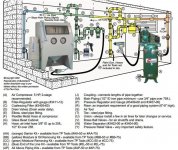
Below is typical airline system setup per TP Tools. Good luck.
 

Attachments

  • Airline system layout_TP Tools_black pipe steel.JPG
    Airline system layout_TP Tools_black pipe steel.JPG
    114.4 KB · Views: 244

gungatim

Well-known member
Joined
Jan 8, 2013
Messages
8,101
Location
west mich
I used 1/2". 3/4" air storage capacity is insignifficant. my longest runs are about 60'. I don't like black steel or galvanized, rust/flaking galvanizing has caused problems in the past. Copper is MUCH easier to cut and modify/add to when needed, and no worries about leaking fittings. don't know what the cost difference is, when I did mine copper was much cheaper but that was a long time ago. horizontal lines are in ceiling with drops down the polebarn 6x6 posts. I ran grounding wire from the lines to the main panel as if it were water lines in a house, along with the required grounding rod...cheap easy insurance...and it gives me an easy accessable place to ground radios and stuff when needed.
 

gungatim

Well-known member
Joined
Jan 8, 2013
Messages
8,101
Location
west mich
...but, I do remember reading a post on the forum where a guy built a homemade roller jig to straighten the pipe as it came off the reel. I couldn't find the thread with a quick search. If I come across it again, I'll post the link.


DC

I think the guy used 3 steel caster wheels mounted on a plate, but for me, I have used the HF ring roller to do this with coiled copper and other lines, works really well...even straightened bent tent poles with it, just an FYI...not to get too far off topic...

maybe this:
 

Attachments

  • roller home made.jpg
    roller home made.jpg
    29.4 KB · Views: 276
Last edited:

Mr onetwo

Well-known member
Joined
Apr 6, 2011
Messages
2,005
Location
Coastal Maine
I have done many air systems in both black iron and copper. Both are very dependent on proper system design. Running your branches up off the top of your main to dirt pockets and pitching the main is very important. I have black iron in my shop, but if I had to do it over I would use L copper with "Silvabrite 100" for the soldered joints. I had all the iron pipe on hand. IMHO running any lines that have joints inwall is a very bad idea.
 

koditten

Well-known member
Joined
Apr 10, 2008
Messages
5,528
Location
Midland, Michigan
I'll second that. Having the lines hidden really makes it hard to do any modifications. Besides, I'd want to show off my sweating abilities.
 

steel 35

Well-known member
Joined
Feb 20, 2011
Messages
2,105
Location
Between the PNW and the Emerald Triangle
Last place I worked had 6" copper air lines :wtf:
I have 1/2 copper for the moisture trap's, I only needed about 10' on the wall but read 30 to 50 feet for the cooling / Condensation and it does work.
The push lock stuff is great in the right place Too.
All the fittings are spendy.
 

akdiesel

Well-known member
Joined
Aug 8, 2008
Messages
2,617
Location
Wasilla, AK
DC73

The iron or copper pipe seems to be the better choices since they do the job they are intended for, are fairly inexpensive, easy to modify if needed, and parts are readily available. There are other options like what I used but let's continue with these two and PEX air rated.
I like the idea of putting your air lines in the wall, but as some have suggested the cons to it there is also the problem with cooling the lines down. Being in the wall the line will not get the air flow to help cool it down as well as being in the insulation. Lines on the outside dissipate the heat (thus the reasons for copper and steel pipe).
Now moisture should be eradicated prior to entering your since when using lots of air the, it does not matter what type of pipe you using the the air will not have time to cool down completely in the run till it gets to your tool or the line reduction (the JT effect).
It is hard to remove the moisture prior to the line run, but can be down with some pre air tank work or expensive equipment (desiccant / chiller system).
If you can get the majority of you moisture out then running your lines in the wall should be great and then you could even go with PEX tubing rated for air. I believe it is PEX AL PEX.
 

pcmeiners

Well-known member
Joined
Aug 13, 2009
Messages
7,853
Location
In the only town in Pennsylvania, Bloomsburg.
"What about fittings and solder? "
3/4" copper, so much easier then black, less internal friction. As to fitting, use sweeps/long radius ELs instead of elbows, Tee should be avoided unless necessary, Full flow valve should be used, regulator/ filters should be high volume type.Solder, silver solder, melts at higher temp.
 

jvitez

Well-known member
Joined
Nov 30, 2009
Messages
2,429
Location
Big Sky Country, Canada
I've been eyeing this 60 gal compressor at a local dealer. The installation manual says this:

"PIPING
Warning! Never use plastic (PVC) pipe for compressed air. Serious injury or
death could result.

Any tube, pipe, or hose used must have a pressure rating higher than 150
PSI. Minimum recommended pipe size, keep in mind that a larger diameter
pipe is always better:

Up to 50 feet long use 1/2”.
Greater than 50 feet use 3/4”."

Logically, 1/2" should be plenty for a one man garage. 1/2" is wider than the usual 3/8" air hose we use, and copper pipe has less friction than hose in any case. The resistance to flow of a fluid through a tube is inversely proportional to the radius to the power of 4. So a pipe twice the diameter will have a resistance to flow 16 times less. This is a physics fact, but does it make a practical difference in the real world?

I can easily see many gents installing more than 50 ft of air line if they use a cooling zig/zag type of design, or want to run a drop at each end of of the shop. So is this 50 ft recommendation an "ideal world" type of thing, or would it make a noticeable difference in our common one-man type of shop?
 

Attachments

  • King 60 gal.jpg
    King 60 gal.jpg
    16.3 KB · Views: 75
To avoid these ads, REGISTER NOW!
Top Bottom