dr_clyde
Well-known member
My old "Ultimate Welding Table" has served me splendidly. It has been an essential fixture in my shop, and I consider it to be one of my most useful and effective fab tools.
However the time has come for its replacement to be fabricated. I sold it to my neighbor after he got some welding equipment and was asking me about a table. I gave him the condition that I be able to use it one last time to fabricate it's replacement. I figured this would be a good opportunity to upgrade some features.
I will update this thread as I go, hopefully it gets done soonish.
This time around, I plan to do a few things different. First, the top plate.
3/4" was too thin on the old one, and had a slight rolled edge where it was sheared at the steel supply. I also hated the mill scale on the surface. It was flaking off inconsistently, and made grounding on sensitive parts a pain. Over 10 feet, the weight of the plate made a very small sag in the middle of the table. Not enough to bug most people, but I was bothered by it.
I ordered this as a replacement. It is 1-1/4" thick A36, Blanchard ground to +/- .005" per foot and a 32 RMS finish.


The next thing I started work on was the bottom of the base. I decided to upgrade from 2-1/2" to 4". I really don't want 6 legs, so the only way to get a self supporting frame with minimal deflection in the center is to build out of material that is stiff enough to not sag over 10 feet. I had some leftover 4", so it was the perfect choice.

I also cut the legs out of this material.
Next up was to cut the bottoms for the legs and weld in some nuts for the leveling feet.
I used some 3/8" hot rolled I had laying around. I set a chunk of it in the W.F. Wells and let er rip.
Top tip, if you're sawing through a thick plate, you can set some round stock on the rear of the vise and tilt the plate a little. This allows the blade to cut a smaller cross section and speeds up the cut. It especially helps on a saw like mine, where the blade drops evenly on twin posts, instead of on a hinge.

Unfortunatley, the stock I had was too short to get 2 parts out of 1 strip so I had to cut 4 and stack them for the last cut. They're getting welded to the bottom of the feet, so I didn't get too fussy with the lengths.

I used a set of small toothed blocks from a mill strap clamp set to space the vise and keep even pressure on the plates.

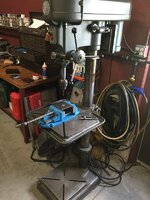
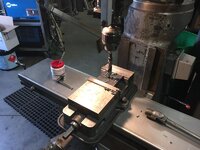
Using the 20" Walker Turner and the Bridgeport I poked some 3/4" holes in the caps.
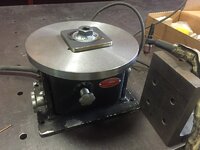
First a root pass, then up onto the rotary table for the cover bead.


That's all for now, I must go back into the shop and make some more progress!
However the time has come for its replacement to be fabricated. I sold it to my neighbor after he got some welding equipment and was asking me about a table. I gave him the condition that I be able to use it one last time to fabricate it's replacement. I figured this would be a good opportunity to upgrade some features.
I will update this thread as I go, hopefully it gets done soonish.
This time around, I plan to do a few things different. First, the top plate.
3/4" was too thin on the old one, and had a slight rolled edge where it was sheared at the steel supply. I also hated the mill scale on the surface. It was flaking off inconsistently, and made grounding on sensitive parts a pain. Over 10 feet, the weight of the plate made a very small sag in the middle of the table. Not enough to bug most people, but I was bothered by it.
I ordered this as a replacement. It is 1-1/4" thick A36, Blanchard ground to +/- .005" per foot and a 32 RMS finish.
The next thing I started work on was the bottom of the base. I decided to upgrade from 2-1/2" to 4". I really don't want 6 legs, so the only way to get a self supporting frame with minimal deflection in the center is to build out of material that is stiff enough to not sag over 10 feet. I had some leftover 4", so it was the perfect choice.
I also cut the legs out of this material.
Next up was to cut the bottoms for the legs and weld in some nuts for the leveling feet.
I used some 3/8" hot rolled I had laying around. I set a chunk of it in the W.F. Wells and let er rip.
Top tip, if you're sawing through a thick plate, you can set some round stock on the rear of the vise and tilt the plate a little. This allows the blade to cut a smaller cross section and speeds up the cut. It especially helps on a saw like mine, where the blade drops evenly on twin posts, instead of on a hinge.
Unfortunatley, the stock I had was too short to get 2 parts out of 1 strip so I had to cut 4 and stack them for the last cut. They're getting welded to the bottom of the feet, so I didn't get too fussy with the lengths.
I used a set of small toothed blocks from a mill strap clamp set to space the vise and keep even pressure on the plates.
Using the 20" Walker Turner and the Bridgeport I poked some 3/4" holes in the caps.
First a root pass, then up onto the rotary table for the cover bead.
That's all for now, I must go back into the shop and make some more progress!
Last edited: