

Garage Flooring
ALLIANCE MEMBER
The intent of this post is to clarify best practices and product types for people looking for a clear sealer. In some cases this would be a gloss type sealer being applied over stained concrete or even bare concrete. In other cases it would be a protective product with little to no aesthetic value. This post is not addressing epoxy or other coatings products like Rust Bullet.
Obviously this is opinion. It is opinion based on fact and my own experience as well as the expertise of those I work with. I can’t be an expert in every individual product that everyone sells. There is even some variation within the products we sell. Each and every job is different. This is just some basic information BUT
It is also important to understand that we, and many, if not most of our colleagues in the industry are not sitting in an actual factory where the material is made. We use companies to make the product for us. In lots of cases they take the same formula and put it in bucket A for me and bucket B for someone else. We then get data sheets and MSDS sheets. Typically in an editable format. Some companies release the full data sheets, while others edit them for one reason or another. We tend to release the full data sheet, only changing company names, part numbers, etc. On a rare occasion we will change a descriptive word after clearing it with the people who make the product for us. These data sheets are technical and contain important information. Thus we believe they are important for our customers to make educated decisions.
Acrylic Sealers, MMA Acrylic sealers and similar products are an outstanding and affordable way to add gloss and protection to decorative or even plain concrete. They are cheap and easy to apply and are ideal for applications like basements *, sidewalks, patios, commercial and many industrial applications.
They are a maintenance product. They are not permanent and depending on usage will need to be reapplied.
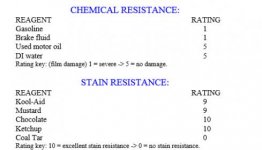
We have several lines of acrylic coatings and for the most part have resisted the temptation to sell them in the garage application. When you look at the full data sheet, talk to the guys in the white coats and funny glasses and most importantly look at what is learned from hands on experience, it becomes incredibly clear that for a true garage application acrylic sealers are not the correct product. Gasoline, solvents, and many if not most of the things that get spilled, leaked or otherwise located on the garage floor will damage the coating. For driveways they are not perfect but they are often the best option – and for the most part they put up with oil leaks.
When you look at the excerpt from an actual data sheet, you can see the types of things they are testing for. Not the type of product I would want in an ordinary garage. The excerpt below is from one of our 6000 series sealers.
Urethanes
Urethanes come in a lot of different categories. For the purpose of this post I am referring to aliphatic urethanes. Other products like polyaspartics may have similar or in many cases even better results.
Urethane applications, with the possible exception of Rust Bullet Clear and a handful of others, are best done over concrete that has been mechanically profiled. Many acrylic sealers are applied over concrete with minimal or chemical preparation. This has made urethanes less attractive in some cases to the DIY consumer.
That said, urethanes will generally hold up longer and be more chemical resistant and more suitable for garage applications. If I was trying to add a finish to stained or bare concrete floor, a urethane or polyaspartic would be my first choice – in most parts of the county. There are some cases where a
100% solids clear epoxy becomes a necessity.
As you can see from the excerpt below, urethanes are more thoroughly tested for garage type applications. Every product will be different..

For exterior applications, in most cases I would go with an acrylic sealer. Both acrylics and urethanes provide aesthetic, gloss and some level of sacrificial protection to the floor below.
Penetrating Sealers
Penetrating sealers often provide zero aesthetic value. No gloss, no sheen. They just protect.
There is a lot of information going around about densifiers and penetrating sealers. Often they are used in conjunction with densifiers. In some cases like with TL39 you have a waterproofing sealer and densifier in one.
There are also combinations of densifiers and sealers that work very well together. For example TL37 is a lithium based densifer that can be used in conjunction with TL40 or TL021 for stain protection and sealing. TL39, TL40 and TL021 all use Silane and Siloxane along with other ingredients to protect the floor.
Kretetek has come out with GhostShield 8505 [Now 8510 as well]. It still needs to go over a densifier. It still has Silane and Siloxane but it adds specific fluorocarbons to increase resistance to stains and penetration from oils and other automotive products. After selling through our complete initial order of the product, working with it and the manufacturer, it has become clear that 8505 combined with a densifier provides outstanding resistance not only to water, but to oil and other automotive fluids that could stain other products.
Since densifiers are an important part of this process, it is important to understand what is and is not a densifier. Here is a good technical article about concrete hardeners. http://www.absolutepolishing.com/wp...erview-of-Concrete-and-Chemical-Hardeners.pdf
A recognized industry association has provided us with a great definition for a densifier http://www.concretepolishingassociation.com/glossary.php and this definition is often overlooked. While it is true that many conditioners and sealers will perform some of the functions of a densifier –such as reducing dusting—they are not a densifier.
If you are serious about using a densifier, look at the MSDS sheet and the full product data sheet and confirm that there is a significant amount of a recognized densifier (see the definition above) in the product.
I put a * next to basements because they can be a little tricky. Talk to the people you are buying the product from about moisture and other issues you may have. These are important considerations in all applications but some things like moisture are more prevalent in basements
Obviously this is opinion. It is opinion based on fact and my own experience as well as the expertise of those I work with. I can’t be an expert in every individual product that everyone sells. There is even some variation within the products we sell. Each and every job is different. This is just some basic information BUT
It is also important to understand that we, and many, if not most of our colleagues in the industry are not sitting in an actual factory where the material is made. We use companies to make the product for us. In lots of cases they take the same formula and put it in bucket A for me and bucket B for someone else. We then get data sheets and MSDS sheets. Typically in an editable format. Some companies release the full data sheets, while others edit them for one reason or another. We tend to release the full data sheet, only changing company names, part numbers, etc. On a rare occasion we will change a descriptive word after clearing it with the people who make the product for us. These data sheets are technical and contain important information. Thus we believe they are important for our customers to make educated decisions.
Acrylic Sealers, MMA Acrylic sealers and similar products are an outstanding and affordable way to add gloss and protection to decorative or even plain concrete. They are cheap and easy to apply and are ideal for applications like basements *, sidewalks, patios, commercial and many industrial applications.
They are a maintenance product. They are not permanent and depending on usage will need to be reapplied.
We have several lines of acrylic coatings and for the most part have resisted the temptation to sell them in the garage application. When you look at the full data sheet, talk to the guys in the white coats and funny glasses and most importantly look at what is learned from hands on experience, it becomes incredibly clear that for a true garage application acrylic sealers are not the correct product. Gasoline, solvents, and many if not most of the things that get spilled, leaked or otherwise located on the garage floor will damage the coating. For driveways they are not perfect but they are often the best option – and for the most part they put up with oil leaks.
When you look at the excerpt from an actual data sheet, you can see the types of things they are testing for. Not the type of product I would want in an ordinary garage. The excerpt below is from one of our 6000 series sealers.
Urethanes
Urethanes come in a lot of different categories. For the purpose of this post I am referring to aliphatic urethanes. Other products like polyaspartics may have similar or in many cases even better results.
Urethane applications, with the possible exception of Rust Bullet Clear and a handful of others, are best done over concrete that has been mechanically profiled. Many acrylic sealers are applied over concrete with minimal or chemical preparation. This has made urethanes less attractive in some cases to the DIY consumer.
That said, urethanes will generally hold up longer and be more chemical resistant and more suitable for garage applications. If I was trying to add a finish to stained or bare concrete floor, a urethane or polyaspartic would be my first choice – in most parts of the county. There are some cases where a
100% solids clear epoxy becomes a necessity.
As you can see from the excerpt below, urethanes are more thoroughly tested for garage type applications. Every product will be different..
For exterior applications, in most cases I would go with an acrylic sealer. Both acrylics and urethanes provide aesthetic, gloss and some level of sacrificial protection to the floor below.
Penetrating Sealers
Penetrating sealers often provide zero aesthetic value. No gloss, no sheen. They just protect.
There is a lot of information going around about densifiers and penetrating sealers. Often they are used in conjunction with densifiers. In some cases like with TL39 you have a waterproofing sealer and densifier in one.
There are also combinations of densifiers and sealers that work very well together. For example TL37 is a lithium based densifer that can be used in conjunction with TL40 or TL021 for stain protection and sealing. TL39, TL40 and TL021 all use Silane and Siloxane along with other ingredients to protect the floor.
Kretetek has come out with GhostShield 8505 [Now 8510 as well]. It still needs to go over a densifier. It still has Silane and Siloxane but it adds specific fluorocarbons to increase resistance to stains and penetration from oils and other automotive products. After selling through our complete initial order of the product, working with it and the manufacturer, it has become clear that 8505 combined with a densifier provides outstanding resistance not only to water, but to oil and other automotive fluids that could stain other products.
Since densifiers are an important part of this process, it is important to understand what is and is not a densifier. Here is a good technical article about concrete hardeners. http://www.absolutepolishing.com/wp...erview-of-Concrete-and-Chemical-Hardeners.pdf
A recognized industry association has provided us with a great definition for a densifier http://www.concretepolishingassociation.com/glossary.php and this definition is often overlooked. While it is true that many conditioners and sealers will perform some of the functions of a densifier –such as reducing dusting—they are not a densifier.
If you are serious about using a densifier, look at the MSDS sheet and the full product data sheet and confirm that there is a significant amount of a recognized densifier (see the definition above) in the product.
I put a * next to basements because they can be a little tricky. Talk to the people you are buying the product from about moisture and other issues you may have. These are important considerations in all applications but some things like moisture are more prevalent in basements
Last edited:
 Have a look at the MSDS sheet for the products. For example if you look at TL40 it has no silicate in it.