

You are using an out of date browser. It may not display this or other websites correctly.
You should upgrade or use an alternative browser.
You should upgrade or use an alternative browser.
Cheaper alternative to $15 Deoxit contact cleaner?
- Thread starter Jacobson
- Start date
rlitman
Well-known member
Nope.
rodsnratfinks
Well-known member
I second this. Nothing else comes close to the effectiveness of De-Oxit. I use it to restore vintage musical instruments (keyboards mostly) and HiFi equipment. You can hear the difference.Nope.
Sent from my SM-G920V using Tapatalk
jayoldschool
Well-known member
Fixed a glow plug harness issue on a VW for me. 15 bucks is worth it.
Mechanical Noise
Well-known member
Cramolin is supposed to be mostly 5% oleic acid and 95% naphtha. Oleic acid is in most vegetable oils to varying degrees. The oleic acid gently deoxidizes copper and brass and leaves a protective film. I got my oleic acid on ebay, although it may be cheaper if it can be found locally a health food store. Anyway, it's not particularly expensive. Lighter fluid or Coleman fuel can be used for the naphtha. Cramolin is what Caig was selling before DeOxit and it seems people really liked it.
CRC QD is a good general purpose cleaner which doesn't leave a residue.
CRC Lectra Clean is a much stronger solvent than QD. It doesn't seem to bother bakelite or other phenolics, but it will eat right through polystyrene and most paints.
I've used Tarn-X type products to clean particularly stubborn switches which nothing else worked on. Needless to say, in these cases, the switches are removed before the treatment and get a thorough flush afterward.
CRC QD is a good general purpose cleaner which doesn't leave a residue.
CRC Lectra Clean is a much stronger solvent than QD. It doesn't seem to bother bakelite or other phenolics, but it will eat right through polystyrene and most paints.
I've used Tarn-X type products to clean particularly stubborn switches which nothing else worked on. Needless to say, in these cases, the switches are removed before the treatment and get a thorough flush afterward.
engineer031
Well-known member
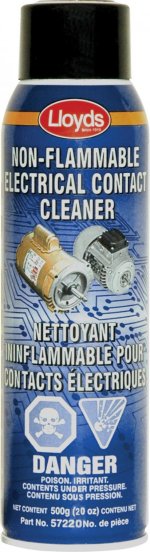
This is what I have been using it works great for cleaning circuits and switches
Lloyds Electrical Contact Cleaner
Multi-purpose cleaner used in servicing, rebuilding and maintaining electrical equipment. Ideal for switches, relays, shafts, bearings, armatures, brushes, contactors, etc.
Safe for all metals and most plastics. Used in most power-on solutions. Low odour. Contains no Trichloroethane 111. Dries quickly leaving no residue and a clean, paintable surface. Non-flammable.
Ideal for switches, relays, shafts, bearings, armatures and brushes
$7.99
Lloyds Electrical Contact Cleaner
Multi-purpose cleaner used in servicing, rebuilding and maintaining electrical equipment. Ideal for switches, relays, shafts, bearings, armatures, brushes, contactors, etc.
Safe for all metals and most plastics. Used in most power-on solutions. Low odour. Contains no Trichloroethane 111. Dries quickly leaving no residue and a clean, paintable surface. Non-flammable.
Ideal for switches, relays, shafts, bearings, armatures and brushes
$7.99
engineer031
Well-known member
Hello,
I'm the CAIG Labs representative and I will be happy to help you with CAIG/DeoxIT related questions.
If you are looking for DeoxIT or other CAIG products, here are some websites to get them at discounted pricing:
1. www.mcmelectronics.com with promo code: CAIG15 (D5S-6 will be $9.99 with promo code)
2. http://www.parts-express.com/brand/caig-laboratories/30 (D5S-6 IS on sale right now for $9.88)
Please feel free to ask me if you have any other questions.
Have a nice day!
CAIG Laboratories, Inc.
12200 Thatcher Court
Poway, CA 92064
Tel: (858) 486-8388
[email protected] | www.caig.com
I'm the CAIG Labs representative and I will be happy to help you with CAIG/DeoxIT related questions.
If you are looking for DeoxIT or other CAIG products, here are some websites to get them at discounted pricing:
1. www.mcmelectronics.com with promo code: CAIG15 (D5S-6 will be $9.99 with promo code)
2. http://www.parts-express.com/brand/caig-laboratories/30 (D5S-6 IS on sale right now for $9.88)
Please feel free to ask me if you have any other questions.
Have a nice day!
CAIG Laboratories, Inc.
12200 Thatcher Court
Poway, CA 92064
Tel: (858) 486-8388
[email protected] | www.caig.com
rlitman
Well-known member
Hello,
I'm the CAIG Labs representative ...
Thanks, and nice first post. No questions from me here. Just wanted to say that I for one really like it when manufacturer's come here to offer help.
Cramolin is supposed to be mostly 5% oleic acid and 95% naphtha.
Perhaps, though Caig claims in their FAQ that Deoxit is NOT oleic acid.
Oleic acid anyway can make up 3/4 of olive oil. And over time, it oxidizes into a sticky varnish (pure oleic acid, as well as olive oil both rancidify). Not a good thing when it is used on switch contacts and the like. That also causes oleic acid to collect dust.
I can testify that having used Deoxit for about 5 years now, it does not turn sticky like oleic acid would over time. Oleic acid also freezes (into a waxy solid, but still, that could cause contacts to stick in the winter. I keep a bottle of olive oil in my unheated porch on top of my popcorn machine, and it certainly does freeze in winter (kind of looks like diesel gelling up). I have a bottle of Deoxit D100 liquid in my unheated garage, and have never seen it cloud in the winter.
As for cost, I'm a total cheapskate, so I have Deoxit D100 at home. I'll spray or wipe with regular drying contact cleaner (usually CRC), and apply a tiny amount of the Deoxit directly using microbrushes. A tiny bottle of D100 is like a lifetime supply (a drop easily covers a few square inches of contact surface). Contact cleaners are often made from acetone or hexane or naphtha or chlorinated solvents. Carb and brake cleaners make good contact cleaners, so long as you're aware that different chemicals have different compatibilities with plastics. I own most of these solvents in gallon quantities, and yet I still buy them in aerosol packaging for their convenience.
At work where I'm not paying the bills, we buy Deoxit DN5. This is only 5% Deoxit, but it cleans well, and leaves behind a protective film, saving me time and effort. Yeah, $25 for a small aerosol can seems like a lot, but I've seen it save my company thousands. Anyway, I go through about two cans a year. I have a number of 250A fuses bolted to 480V bus bars in UPS equipment. The FLIR once picked up a connection that was starting to fail at 450F+. Since cleaning up with scotch brite and then Deoxit, 2 years later, and it's still hardly ever over ambient temperature any more, still carrying the same load.
My first personal test of Deoxit went like this. I found the grungiest dark brown penny I had, and put it up on a shelf, with a single drop of D100 over Lincoln's face, and left it to sit. Within a month, the circle had a blue/green scum floating on it. I wiped off the scum, and under that was a nice clean circle of copper (surrounded by the brown). It is like it turns the clock back on copper; releasing the oxidization from the surface, and preventing it from worsening.
The 250A fuses above were some of the only fuses I have that use copper connections (most of this kind of stuff is silver plated; which also seems to improve with Deoxit treatment, though differently). Six months after treatment, at the next PM, we pulled the connection apart and wiped off some of this green scum. Since then, the film left by the Deoxit has not allowed any more of it to form.
Last edited:
zakmartin
Well-known member
I used DeoxIT to get an ancient synthesizer working again, to get the removable faceplate to my car's head unit working again, to make every pot, switch and plug on my electric guitar and amp to work like new. It's like a miracle cure for people who refuse to throw away electronic goodies from the days when they were still serviceable. Right now, I'm replacing all the caps in a NOS ghetto blaster from 1982, and yup, I have a can of DeoxIT sitting right next to it. $15 is a small price to pay for that stuff (and a little bit goes a long way).
jeepinerdeep
Well-known member
Its liquid gold. Buy it.
Hello,
I'm the CAIG Labs representative and I will be happy to help you with CAIG/DeoxIT related questions.
If you are looking for DeoxIT or other CAIG products, here are some websites to get them at discounted pricing:
1. www.mcmelectronics.com with promo code: CAIG15 (D5S-6 will be $9.99 with promo code)
2. http://www.parts-express.com/brand/caig-laboratories/30 (D5S-6 IS on sale right now for $9.88)
Please feel free to ask me if you have any other questions.
Have a nice day!
CAIG Laboratories, Inc.
12200 Thatcher Court
Poway, CA 92064
Tel: (858) 486-8388
[email protected] | www.caig.com
Welcome to the forum!!
Will your product remove residue from alkaline batteries that started to leak?
MFolks
Well-known member
This is what I wrote up for owners of older motorcycles:
Cleaning Motorcycle Electrics
Get some of the De-Oxit electrical contact cleaner and figure on spending a good day going from the front of the bike to the back. It’s a plastic safe cleaner/preservative. www.deoxit.com is their website.
On the older Kawasaki's, a majority of electrical connectors are inside the headlight housing requiring removal of the headlight, then the fun begins.
Do one set of electrical connectors at a time to avoid mixing up what connects to where. Usually disconnecting, spraying with De-Oxit and reconnecting is about all you'll need.
However, when encountering the green crud of corrosion, a brass wire brush may be needed on the pins you can reach.Some 400-600 grit wet and dry sandpaper strips rolled into a tube should reach the male and female pins in the more difficult to clean connectors.
Smoker’s pipe cleaners, cotton swabs and wooden toothpicks work as cleaning aids.
Really small electrical connectors may require the use of a welders tip cleaning tool assortment.
Most pins in the connectors are coated with a thin plating of tin, and others may be nothing more than copper or brass.
If moisture is added, the resulting corrosion lowers the voltage/current being carried causing dim lights, slow engine cranking, slow turn signal response and lower input voltage to the ignition coils resulting in weak spark.
The left and right handlebar switch pods will need attention too as they have circuit functions like turn, horn, run/stop, and start.
Usually a spritz or two with actuation of the switch is about all needed for these switches unless corrosion is detected and then careful disassembly is required.
The ignition switch may or may be not sealed to allow spraying the internal contacts. I urge caution if attempting to open this up as springs, and ball bearings may fly out never to be seen again!
If your bike has the older style glass tubed fuses, I suggest replacing them as vibration can cause internal failure. AGX is the type used, and most auto parts stores can get them for you.
Clean the fuse holder clips, looking for signs of overheating(discolored insulation, signs of melting).
I use metal polish on a cotton swab, followed by spraying another clean swab with the De-Oxit and then rubbing the inside of the fuse clip.
All battery cables must be clean and tight for maximum current transfer. Check the cables going from the Negative(-) battery terminal/post to the engine mounting bolt
Also the one going from the Positive(+) terminal to the starter solenoid and from there to the starter motor.
If any battery cable feels ”Crunchy” when flexed, replace it as possible corrosion is inside the insulation.
Each "Bullet Connector" will have to be sprayed to ensure good connectivity, especially the ones going to the energizing coil of the starter solenoid.
The alternator output “Bullet Connectors” are usually behind the engine sprocket cover and will need inspecting and cleaning too.
The turn signal light sockets will benefit from a spritz from the contact cleaner along with the tail light/brake light socket.
Some brake light switches can be sprayed on the actuating rod, with the spray running down inside to the electrical contacts, others may be sealed requiring replacement if the switch is intermittent in operation.
Some people put the Di-Electric Grease on cleaned terminations/connectors, I don’t, as I’ve read/heard it can cause problems when it gets hot, actually insulating the connections, so the choice is yours to use or not.
Using WD-40?
Bad idea! WD40 is a bad thing to use on wires, contacts, etc.! More than one person on this site has suffered the effects of using it that way. Use Deoxit or some other contact cleaner to clean that WD40 off anything electrical before that WD40 **** sets up and becomes an insulator.
As a matter of fact dielectric grease isn't a great idea either. Dielectric is essentially an insulator for the purposes of conducting electricity. I've spent many hours cleaning dielectric grease out of connections. It heats up, liquefies, then gets wicked into contacts. The contact area that actually carries current then is reduced and heats up more.
Just got done replacing headlight connectors on a Civic. They were full of grease (that looked cooked), and the bulbs were dim. Only chopping off the connectors and replacing them got the bulbs back to full brightness
I think I've covered about all of the electrical systems on the bike.........
“I spent a weekend going through every electrical connection and switch on the bike with a little scotchbrite pad and DeOxit - what a difference! Everything was brighter, gauge backlights, indicator lights, turn signals, I was getting a nicer spark, it fired up quicker, etc. Well worth my time. WELL worth it! “
From a forum member at www.kzrider.com
Re: Cleaning the many and various Motorcycle electrics.
I used the De-oxit D-5 spray on all the electrical connections of my 78 Kz1000 that had sat for twenty years .
When I parked the bike in 92 I was starting to have troubles with some of the electrical system, but after pulling everything apart and giving it a spray , reconnecting the connectors and working them back and forth a few times, then gave them another shot of spray to wash them off before the final reconnection.
Everything still works perfectly and has for over 7000 miles this year.
I am extremely happy with the results , a lot of the connectors were green when I started and after the cleaning they looked new ( shiny gold )
I found the Deoxit D-series, D-5 spray in a 4 oz can at a big electronics store called Frys in Illinois, don't get the small cans at Radio Shack , they are different and meant for computer type stuff.
http://store.caig.com/s.nl/sc.2/category.188/.f
Recommendations:
Excellent contact cleaner from audio to ac power contacts
I've been an A/V Tech-Roadie for over 30 years and have used Deoxit since it was first introduced. I've cleaned /rejuvenated volume controls,switches and audio connections on everything from guitar amps to full blown recording consoles. It not only cleans mild to excessive corrosion but the lubricant keeps the part in good working order months afterwards. Much easier than replacing a hard to replace part. I also spray it on all the audio connectors periodically to insure good connectivity. Along with my A.C. power plugs and quad boxes that are used outside for live shows to prevent corrosion from the elements.
Good stuff. Obviously highly recommended.
Great Stuff
I used this stuff on my 35 year old Kenwood KA-7300 amp which had not been used in more than 10 years and it was fantastic. When I first tried to use the amp, all of the switches only worked sometimes and the static and intermittent sound was unbearable. I thought that my left channel was not working because it had such a low output compared to the right channel no matter where the balance was set. After cleaning all the input/ and output jacks and the switches along with vacuuming out the inside of the amp, the amp works great and sounds like it did back in the day! I was more than pleasantly surprised!!
Cleaning Motorcycle Electrics
Get some of the De-Oxit electrical contact cleaner and figure on spending a good day going from the front of the bike to the back. It’s a plastic safe cleaner/preservative. www.deoxit.com is their website.
On the older Kawasaki's, a majority of electrical connectors are inside the headlight housing requiring removal of the headlight, then the fun begins.
Do one set of electrical connectors at a time to avoid mixing up what connects to where. Usually disconnecting, spraying with De-Oxit and reconnecting is about all you'll need.
However, when encountering the green crud of corrosion, a brass wire brush may be needed on the pins you can reach.Some 400-600 grit wet and dry sandpaper strips rolled into a tube should reach the male and female pins in the more difficult to clean connectors.
Smoker’s pipe cleaners, cotton swabs and wooden toothpicks work as cleaning aids.
Really small electrical connectors may require the use of a welders tip cleaning tool assortment.
Most pins in the connectors are coated with a thin plating of tin, and others may be nothing more than copper or brass.
If moisture is added, the resulting corrosion lowers the voltage/current being carried causing dim lights, slow engine cranking, slow turn signal response and lower input voltage to the ignition coils resulting in weak spark.
The left and right handlebar switch pods will need attention too as they have circuit functions like turn, horn, run/stop, and start.
Usually a spritz or two with actuation of the switch is about all needed for these switches unless corrosion is detected and then careful disassembly is required.
The ignition switch may or may be not sealed to allow spraying the internal contacts. I urge caution if attempting to open this up as springs, and ball bearings may fly out never to be seen again!
If your bike has the older style glass tubed fuses, I suggest replacing them as vibration can cause internal failure. AGX is the type used, and most auto parts stores can get them for you.
Clean the fuse holder clips, looking for signs of overheating(discolored insulation, signs of melting).
I use metal polish on a cotton swab, followed by spraying another clean swab with the De-Oxit and then rubbing the inside of the fuse clip.
All battery cables must be clean and tight for maximum current transfer. Check the cables going from the Negative(-) battery terminal/post to the engine mounting bolt
Also the one going from the Positive(+) terminal to the starter solenoid and from there to the starter motor.
If any battery cable feels ”Crunchy” when flexed, replace it as possible corrosion is inside the insulation.
Each "Bullet Connector" will have to be sprayed to ensure good connectivity, especially the ones going to the energizing coil of the starter solenoid.
The alternator output “Bullet Connectors” are usually behind the engine sprocket cover and will need inspecting and cleaning too.
The turn signal light sockets will benefit from a spritz from the contact cleaner along with the tail light/brake light socket.
Some brake light switches can be sprayed on the actuating rod, with the spray running down inside to the electrical contacts, others may be sealed requiring replacement if the switch is intermittent in operation.
Some people put the Di-Electric Grease on cleaned terminations/connectors, I don’t, as I’ve read/heard it can cause problems when it gets hot, actually insulating the connections, so the choice is yours to use or not.
Using WD-40?
Bad idea! WD40 is a bad thing to use on wires, contacts, etc.! More than one person on this site has suffered the effects of using it that way. Use Deoxit or some other contact cleaner to clean that WD40 off anything electrical before that WD40 **** sets up and becomes an insulator.
As a matter of fact dielectric grease isn't a great idea either. Dielectric is essentially an insulator for the purposes of conducting electricity. I've spent many hours cleaning dielectric grease out of connections. It heats up, liquefies, then gets wicked into contacts. The contact area that actually carries current then is reduced and heats up more.
Just got done replacing headlight connectors on a Civic. They were full of grease (that looked cooked), and the bulbs were dim. Only chopping off the connectors and replacing them got the bulbs back to full brightness
I think I've covered about all of the electrical systems on the bike.........
“I spent a weekend going through every electrical connection and switch on the bike with a little scotchbrite pad and DeOxit - what a difference! Everything was brighter, gauge backlights, indicator lights, turn signals, I was getting a nicer spark, it fired up quicker, etc. Well worth my time. WELL worth it! “
From a forum member at www.kzrider.com
Re: Cleaning the many and various Motorcycle electrics.
I used the De-oxit D-5 spray on all the electrical connections of my 78 Kz1000 that had sat for twenty years .
When I parked the bike in 92 I was starting to have troubles with some of the electrical system, but after pulling everything apart and giving it a spray , reconnecting the connectors and working them back and forth a few times, then gave them another shot of spray to wash them off before the final reconnection.
Everything still works perfectly and has for over 7000 miles this year.
I am extremely happy with the results , a lot of the connectors were green when I started and after the cleaning they looked new ( shiny gold )
I found the Deoxit D-series, D-5 spray in a 4 oz can at a big electronics store called Frys in Illinois, don't get the small cans at Radio Shack , they are different and meant for computer type stuff.
http://store.caig.com/s.nl/sc.2/category.188/.f
Recommendations:
Excellent contact cleaner from audio to ac power contacts
I've been an A/V Tech-Roadie for over 30 years and have used Deoxit since it was first introduced. I've cleaned /rejuvenated volume controls,switches and audio connections on everything from guitar amps to full blown recording consoles. It not only cleans mild to excessive corrosion but the lubricant keeps the part in good working order months afterwards. Much easier than replacing a hard to replace part. I also spray it on all the audio connectors periodically to insure good connectivity. Along with my A.C. power plugs and quad boxes that are used outside for live shows to prevent corrosion from the elements.
Good stuff. Obviously highly recommended.
Great Stuff
I used this stuff on my 35 year old Kenwood KA-7300 amp which had not been used in more than 10 years and it was fantastic. When I first tried to use the amp, all of the switches only worked sometimes and the static and intermittent sound was unbearable. I thought that my left channel was not working because it had such a low output compared to the right channel no matter where the balance was set. After cleaning all the input/ and output jacks and the switches along with vacuuming out the inside of the amp, the amp works great and sounds like it did back in the day! I was more than pleasantly surprised!!
Mechanical Noise
Well-known member
Perhaps, though Caig claims in their FAQ that Deoxit is NOT oleic acid.
Didn't say DeOxit is oleic acid. DeOxit is the alternative to
Cramolin.
Oleic acid anyway can make up 3/4 of olive oil. And over time, it oxidizes into a sticky varnish (pure oleic acid, as well as olive oil both rancidify). Not a good thing when it is used on switch contacts and the like. That also causes oleic acid to collect dust.
Oleic acid cleaners have long been recommended for use on the brass and phosphor bronze parts inside clocks. I don't have any first hand experience with old clocks, but I'd think the clock hobbyists would be point out these problems, too.
@davefr:
You can use DeoxIT 100% liquid to remove the residue :
http://store.caig.com/s.nl?sc=1&category=&search=D100L
If it's really bad, let it sit overnight then wipe off the excess.
@MFolks:
Thank you very much for the wonderful review!
You can use DeoxIT 100% liquid to remove the residue :
http://store.caig.com/s.nl?sc=1&category=&search=D100L
If it's really bad, let it sit overnight then wipe off the excess.
@MFolks:
Thank you very much for the wonderful review!
rlitman
Well-known member
Will your product remove residue from alkaline batteries that started to leak?
I've tried D100 on it. It's ok, and certainly better than nothing. It softens the residue to the point that it wipes right off after a day of soaking. But if the chrome plating on the steel spring has started to flake and if rust is already appearing, then after Deoxit you'll want to clean it with an abrasive. I like to use a fiberglass brush, but crocus cloth or fine sandpaper would work too.
On that note, here's a REALLY good use for Deoxit. If you've got some, I suggest you go use it on this now:
Cordless phone charging contacts. The plated steel contacts on the phone charging base and the bottom/back of the phone will oxidize over time, which starts to kill the batteries, since they're too cheap to use gold plating. I've gotten significantly better phone battery life after using Deoxit on these, or you could clean the surface with an eraser every month. Your choice.
Didn't say DeOxit is oleic acid. DeOxit is the alternative to Cramolin.
Oleic acid cleaners have long been recommended for use on the brass and phosphor bronze parts inside clocks. I don't have any first hand experience with old clocks, but I'd think the clock hobbyists would be point out these problems, too.
Yes, and I didn't correct you on that part. I was just saying that oleic acid isn't as good as Deoxit. I DO have quite a bit of first hand experience with antique clocks (and know both hundreds of hobbyists AND professionals in the field), and can see exactly why oleic acid would be fine for some clock applications. The brass plates of clocks will stay shiny for far longer when protected by something like oleic acid, but the plates are not moving parts. OTOH, any added sticktion in the pivots would spell disaster, so a proper lubricant containing oils that do NOT rancidify is still a necessity (in the old days, this used to be whale oil; today there are good synthetics for the job).
It would probably be a good treatment on brass bells too.