To avoid these ads, REGISTER NOW!

why it is not safe to use a dryer receptacle for a 220 VAC device

woodturner9

Well-known member
Joined
Feb 16, 2007
Messages
576
Location
Indiana(ish)
Had a chat with sberry on another forum regarding why a 3 prong dryer receptacle is not safe or legal for use with a welder, and he asked to move the discussion here.

to recap the prior discussion:
I explained that a dryer is a dual voltage device and a 3 prong receptacle has two hots and a neutral. I explained that neutral is not ground, but he thinks they are the same, since the ground (equipment grounding conductor EGC) and neutral are connected in the service panel. I explained that current should not flow in the ground for protection, and that a DC connection is different than an AC connection. I suggested a simple test to demonstrate this, measure resistance between the ground wire and the earth, but I don't think he tried it.

I have explained the difference between impedance and resistance, and explained that a fault is more affected by reactance than resistance. I started to explain the calculations, but it didn't seem productive.

Have any of you figured out a simpler way to explain this? My college students get this, but somehow it's not clicking for folks here.

Thanks.
 
Last edited:
To avoid these ads, REGISTER NOW!

lametec

Well-known member
Joined
May 5, 2008
Messages
2,099
Location
Michigan
I'd say it's perfectly safe.

If you use a dryer outlet to power a welder, the neutral does become identical to a ground conductor electrically speaking, since there's no current being returned on it under normal conditions.

At that point the only difference is the color of the wire.

Now, if the dryer receptacle is wired through a sub panel, which is fed by separate ground and neutral conductors, then there will indeed be a (voltage) difference between ground and neutral, since other loads in the panel will be returning current on the neutral, even if the welder doesn't. Still, though, the neutral will only be a couple volts off ground (maybe up to 4V under full load).

The fact that dryers bind their internal neutral to chassis ground when using a 3-prong plug is indicative of the neutral being safe to use as an equipment ground as well.
 
Last edited:

Warrenator

Well-known member
Joined
May 31, 2008
Messages
781
Location
Newberg, OR
Current CAN flow through a neutral, current should NEVER flow through a ground unless there is a fault. Neutral is the groundED circuit, ground is the groundING circuit.

I agree though, it is hard to explain. My electrics instructor told us don't nick the wires, or you'll let the magic smoke out.

I did some work in the UK and found that sometimes they will make a circuit half size wire, but make sure the wire does a complete loop around the room and comes back to the breaker box, that way both sides of the wire carry current and you can save copper. And oh, by the way the UK difference between phases is 415 volts, in the good ol' Us of A it is 220 volts. Lots of ways to get deaded in this electrickery biz.
 

Zeke

Well-known member
Joined
Aug 13, 2009
Messages
17,176
Location
Long Beach CA, the sewer by the sea.
All the old elec dryers returned current on the ground, or neutral if you wish. That's why a 3-wire w/ grd is required now. I'd say a welder is more suitable for a 3-prong dryer circuit than a dryer.
 

alfredeneuman

Well-known member
Joined
Mar 3, 2011
Messages
4,580
Location
Fullerton, CA
' Us of A it is 220 volts. Lots of ways to get deaded in this electrickery biz.

Didn't your electrics instructor also tell you that there is no 220 volt system at all in the USA?
It's either 240 or 208 volt.
There is no such thing as 110 or 115 either
 
Last edited:

jkwilson

Well-known member
Joined
Dec 5, 2012
Messages
758
Location
SW Indiana
Had a chat with sberry on another forum regarding why a 3 prong dryer receptacle is not safe or legal for use with a welder, and he asked to move the discussion here.

to recap the prior discussion:
I explained that a dryer is a dual voltage device and a 3 prong receptacle has two hots and a neutral. I explained that neutral is not ground, but he thinks they are the same, since the hot and neutral are connected in the service panel. I explained that current should not flow in the ground for protection, and that a DC connection is different than an AC connection. I suggested a simple test to demonstrate this, measure resistance between the ground wire and the earth, but I don't think he tried it.

I have explained the difference between impedance and resistance, and explained that a fault is more affected by reactance than resistance. I started to explain the calculations, but it didn't seem productive.

Have any of you figured out a simpler way to explain this? My college students get this, but somehow it's not clicking for folks here.

Thanks.

My suspicion is you mean "Ground and neutral" in the highlighted segment.
 

Warrenator

Well-known member
Joined
May 31, 2008
Messages
781
Location
Newberg, OR
Didn't your electrics instructor also tell you that there is no 220 volt system at all in the USA?
It's either 240 or 208 volt.
There is no such thing as 110 or 115 either


True Dat. Like on cars we don't really have 12 Volt systems, it is 14 point something. Depends on who you're talking to. :)

I often wondered why we say 110 or 115 or 120 volts, i think at least part of it is to add to the mysteriousness of it all. Oh this is far too complex for me, better call in a licensed electrician.
 

theoldwizard1

Well-known member
Joined
Feb 22, 2011
Messages
43,077
Location
SE MI
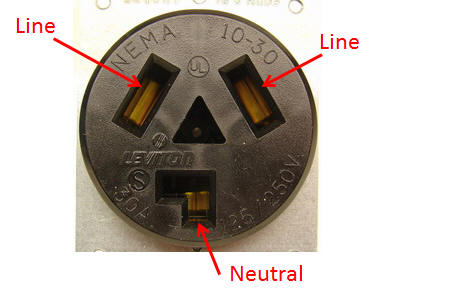
WOW ! I always though on older dryer (30A) and range (50A) outlets the third prong was ground, NOT NEUTRAL (Why would it be neutral ? Neural is not required on a 240V appliance.)

I have found both of these on the web
3-prong_dryer_outlet.jpg


I would not call either of these the DEFINITIVE source.

Of course more "modern" dryer outlets have 4 prongs.

4-prong_dryer_outlet.jpg
 
Last edited:

jkwilson

Well-known member
Joined
Dec 5, 2012
Messages
758
Location
SW Indiana
The reason you want a ground conductor that doesn't carry current is to keep it at zero volts with respect to what you are standing on. The current and resistance in a neutral wire can result in voltages with respect to ground that have the potential to be unsafe. Because the ground carries little to no current in normal operation, equipment chassis and other metallic objects stay close to ground potential.

A 12AWG neutral wire 30 ft long with 20A flowing will be at nearly 1V RMS above ground at the equipment end. If that wire is damaged or loose in the panel, that voltage can rise substantially, and if a neutral wire were to break, the chassis could rise to line voltage.

Imagine an incandescent light bulb in a metal box with the neutral conductor tied to the box. Now imagine that the neutral wire fails somewhere between the panel and the box. One side of the bulb is hot and the other side is connected to the chassis. The chassis only has a short piece of low resistance wire between the metal and the hot wire.

The ground wire, carrying little current remains very close to ground potential.
 

jkwilson

Well-known member
Joined
Dec 5, 2012
Messages
758
Location
SW Indiana
WOW ! I always though on older dryer (30A) and range (50A) outlets the third prong was ground, NOT NEUTRAL (why would it be neutral?)

Because timers, lights and other things use 120VAC. It's really part of the same electrical system that gave us two prong outlets.
 

theoldwizard1

Well-known member
Joined
Feb 22, 2011
Messages
43,077
Location
SE MI
True Dat. Like on cars we don't really have 12 Volt systems, it is 14 point something. Depends on who you're talking to. :)
During cranking, it can dip below 10V, momentarily ! Older cars, with separate voltage regulators could actually hit 15V !!
 

Steve from Socal

Well-known member
Joined
Jan 27, 2009
Messages
3,491
Location
Hutchinson Ks.
While not to code a three prong dryer plug "could" be wired with the neutral to EGC. The 30 and 50 amp three prong plugs with a neutral and no ground are cheap and lots of folks just want cheap!

Are they to code no; are they unsafe, probbally not.

Steve
 

sberry

Banned
Joined
Jun 18, 2005
Messages
35,747
Location
Brethren, Michigan
A 12AWG neutral wire 30 ft long with 20A flowing will be at nearly 1V RMS above ground at the equipment end. If that wire is damaged or loose in the panel, that voltage can rise substantially, and if a neutral wire were to break, the chassis could rise to line voltage.
This is good, simple.
 

Stuart in MN

Well-known member
Joined
Sep 8, 2005
Messages
23,000
Location
Minneapolis
Here's a reasonable explanation, from https://fredsappliance.com/service/3-prong-vs-4-prong-dryer-outlets-whats-the-difference/ I edited it slightly for clarity.

Most homeowners have run into problem of trying to hook a 3-prong dryer cord up to a 4-prong outlet, or vise-versa, at one point or another. Whether you move into a new home that has a different outlet or purchase a new dryer with a different power cord, this is an all-too-common scenario. Unfortunately, few people understand the different between 3-prong and 4-prong dryer cord. In an effort to shed some light on this subject, we’re going to discuss the purpose of these cords and why there’s a growing popularity for 4-prong cables.

Up until the mid 1990s, 3-prong outlets were the standard used in American homes. Nearly all homes built before this time featured either a 3-prong outlet or range outlet (slightly different than a typical 3-prong dryer outlet). It wasn’t until 1996 when the National Electrical Code (NEC) was updated to require 4-prong dryer outlets in all new homes. Existing homes may still use 3-prong outlets, as the NEC changes are limited strictly to new homes.

So, why did the NEC make the decision to switch from 3-prong to 4-prong dryer outlets in new homes? Although the old 3-prong outlets were effective at providing power to dryers, they had one major flaw: the ground and neutral wires were grouped together, creating the potential for shock. 3-prong dryer cords contain two ‘hot’ wires, along with a third wire that acted as both the ground and neutral wire. If a current happened to make its way onto the ground wire, it could travel up to the dryer, leading to the metal frame of the dryer becoming energized.

The more recent 4-prong dryer cords feature two hot wires, a neutral wire and a ground wire. This eliminates the possibility for a ground current traveling to the machine, as it features a separate return path.

***

This is from the 2011 NEC (note that many areas of the country are using the 2014 NEC, but the information is the same.) I found this at http://diy.stackexchange.com/questi...-three-pronged-wire-into-a-four-pronged-dryer


2011 NEC Article 250 Grounding and Bonding

VII. Methods of Equipment Grounding

250.140 Frames of Ranges and Clothes Dryers

Frames of electric ranges, wall-mounted ovens, counter-mounted cooking units, clothes dryers, and outlet or junction boxes that are part of the circuit for these appliances shall be connected to the equipment grounding conductor in the manner specified by 250.134 or 250.138.

Exception: For existing branch-circuit installations only where an equipment grounding conductor is not present in the outlet or junction box, the frames of electric ranges, wall-mounted ovens, counter-mounted cooking units, clothes dryers, and outlet or junction boxes that are part of the circuit for these appliances shall be permitted to be connected to the grounded circuit conductor if all the following conditions are met.

- The supply circuit is 120/240-volt, single-phase, 3-wire; or 208Y/120-volt derived from a 3-phase, 4-wire, wye-connected system.

- The grounded conductor is not smaller than 10 AWG copper or 8 AWG aluminum.

- The grounded conductor is insulated, or the grounded conductor is uninsulated and part of a Type SE service-entrance cable and the branch circuit originates at the service equipment.

- Grounding contacts of receptacles furnished as part of the equipment are bonded to the equipment.

Here is the handbook commentary:
The exception to 250.140 applies only to existing branch circuits supplying the appliances specified in 250.140. The grounded conductor (neutral) of newly installed branch circuits supplying ranges and clothes dryers is not permitted to be used for grounding the non–current-carrying metal parts of the appliances. Branch circuits installed for new appliance installations are required to provide an equipment grounding conductor sized in accordance with 250.122 for grounding the non–current-carrying metal parts.

Prior to the 1996 Code, use of the grounded circuit conductor as a grounding conductor was permitted for all installations. In many instances, the wiring method was service-entrance cable with an uninsulated neutral conductor covered by the cable jacket. Where Type SE cable was used to supply ranges and dryers, the branch circuit was required to originate at the service equipment to avoid neutral current from downstream panelboards being imposed on metal objects, such as pipes or ducts.
Caution should be exercised to ensure that new appliances connected to an existing branch circuit are properly grounded. An older appliance connected to a new branch circuit must have its 3-wire cord and plug replaced with a 4-conductor cord, with one of those conductors being an equipment grounding conductor. The bonding jumper between the neutral and the frame of the appliance must be removed. Where a new range or clothes dryer is connected to an existing branch circuit without an equipment grounding conductor, in which the neutral conductor is used for grounding the appliance frame, it must be ensured that a bonding jumper is in place between the neutral terminal of the appliance and the frame of the appliance.

The grounded circuit conductor of an existing branch circuit is permitted to be used to ground the frame of an electric range, wall-mounted oven, or counter-mounted cooking unit, provided all four conditions of 250.140, Exception, are met. The exception can be applied only where the existing branch-circuit wiring method does not provide an equipment grounding conductor. There are many existing branch circuits in which nonmetallic sheath cable with three insulated circuit conductors and a bare equipment grounding conductor was used to supply a range or clothes dryer. The bare equipment grounding conductor was simply not used because it was permitted to ground the equipment with the insulated neutral conductor of the NM cable. This “extra” conductor results because the bare conductor in a Type NM cable is to be used only as an equipment grounding conductor and cannot be used as a grounded (neutral) conductor in the same manner as is permitted for the uninsulated conductor in Type SE cable.
In addition to grounding the frame of the range or clothes dryer, the grounded circuit conductor of these existing branch circuits is also permitted to be used to ground any junction boxes in the circuit supplying the appliance, and a 3-wire pigtail and range receptacle are permitted to be used.

Exhibit 250.55 shows two examples of existing installations in which Type SE service-entrance cable is used to supply ranges, dryers, wall-mounted ovens, and counter-mounted cooking units. Junction boxes in the supply circuit are also permitted to be grounded from the grounded neutral conductor. In the bottom diagram the service-entrance cable installed from the feeder panelboard to the range or clothes dryer outlet contains an insulated grounded conductor to prevent incidental contact between the conductor and metal enclosures. Such contact could result in current being introduced onto circuit paths other than on the intended path, which is the grounded (neutral) conductor.**
 
Last edited:

nh_yota

Well-known member
Joined
Mar 10, 2015
Messages
4,068
Location
Seacoast New Hampshire
The ground and neutral should only ever be tied together at the first disconnect, which for most people is their breaker panel. The issue with dryers, ranges and other 240V appliances is that many 240V appliances do in fact use 120V for things such as electronics and timers, so the neutral is used in addition to both hot legs. If the neutral was tied to the chassis ground and there was an issue with the appliance, or an issue with neutral connection somewhere else in the house, it could make the chassis live and cause a ground fault if you were to touch it.
 

sberry

Banned
Joined
Jun 18, 2005
Messages
35,747
Location
Brethren, Michigan
I'd say a welder is more suitable for a 3-prong dryer circuit than a dryer.
Zeke, when you word it like that it is.
It makes it an insulated ground really very similar to the isolated ground hospital and sensitive equipment circuits.
The 4 wire is vastly superior. I remove 3 wire on corded appliances and install 4 first chance I get. For a couple reasons. 1 being while many times is ok the wire is old. Usually someone else installed it or I did back when I was a kid which makes it close to old and they aint never going back, I don't want to leave my stuff to the next generation with an old outdated hybrid system.
 

nh_yota

Well-known member
Joined
Mar 10, 2015
Messages
4,068
Location
Seacoast New Hampshire
Didn't your electrics instructor also tell you that there is no 220 volt system at all in the USA?
It's either 240 or 208 volt.
There is no such thing as 110 or 115 either

My understanding from electrician friends of mine is that back in the old old days it was common to have 110/220 in the USA, and the voltages increased to 115/230 and then to 120/240 as time progressed and utilities standardized their voltages.

An electrician once told me that's how you can tell an electrician from an amateur, being that amateurs commonly use the term "220 line" or "220 outlet" when it's really 240.
 
To avoid these ads, REGISTER NOW!

sberry

Banned
Joined
Jun 18, 2005
Messages
35,747
Location
Brethren, Michigan
The OP knows the correct way to wire it.

But I might read some of this word for word. Most of the real math is over my head anyway, I am a simple installer and really have to watch myself when I do machine design etc but most of it is hooking up 3 wires and sometimes 4 if you don't count the one to the rods. Its important for me to understand some of the math involved but most in a general rudimentary nature. I simply know if its a little or a lot or somewhere in between and or variable.
Exhibit 250.55 shows two examples of existing installations in which Type SE service-entrance cable is used to supply ranges, dryers, wall-mounted ovens, and counter-mounted cooking units. Junction boxes in the supply circuit are also permitted to be grounded from the grounded neutral conductor. In the bottom diagram the service-entrance cable installed from the feeder panelboard to the range or clothes dryer outlet contains an insulated grounded conductor to prevent incidental contact between the conductor and metal enclosures. Such contact could result in current being introduced onto circuit paths other than on the intended path, which is the grounded (neutral) conductor.**
I only came here due to getting an idea that most quotes by all but a few people were inaccurate or they couldn't splain it to the point I could understand. I got a guy works for me on occasion could be Edisons nephew, super top knotch if he cares but cant teach anyone anything. He can do. I get an old boiler with a gob of wires or motor schemes with every color you can imagine and I don't bother with any 1 of several sparks I know or heating guys which usualy include the statement,,, well most of them,,, Ha.
 

sberry

Banned
Joined
Jun 18, 2005
Messages
35,747
Location
Brethren, Michigan
When I want to know whats wrong with something I call my TV repair man. If I am in a hurry say, tell me whats wrong with it, sometimes I ask him to help me. The man doesnt care much about codes and in fact it turns out my shirt tail study may have enlightened him to stuff he hadn't though about,,, its not that he couldn't, just hadn't and don't care. The man can live from a 15A cord.
But myself,,, I got to install it, maintain and live so I was tired of guessing and missed a few things early on I am correcting and in short order would have to work at finding something that strayed too far from being compliant and a couple levels above a lot of typical you see in my industry.
 

sberry

Banned
Joined
Jun 18, 2005
Messages
35,747
Location
Brethren, Michigan
One of the things I find out is today I am way less worried about a little V drop and smidge of efficiency than I am about interruption. My thought today is more about being adequate and economical, utilization and safety.
I use a 16 cord at 100 ft for the leaf blower I use 15 minutes a year. Same for my circ saw, there is a difference between zinging a 2x4 off and cutting down the national forest.
 

JimDon

Well-known member
Joined
Jan 23, 2007
Messages
602
In any three conductor 240 V system you have two hots and a ground. Ground is never ever a neutral. Want to check this out? Disconnect the ground wire for your 3 wire dryer or your 3 wire welder outlet and turn on whatever appliance you have hooked up. Voila! It will work. That's because that ground connection is simply a ground -- not a neutral.
Cheers,
Jim
 

DenisG

Well-known member
Joined
Jul 14, 2013
Messages
1,278
Location
Milwaukee
Neutrals can carry current, so I don't think that it's ever safe to use them as a ground. That said, some NEMA 3-prong plugs include a proper ground:
What's dangerous is dealing with wiring that doesn't follow established standards (like NEMA).
 

Attachments

  • NEMA_wiki.jpg
    NEMA_wiki.jpg
    129.1 KB · Views: 45
Last edited:

ishiboo

Well-known member
Joined
Oct 27, 2010
Messages
9,481
Location
Oshkosh, WI
In any three conductor 240 V system you have two hots and a ground. Ground is never ever a neutral. Want to check this out? Disconnect the ground wire for your 3 wire dryer or your 3 wire welder outlet and turn on whatever appliance you have hooked up. Voila! It will work. That's because that ground connection is simply a ground -- not a neutral.
Cheers,
Jim

Unfortunately you're wrong, and that's the whole point of this discussion.

The old 3-wire setup sometimes used the grounded conductor as both the ground and neutral for some 120v circuitry. That's why it's no longer acceptable. They won't function without it hooked up.
 
Last edited:

A_Pmech

Well-known member
Joined
May 8, 2007
Messages
8,002
Location
IL
Considering a welder does not place a current on the neutral line, I don't see the issue...
 

sberry

Banned
Joined
Jun 18, 2005
Messages
35,747
Location
Brethren, Michigan
If one is looking for hidden connections don't miss old heating equipment, we ran in to a couple gas furnaces that have an internal bond.
Agree, the dryer will stop.
 
Last edited:

sberry

Banned
Joined
Jun 18, 2005
Messages
35,747
Location
Brethren, Michigan
Considering a welder does not place a current on the neutral line, I don't see the issue...
The only time its an issue is if its hooked to the N in a 4 wire fed panel, you would simply move the other end of the wire and land it on the ground bar.
Its safe (on service main) but 2 things make it a violation. First the recept isn't listed as the proper type due to the fact its non grounding and the second if its not an entrance wire is that the color of the grounding conductor is wrong.
 
Last edited:

Trey T

Well-known member
Joined
Aug 3, 2011
Messages
3,749
Location
Houston, TX
... I explained that neutral is not ground, but he thinks they are the same, since the hot and neutral are connected in the service panel. ...
Thanks.
Generally speaking, it's not the same but when you have a simple 220V circuit, neutral and ground is the exactly the same.

Let me explain further...

If your home is wired nothing but a dryer 3-prong with two hots and one "neutral", that neutral is EXACTLY ground. Neutral is depended on the load you put on, it's not the line/branch. If you never have 110v on that line, technically, it's redundant to call it neutral. Therefore, if you got 110v on that same line, then neutral is not ground.
 
Last edited:

spongerich

Well-known member
Joined
Apr 17, 2010
Messages
2,339
Location
Monroe, NY
My understanding from electrician friends of mine is that back in the old old days it was common to have 110/220 in the USA, and the voltages increased to 115/230 and then to 120/240 as time progressed and utilities standardized their voltages.

I had an old Century motor that dated from 1910-ish that listed the voltage as 104V. IIRC, a slightly later one listed it as 118V.
 

DenisG

Well-known member
Joined
Jul 14, 2013
Messages
1,278
Location
Milwaukee
Considering a welder does not place a current on the neutral line, I don't see the issue...

Other devices that use the neutral as a return current path could put the welder chassis at > 0V if you use the neutral as a chassis ground. As an experiment you could see what kind of voltages you get between neutral and ground when you operate different electrical devices in your house.
 
Last edited:

404

Well-known member
Joined
Aug 23, 2014
Messages
3,463
Location
Mass
How many people have been killed by their 3 prong dryer?

None you say? Right. But regulators must be kept employed.
 

sberry

Banned
Joined
Jun 18, 2005
Messages
35,747
Location
Brethren, Michigan
Other devices that use the neutral as a return current path could put the welder chassis at > 0V if you use the neutral as a chassis ground. As an experiment you could see what kind of voltages you get between neutral and ground when you operate different electrical devices in your house.
Where would one measure the difference between these 2 at? From the installers point of view they are landed on the same bar,,, where,,,, how do you measure,,, what? On a 4 wire appliance there would be some V difference at the point it becomes N depending on the resistance of the wire between it and the ground wire.
All this is moot frfom the original question as to what is wrong with using a dryer recept or circuit as a welder circuit.
 

sberry

Banned
Joined
Jun 18, 2005
Messages
35,747
Location
Brethren, Michigan
I saw one the other da where the handyman did a fair job of wiring and did actually use 4 wire UF but when he terminated the second panel put the white and the ground under the same screw on the N bar, simply copied some scheme he seen and left the panel floating as I recall?? We added a pipe for entrance a bar in the panel and a rod and moved some wires.
He wired a bunch of stuff, I think we added a gfci maybe and isolated a fridge or freezer deal and maybe added another switch to an outbuilding that didn't have a means of disconnect.
 

sberry

Banned
Joined
Jun 18, 2005
Messages
35,747
Location
Brethren, Michigan
As a matter of fact a HVAC contractor bud of his had added a sub with beautiful work to the same scheme and one guy followed another. It was great, theyh had enough wires but simply landed them wrong and left the boxes ungrounded. Yes eventually wire 3 a and 4 meet but not under the same screw in a daisy chain,,, ha.
 

sberry

Banned
Joined
Jun 18, 2005
Messages
35,747
Location
Brethren, Michigan
One of the guys, wylie maybe post a sticky about all this but when we see it requires an electrically grounded circuit it doesn't really mean much to the installer other than he needs to provide a conductor in the same cable pipe raceway ect, it certainly doesn't mean find some spot and bootleg a wire over to it.
 

Zeke

Well-known member
Joined
Aug 13, 2009
Messages
17,176
Location
Long Beach CA, the sewer by the sea.
How many people have been killed by their 3 prong dryer?

None you say? Right. But regulators must be kept employed.

I hooked up a dryer when I was in my 20's and got it wrong. If you touched the wall valve for the washer while touching the dryer, you got hit hard. Yet the breaker didn't see a direct short. Should have popped the instant I plugged the dryer in if I had one hot and the ground reversed. What else could I have done wrong? There aren't many possibilities. But there you are, a potentially killer dryer.
 

404

Well-known member
Joined
Aug 23, 2014
Messages
3,463
Location
Mass
I hooked up a dryer when I was in my 20's and got it wrong. If you touched the wall valve for the washer while touching the dryer, you got hit hard. Yet the breaker didn't see a direct short. Should have popped the instant I plugged the dryer in if I had one hot and the ground reversed. What else could I have done wrong? There aren't many possibilities. But there you are, a potentially killer dryer.

And yet here you are. Glad you survived. :beer:
And you did fix the wiring, right?:thumbup:
So kind of a non issue, yes?:willy_nil:willy_nil:willy_nil
 
To avoid these ads, REGISTER NOW!
Top Bottom