To avoid these ads, REGISTER NOW!

64 Hammond C-3 organ full restoration

rodsnratfinks

Well-known member
Joined
Jan 13, 2015
Messages
1,397
Location
California
Since I began playing the organ in my teens, this is one type of organ I've most wanted to personally own. Hammond organs like this have been featured on many great rock, pop, jazz, gospel, and country recordings, as as in baseball stadiums, roller rinks, and on TV. Chances are, if you've heard an organ in a song or on television, you have heard this organ. As non classical organs go, this is the gold standard; the '59 Les Paul of organs.
I thought I would share the restoration of my 1964 Hammond model C-3 organ. I acquired it in non working condition and in need of an extensive restoration. Here, I will log my progress on this project up to the point I'm currently at, then update as developments occur.

Enjoy.

0b3985a77d9388b0084333a5e1a1cd0b.jpg
 
To avoid these ads, REGISTER NOW!
OP
R

rodsnratfinks

Well-known member
Joined
Jan 13, 2015
Messages
1,397
Location
California
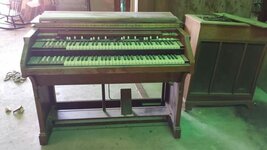
Here is the C-3 on day and at the location I picked it up. The organ was in Southern California, so I made a day trip to pick it up. It was found in a warehouse where it had spent the last two decades in less than careful storage.
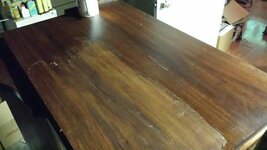
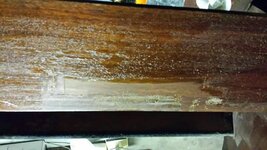
While more or less in tact, the cabinet woodwork was severely dried out and sun bleached. Part of the original shellac had dissolved(?) Where it had gotten the most sun exposure. Some case parts were splitting and/or separating as well.
Two decades of neglect and being left uncovered in a warehouse in the middle of the desert left the keys and controls excessively dirty.
936588007da254bd10f84839eac5ac0f.jpg
415cf844674616ce4ccea4af7535690e.jpg12155cc5de562178a5d691016adda425.jpg
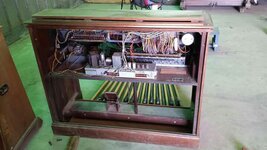
The internals however, were fairly well preserved, as they kept the back on the whole time. The interior appeared more promising. Most of the wiring and mechanical parts seemed to be pretty well preserved. Though, mouse feces were present, I found no damaged wiring upon initial inspection. However, the mice did attack the green felt dust cover on the tone generator, which seemed like a good compromise.44f011aeb6effc3a9d52f89cfe8b0b44.jpg5e330b106f688ee101ac4a90fddc7235.jpg

I had driven 200 miles one way to pick this organ up, sight unseen. There was no way I would leave empty handed. So, I loaded it up and headed home.8aa6fa1f55132a5d5067595a5181c3b7.jpg
 
OP
R

rodsnratfinks

Well-known member
Joined
Jan 13, 2015
Messages
1,397
Location
California
Once the organ was in its new home, it was time to begin cleaning. The pictures don't show it, but the thing was so dirty, you'd think it had been buried in the ground. First, I vacuumed then I wiped it down several times with a damp cloth. The keys would need to be cleaned individually, so I removed the front retention rail, so I could get all the spaces between. This was a tedious process.c7b24da950ccbe2b618d26e2cc0c008a.jpgadb0de0415bb190a866eb7f1971b2d66.jpgc0f2a0849e20c11c6a905d93c39cb56f.jpg
I also cleaned up the inside a bit.f5eaa9d10b12603c4b8ad9643807d4ad.jpg

Pardon the messy garage. At the time I brought the organ home, we had only lived here for about three months.
 
OP
R

rodsnratfinks

Well-known member
Joined
Jan 13, 2015
Messages
1,397
Location
California
Having sat next to a window for much of its life, the finish was faded and sun bleached. What's more, the clearcoat was cracked and dried out. My goal was to avoid refinishing if at all possible, so I decided I would try to rejuvenate the original finish. I wanted to address only the functional aspects of the instrument at this time, so that it would be in working condition. I could always go back and refinish it if I wanted in a few years when I had time. I used a variety of products to achieve these results. These pictures show the contrast between the the areas I repaired and the before.a7658fec247c4d82b8aa1e34944f66b2.jpg40805fe92e81144b9ae1e33e8c697a2e.jpg63515d1c569ff8e558b5c7d23526fdc8.jpg
 

Dick in Wisconsin

Well-known member
Joined
Mar 3, 2012
Messages
3,048
Location
Shawano, Wisconsin
Interesting project.

Was is the difference between the Hammond "B-3" and the Hammond "C-3". I've heard many times references to the B-3, but have never heard of a C-3.
 
OP
R

rodsnratfinks

Well-known member
Joined
Jan 13, 2015
Messages
1,397
Location
California
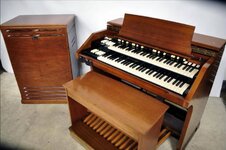
The B-3 and C-3 are identical in every way except the furniture.
This is a B-3202c8e18e916cac4f16302b05f6149bf.jpg
This is a C-33212daf23c194bf98e9ee9145b564e65.jpg
The reason that the B-3 name is often mentioned and the C-3 isn't, is because the B-3 is more common in US while the C-3 is more common in the UK and Europe. As a general rule, if an artist is from Europe they probably used a C-3, not a B-3 (Ex: The Beatles, Deep Purple, Led Zeppelin, Pink Floyd, Yes, Emerson, Lake, and Palmer, etc. used the C-3 while Jimmy Smith, Santana, Allman Brothers, and Al Kooper used a B-3) Also, in general the the B-3 was popular with jazz artists while the C-3 was frequently used by rock artists.
Here's a picture of Deep Purple for fun:387a758efdd476b3b28fdbe47005457a.jpg
 
Last edited:

ishiboo

Well-known member
Joined
Oct 27, 2010
Messages
9,481
Location
Oshkosh, WI
Looking forward to this one. Nothing like a Hammond through a Leslie.

Amen.

Just saw Mark Knopfler in concert and they had a Hammond with a big Leslie spinning behind it... didn't use it was much as I had hoped. Great show though.

Subscribed to see this happen!
 

MBfreak

MEMBER EMERITUS
Joined
Dec 10, 2010
Messages
2,301
Location
Linkoping , Sweden
A dream project!
Has it all. A great instrument to start with, considerable skills needed for the keyboard assembly and cabinetry. Expect to restore every connection, except the soldered ones. The amp is the easy part, even though good tubes are becoming hard to find .
Some of my $0,02´s worth:
If it has wax impregnated paper insulated capacitors in the range a few hundred pF to maybe 0,5 microF, I would check all of them. A Fluke 82 is your friend. Wax/paper caps have a tendency to increase in value, since the wax seems to evaporate over the decades, bringing the alufoil layers closer together. Very common on 50/60s radios. The electrolytic filter caps can survive and do so quite often. Easy to check.
Fantastic project. Get a Leslie and enjoy.

Best regards

Ola
 
OP
R

rodsnratfinks

Well-known member
Joined
Jan 13, 2015
Messages
1,397
Location
California
Cleaning the individual drawbars (sliders), and the individual keys and controls.846670c891d35a2316a5a77f21b78625.jpg4b3db9edaf02afbe6046194b75dc8c8d.jpg
Replacing the old rotten key felts. b7fb319f6d5dde664c02ce1c1f143d4d.jpg
Here is the reassembled keybed. Looks and feels so much better now.bc9344b6b8d20f60b35cd45c9326a2af.jpg
 

Mr. T

Well-known member
Joined
Sep 4, 2013
Messages
636
Location
Central PA
Much respect and admiration for this project. If there is a single electric organ worth the effort this is it.
 
OP
R

rodsnratfinks

Well-known member
Joined
Jan 13, 2015
Messages
1,397
Location
California
Speaking of Leslies: I had said before that the C-3 is my dream organ, and while that is true, that's only part of the dream. Just like with an electric guitar, at least half of the sound is the amp you use. While there are several amplifiers that sound great with Hammond organs, there is no more iconic/loved speaker to use with the C-3 than a Leslie rotary speaker, and there is no Leslie model that sounds and fits better to my playing style and ears than the Leslie model 147. It just so happens, that around the same time I got my C-3, a 1969 Leslie 147 in working condition came up for sale for a price I could (sort of) afford. Perfect.

a599508573897483e93b50c400c5935a.jpg

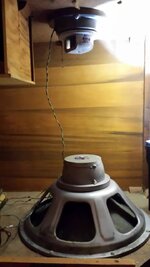
I didn't take enough photos to prove it, but the Leslie had been through a rough life and had quite a bit of wear from being used in a band since new. I already happened to have a more gently used older (about 1950) Leslie that was in good mechanical shape, but very bad cosmetically. I combined the best parts from both Leslies and rebuilt all the mechanical components. The bass driver had been replaced by an inferior reproduction model, so I used the original 1950s Jensen alnico drivers out of the older speaker which actually sound even better than the original 1969 drivers do, (in my opinion). I was very fortunate to have such things on hand as they are not inexpensive. The results make for one of the better sounding Leslies I've heard.

31be80fa7433bc5c5441a70d533bd468.jpg
 

MBfreak

MEMBER EMERITUS
Joined
Dec 10, 2010
Messages
2,301
Location
Linkoping , Sweden
rodsnratfinks.
A Hammond C3 and a Leslie 147. Dreams do come thru!!

All the best with the restoration and playing!
Some Jimmy ( Jimmie?) Smith maybe?

Best regards

Ola
 

Dick in Wisconsin

Well-known member
Joined
Mar 3, 2012
Messages
3,048
Location
Shawano, Wisconsin
Sounds of the best jazz ever was done on a Hammond B-3, maybe it was a C-3.

About 20 years ago or so, a very good friend and his wife were moving from their big house to a condo. There was a large, nice looking organ off to the side in the living room for years and years. Never thought about it much. They didn't know what to do with it. They were going to try a few churches to see if they wanted it.

It was only years later that I realized it was probably a B-3. With two Universities in town, they should have been able to get one or both of their music departments to just "pick it up". I was probably bought brand new (they NEVER bought used stuff) and was probably in perfect condition. I hope it didn't go in the dumpster.
 
OP
R

rodsnratfinks

Well-known member
Joined
Jan 13, 2015
Messages
1,397
Location
California
For those who don't know what these organs sound like, here's a nice medley of classic rock organ parts (not me playing). Pretty great stuff:

Sent from my SM-G920V using Tapatalk
 

fergus

Well-known member
Joined
Oct 4, 2009
Messages
1,620
Location
Yolo County CA
Awesome man! My grandmother has (and still plays almost daily) a C-3 that she's owned for the last 50 years or so. I hope to inherit it one day. One of my favorite sounds ever.

Side note: She used to have a 4x15 cab that she used with it. That much sound in a small 3 bedroom house...EVERYTHING was ratttling! Cracked me up when I was a kid.
 
OP
R

rodsnratfinks

Well-known member
Joined
Jan 13, 2015
Messages
1,397
Location
California
The organ after having been cleaned, the finish touched up, and mostly put back together.

785a129666eb094872d47c8fb3aa9989.jpg
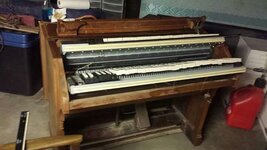
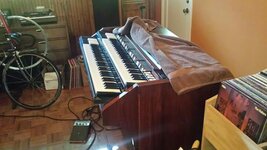
And... Here is the organ after being moved indoors. At this point it had not turned on. Remember, when I got the organ, the (mechanical) tone generator was seized. There are techniques that can be used to un-freeze the tone generator, that usually require oiling a little at a time and waiting, then oiling, then waiting... The process is repeated usually for several months before useful results show. The oil is distributed via a capillary system and the friction must be minimal before the 60Hz AC synchronous motor can run it.

3c394899c446fe635c88d3ffb3e7cab4.jpg

About a month later...

61e5e4b88d73b7db250dfd848662449f.jpg

The organ finally lives again. 06/06/14 was the first day the organ was capable of running under its own power (I brought it home in the tail end of March). I got to hear its first sounds. And what beautiful sounds they are. Of course, I was not done yet. I still needed to iron out some kinks. It was another three weeks from this point before it ran well. Keep in mind also, that only the core part of the organ was cleaned up and repaired at this point. Even in the best case scenario, there would still be much to do.
 
Last edited:
OP
R

rodsnratfinks

Well-known member
Joined
Jan 13, 2015
Messages
1,397
Location
California
So, once the tone generator assembly was spinning smoothly. I started 'waking' up the organ electronically. All the tubes tested well and some contact cleaning in the preamp fixed any other problems for the time being. I went through and cleaned and tested every key and switch, but found that numerous tones were either not sounding, or sounded unnatural. Exhaustive research found me taking the organ apart again looking for the cause.

889eb078f17252e9f2f86d9d64e89083.jpg

I ended up having to take the preamp out and inspect the wires that fed the pedals and manuals (keyboards).
426f4a16fe828240a44f6076c2dc85cf.jpg

That's when I found this:
5dcd50857695627e326998edd9b7a971.jpg

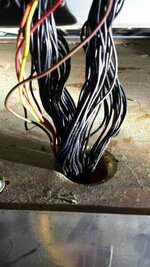
I discovered that a rodent had chewed on/through these wires (that connect the pedal keyboard to the organ tone generator), severing three, and striping the insulation of about twelve more. In order to repair the wires, I would need to replace fifteen four foot sections. So, I began removing the pedal switch assembly.

c5c252966f845d5fae191d33fa3e0d17.jpg

These wires would need to be removed.

b6a83f61471f68c7571ca3763c55cca3.jpg
5f139d9712cc1807da32c20fcf779cf2.jpg

The pedal wiring removed.
da6c802071470032a36144a06a5facfd.jpg
f9a27cf316d2d4d160a068d5b2092450.jpg
 
To avoid these ads, REGISTER NOW!
OP
R

rodsnratfinks

Well-known member
Joined
Jan 13, 2015
Messages
1,397
Location
California
Ah, the Novachord. I'm well acquainted. In fact, it was that exact Novachord that I almost bought from in Summer of 08, (or was it 07?). I know the previous owner and saw when he offered it, but knowing it would be a while before I would have been able to properly restore it, I chose to pass on it so that it could go to someone else who would really appreciate it. That turned out to be a wise decision, because he did an amazing job. Far better than I could, and I'm sure if I had purchased it at the time, it still would not be finished. Sometimes it's better to let projects go to other people who will finish them. I have no regrets. His documentation of the restoration is a treasure. Without it, few people living would know what a Novachord even sounds like. Very cool. Maybe one day I'll find another for me to restore.
 

jayoldschool

Well-known member
Joined
Apr 23, 2006
Messages
2,119
Location
Canada
Nice. There's an M3 sitting at my grandmother's house that's mine for the taking. One of these days I need to go pick it up.
 
OP
R

rodsnratfinks

Well-known member
Joined
Jan 13, 2015
Messages
1,397
Location
California
So, at this point in the story I was at a crossroads. I had to disassemble the organ quite a bit just to repair the pedal switch assembly. Three of the tones were non responsive indicating that the issue was earlier in the signal path than the other twelve, possibly in the tone generator itself. Also, my attempt to improve key contact response by moving the busbars had yielded less than satisfactory results. The busbars needed to be cleaned. Doing so would necessitate desoldering the manual (keyboard) assembly from the tone generator, something I was previously trying to avoid. Given these factors, the condition of the woodwork, and my tendency toward perfectionism, I elected to take this opportunity to restore the organ from the ground up, the right way. That way, it's done and I have the satisfaction of knowing that I have personally overhauled every system in the instrument. Well worth it if you ask me.

So, here is the tone generator desoldered from the manuals.
b79e8a36f49bfc6441c523374244ebbe.jpg

Removing the run motor.
2a3fc6edc934bbc6bebeeecdca1005f8.jpg

The tone generator assembly completely removed.
53b55e207971ad57d6262c73fb6c1de4.jpg
a4bf1766bb589907ec3caeb54f088e17.jpg

Then the vibrato scanner. This will have to be overhauled.
0d69e87a3a2bdacb31f78bcca33ac6c0.jpg
 
Last edited:
OP
R

rodsnratfinks

Well-known member
Joined
Jan 13, 2015
Messages
1,397
Location
California
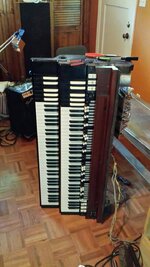
The manual assembly removed from the cabinet.

3ed14d564652da6dc08d82e30e7a9c75.jpg
99c857fb0ab14a6b3ebf72d4431d2236.jpg

These are the busbars removed from the manuals. They are about half the diameter of a wire hanger and 4 feet long, coated with palladium. Very delicate. One must be extremely careful when replacing them since they fit into the manuals with no play and if you're not careful, can damage the key contacts inside which are almost impossible to replace. There are nine busbars per manual and they were all filthy. Top is clean, bottom is dirty.
f454b9896f03debe5147405d645f1f94.jpg
6f664dd78fdd5a9c37c5c16b3f09a456.jpg
Here it is back together.
ef336858fd2d009029af25cea034bc01.jpg
1109adb6e93878a94a0b7051688a05ea.jpg
 
Last edited:

SK Eric

Well-known member
Joined
Mar 3, 2015
Messages
109
Looks great! Check out what this company does.

theSARGE-1.jpg
 
OP
R

rodsnratfinks

Well-known member
Joined
Jan 13, 2015
Messages
1,397
Location
California
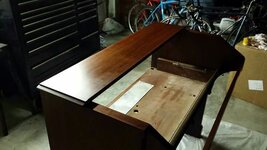
I was very pleased to find that the wood underneath was well preserved. The original shellac is very thick and durable. Even though it was almost destroyed, the wood underneath was healthy for the most part. Stripping the finish took longer than any other part of the project. I got really distracted/discouraged during this time and went long periods of time without doing anything. These pictures are after sanding and staining. I elected to touch up the finish with stain since it looked pretty good overall and I wanted to avoid the additional complication of bleaching the wood and restaining. While that may have yielded better results, I kind of wanted the organ to retain some of its vintage character. It's had a hard life, so it's never going to look perfect, and that's okay. Also, I'm a novice woodworker at best, so I'm just glad I didn't have to pay someone else to do it.

f8ec0c8243d90eb3f61dbe72fd77a35c.jpg
8ce29a035a79a90ee4e4ff64a4d8bc87.jpg
53b0d07fa02842e03e873bc46d7bca6c.jpg
 
OP
R

rodsnratfinks

Well-known member
Joined
Jan 13, 2015
Messages
1,397
Location
California
The first coat of lacquer has been applied. I couldn't wait to get past the refinishing stage. It's so time intensive and requires long uninterrupted periods of tedious work. Not exactly something new dads can often afford.

52c3fd92395b84d2dc67eb0f80840aef.jpg
d922e8381f5748e5c81f8eb47f67d361.jpg
92e77cbc45481f0b1bbd8399d024893b.jpg
 
OP
R

rodsnratfinks

Well-known member
Joined
Jan 13, 2015
Messages
1,397
Location
California
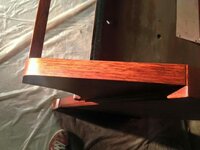
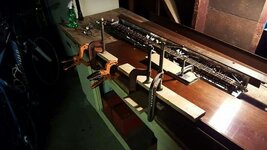
Right around the time I finished the last coat of lacquer, I discovered by accident that several of the joints in woodwork had loosened up and were falling apart. Well, that wasn't going to fly if I want this thing to last another sixty years. So, I did some joint repair. And since the a few of the case parts were also splitting, I took it upon myself to remedy those.
Gluing the back support panel back into place. This had to be done on both ends. There were several other parts that needed repair as well. When I was done, the case was much more sturdy.
c3c667252517ff7fbca5a5da8e434f53.jpg

Some of the case parts also needed repair. I didn't take many pictures of this process, unfortunately.
39bf0e1b40bb88fd1f8d857b693fad2b.jpg
8da41789a467ceb8cde71ad1f8e5c001.jpg
4a5b8b4caa914506258f97dd9ac6f0f9.jpg

These repairs caused me to realize that I need more woodworking clamps. So, after I finished the piece pictured, I splurged on several Bessy bar, pipe, and spring clamps. Money well spent. : )
 
Last edited:

SteveH-CO

Well-known member
Joined
Aug 29, 2014
Messages
283
Location
Southern Colorado
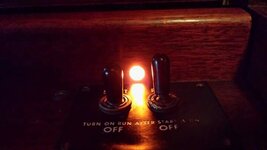
I grew up with such a Hammond organ, and it got balkier with age. It was finally sold/given away when my parents moved away from Michigan. I recall holding the 'start' and 'run' buttons to fire it up. Thanks for the excellent writeup and photos - you're making huge progress on a daunting task.
 

jhn9840

Well-known member
Joined
Mar 11, 2007
Messages
1,189
Location
Northern Panhandle of WV
This thread is very entertaining and I know absolutely nothing about any musical instrument. Have you actually finished the organ restoration? How much time do you have in it? Excellent work please keep the pictures coming.

jhn9840
John
 
OP
R

rodsnratfinks

Well-known member
Joined
Jan 13, 2015
Messages
1,397
Location
California
I grew up with such a Hammond organ, and it got balkier with age. It was finally sold/given away when my parents moved away from Michigan. I recall holding the 'start' and 'run' buttons to fire it up. Thanks for the excellent writeup and photos - you're making huge progress on a daunting task.

Thanks. It's a labour of love. We never owned an organ growing up, but I was always envious of those who had them.

This thread is very entertaining and I know absolutely nothing about any musical instrument. Have you actually finished the organ restoration? How much time do you have in it? Excellent work please keep the pictures coming.

jhn9840
John

Hi. That's a great compliment. It is not finished at this time, but I am getting close. My wife found out she was pregnant with our first around the time I acquired this one (...I can't remember if it was just before or after). I knew that was going to make it more difficult to finish the organ, but never anticipated it would take as long as it has. Since we bought our first home right before THAT, it complicated things even further because we were still moving in at the time. Now, my wife is 5 months pregnant with our second child and things are about to get even more hectic. I *might* be able to finish the organ before the next kiddo comes along if everything goes smoothly from here on out. In reality, if I went uninterrupted, I could probably finish the organ in a week or two. It's just so rare that I have even a few hours to myself, and want to do anything more with them than sleep or clean house.

...keep in mind though, it's much harder and more time consuming to do a job like this with frequent interruptions/over an extended period of time.
 
Last edited:
OP
R

rodsnratfinks

Well-known member
Joined
Jan 13, 2015
Messages
1,397
Location
California
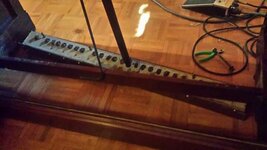
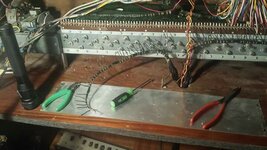
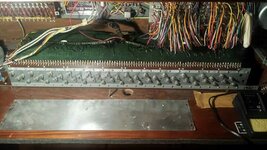
Next, I identified which wires need replacing in the pedal switch assembly. Once the damaged wires were identified and tagged, I could go back and replace the damaged wires one by one. There are about 70 wires about four foot long in the assembly. While the unit is apart, I will also remove and clean the bus bars, like I did in the manuals (keyboards).

b1e54b60bcd358c8dcd3f53087bbdb3e.jpg

This was after I finished checking and tagging all the damaged wires in need of replacement. All the white pieces of tape indicate damaged wire. There are at least that many tagged with black tape because I wised up halfway through and switched to white tape for better visibility.

fb7dda0b6d31a4396737ce08bc24f8a5.jpg
 
OP
R

rodsnratfinks

Well-known member
Joined
Jan 13, 2015
Messages
1,397
Location
California
Applying paste wax to the organ cabinet. I gave it a good two or three coats. For the most part, the results are quite satisfactory. It was at this point that I realized I didn't do too bad of a job on the finish.
04ae6eec72dda7d802b6f09c29522ae2.jpg
 
OP
R

rodsnratfinks

Well-known member
Joined
Jan 13, 2015
Messages
1,397
Location
California
This was a big day. The day I finally brought the cabinet inside again.

68f468b8fd2025430e10fe63390a8495.jpg

The next step, of course, was to shoehorn the keyboard assembly back into the case. It turned out to be quite a chore since the tolerance is about a 1/16" per side and the assembly weighs about 80 pounds. Luckily, we're a couple of mechanics so this is nothing out of the ordinary for us.

f4959bfa8ede0bee5e42d9da1d45695a.jpg
5b478b4a6fd90136acd20e6cfe7525dc.jpg
966f6b0f5e847b56259a909e6835722b.jpg
 

memphisnate

Well-known member
Joined
Jan 8, 2010
Messages
398
Location
Memphis, TN
Really enjoying following your process/progress! We have a B-3 And Leslie cabinet at my church that we use frequently and it sounds awesome.

PS. I spy some mid-century pieces. :thumbsup:
 
To avoid these ads, REGISTER NOW!
Top Bottom