To avoid these ads, REGISTER NOW!

Wiring a big compressor with magnetic motor starter

StevenMorgan

Well-known member
Joined
Oct 20, 2011
Messages
137
Location
Paris, KY
I've been doing a lot of research on this subject trying to sort through the posts on various threads and deciphering the info. Regardless whether you have a 5hp, 7.5hp or 10hp compressor, these are the rules for a good and legal installation. Here is my breakdown to confirm my thoughts and to put all the info out there yet again for others to hopefully comment on, correct me about, and benefit from.

1. If your compressor has a motor that is a no kidding 3hp or more, you'll likely need a magnetic motor starter to switch the thing off and on, instead of wiring directly through a pressure switch. Most pressure switches are only good for about 3hp. Also, the big compressors become much easier to hardwire than to buy plugs and receptacles any bigger NEMA 50a style plugs capable of handling this horsepower... There are plenty of threads on this topic.

2. When selecting a motor starter, choose the correct starter based on the HP rating, phase, and amp rating listed on the motor starter specs and verify it meets the full load amps (FLC or FLA) provided on the nameplate of the motor. It is possible to use a 3 phase (3 pole) starter on a single phase (2 pole) starter, just ensure it meets the specs of your motor.

3. When selecting power wires from the panel to the motor starter, use the correct NEC table to define an amperage... NEC table 430.248 is for single phase AC motors and NEC 430.250 is for three phase AC motors. Use the right chart. Multiply that amperage by 125% to get the amps your wire needs to carry at your motor's voltage.

4. To size the circuit breaker, Use the FLA or FLC amperage from the appropriate NEC table and multiply by 250% to find the maximum circuit breaker size usable to account for the massive inrush current these motors need for startup.
Wire for motor circuits is sized differently than standard branch circuits. Breakers can be rated higher than the wire ampacity because the breaker for a motor circuit only protects against short circuits and ground faults but not overloads. Overloads are handled by either the overload relays in the motor starter or the overload on the motor itself(red push button).A smaller breaker is often used, but the exact size depends on many variables.

5. Motor starters have several different voltages for the coil, with 120v and 240v being most common. Wiring your motor starter gets pretty specific at this point, depending on your choices of motor starter manufacturer, pressure switch, an on/off switch, and if you need service disconnects for your location. (anything further than 50' from the service panel, or not in line of sight of the panel.)

6. Once you add a motor starter to your compressor wiring setup, the power to the motor is controlled by the magnetic motor starter, and subcomponents like a pressure switch or a manual on/off switch are part of the control circuit and don't have a large amperage flow through them. Selecting a smaller 12awg or 14awg wire for these control wires.
 

Attachments

  • NEC 430.248.JPG
    NEC 430.248.JPG
    58.9 KB · Views: 204
  • NEC 430.250.JPG
    NEC 430.250.JPG
    89.2 KB · Views: 176
Last edited:
To avoid these ads, REGISTER NOW!
OP
S

StevenMorgan

Well-known member
Joined
Oct 20, 2011
Messages
137
Location
Paris, KY
So here is my setup.

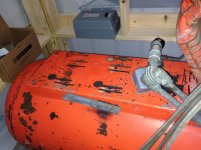
The Compressor
I picked up a DeVilbiss 445 compressor pump and 120gal tank off craigslist without a motor. This pump can accept any motor from 7.5hp to 15hp as long as you adjust the rpm of the pump accordingly using the appropriate pulley.

Since it didn't come with any electrical stuff at all, I'm starting from scratch.

The Motor
I chose a 10hp single phase motor size to provide the maximum power as financially possible at this time. I found a Baldor motor that was rebuilt after a warranty failure and am waiting for it to arrive. Here are the motor specs:

Baldor L3712T
10HP TEFC
230v 1PH
38A
1740rpm
1.00 SF
86.5% EFF
98 PF

The Magnetic Starter
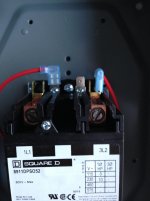
I watched eBay for a 50a/10hp motor starter and finally picked up a Square D 8911DPSG52V09 motor starter. Following the chart on the inside of the starter, I selected the thermal unit:
1.00 SF motors require a thermal unit that is 90% of the nameplate amps...

so thermal unit = 38a x 90% = 34.2a

scanning down the first column of the thermal unit chart on the cover of the starter I found the B 45 thermal unit if for 31.5-36.0a... Bingo

Now I have to start planning the wiring!

Sizing the main power wiring:
Wire size per the NEC table in the first post says my 10hp 240v motor will be 50a.

I measured my wiring run from the 200a panel I just had installed over to where the compressor will be and it came out to 28' of wire. No need for a service disconnect since mine will be set up within 50' and in direct line of sight.

28'
50a
240v

So I went online and plugged in my info and found that #6 THHN will be good to hook this motor up.

I've also got you guys to help confirm that #6 THHN is good to go! Thanks Wylies!

I ran pvc conduit from the 200A panel to the air compressor location and roughed in a box. Pulled three #6 THHN wires through it.

Next is breaker sizing.
The same chart is used to calculate the maximum circuit breaker size.

50a x 250% I= 125a breaker... wow!

The biggest breaker I've found locally is 70a, and they start getting more expensive online for the bigger ones... so I'll see how a 70a does before I pull out the big bucks for another one.

Hooking up main power to the mag starter see my next post below for more pics
I used 3/4" liquidtight conduit to go from the junction box to the motor starter on the compressor itself and pulled the #6 THHN and two #14 wires for a pushbutton switch to control the compressor.

I ran out of black wire, so I used two red wires for this run. These hook up to L1 and L2 at the top of the motor starter. Ground wire got a ring terminal crimped and is attached to the motor starter enclosure with a standard 10-32 grounding screw.

Creating the control circuit
I needed to install a pressure switch, but also wanted a simple on/off switch near the compressor to control it. I ran these two switches in series with each other. I used green and white stranded THHN wire for this control circuit because it was on-hand. I wrapped black electrical tape on the green wire that actually sees voltage.

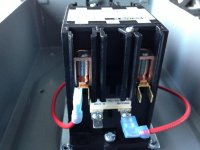
The factory wired heater circuit starts at a spade connection tapping off L2 and goes to the heater at the bottom, and then comes back up top and connects to a spade connection below L1 (but not physically connected to L1!!).

I made my control wiring exactly opposite of this factory wiring. I started at the spade connection that taps off of L1 and ran a green wire marked with black tape through some 1/2" armored cable that runs to my pressure switch along with a ground wire and white return wire. The white wire runs from the pressure switch, back into the motor starter enclosure, loops around and up the 3/4" liquidtight to the wall junction box. I installed a second electrical box and connected it to my main power connection junction box.

This second box is where I installed my big start/stop pushbutton switch. The white wire connects to the switch and a green wire marked with black tape connects to the opposite side of the switch and runs back to the motor starter through the conduit. Once back in the motor starter enclosure, I completed the circuit by connecting this to the spade terminal below the L2 terminal (but not physically connected to L2!!).

Connecting the magnetic motor starter to the electric motor
From the bottom connection points I ran 3 #6 THHN wires from the two contacts and the enclosure ground point, through a short section of 3/4" liquidtight conduit to the motor. My motor already had its internal wiring twisted together appropriately for my CCW rotation so all I needed to do was connect the two legs from the motor to the two pairs of wires inside the motor and the ground wire to the ground point on the motor.
 

Attachments

  • IMG_1115.jpg
    IMG_1115.jpg
    143.5 KB · Views: 175
  • IMG_1113.jpg
    IMG_1113.jpg
    143.7 KB · Views: 159
  • IMG_1099.jpg
    IMG_1099.jpg
    144.4 KB · Views: 168
  • IMG_1100.jpg
    IMG_1100.jpg
    142.4 KB · Views: 138
  • Nameplate.JPG
    Nameplate.JPG
    81.6 KB · Views: 120
  • IMG_1119.jpg
    IMG_1119.jpg
    146.6 KB · Views: 149
  • IMG_1116.jpg
    IMG_1116.jpg
    138.9 KB · Views: 179
Last edited:

Zrexxer

Well-known member
Joined
Jan 23, 2007
Messages
5,058
Location
Pflugerville, TX
I can't speak to the NEC requirements, but the rest of your breakdown is right on the money. Good job extracting the pertinent facts from a WHOLE lot of posts and other extraneous information here.
 

wyliesdiesels

Well-known member
Joined
Aug 14, 2012
Messages
19,983
Location
Modesto, CA
I havent read everything u posted but the NEC chart u used is wrong.

Its for DIRECT CURRENT motors. U need T430.148

A 10HP motor will be closer to 50a.

However looking at Baldors site, i see that the motors FLA is indeed 38a.

The wire will still need to be sized for the NEC FLC rating.

125% x 50 = 62.5a so u need #6 THHN in conduit or #4 NM-b.

Where do u plan on installing this beast?

Do u have an electrical service large enough to support it?
 
Last edited:
OP
S

StevenMorgan

Well-known member
Joined
Oct 20, 2011
Messages
137
Location
Paris, KY
I havent read everything u posted but the NEC chart u used is wrong.

Its for DIRECT CURRENT motors.

A 10HP motor will be closer to 50a.

Is the 38a youre going off of from the actual nameplate of the motor or did u pick it from that incorrect chart u used?

wylies, I've used a lot of your posts to get me this far. Luckily for me, my nameplate amps is ironically 38a... just like in that table. Do you know the correct table to use so I can change the post to reflect the right one?

EDIT: I found the correct table for single phase AC motors and updated the first post.
 

Attachments

  • IMG_1174.jpg
    IMG_1174.jpg
    131.2 KB · Views: 161
  • IMG_1175.jpg
    IMG_1175.jpg
    127.2 KB · Views: 136
  • IMG_1178.jpg
    IMG_1178.jpg
    133 KB · Views: 115
  • IMG_1179.jpg
    IMG_1179.jpg
    132.9 KB · Views: 112
  • IMG_1180.jpg
    IMG_1180.jpg
    114.5 KB · Views: 115
  • image.jpg
    image.jpg
    138.6 KB · Views: 135
Last edited:

wyliesdiesels

Well-known member
Joined
Aug 14, 2012
Messages
19,983
Location
Modesto, CA
Next is breaker sizing.
The same chart is used to calculate the maximum circuit breaker size.

50a x 250% I= 125a breaker... wow!

The biggest breaker I've found locally is 70a, and they start getting more expensive online for the bigger ones... so I'll see how a 70a does before I pull out the big bucks for another one.

The 250% sizing for the breaker is the MAX size allowed not the minimum needed.

Seeing as your motor's FLA is way lower than the table FLC its possible that the 70a will hold. It all depends on the in-rush characteristics of the particular motor. In-rush can be 4x-8x FLA...
 

Junkman

Well-known member
Joined
Dec 18, 2006
Messages
6,597
Location
Northeastern CT
I have been reading a lot of old posts about magnetic motor starters, since I need to get one for a compressor that I am "refurbishing" from a 3 phase to a single phase unit. Mine is a 5 HP 20 amp Baldor motor. My specific question is can I use the on / off pressure switch with 2 wires to control the motor starter, like they did with the 3 phase motor starter? Might someone have a wiring diagram that I can follow? This is the Square D starter that I am considering... Motor Starter, DP, 208/240V, 2P, 30A, NEMA 1

thanks
 
Last edited:

wyliesdiesels

Well-known member
Joined
Aug 14, 2012
Messages
19,983
Location
Modesto, CA
Yes u can. That is how its suppose to be setup.

What u do is wire the pressure switch to one side of the coil for the contactor.

1PhWiring.JPG
 
Last edited:

Norcal

Well-known member
Joined
Mar 16, 2008
Messages
13,751
I have been reading a lot of old posts about magnetic motor starters, since I need to get one for a compressor that I am "refurbishing" from a 3 phase to a single phase unit. Mine is a 5 HP 20 amp Baldor motor. My specific question is can I use the on / off pressure switch with 2 wires to control the motor starter, like they did with the 3 phase motor starter? Might someone have a wiring diagram that I can follow? This is the Square D starter that I am considering... Motor Starter, DP, 208/240V, 2P, 30A, NEMA 1

thanks


Just like the starter the OP listed, it uses a elcheapo definite purpose (DP) contactor there are some who say DP stands for Don't Purchase which I agree. Any SQ D starter that has the type S contactor is a good choice, DP contactors are built for a specific number of cycles, non repairable, no coil swaps, as long as they last just beyond the warranty period, it's all good.
 

Junkman

Well-known member
Joined
Dec 18, 2006
Messages
6,597
Location
Northeastern CT
The other one that I have been looking at is a Siemens Magnetic Motor Starter 16CF15AGACF, which is more expensive, but might be a better choice based on you assessment of the DP unit. What is your opinion of this Siemens item?
 
To avoid these ads, REGISTER NOW!
OP
S

StevenMorgan

Well-known member
Joined
Oct 20, 2011
Messages
137
Location
Paris, KY
In the product description it mentions 30a-40a nominal, 50a maximum... I read that to say you would be fine with this mag starter for any 220v motor that has a continuous data plate amperage between 30-40 amps. I wouldn't want it on a 50a motor.

Notice that it has an adjustable heater depending on your FLA
 

Aceman

Well-known member
Joined
Jan 28, 2007
Messages
2,513
Location
Eastern Oregon
You did a great job with the write up, but I haven't seen any mention of the most important detail. Starting a single phase motor of that size will most likely require power company approval. Here's a cut-and-paste of our local power companies service requirements.

UEC:

Customers connecting any individual motor larger than five horsepower must obtain prior approval in writing from the Power Company. In addition, air conditioners and heat pumps larger than five tons require prior Power Company approval.


Pacific Power has similar guidelines in their manual.
 
Last edited:

TractorJeff

Well-known member
Joined
Dec 8, 2013
Messages
3,309
Location
Elkhorn, WI
He states he has a 200 amp panel installed. Are you sure you need to size the breaker 250%? My neighbor has an "Honest to God" 5hp compressor on a 40 amp breaker and it is starting and running with no issues.
Full Load Starting Amps could very well reach 250% for the first few rotations but should rapidly decay back to Nominal as speed approaches rated rpm.
Anybody want to comment?
 

dw1

Well-known member
Joined
Jan 26, 2015
Messages
1,335
Location
Ky
You did a great job with the write up, but I haven't seen any mention of the most important detail. Starting a single phase motor of that size will most likely require power company approval. Here's a cut-and-paste of our local power companies service requirements.

UEC:

Customers connecting any individual motor larger than five horsepower must obtain prior approval in writing from the Power Company. In addition, air conditioners and heat pumps larger than five tons require prior Power Company approval.


Pacific Power has similar guidelines in their manual.

I had a similar issue on a job I did for my B.I.L, he bought 30+ acres in a residential area (Zoned Agriculture), I put a 400a service in, he has a 5HP compressor in one bldg and a 5HP water pump in a pump house to irrigate this tree farm, the really nice lady from the power company showed up one day, she explained that if any of his equipment wreaks any Havoc on "Her" Power lines, they would start by cutting off the service to this property, she claimed as your above statement said, nothing over 5 HP. Its been running over a year now with no problems!!
 

motofool33

Well-known member
Joined
Feb 2, 2013
Messages
1,634
Location
Currently North of Houston
I had a similar issue on a job I did for my B.I.L, he bought 30+ acres in a residential area (Zoned Agriculture), I put a 400a service in, he has a 5HP compressor in one bldg and a 5HP water pump in a pump house to irrigate this tree farm, the really nice lady from the power company showed up one day, she explained that if any of his equipment wreaks any Havoc on "Her" Power lines, they would start by cutting off the service to this property, she claimed as your above statement said, nothing over 5 HP. Its been running over a year now with no problems!!
2 5hp motors not starting at same time is nothing like a 10hp starting up. I decided after talking to many people just not worth it in power consumption wise to use a 10hp single phase compressor. Switched mine to 7.5hp instead not crazy requirements to get it installed and running on a 200amp panel.

Sent from my SAMSUNG-SM-G900A using Tapatalk
 
OP
S

StevenMorgan

Well-known member
Joined
Oct 20, 2011
Messages
137
Location
Paris, KY
2 5hp motors not starting at same time is nothing like a 10hp starting up. I decided after talking to many people just not worth it in power consumption wise to use a 10hp single phase compressor. Switched mine to 7.5hp instead not crazy requirements to get it installed and running on a 200amp panel.

Sent from my SAMSUNG-SM-G900A using Tapatalk

I just finished wiring mine up, and edited the my posts above to complete my wiring description.

I added oil, hydrostatically tested my tank, crossed my fingers, flipped the breaker on, and then pushed the start button. It started right up and was surprisingly quiet considering I am still waiting for my intake filter and cover plate to show up. A nice satisfying chug-chug-chug. Consider me a happy DIY'er :drool::beer:

I do hope the local power company doesn't mind my 10hp motor. I will read my agreement and see if they say something about motor size. That would ****.
 
Last edited:

md21722

Well-known member
Joined
Nov 30, 2015
Messages
1,840
Location
Mt Juliet, TN
That's really interesting. Last time I lived in the country I asked the power company out to look at some things and told them every time my neighbor's heat pump comes on my lights dim and they said "maybe we need to put a bigger transformer out there". Reaching out to them first may smooth things over. Power consumption wise I would think a 10HP is more efficient than a 5 HP. By the NEC tables, 5HP is 28A FLC and 10HP is 50A FLC.
 

86turbodsl

Well-known member
Joined
Jul 1, 2005
Messages
6,554
Location
Michigan
Reality is, if you're the only one on the transformer, you probably won't annoy anybody but yourself with big motors. Primary runs a pretty long ways out in the country, there's plenty of loads and plenty of 5+ HP compressors on rural properties.
 

FTG-05

Well-known member
Joined
Oct 11, 2012
Messages
1,517
Location
TN
Reality is, if you're the only one on the transformer, you probably won't annoy anybody but yourself with big motors. Primary runs a pretty long ways out in the country, there's plenty of loads and plenty of 5+ HP compressors on rural properties.


Good to know. Both my house and shop are on their own transformer, as are most of my neighbors since we're all 1/4 mile or more apart.


Good thread, thanks for posting it!

:beer:
 

slowzuki

Well-known member
Joined
Nov 26, 2012
Messages
121
Location
Eastern Canada
I ran a 10 hp single phase sawmill several years and can offer some tips. A 50 amp breaker works fine. Never tripped in hundreds and hundreds of hours hundreds of starts.

I happened to have a dual wound 220/440 single phase motor as it was built in Brazil, this means here I could use a series parallel setup on the contractor to start it as a 440 then switch to 220. Tons of work to wire requires extra contractor etc and turned out to be unneeded. Starts fine on 220 accross the line starting.

In compressors, the hp rating in influenced by your peak cutout pressure as well. If you run a little lower peak pressure you can often drop down a motor size and save a lot of money on the motor and copper to wire it. This is mostly for the two stage if you don't need the bump in storage from running high pressure.
 
To avoid these ads, REGISTER NOW!
Top Bottom