To avoid these ads, REGISTER NOW!

Rebuilt your own NiCd cordless tool batteries?

TNToy

Well-known member
Joined
Oct 11, 2006
Messages
1,385
Location
West Tennessee
Who here has done it?

I have a box full of forty sub-C 2800 mAh cells sitting on my workbench (sourced from eBay, of course) ready to get slapped into the dead/dying battery packs for my Snap-On 14.4 and 18v tools (3/8" and 1/2" impacts and a flashlight)

I watched a few online tutorials and it's a shockingly simple process, and you can't beat restoring three battery packs to better-than-new capacity for $52 shipped - I'll take that to keep these rather pricey tools operational!

14.4volt pack = 12 cells (2 batt. packs being rebuilt)
18.0volt pack = 15cells (1 batt. pack being rebuilt)

I haven't seen mention of anyone here breaking out the soldering gun and restoring their Milwaukee/Makita/etc tool - so I'm curious if a lot of you are doing this or simply upgrading to a new set of tools every few years.
 
Last edited:
To avoid these ads, REGISTER NOW!

martin666

Well-known member
Joined
Apr 15, 2015
Messages
425
Location
New Jersey
Haven't done it myself yet but im getting ready to also. Sent 4 Snap On batteries ( 3 12volts and a 18volt ) out last month and had them rebuilt for $145 , cheaper than the cost of just one of the batteries from Snap On. Very happy with the results but after some investigating figure I can do it even cheaper myself, just ordered the packs for 3 18volts batteries. All my cordless tools are in great shape, can't see replacing them just because the batteries bit the bullet
 

guy48065

Well-known member
Joined
Aug 12, 2012
Messages
637
Location
Calibration Lab
I still have my first rechargeable Panasonic drill--a 9.6V I've had for about 25 years. It's on its 3rd set of sub-C batteries and is due once again. It's not hard to do if you have some soldering experience (heat range is important). Definitely buy only the type cells that already have the tabs welded on. I made a pack or 2 using copper braid but it's really difficult the get enough heat on the battery to flow the solder, without damaging the battery (acts like a big heatsink).

Not all packs can be opened without nearly destroying it...

Lithium is a whole different animal. Those packs can be dangerous and many include a battery management module inside.
 

gungatim

Well-known member
Joined
Jan 8, 2013
Messages
8,101
Location
west mich
you need to be careful about soldering the batteries directly, heat can destroy them. there is a good article in the current issue of Machinist's Workshop on using the HF replacement batteries (drillmaster 18v ni-cd) that are already soldered together and using those in other battery packs. check out the dec/Jan issue...it is even cheaper than buying the individual batteries that way. ($12.99 on sale)
 

stikman56

Well-known member
Joined
Jun 12, 2014
Messages
3,127
Who here has done it?

I have a box full of forty sub-C 2800 mAh cells sitting on my workbench (sourced from eBay, of course) ready to get slapped into the dead/dying battery packs for my Snap-On 14.4 and 18v tools (3/8" and 1/2" impacts and a flashlight)

I watched a few online tutorials and it's a shockingly simple process, and you can't beat restoring three battery packs to better-than-new capacity for $52 shipped - I'll take that to keep these rather pricey tools operational!

14.4volt pack = 12 cells (2 batt. packs being rebuilt)
18.0volt pack = 15cells (1 batt. pack being rebuilt)

I haven't seen mention of anyone here breaking out the soldering gun and restoring their Milwaukee/Makita/etc tool - so I'm curious if a lot of you are doing this or simply upgrading to a new set of tools every few years.

Problem I had with it was getting good sub-c batteries to start with to use for the rebuilds. First batch were great, second time I bought, they turned out to be junk.
 

TomB19

Well-known member
Joined
Jan 1, 2015
Messages
547
Location
Regina, SK, Canada
I've done a few. It's easy and fairly high value but I don't expect to do any more. We're in the era of LiPo.

Here are some thoughts:

These packs aren't balanced at charge time so it's important the cells be as balanced as possible when you build the pack.

I ordered 96 cells and then broke in and tested every cell in a La Crosse BC-800. I don't particularly recommend this charger but it has automatic charging and capacity testing functions. Each cell was numbered and the capacity documented. This step required an adapter AA->C. I 3d printed one using components from Thingiverse.

Soldering damages cells. You're better off to spot weld tabs. Having said that, I've soldered all but one of the packs I've done. Soldering isn't the biggest deal. You can build your own spot welder using a microwave transformer. There are tons of videos on YouTube showing how. It's real easy. If you're building lots of packs, it's worth it.

Lastly, be neat. Don't glob on huge chunks of solder. There is extreme little space for solder nuggets when you put the pack back into it's case. Clean the solder surfaces and use acid flux solder so the solder will flow. You just need enough for a strong bond. Big lumps will not improve conductivity.

Good luck.
 
OP
T

TNToy

Well-known member
Joined
Oct 11, 2006
Messages
1,385
Location
West Tennessee
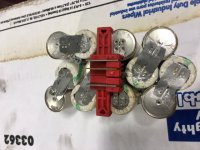
Finished the first pack. The hardest part was making sure the batteries were laid out in the correct orientation (tabs on top AND bottom pointed the correct way) before soldering.

I quickly abandoned trying to do it loose on the bench and realized using the case for the battery pack to hold them together was the ticket. Once I figured out which way each battery would need to be indexed it got a stripe from a sharpie so that bumping them around wouldn't frustrate me to death.

I made diagrams of tab locations on top, and bottom. Then made a third sketch of the bottom tab locations as seen from the top, since flipping the pack over obviously flips everything to a mirror image.

Once I figured out that I needed those things, it took maybe 20 minutes to do the actual building. I spent at least that much time planning, diagramming, and triple checking.

Definitely have a solder gun on hand - as the others have said, you want to heat the tabs up and cool them back down quickly. Not transfer a lot of heat into the batteries themselves with a small underpowered iron.
 

Attachments

  • batt1.jpg
    batt1.jpg
    112 KB · Views: 80
  • batt2.JPG
    batt2.JPG
    115.1 KB · Views: 78
  • batt3.JPG
    batt3.JPG
    105.3 KB · Views: 84
  • batt4.jpg
    batt4.jpg
    101.6 KB · Views: 84
OP
T

TNToy

Well-known member
Joined
Oct 11, 2006
Messages
1,385
Location
West Tennessee
Once the top was done, I carefully flipped the pack over and finished the bottom. After those were done and I verified the entire pack had the correct voltage, I soldered the connector for the tool/charger to the cells on the ends. This was the hardest thing to do without dumping a lot of heat into them - soldering the thin tabs was quite easy.

I then stuck the padding/insulation back on onto the top and bottom of the new pack. The piece which totally fell apart got replaced with the closest suitable material to the workstation - in this case, a piece of folded-up paper bag from Burger King.
 

Attachments

  • batt6.JPG
    batt6.JPG
    104.5 KB · Views: 56
  • batt7.JPG
    batt7.JPG
    124 KB · Views: 56
  • batt8.JPG
    batt8.JPG
    85.7 KB · Views: 49

uart

Well-known member
Joined
Nov 17, 2011
Messages
1,226
Location
Australia
Hi TNToy. Did your original pack have a thermistor included? These are typically a small two legged component tucked somewhere down between the cells, and connected by small wires to the overall negative and the auxiliary (middle) terminals on the pack.
 
To avoid these ads, REGISTER NOW!
OP
T

TNToy

Well-known member
Joined
Oct 11, 2006
Messages
1,385
Location
West Tennessee
Sure did. It's that center contact on the pack in the last post, tucked down between two of the center cells, right where you described. It came off with the red plastic bracket for the terminals, and went right back into place along with it when I reattached it to the new cells.
 
Last edited:

uart

Well-known member
Joined
Nov 17, 2011
Messages
1,226
Location
Australia
Sure did. It's that center contact on the pack in the last post, tucked down between two of the center cells, right where you described.

That's good. Most chargers won't touch them if the thermistor isn't properly in place.

BTW. I've rebuilt a few packs in the past. It's definitely worthwhile if you can get the cells for the right price. If you got the 40 cells for $52 shipped then that's a pretty good deal. :)
 

larry4406

Well-known member
Joined
Jan 27, 2006
Messages
19,345
Location
Northern Virginia
These packs aren't balanced at charge time so it's important the cells be as balanced as possible when you build the pack.

I ordered 96 cells and then broke in and tested every cell in a La Crosse BC-800. I don't particularly recommend this charger but it has automatic charging and capacity testing functions. Each cell was numbered and the capacity documented. This step required an adapter AA->C. I 3d printed one using components from Thingiverse.

Can you explain this a little better? Are you saying you charged each cell individually, then grouped them by the maximum charge attained? What then was the criteria on "how close" the charges matched for grouping?

I've seen some cells advertised that have spot welded tabs on them for soldering to them vs to the battery.

I need to do this to some DeWalt 14.4 batteries.
 

rsanter

Well-known member
Joined
Dec 22, 2007
Messages
18,521
Location
visalia ca
I did some years ago. I did not replace all the batteries but just a cell or,two that were dead.
You can check each cell with a VOM and determine which one is not holding a charge.

Bob
 
OP
T

TNToy

Well-known member
Joined
Oct 11, 2006
Messages
1,385
Location
West Tennessee
I've seen some cells advertised that have spot welded tabs on them for soldering to them vs to the battery.

I need to do this to some DeWalt 14.4 batteries.
The ones I purchased had tabs, and I'd recommend using them highly, along with a high-wattage iron or a soldering gun, which I used. You need enough power to quickly get the tabs up to temp and soldered while the batteries are trying to **** in all of that heat and cook themselves.
 

TomB19

Well-known member
Joined
Jan 1, 2015
Messages
547
Location
Regina, SK, Canada
Can you explain this a little better? Are you saying you charged each cell individually, then grouped them by the maximum charge attained? What then was the criteria on "how close" the charges matched for grouping?

I've seen some cells advertised that have spot welded tabs on them for soldering to them vs to the battery.

I need to do this to some DeWalt 14.4 batteries.

Every cell is numberd, broken in using the charger, and then capacity tested. From there, I document the capacities.

Eg:

Cell 1 - 2410 Mah
Cell 2 - 2150 Mah
Cell 3 - 1850 Mah
Cell 4 - 2415 Mah
.....


I then invert sort the list, based on Mah.

Cell 4 - 2415 Mah
Cell 1 - 2410 Mah
Cell 2 - 2150 Mah
Cell 3 - 1850 Mah
....

Keep in mind, I did this with 96 cells. I have 3 x LaCrosse BC-800 chargers and it still took over a week.

If you use the cells from the sorted list in sequence, they will be as close to being matched as possible.

Also worth noting, the BC-800 will not put more than 3000 Mah into a cell, as it was designed for AA and AAA charging. Some Sub-C NiMH cells are rated pretty highly. Fortunately, none of the crappy cells from eBay do anything even remotely close to rated capacity. :D

As far as using decent Sanyo cells goes, I believe it isn't worth it. For the cost of those cells, you're not far from buying a new LiPo tool. If I had a NiCD tool that had high value to me, I would definitely go for the Sanyo cells. Sanyo makes the best NiCD cell.

Some eBay cells are so crappy, they didn't work. I suggest buying a couple of extra cells when using the cheap ones.

The last packs I did was for a 14.4v Mastercraft drill and impact combo. That was a couple of years ago. I use those tools infrequently and they still work fine but, when those packs go, the tools will be tossed. New cordless tools are so good and so cheap for what you get, it doesn't make a lot of sense to keep the old tools running.

My memories of how good and compact the Mastercraft tools are were exaggerated. The impact is wonderfully short but not shorter than my M18 FUEL. It's quite a bit smaller diameter but that has never been something that mattered in what I do.
 
OP
T

TNToy

Well-known member
Joined
Oct 11, 2006
Messages
1,385
Location
West Tennessee
Some eBay cells are so crappy, they didn't work. I suggest buying a couple of extra cells when using the cheap ones.
If I had the capability to check the capacity of the cells and to match them, like you did, I'd definitely have done so. I settled with simply using a multimeter to verify that all of them functioned, but I have no idea how well my pack is matched.

*shrugs*

Oh well... A functional pack of any kind beats one that had 100% dead cells!

TomB19 said:
New cordless tools are so good and so cheap for what you get, it doesn't make a lot of sense to keep the old tools running.
I can't argue with you there! I only bothered to do this because I paid $499 off the snap-on truck for the two impacts in question - they're not just another $150 drill & impact combo from the box store down the street, and a transmission and engine rebuild on a project truck in the garage is eating every possible spare dollar while simultaneously making a functional pair of battery powered impacts VERY attractive.

The Snappy 3/8" is still among the shortest currently made, even 8 years later, and the 1/2" still removes 90% of what my IR 2135Ti Max would otherwise be needed for. Including crank bolts and over torqued lug nuts.
 
Last edited:
To avoid these ads, REGISTER NOW!
Top Bottom