To avoid these ads, REGISTER NOW!

GE Triclad 3HP Motor Rebuild, c1950s

Pupuhd

Well-known member
Joined
Aug 18, 2011
Messages
346
Location
New Jersey
Recently I finished rebuilds on two electric motors, one a vintage 1940s-1950s Century Electric Company 1HP capacitor start (http://www.garagejournal.com/forum/showthread.php?t=311993) and a smaller more modern Century Electric 3/4HP capacitor start (not posted). These along with other old Arn items were occupying space on my workbench, so I decided to continue with the motor rebuild flow and hit the 3HP General Electric Triclad Capacitor Motor, roughly 1950s. This particular one was started almost 4 years ago but however got pushed back. This motor came on a vintage Westinghouse Air Brake Company air compressor from the same era. Somewhere on this forum is the original thread to that, however to this date not yet completed. Here I will only post the rebuild on the GE 3HP electric motor, since I believe here and in another forum there was an interest in the Triclad motors.

Like the 1HP Century electric motor rebuild, in this new thread I will include details, photos and a video uploaded onto Youtube. I'm hoping this information will help some one else with a similar motor, like many post here have help me. I'll start with some of the original photos taken four years ago of the disassembly, but first some facts regarding this motor:

General Electric Triclad Capacitor Motor
Model: 5KCJ215AG201B
HP: 3, No.: XV
Volts: 115/230
Amp: 29/14.5, PH: 1
Service Factor: 1.15, Cycles: 60
Continuous duty at 40 deg. Celsius rise
 
To avoid these ads, REGISTER NOW!
OP
P

Pupuhd

Well-known member
Joined
Aug 18, 2011
Messages
346
Location
New Jersey
Here you can see the motor in its original installation on the Westinghouse Air Brake Com. air compressor.
DSCN0239.jpg

DSCN0241.jpg


First order of business was to remove the 3-belt pulley and end covers.
DSC_6522.jpg

DSC_6526.jpg

DSC_6528.jpg


Inside had no rust at all, just dirty. Centrifugal switch end cover, note the two switches mounted to the cover and detail photos of the wiring callout numbers and locations.
DSC_6529.jpg

DSC_6535.jpg

DSC_6536.jpg

DSC_6537.jpg


On this end cover there are four spacer washers located inside the bearing race.
DSC_6541.jpg


GE logo cap and machinery tag removed.
DSC_6545.jpg

DSC_6546.jpg

DSC_6547.jpg


Shaft end cover removed, and several spacer washers also.
DSC_6553.jpg

DSC_6557.jpg


Bearings moved freely, however I decided new ones would be in order since I had it all apart.
DSC_6554-1.jpg

DSC_6584-1.jpg

DSC_6587-1.jpg
 
OP
P

Pupuhd

Well-known member
Joined
Aug 18, 2011
Messages
346
Location
New Jersey
On top the capacitor cover and run capacitor were removed. While the start capacitors (2) were hidden inside the bottom of the base. These two are held by metal spring clips and to my surprise the original capacitor boxes were stuffed in there with them. Apparently providing a cushion for them.
DSC_6561.jpg

DSC_6565.jpg

DSC_6568.jpg

DSC_6576.jpg

DSC_6578.jpg

DSC_6579-1.jpg

DSC_6590.jpg


Wiring diagram under electric cover plate and major parts disassembled.
CSC_6534.jpg
DSC_6595.jpg
 

Packard V8

Well-known member
Joined
Mar 16, 2009
Messages
7,380
Location
Spokane, WA
Those are VERY well built motors. We just resurrected a 5hp for a IR Type 30 compressor. It has four capacitors inside an external mounted box. Mice had built nests inside that housing and mouse piss is more corrosive than sulfuric acid. It had eaten the contacts off all the capacitors.

We just blew it out, greased the bearings, replaced the capacitors and it fired up and ran smoothly.

jack vines
 
OP
P

Pupuhd

Well-known member
Joined
Aug 18, 2011
Messages
346
Location
New Jersey
Fast forward four years from disassembly to present blasting and paint. First, I decided to run the rotor inside my blast cabinet with newly acquired Glass Media #9 in order to clean it up.

Before photos of rotor:
GE%20Motor%203HP%201%20800x535.jpg

GE%20Motor%203HP%202%20800x536.jpg

GE%20Motor%203HP%203%20800x536.jpg

GE%20Motor%203HP%204%20800x536.jpg


After glass bead blasting:
GE%20Motor%203HP%205%20800x536.jpg

GE%20Motor%203HP%206%20800x536.jpg

GE%20Motor%203HP%207%20800x536.jpg


Next prep work for blasting and paint. For this blasting step I used FIne Glass Abrasive to remove all the old paint. Wood dowels were used for the screw holes.
GE%20Motor%203HP%208%20800x535.jpg

GE%20Motor%203HP%209%20800x533.jpg

GE%20Motor%203HP%2010%20800x545.jpg

GE%20Motor%203HP%2019%20800x536.jpg

GE%20Motor%203HP%2020%20800x536.jpg


Next primer and finish paint. For this project I decided to brush all the parts, unlike my previous thread in which I sprayed everything. The only parts sprayed was the fan shield inside the motor and inside of each end cover, all others one coat of primer and two coats of enamel paint were brushed on. Also when possible, all parts were baked in the oven after each coat between 225-300 deg., in order to speed up the drying time for the next coat.
GE%20Motor%203HP%2011%20800x570.jpg

GE%20Motor%203HP%2012%20800x535.jpg

GE%20Motor%203HP%2013%20800x500.jpg

GE%20Motor%203HP%2014%20800x535.jpg

GE%20Motor%203HP%2021%20800x536.jpg

GE%20Motor%203HP%2022%20800x535.jpg

GE%20Motor%203HP%2031%20800x535.jpg
 

kunkernator

Well-known member
Joined
Sep 27, 2012
Messages
2,438
Location
US of A
Glad you decided to do another post with the restore of this motor. I feel like the 1HP one was a little bit more detailed, but this one is very interesting as well.

It is real neat how they shoved the cardboard boxes in with the capacitors. I cant wait to see how it turns out. Are you going to use new insulating varnish again? And what are those little yellow things you use to hold the piece while painting? I could use some of those.
 
OP
P

Pupuhd

Well-known member
Joined
Aug 18, 2011
Messages
346
Location
New Jersey
Glad you decided to do another post with the restore of this motor. I feel like the 1HP one was a little bit more detailed, but this one is very interesting as well.

It is real neat how they shoved the cardboard boxes in with the capacitors. I cant wait to see how it turns out. Are you going to use new insulating varnish again? And what are those little yellow things you use to hold the piece while painting? I could use some of those.

kunkernator: Thanks. This GE motor had little to no rust, some light surface rust on the inside of the stator housing. Other than that pretty clean and straight forward to rebuild, just new bearings and paint. Compared to the Century 1hp motor, this one is a piece of cake just like the Century 3/4hp which took me a week to do. This one just currently waiting a week for paint to cure to do final assembly.

It was all fast light glass blasting to the exterior of the stator section and all the rest of the components. I was thinking the same, very little detail on this one. No, I won't be using the red insulating varnish on this one, except for the string on the windings (post to follow), the windings themselves are in perfect condition.

Those yellow things are Painters Pyramids by Hyde. Last week while at Home Depot looking for a 1 inch brush for this project, I saw them on the shelf. It's a ten pack of plastic pyramids ($5) which you can use to raise any object for finishing. Thought these would be good to paint the end covers instead of using tin cans. Also seems the enamel paint can be easily removed off the plastic for another clean use.
Painter's Pyramids.jpg
 
OP
P

Pupuhd

Well-known member
Joined
Aug 18, 2011
Messages
346
Location
New Jersey
In 2011, when I purchased the air compressor with this electric motor, it was my first old arn machinery. Pretty much I was a newbie to all this. OWWM and Garage Journal were the first I joined in order to get more info and insight into this decease of collecting old vintage US made machines. Since then, I have collected over a dozen, maybe two dozen, vintage types of machines and hand tools all in different aspects of repairs, rebuild or resto.

To put it into perspective, with the blessing of my wonderful wife, I have collected the following: (2) 1940s Unisaws, Clausing 15" DP, Craftsman DP, Parks planer, (2) Craftsmen "Block" grinders, Baldor 8" grinder, United States of America Electric Tool 12" pedestal grinder, (2) Atlas metal lathe, Atlas metal shaper, (2) Atlas metal horizontal mill, (2) vintage bench vise, (2) Delta band saws (one being a wood/metal with cast iron base), a second 12" Cincinnati pedestal grinder (currently for sale), Dewalt radial arm saw, WT scroll saw, about ten vintage electric motors, and a slew of American made hand tools, too many too mention. All ranging from the early 1900s to the mid 1970s.

With that said, I have made many mistakes and still do, however keep learning. The first was I wasn't aware of Electric Motor spray cleaners. At first to clean the inside of the stator I used, as recommended, mineral spirits. Then proceeded to bake off the residual at too high of a temp. This resulted in the string holding the windings to get brittle and fall apart. The rest of the stator was unharmed but the string didn't survive too well. Since then I have accumulated a cabinet full of all sorts of chemicals, cleaners, oil, lubricates, etc., all thanks to these forums.

Original four year old photo of the stator baking and the resulting damaged to the winding string:
DSC_6593.jpg

DSC_6602.jpg

DSC_6601.jpg


Present time this weekend, I finally got around to repairing it. I don't know if installing new string around the ends of the windings would do anything for a motor, however I was thinking it couldn't hurt. For the life of me I couldn't figure out the knot configuration they original used. After a while, I gave up and went with what I know would work to hold the winding and wires in place. On both ends the old brittle string was removed and new installed.
GE%20Motor%203HP%2015%20800x535.jpg

GE%20Motor%203HP%2018%20800x536.jpg
 
OP
P

Pupuhd

Well-known member
Joined
Aug 18, 2011
Messages
346
Location
New Jersey
Since the end covers were painted over a week ago, it was safe to assume they were close to cure. With this, I proceeded to do some minor assembly to these. First all holes were cleaned of paint by deburring, then fasteners which were glass bead blasted were installed: two grease filling screws on each end and electric cover plate screws.
GE%20Motor%203HP%2024%20800x535.jpg

GE%20Motor%203HP%2025%20800x535.jpg


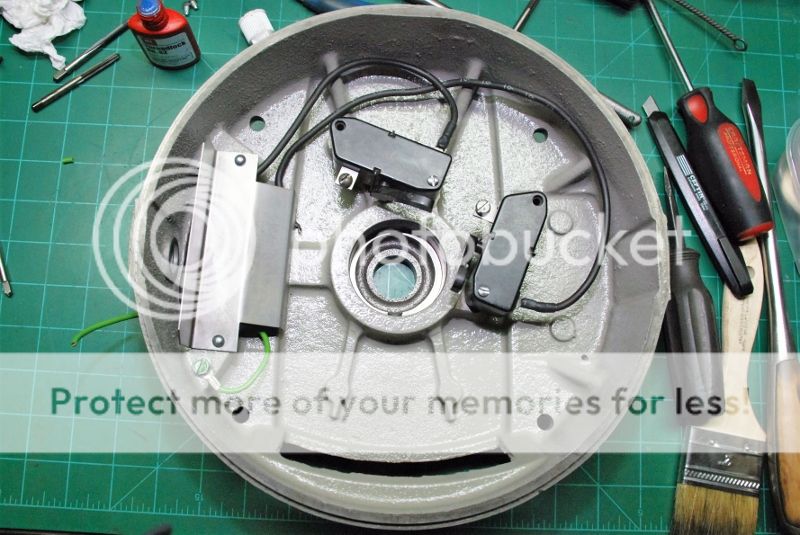
Before installing anything on the inside of the end cover for the electric side, I took the opportunity to take apart the two centrifugal switches and blow out any blast media inside. While I was at it, put marine heat shrink tubing to the ends of the wires.
GE%20Motor%203HP%2028%20800x536.jpg


Then the two switches were installed following the details on the original photos and also the metal shield housing the electrical connections. This was installed using #6 udrive screws.
GE%20Motor%203HP%2027%20800x536.jpg

GE%20Motor%203HP%2026%20800x535.jpg


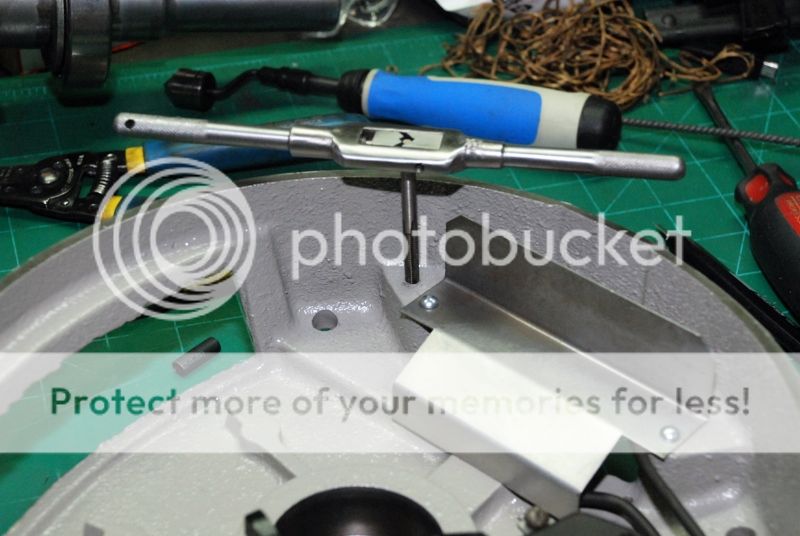
Almost forgot to add a Ground wire for this motor. Did this by tapping a 10-32 hole at one of the larger flat spots next to the shield.
GE%20Motor%203HP%2029%20800x536.jpg


Before and after photo of this end cover. Note the new #14ga green ground wire at about 8 o'clock:
DSC_6539.jpg

GE%20Motor%203HP%2030%20800x535.jpg


Now to wait another week for the center stator section to cure.
 
Last edited:

DocsMachine

Well-known member
Joined
Sep 16, 2006
Messages
1,844
I have a couple of old GE motors just like that, listed as 1HP on the tag and they don't have the top cover/capacitor. (Not that they're missing, mine never had them.)

I've always thought they were absurdly large for a mere 1HP, but as they'd come out of an old bowling alley (the ones I got were kept as spares) I'd assumed they were larger motors "derated" for that kind of high-use/long-hours service. (But that was just a guess.)

They work like a champ, and in the one thing I've installed one in, they sure seem to have a great deal of torque. I wonder if yours has the separate run cap just to make room for an extra start cap, for the compressor use.

Doc.
 

marinusdees

Well-known member
Joined
Oct 30, 2012
Messages
1,325
Location
Edgewood, Washington
Recently I finished rebuilds on two electric motors, one a vintage 1940s-1950s Century Electric Company 1HP capacitor start (http://www.garagejournal.com/forum/showthread.php?t=311993) and a smaller more modern Century Electric 3/4HP capacitor start (not posted). These along with other old Arn items were occupying space on my workbench, so I decided to continue with the motor rebuild flow and hit the 3HP General Electric Triclad Capacitor Motor, roughly 1950s. This particular one was started almost 4 years ago but however got pushed back. This motor came on a vintage Westinghouse Air Brake Company air compressor from the same era. Somewhere on this forum is the original thread to that, however to this date not yet completed. Here I will only post the rebuild on the GE 3HP electric motor, since I believe here and in another forum there was an interest in the Triclad motors.

Like the 1HP Century electric motor rebuild, in this new thread I will include details, photos and a video uploaded onto Youtube. I'm hoping this information will help some one else with a similar motor, like many post here have help me. I'll start with some of the original photos taken four years ago of the disassembly, but first some facts regarding this motor:

General Electric Triclad Capacitor Motor
Model: 5KCJ215AG201B
HP: 3, No.: XV
Volts: 115/230
Amp: 29/14.5, PH: 1
Service Factor: 1.15, Cycles: 60
Continuous duty at 40 deg. Celsius rise
About 25 years ago, I was gifted a Dunham-Bush v6 refrigeration compressor. Then a dairyman gave me a 5 hp Triclad motor which had been on his **** pump, suspended over his lagoon. The microswitches to control the start winding were totally destroyed by the ammonia fumes. I found some new switches, and the shaft end bearing had a whisper in it. It was a double row ballbearing and cost me $35. I modified a cheap puller to get the bearing off. The compressor was a direct drive through a Lovejoy coupling and QUIET.. I found a receiver (don't ask, it will bring the doomsayers out), and built a compressor. Then 6-8 years ago, I found a DeDilbiss two stage with a 5 hp Leeson motor for $400. I sold the homemade for $300 and bought the DV for $400. Now I have a fiend who owns an electric motor repair shop and he tells me a TriClad 5hp is worth minimum $300. I have a standing offer to buy it back for $300. I could sell the motor for more than $300. So far, no dice. They don't build motors like Triclads anymore!!! Count your blessings!!


$400
 
OP
P

Pupuhd

Well-known member
Joined
Aug 18, 2011
Messages
346
Location
New Jersey
They don't build motors like Triclads anymore!!! Count your blessings!!

Thanks, I believe back in 2011 I purchased the WABCO air compressor with GE motor for $100.Got it from a local auto garage here in town. Was asking $150, but he was happy to get it out of storage for less. Think he said the $ would be lunch money for that week. Had to scrap the tank, too iffy, and some other found scrap that week and made $50 in scrap $ (that's when scrap metal per pound was high, now not even worth the gas to take there). This GE Triclad motor ran beautifully prior to rebuild, excellent & extremely heavy beast.
 
OP
P

Pupuhd

Well-known member
Joined
Aug 18, 2011
Messages
346
Location
New Jersey
Today I took the opportunity to do some more minor assembly, this time on the electrical end of the stator. It's still curing on the table from the second and final coat of brushed on enamel paint.
GE%20Motor%203HP%2032%20800x536.jpg


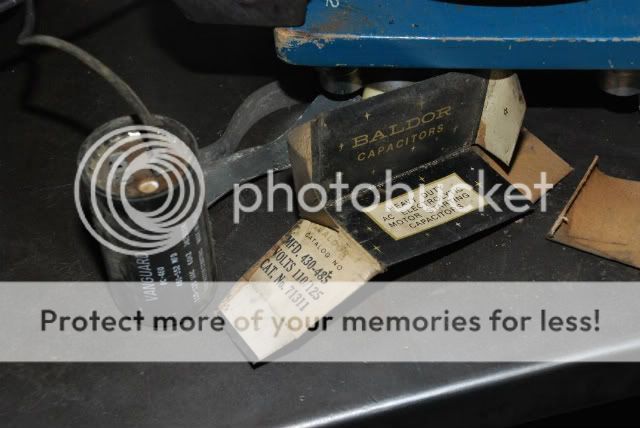
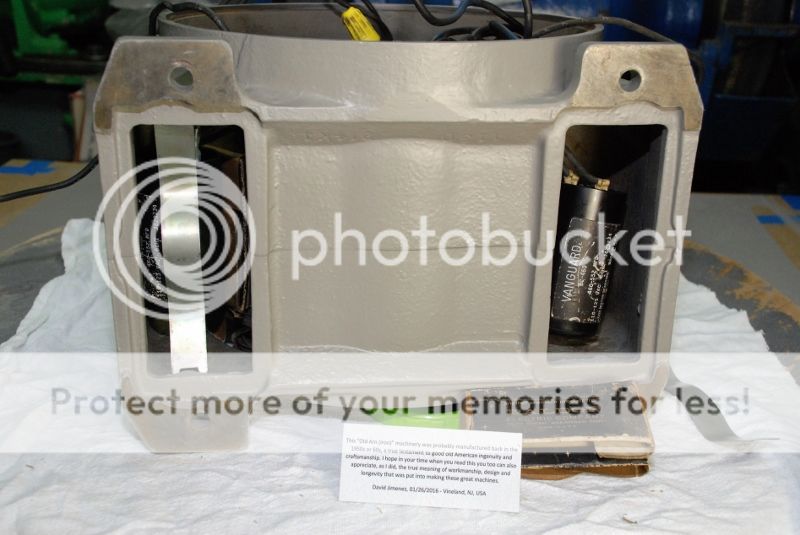
First, I cleaned up all brass ring connectors. These will be attached to the two centrifugal switches on this end. Then installed the two original start capacitors. My original idea was to use foam padding around the caps, however my nostalgic side got the better of me and used the original Baldor capacitor boxes that were sandwiched between the stator and the caps. Something told me to take this further, inside the one capacitor box I decided to insert a time-capsule note for any one in the future who might venture into this old arn machine.
GE%20Motor%203HP%2033%20800x500.jpg

GE%20Motor%203HP%2034%20800x535.jpg

GE%20Motor%203HP%2035%20800x536.jpg


The original grommet was rotted and had none thick enough for the 1/4" thick stator housing. Decided to use wire loom at this point to protect the two start cap wires. The lacing technique on each end was courtesy of a fellow forum member.
GE%20Motor%203HP%2036%20800x536.jpg


Shield slipped in place. Had to do one repair to a crack wire insulation, fixed with marine heat shrink tubing. At this point, I replaced the old wire nuts with crimped style nuts for a more cleaner and lasting rebuild. If you look closely at the bundle of wires coming through the knockout of the shield, you'll see a white nylon string tying off the bundle from rubbing the shield. I did find evidence of one wire that had a gouge in the insulation from contact with the edge. Dry fit of the end cover to see if the internal shield lined up correctly with the through bolts.
GE%20Motor%203HP%2038%20800x536.jpg

GE%20Motor%203HP%2037%20800x536.jpg
 

marinusdees

Well-known member
Joined
Oct 30, 2012
Messages
1,325
Location
Edgewood, Washington
30 or so years ago, a friend gave me Dunham-Bush v6 refrigeration compressor. Heavy!!
Then another friend gave me a GE Triclad 5 hp single phase motor. I scrounged an 80 gallon tank, can't tell you, it will bring out the doomsayers. I built a channel iron frame. the Triclad was on a **** pump over the lagoon on a dairy farm. It didn't run. I disassembled it (sounds better than I tore it apart). The ammonia had destroyed the microswitches in the start switch. I managed to find some new ones. The shaft end bearing had a whisper in it, so I bought a new one for $37. I modified a cheap puller, didn't know what bearing splitters were, to pull the bearing. I painted it and mounted motor and compressor on the frame. It was a direct drive through a Lovejoy coupling. It was quiet and a real air monster. I sold it to a friend of my son for $300 and bought a heavy duty 2 stage DeVillbiss for $400. I have made a standing offer to buy it back for $300. He has used it for 25 or so years with no problems. The motor alone is worth more than $300. Only thing I gained was a higher maximum pressure, 150 instead of 135. And, more noise. Oh.well. I won't wear out the DV. My buddy who owns an electric motor repair shop says GE quit building them because they lasted too long and killed new motor sales. They were built hell for stout. PS The DV has a Leeson 5 hp, but it is a lot less motor than the Triclad. Triclads were the standard of the industry. Now we get Chinese stuff or WEG Brazilian stuff. My electric motor pal says WEG stands for World Electrical Garbage. It seems better to me than Chinese stuff, but , what do I know?? The start switch on the Triclad was unique, and well designed.
 
OP
P

Pupuhd

Well-known member
Joined
Aug 18, 2011
Messages
346
Location
New Jersey
Week and a half without any progress here. Lets see: wife was sick, then 12 plus inch snow blizzard, one son then gets sick for a few days, overtime starts back up (12 hr days puts a toll on you), then Boys Scout pine derby car build. Not for one son, not two, but three sons that I have to help build a pine derby car each. Heck who am I kidding, mostly built by me. Isn't that the way it's suppose to be. Hopefully they'll build their own with their boys.

Well enough said, since then I manage to get to finalizing the build, almost. One thing I omitted earlier was the new bearings on the rotor. Over four years ago when I began the disassembly, I had the old ones removed and new ones pressed in. At that time, I didn't own a pulley puller nor a shop press. Since then I have done this type of work myself. Both bearings at that time with install ran me about $25. That's why in previous photos for the bead blasting of the rotor, the new bearings were taped off.
DSC_6613.jpg

DSC_6611.jpg


Next was to slip in the rotor, insert the four space washers into the bearing race of the electric end cover. Two center ones are opposing cone style washers. Followed by installing this end cover onto the center section and rotor.
GE%20Motor%203HP%2039%20800x536.jpg

GE%20Motor%203HP%2040%20800x500.jpg

GE%20Motor%203HP%2041%20800x535.jpg


Shaft end cover the same except just two spacer washers. Installed purchased over-sized 5/16-18 nuts on the through bolts with loctite.
GE%20Motor%203HP%2042%20800x535.jpg

GE%20Motor%203HP%2043%20800x500.jpg

GE%20Motor%203HP%2050%20800x500.jpg

GE%20Motor%203HP%2045%20800x500.jpg

GE%20Motor%203HP%2046%20800x500.jpg


While attempting to install the run capacitor on top, I bent and broke one of the right angle 1/4 inch female spade connectors. Not having any on hand, I quickly ordered a bag full withing a few days and new repair complete, cap and cover installed.
GE%20Motor%203HP%2044%20800x500.jpg

GE%20Motor%203HP%2047%20800x500.jpg

GE%20Motor%203HP%2048%20800x500.jpg

GE%20Motor%203HP%2049%20800x500.jpg
 

DocsMachine

Well-known member
Joined
Sep 16, 2006
Messages
1,844
Next was to slip in the rotor, insert the four space washers into the bearing race of the electric end cover. Two center ones are opposing cone style washers.

-Those are called Belleville Washers, they're a form of stiff, short-travel spring.

Thanks for the write-up. I don't need to rebuild any of mine, but I'll definitely keep this in mind if I ever do. :D

Doc.
 

blazemaster83

Well-known member
Joined
Oct 8, 2009
Messages
604
Location
Lacey, Wa.
I used to have this same exact motor on a flat belt drill press. I kick myself for selling it with the drill, it was one of the best motors I've owned. I ran it on 110v and it ran fine, even though its rated at 29 amps.
 
OP
P

Pupuhd

Well-known member
Joined
Aug 18, 2011
Messages
346
Location
New Jersey
-Those are called Belleville Washers, they're a form of stiff, short-travel spring.

Thanks for the write-up. I don't need to rebuild any of mine, but I'll definitely keep this in mind if I ever do. :D

Doc.

Thanks for the info. Indeed they are stiffer than wavy washers. Guess due to the mass of the rotor it needs these type of washers to take up any lateral play.
 
OP
P

Pupuhd

Well-known member
Joined
Aug 18, 2011
Messages
346
Location
New Jersey
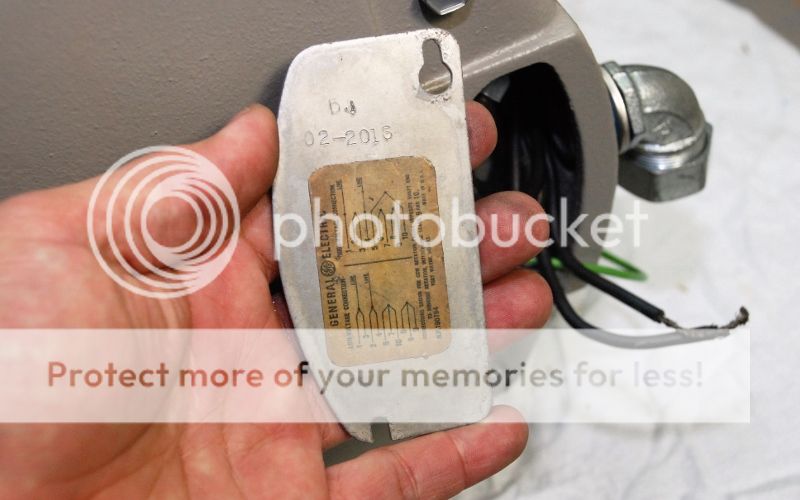
I had carefully removed and cleaned the wiring label from the back of the cover. Now that the cover was painted on the outside and glass bead blasted on the inside, the label was reapplied with spray adhesive. While I was at it, I stamped my initials and date.
GE%20Motor%203HP%2051%20800x500.jpg


Installed a Liquid-tite right angle fitting to the side. Most likely when this motor gets installed back onto the compressor, I will be using liquid-tite conduit for all the wire runs. Temporary 14/3 SJ cord installed for test. I have the internal wiring wired up for 220 volts. I ran the motor and it ran quite and smooth, no issues at startup.

Only two items left are the motor tag and GE logo cap on. I need to reproduce on the computer both so I can get vinyl stickers made and applied. That may be awhile since my skills using software like Gimp is limited.
GE%20Motor%203HP%2052%20800x500.jpg

GE%20Motor%203HP%2053%20800x500.jpg
 
To avoid these ads, REGISTER NOW!
OP
P

Pupuhd

Well-known member
Joined
Aug 18, 2011
Messages
346
Location
New Jersey
Nice rebuild. They were the best motors GE ever built. Yours was manufactured in October, 1961.

This motor is a beast, the stator section alone weighs a ton. I'm looking forward to soon installing it with the Westinghouse Air Brake Company compressor, that'll be my pride and joy in the shop.

October 1961, if you don't mind me asking, how did you come to that date? Is it in the serial numbers on the machine tag? Thread title stated circa 1950s, however I also thought early 60s. I'd be very interest in your process here, that would mean the compressor would be of that same era. David
 

Cubatime

Member
Joined
Feb 8, 2016
Messages
12
Location
South Central Ontario
They were very quiet and extremely smooth running. The date comes from the No. XV.
In GE's date codes X is October and V is 1961. I have repaired many of that style, they were used extensively on Brunswick bowling ball returns and Dairy Queen ice cream machines.
 
OP
P

Pupuhd

Well-known member
Joined
Aug 18, 2011
Messages
346
Location
New Jersey
They were very quiet and extremely smooth running. The date comes from the No. XV.
In GE's date codes X is October and V is 1961. I have repaired many of that style, they were used extensively on Brunswick bowling ball returns and Dairy Queen ice cream machines.

Great information, thanks. I'll make sure to include that date in my brass rebuild tag I install at the end of the rebuild.
 

Semohandyman

Active member
Joined
Aug 22, 2012
Messages
33
Location
Southeast Missouri
I enjoyed reading about your repair of this motor. Back in the 70's and 80's I use to repair small electric motors. I probable repaired over 5000 motors. I have repaired only a few since then. If you have any questions I will be happy to answer them if I can remember that for back. Most of the motors that I repaired were made after WW2 thru 1980.
 
OP
P

Pupuhd

Well-known member
Joined
Aug 18, 2011
Messages
346
Location
New Jersey
Last week I had the chance to finally install a newly reproduced motor tag. This I created using Adobe Illustrator, using the original as a guide. This is the image produced on Illustrator.

GE%203HP%20Motor%20Tag%2001.jpg


This badge among others I have been working on are printed (infused) on sheets of .041 thick aluminum. I have a thread here explaining the whole process in detail:http://www.garagejournal.com/forum/showthread.php?t=323165

Side by side comparison of old vs. new.
DSC_6546.jpg

GE%20Motor%203HP%2055.jpg
 
Last edited:

CoopVA

Well-known member
Joined
Jan 20, 2014
Messages
2,144
Location
Virginia
Last week I had the chance to finally install a newly reproduced motor tag. This I created using Adobe Illustrator, using the original as a guide. This is the image produced on Illustrator.


GE%203HP%20Motor%20Tag%2001.jpg


This badge among others I have been working on are printed (infused) on sheets of .041 thick aluminum. I have a thread here explaining the whole process in detail:http://www.garagejournal.com/forum/showthread.php?t=323165


Side by side comparison of old vs. new.

GE%203HP%20MOTOR%20TAG.jpg


GE%20Motor%203HP%2055.jpg


Wow! That's fantastic!
 

Evergreentree

Well-known member
Joined
Nov 24, 2015
Messages
452
Location
Montgomery County PA
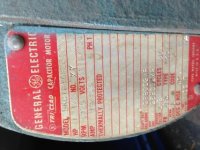
Hey guys. Is anyone still subscribed to this thread? I have an amazing old 1 1/2hp ge tri clad motor that came off an old compressor (I think) that was left behind in my house when I moved into it. I've been told it works, and the only reason why it came out of the body shop it was in, was because it had an exposed pulley.

My plans are to make a big pulley buffer set up with it, really, just because the motor is just ACES!

I've posted this in a few threads now, trying to feel out who's available to help. Anybody out there that can help walk me through the wiring? Just to be clear, I have no experience with this, I would like to learn, I am not afraid of it, and the panel diagram is clear as...well, a crystal clear night sky. I'll post pics when I get a few responses.
 
OP
P

Pupuhd

Well-known member
Joined
Aug 18, 2011
Messages
346
Location
New Jersey
Hey guys. Is anyone still subscribed to this thread? I have an amazing old 1 1/2hp ge tri clad motor that came off an old compressor.......Anybody out there that can help walk me through the wiring? Just to be clear, I have no experience with this, I would like to learn, I am not afraid of it, and the panel diagram is clear as...well, a crystal clear night sky. I'll post pics when I get a few responses.

Post photos here of motor badge to gets specs ans also the inside of the wiring box. Maybe some one or myself might be able to help. David
 

Evergreentree

Well-known member
Joined
Nov 24, 2015
Messages
452
Location
Montgomery County PA
Here's the wire diagram. It has a high and low set up option. I will need it to be low volt to plug into 110 if my understanding of the options is correct.
 

Attachments

  • image.jpg
    image.jpg
    12.5 KB · Views: 33

Evergreentree

Well-known member
Joined
Nov 24, 2015
Messages
452
Location
Montgomery County PA
Here's the wires as is. They are all numbered, and to me it looks like they are set up for high volt.

My question is really how to read the diagram, and how it translates to setting up/connecting the wires, and how to install a plug, etc. maintenece and cleaning will follow..

Remember, this is a brand new language that I'd like to learn...and I'd really appreciate the lesson! Really. This motor is to me, to nice to let sitting idle for another 15years!
 

Attachments

  • image.jpg
    image.jpg
    12.5 KB · Views: 17
Last edited:

Evergreentree

Well-known member
Joined
Nov 24, 2015
Messages
452
Location
Montgomery County PA
Photos are clear on my phone, but when I post them they are fuzzy! Let me know if you need me to read off any of the info. Can I even use this "capacitor" motor the way I intend to? Running a buffer for good stretches of time...
 
Last edited:
OP
P

Pupuhd

Well-known member
Joined
Aug 18, 2011
Messages
346
Location
New Jersey
Photos are clear on my phone, but when I post them they are fuzzy! Let me know if you need me to read off any of the info. Can I even use this "capacitor" motor the way I intend to? Running a buffer for good stretches of time...

Yes on the posting info(specs). Either way, post your image, fuzzy or not. As far as a buffer, don't know. Belt driven or direct? David
 

Evergreentree

Well-known member
Joined
Nov 24, 2015
Messages
452
Location
Montgomery County PA
Belt driven, with really big buffing wheels/pads to get the surface speed way up. I'll have to do calculations. Either that or a sander set up, or grinding wheel set up. I'm not 100% sure yet. That's secondary to getting this beauty of a motor rolling!I'll read/write down specs in a bit.
 
Last edited:
To avoid these ads, REGISTER NOW!
Top Bottom