Denwood
Well-known member
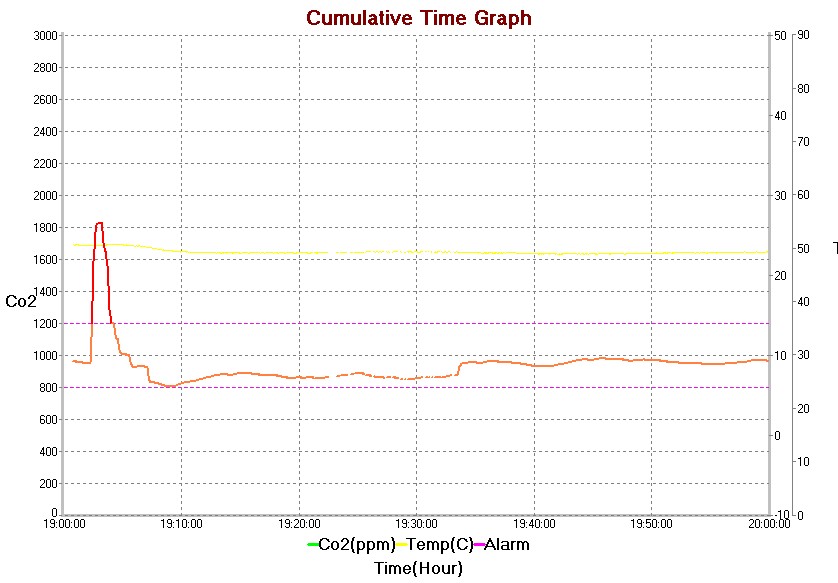
The goal of this little project is to minimize BTU loss and electricity use (the costs of running an HRV), while ensuring good air quality in our work environment.
I've been on an efficiency kick in our 9100 sq/ft headquarters, building on a net zero goal envelope update completed 3 yrs ago. Having recently updated the building's 9 thermostats to Ecobee3 units, the next step is HRV control. The building uses a Venmar 220V commercial unit for fresh air exchange. It was previously just controlled by one of the air handler fan circuits, so operated via the thermostat's programmed fan function. This method of operation is pretty much a guess at adequate ventilation, and may in fact be quite wasteful.
We're trying to keep the building as simple as possible, so have deliberately avoided a dedicated building control. The Ecobee3 thermostat can control an HRV using an standard set of dry contacts. This however only runs the HRV on a schedule, rather than on demand.
Based on some research, particularly as humidity is not an issue, controlling the HRV based on CO2 levels makes a lot more sense. Here are some baselines. "ppm" means parts per million as a measure of C02 levels in air. From kane.co.uk:
250-350ppm Normal background concentration in outdoor ambient air
350-1,000ppm Concentrations typical of occupied indoor spaces with good air exchange
1,000-2,000ppm Complaints of drowsiness and poor air.
2,000-5,000 ppm Headaches, sleepiness and stagnant, stale, stuffy air. Poor concentration, loss of attention, increased heart rate and slight nausea may also be present.
5,000 Workplace exposure limit (as 8-hour TWA) in most jurisdictions.
>40,000 ppm Exposure may lead to serious oxygen deprivation resulting in permanent brain damage, coma, even death.
A call to Co2meters.com resulted in a few recommendations to manage our HRV. Joshua knew exactly what I needed, and was extremely knowledgeable. I ordered up the RAD-0301 Indoor air quality monitor, as well as the TON-0007 Co2 Monitor with Relay
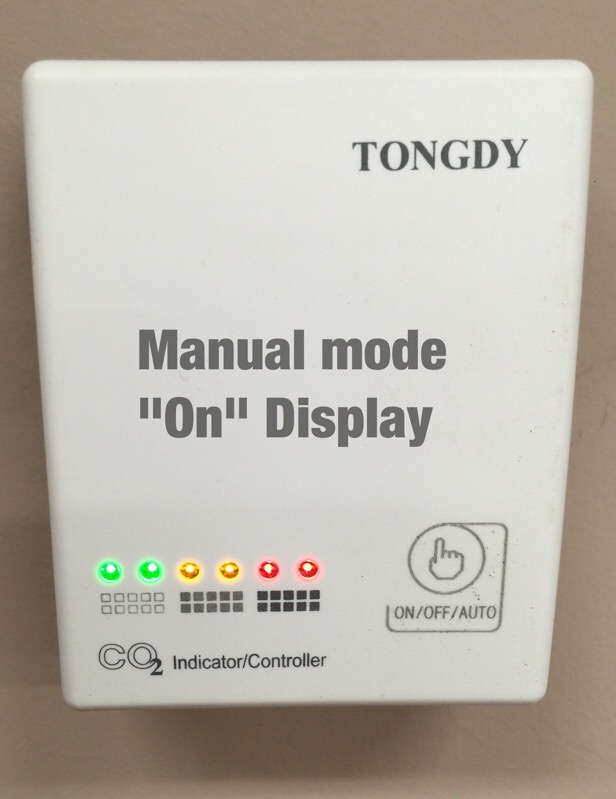
The Co2 monitor plugs into a computer or power supply via USB, and uses free software to log levels. The wall mount CO2 monitor runs on 24V (like the HVAC system) and has a relay that in our case will open at 900ppm, and close when levels fall below 700ppm. You have four options, 800ppm, 1000, 1200 and 1400 set by jumpers for relay control.
You can see here that C02 levels in my office are just under 700ppm, with the HRV running constantly for a few hrs. The unit on the right is the USB powered monitor, and on the left, the wall mount monitor that will eventually control the HRV.
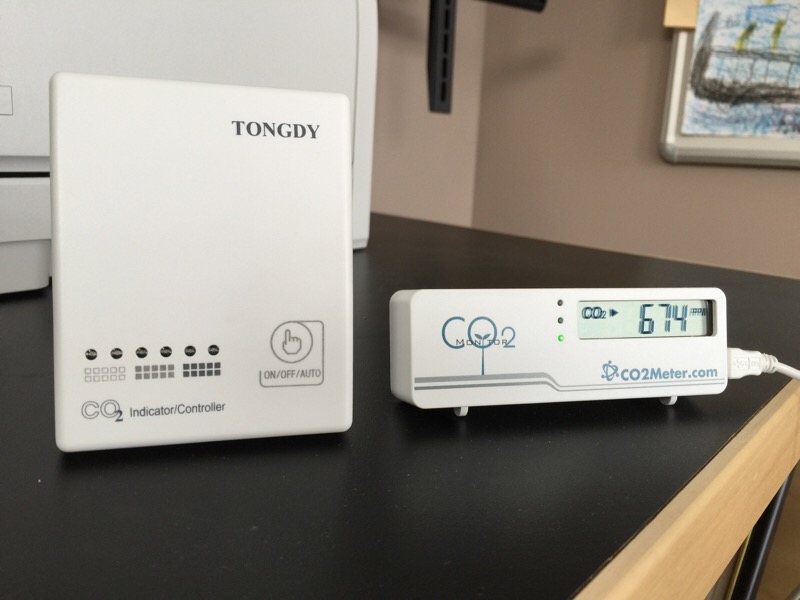
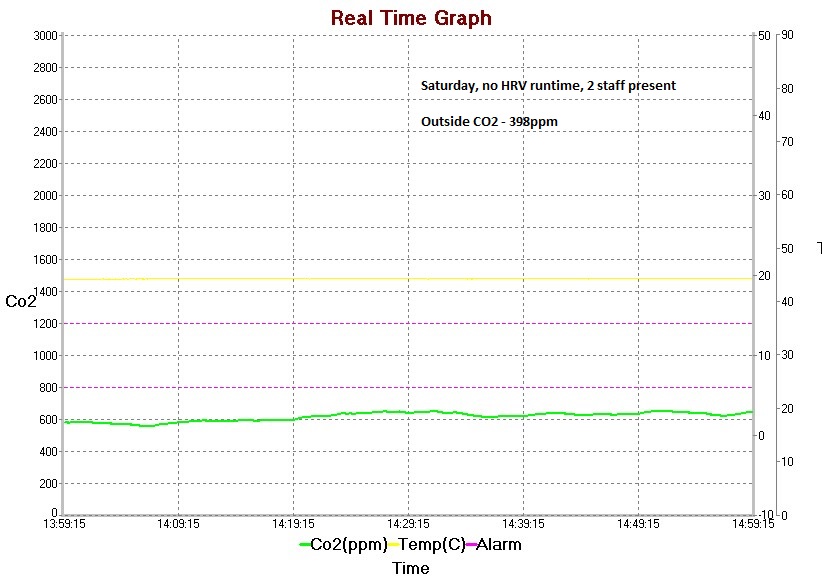
Before I install the wall mount units, wired to the HRV, we'll monitor a bit to see what our baseline looks like. The small monitoring unit plugs into a PC USB for both power, and the ablity to log CO2 levels.

I'll update this post as we move through the installation.
I've been on an efficiency kick in our 9100 sq/ft headquarters, building on a net zero goal envelope update completed 3 yrs ago. Having recently updated the building's 9 thermostats to Ecobee3 units, the next step is HRV control. The building uses a Venmar 220V commercial unit for fresh air exchange. It was previously just controlled by one of the air handler fan circuits, so operated via the thermostat's programmed fan function. This method of operation is pretty much a guess at adequate ventilation, and may in fact be quite wasteful.
We're trying to keep the building as simple as possible, so have deliberately avoided a dedicated building control. The Ecobee3 thermostat can control an HRV using an standard set of dry contacts. This however only runs the HRV on a schedule, rather than on demand.
Based on some research, particularly as humidity is not an issue, controlling the HRV based on CO2 levels makes a lot more sense. Here are some baselines. "ppm" means parts per million as a measure of C02 levels in air. From kane.co.uk:
250-350ppm Normal background concentration in outdoor ambient air
350-1,000ppm Concentrations typical of occupied indoor spaces with good air exchange
1,000-2,000ppm Complaints of drowsiness and poor air.
2,000-5,000 ppm Headaches, sleepiness and stagnant, stale, stuffy air. Poor concentration, loss of attention, increased heart rate and slight nausea may also be present.
5,000 Workplace exposure limit (as 8-hour TWA) in most jurisdictions.
>40,000 ppm Exposure may lead to serious oxygen deprivation resulting in permanent brain damage, coma, even death.
A call to Co2meters.com resulted in a few recommendations to manage our HRV. Joshua knew exactly what I needed, and was extremely knowledgeable. I ordered up the RAD-0301 Indoor air quality monitor, as well as the TON-0007 Co2 Monitor with Relay
The Co2 monitor plugs into a computer or power supply via USB, and uses free software to log levels. The wall mount CO2 monitor runs on 24V (like the HVAC system) and has a relay that in our case will open at 900ppm, and close when levels fall below 700ppm. You have four options, 800ppm, 1000, 1200 and 1400 set by jumpers for relay control.
You can see here that C02 levels in my office are just under 700ppm, with the HRV running constantly for a few hrs. The unit on the right is the USB powered monitor, and on the left, the wall mount monitor that will eventually control the HRV.
Before I install the wall mount units, wired to the HRV, we'll monitor a bit to see what our baseline looks like. The small monitoring unit plugs into a PC USB for both power, and the ablity to log CO2 levels.
I'll update this post as we move through the installation.
Last edited:
 Depending on what you have for duct work, you may want to install a VFD with the appropriate motor and controls to vary the CFM of the Venmar.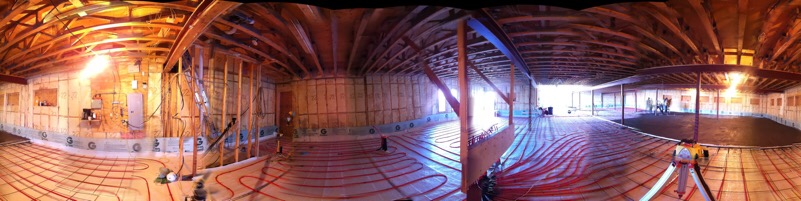


 I'm glad you find my "ruminations"
 useful. This is a very interesting discussion for me.
 Hopefully it will be useful to someone else.


 What brand of air handlers did you use in your building?