To avoid these ads, REGISTER NOW!

Tool Crib of the North

matt_i

Well-known member
Joined
Mar 14, 2008
Messages
10,723
Location
SE Michigan
I thought I'd start a build thread here, I'm about 10 months ahead of where we start but have probably 1000 pics to date, so I'll keep going and hopefully get back even with continual progress.

I bought a house with a very nice shop which had been built in 2 stages, a 25x 25 with walk-up attic and attic trusses inside somewhere around a 10:12 pitch. Added on the side was a 18x25 shop. I had filled all of these spaces with my shop stuff (mostly fabrication and machine shop equipment) and had spilled over into the main garage where people normally park cars :) After I got married my wife was not very keen on my useage of space, so this generated the idea for the 3rd shop space.

I didn't have many zoning restrictions other than only 1 outbuilding was allowed per property. Had usual side and rear restrictions but they were not in the way. I was attempting to put in something that would maximize space but not carve up the backyard, not interfere with the drainfield, and hopefully something not so crazy as to kill property value.

The existing shop was built by an HVAC installer, so it had its own furnace & ductwork all throughout. It had a 60A mini subpanel on aluminum feeder wire, I had replaced this with my own 100A subpanel on #2 copper just to get power for my existing machinery. So, thinking along the lines of utilities, if I was to build a separate building, I would need to trench in another electric service (sub or new meter), a gas line, and duplicate the heating capacity.

Armed with these parameters and many brainstorming sessions, I decided on a 25x40 building envelope with 10ft inside height (no lifts ever planned, my neighbor across has one in his shop if I were to have a project worthy of it. I have wrenched on cars/trucks and changed engines, rebuild front ends, but out of necessity, I don't actually intend to do this not often enough to justify it).

Also important to the initial design was an existing was a drive-thru layout, so my intention was to use the back garage door as the entrance to the new building. I just got into boating a year earlier and the family loved the first season, so I also wanted a spot to store the watercraft and possibly a slightly larger one in the future.

My wife's input was to match the house with vinyl siding and roofing, and not be a "warehouse" which is code for put in windows. Its definitely an extra expense and directionally wrong for thermal performance and places to break in, but keeping domestic harmony also helps too.

What I did was to twist up my CAD program (Ashlar Vellum Graphite) which typically is used for parts that fit into 1 or 2 hands, into much larger units and start drawing basic layout of the interior.


Few things that are going to find a home, the family watercraft as mentioned, automatic hydraulic shuttle feed bandsaw, a cold saw, an "abrasive" room with belt & disc sanders, surface and OD grinders, a radial arm drill, a 6ft planer (metal planer), Barber Colman large gear hobbing machine, and some pallet racking with sheetmetal tools (notcher, punch, mini press brake, etc.) A large floor model arbor press. Wanted to move my finger brake and hydraulic shear into the new shop. Also to move over to existing shop are the 2 forklifts, a 3k Clark and a 7k Hyster.
 
Last edited:
To avoid these ads, REGISTER NOW!
OP
M

matt_i

Well-known member
Joined
Mar 14, 2008
Messages
10,723
Location
SE Michigan
Continuing...

Plans drawn in CAD, exported to .pdf files and printed on D-size paper at Kinkos to the tune of about $5 each for B&W.

Plans submitted first to the township for zoning approval, then the county. The township official signed one of the copies to denote his approval, basically he was just checking for any setback violations and the "1 outbuilding per non-farm property". I did learn that with an agricultural property (unsure of requirements) one can build anything at any time without any permits!

I was tabbed with inspections from Health (septic tank & drainfield review), Soil Erosion, and the normal Building Dept. Soil Erosion was dragging their feet, in fact I got a call from the Bldg Dept saying my plans were approved, time to pay, and realized that the Soil Erosion was still holding out. Interestingly they are offices that use the same "entry desk" in the same building, and apparently don't talk to each other. So I got to sit down with one of the Soil Engineers, wrote out a plan to denote I was going to cut sod, replace it at the end of the project, and mark out a perimeter for the erosion control fences (silt fence) I would use. Needless to say I live in what used to be a flat field, with around 4-6 feet of drop all across established grass over 250' to a small stream.

Got the approvals while I was there, have the red-stamped plans that must stay on the jobsite, and these are screenshots of what I drew.

elevation


plat/site plan


foundation & anchor bolt plans


CAD makes everything scaled, easy to measure out and set the drainfield & tank into the drawing. The "legal description" can be resolved to angles and feet to make up an accurate outline of the property, and then parallel lines for the setbacks.

The permit acceptance was in April, 2015.

To be continued...
 
Last edited:
OP
M

matt_i

Well-known member
Joined
Mar 14, 2008
Messages
10,723
Location
SE Michigan
Here's where we begin...back side of existing shops


Small concrete pad was already in place for the watercraft, I have 2 tractors, one is an International 460 utility tractor with 3pt and bucket loader, needs some restoration but has a lot of power....also under wraps is a Farmall Super A used for cutting the grass.

One dilemma I had while planing was that I wanted the ability to use the forklifts to drive thru the door and into the new shop. In the way was a 7ft overhead door header. One forklift would barely scrape thru with the mast tilted fully fwd, but the other larger unit won't go, without an 8foot door, which I have on the front side. This meant a project to raise the door header in preparation for moving equipment thru...someday.

First task is to strip back the metal door drim and open up some vinyl siding. I marked the back of every piece of siding so I could fit it all back in place, not wanting the bare OSB to be out for many months.


As you can see, some shock and surprise when I got to the door-top J-channel. A key part of siding is to trim & bend two tabs over into the vertical J-channels....but this was never done, it was simply mitered, cut flat, and nailed up...with water allowed to run right down inside behind everything.

Yuck


A further curiousity is that there is housewrap used, but its on the *inside* of the OSB...that had to be some effort to dry-in the building between framing and sheathing...sketchy, but the OSB seems in great shape save what's pictured.

More inspection reveals that the jacks are just fine with just light discoloration, its the OSB that has the bad rot. I ended up replacing one piece of OSB sheeting.


This is the initial prep for removing the header. I installed a couple of additional headers outside, screwing these into every stud after giving myself enough clearance to work.


Here is the inside prep, same type of header. Garage door track (no opener) was removed and saved.


Screws are #10 x 4" torx drive deckscrews to give plenty of grip. In retrospect I would have probably used the GRK structural screws had I known about them at that time :).

To be continued...
 
Last edited:
OP
M

matt_i

Well-known member
Joined
Mar 14, 2008
Messages
10,723
Location
SE Michigan
A shortage of pics during the process but the header has been raised and new jacks cut. One limitation was that I had to use a super sawzall to cut the cripples up top. This was not ideal but I didn't have enough clearance to do anything else other than a hand saw. I marked several pencil lines to keep me on track.

I used the two bottle jacks to lightly compress the header into position before measuring for the new jacks. Just enough to keep things tight.


This is closing up shop for the night. Couple sheets of ply to block the opening.


I ended up building a temporary panel that makes up the difference between the new taller header and the old, former header. Its held in with 4 deck screws, its design is so that I can put the rollup door back together, the siding and trim back together as original, and be secure for several months until time as I need to move things. Also, not knowing the inspector well I didn't want to draw attention to a job element not described specifically in the plans.

No pics of that for the time being. To temporarily resolve the water situation, I got out some silicone caulk and beaded up a glob big enough to get water a harder path down behind the siding. Important lesson learned here and I need to go thru the rest of the building and house for similar shoddy work.....

To be continued...
 
Last edited:
OP
M

matt_i

Well-known member
Joined
Mar 14, 2008
Messages
10,723
Location
SE Michigan
Up next...get rid of the concrete slab. It was nice but right in the way. I dug under one corner and pried up a little bit with a large pinch bar, drilled thru the corner for a 1/2" hex bolt...


The trusty TE-5 bought many years ago, good used in the heyday of ebay.


Here's what I am attaching with the bolt, a piece of angle iron and an offcut of flatbar that's welded to it with heavy welds.


And, you guessed it. You get the power to the ground with a tractor, you can almost move a mountain. In this case I hooked to the back leg of the plow to get some more moment on the rear tires which helps them bite in. This was no challenge, done right off idle. The governor kicks in, opens the throttle and resistance is futile :)


Once out in the open, relatively unsupported and with no rebar or mesh, its 1 minute or less to break it all to bits. Good exercise too!


To be continued...
 
Last edited:
OP
M

matt_i

Well-known member
Joined
Mar 14, 2008
Messages
10,723
Location
SE Michigan
Continuing the adventure, same formula


Resist...no longer....


Here is where the Custom Deluxe comes in, this is a 1988 Chevrolet Custom Deluxe, big block TBI + 3 speed THM475 transmission. 6 bolt torque converter. Camper Special extra leaf suspension. It was the big dog 27 years ago, now its in my care, and does a great job with heavy loads. I estimate 4000# of concrete here, its a load but its no problem. The municipal dump accepted my load for around $30. :)


Here's where we go next, to one of a couple local rental yards for a sod cutter. These guys are literally 1/2 the price of the big boxes :)


Using the tractor bucket to move sod, I filled in the back of my garden area, in anticipation of the summer build, I decided not to garden this year. So, the sod went out there. I figured that I could cut it back out and relay it when done, my original thought is that I'd be done before winter. ;) In any case, sod is so much better than jacking around with grass seed, etc.


Several nights later, getting closer.


Yours truly, posing with tractor


Some wierdness ensued, it seemed like there was clay over sand when I did some preliminary digging. I had dug a deep hole back out by the garden and hit pure coarse sand about 3 feet down, so I figured this was it, and was following it...but, it kept getting deeper and deeper, so I elected to stop hand digging as the test wasn't working out as I expected.


Better shot of me attempting to plane the land with my bucket edge.


Finally the weekend arrived when I would begin excavating. Some time spent with concrete form stakes and strings laying out lines, and then spray paint dots on the dirt to guide the excavator. In hindsight, it might have been a better choice to make some batterboards. This turned out OK but I kept knocking into strings, posts, had them fairly deep but was always worried about removing a string and then not being able to replace it in the same position.


The dots are the outside walls, the "lane" is for the footing.


Here is the morning of excavation, an ominous front of clouds at the west...


To be continued...
 
Last edited:
OP
M

matt_i

Well-known member
Joined
Mar 14, 2008
Messages
10,723
Location
SE Michigan
Here is my son, doing a pre-op inspection of the mini excavator that I rented. $300 for the day, which is May 27, 2015.


Oh yea, let me at it Dad!


My daughter making sure the pre-op was done right


Back to business. Purchased for this job was a Stabila rotary laser level with sensor. Something I would absolutely do over, on a 2nd chance. No other way is as efficient and fast as a piece of PVC pipe, calibrated to a hard point, in my case its the edge of the existing concrete floor in the existing shop. I want the floor to match that, all other dimensions on my plan are offset from that to make a tape and pencil mark on the pipe. Then I clamp the sensor's "zero line" to that same line, and I'm off to go gaging.


Probing/gaging the depth of the dig. Going slowly as to not overdig.


About right :)


If you've never rented one of these before, its very easy to learn, two joysticks that you get used to quickly. My son learned it in a few minutes. The main point of practice is getting smooth with it so its not jerking.


My Dad doing a little cleanout in the corner.


Turning the corner. A big dilemma when digging is where to put the dirt piles. Outside the hole is an obvious choice, but limits access by concrete trucks, wheelbarrows, even walking, etc. I didn't find a clear solution, having a dump truck handy to carry it off would be nice. One limitation of the arm on this machine is that it does not swing very far. On this side I was extremely close to the deck, just barely enough clearance for the machine. I elected to put a few scoops in the tractor bucket and carry it away like that. It was cleaner but ate a lot of time switching machines.


To be continued..
 
Last edited:
OP
M

matt_i

Well-known member
Joined
Mar 14, 2008
Messages
10,723
Location
SE Michigan
Not too shabby for a rank amateur, if I do say so myself :)


After much more work, I am here. There's a dilemma in connecting a trench like this. The excavator cannot be driven back over the trench to straddle it. So the last piece has to be cut out on a 45 degree angle with the tracks sitting outside on solid ground. I purposefully left this outside corner open, as I needed some way to bring in concrete for the footings. Note I had to place dirt inside the foundation, did not take the time to remove it with the tractor due to what I thought was an incoming rainstorm. The rain miraculously cleaved right around us, it was probably raining hard 10 miles north and south of us, but it did add to the stress having to be online with accuweather radar every 15 minutes.


You can see the diagonal bite marks where I had to dig out the missing piece. Lots of checking with the laser level is not shown. I hit a very hard spot just one side of this area, the hoe just bounced off, I thought it could be a giant rock there was no hope of moving. About 3" proud of where I wanted to go. Kept moving in the interest of time.


The hoe was washed and returned, no issues. I had spent the better part of the day digging and put 2.5gal of diesel in it to make it full again. Amazing machine, I think I could have dug every day for a month and not gotten that much done. Along the way I was pulling many chunks of pavement, thick asphalt, I think the biggest could have been 18" diameter (roughly). Definitely some junky fill dirt that had been brought in to build this house or possibly from when the original farm was sold about 20 years ago, the neighbors told me that all the topsoil was scraped off and sold by the exiting farmer.

Next day's trip was to Alro steel in Jackson, MI to pick up 120pcs of 20' rebar, #4 bar = 1/2" dia and grade 60.


After lunch we found ourselves at the Fingerle lumberyard in Ann Arbor to pick up 2x10s for the footing forms. High gear, my friends, high gear!


To be continued...
 
Last edited:
OP
M

matt_i

Well-known member
Joined
Mar 14, 2008
Messages
10,723
Location
SE Michigan
The next day is when things certainly started to change.

Monsoon rain. Note my complete failure to recognize that there is a system of 2 gutters combining to fill the trench, in addition to the normal rainfall.


I did a desperation run to Lowes the same day, continuing to rain, to try to at least push the downspouts out into the yard. You can see how much has accumulated...


My trench which started at 19" wide, was now 3ft and growing...the gutter system was iffy at best and had only diverted maybe 25% of the volume.


Not clean any more


Yuck.


Talk about 2 steps back


I lack the proper words to describe the hateful nature of this slippery saturated clay.


Lots of work bailing with a bucket and hand shoveling the stuff that won't even slide off the shovel and its starting to get some shape back.


You can see how janky the outflow gutter pipe is here. Trying to work around the trench with nowhere to go next to the pile and trying to stay level.


This is a very good exercise plan!


At last, actual improvement in the gutter design. Took off the elbows, did some cutting and blocking to get proper downhill flow.


Welp. It rained again....June 13th... Another drenching monsoon.


To be continued....
 
Last edited:
OP
M

matt_i

Well-known member
Joined
Mar 14, 2008
Messages
10,723
Location
SE Michigan
Scraping back out, trying to keep moving.


Some minor progress in the same general area.


An example of the tremendous asphalt crags I unearthed. I put them all in a pile, vowing not to jack the next guy like that :)


Reached the wall of the existing shop! I believe these walls were poured at the same time as the house/basement. Very nice work overall, good deep footings.


Taking control of the mess!


More rain.


To not totally bore the kind readers of this blog, it was a terrible May and June. Rain after rain after rain. At first I was completely scared that the hole was getting deeper and deeper. I knew that i could not pour footings on the muck. But I realized after awhile that the rainfall washed more clay "fines" to the bottom which made it seem soft, and if I scraped with a hoe I'd find the "hard ground" still where it was under there. I eventually dug one of the corners about 6" too deep on purpose so it would collect water. Got a small pond pump from Amazon that saved me bailing with a kitty litter bucket (lol, but it was the perfect size).

We are now at July 03, roughly 2 months post excavation, and beginning to build some wood forms. This was a big milestone after days after work and weekends tromping thru the mud.


The forms required a lot of tampering with a pickaxe (adze blade) to get things level, the laser level is invaluable here. Once "calibrated" with the right offset, it shows you an arrow up or down on the remote sensor so you know where to move it. There is a "coarse setting" of probably 1/4" sensitivity and a "fine setting" which can darn near find a 1/16" difference.


To be continued....
 
Last edited:
OP
M

matt_i

Well-known member
Joined
Mar 14, 2008
Messages
10,723
Location
SE Michigan
Here is a fun, tasty aside from the building project. We had a family vacation planned to go to a rented lake house in northern michigan for a week. I always smoke a couple of pork shoulders for the trip, I just use Cowboy Charcoal and saturated applewood sticks which are chipped from some large chunks I got a few years back.


Can you smell that??? :D


To be continued. Thanks for the comments thus far :)
 
OP
M

matt_i

Well-known member
Joined
Mar 14, 2008
Messages
10,723
Location
SE Michigan
Here are a few of my gang of tools. Using the hoe to scrape out soft mud.


Clay is a funny thing. Thick soup to rock hard depending on moisture, and, as things dried out I found myself using the pickaxe more and more. The hard spot I found with the backhoe was some type of sand and dirt, hard packed, that I had to chip out with the pickaxe.


Aligning the form to the string basically consists of a string with washer dropped to a jig-board, very simple but aligns the 16" inside-inside spacing and has the offset between the outside wall and the inside of the form marked in pencil.


Here is the feedback device for the guy doing the digging :)


Built a ramp and a bridge. 3/4 ply and 2x8s, cross-braced underneath, this is part of my brainchild for getting concrete into the forms...also makes it easy to use the wheelbarrow. My Dad is not going to be able to jump across the chasm either :)


Ttrying to race the uncertainty of weather to cleanup the trench, build and level the forms before I get another monsoon and have to go back and work around the already set wood (that's a bad problem to have). This puts us up to July 21. Things are definitely drying out as compared to the previous two months.


Except....it happens. But light rain and not as hard to scrape things clean, but still having to go back and redo my work.


Bent some inside corners to use with deck screws, as there is not room in the trench to use any type of screw on the outside. Being on the inside, it will be buried with concrete, but I have a plan to free them.


Another new tool arrives on the jobsite, its a Metabo 5" angle grinder, fitted with thin cutoff wheel. Makes very short work of 1/2" rebar!


I think these are installed on 3 foot centers (kinda forgot!) but its a hole drilled partially into each side of the form, and the short bar installed. It was basically some quick mockup testing to make sure I could not permanently bend the bar by walking across a couple of them. I had purchased some 3" chairs, but it proved very unstable with the undulating center of the form. I abandoned those for now and used the crossbars. Eventually became rock solid enough to walk on. I had some worries about the ends of the bars being exposed out the side of the form into the soil to start rusting, but any other type of support pounded into the ground would have the same issue. The chairs would have been good but were too weak.


Here is the design of the reinforcement for the footing. 3 parallel bars.


Bars doweled into the existing stem wall to prevent vertical movement.


I worried for a long time about how to place the concrete. I was very worried about my driveway being destroyed by the heavy concrete truck, so my intent was to use powered concrete buggies to deliver from the street back to the project, over the ramp, and inside the center of the wall where I could access any point within reason. To allow the buggy to dump without serious coordination of the "waterfall" I made this up from a damaged piece of metal roofing I got nearly free at the lumberyard.


In preparation, I had to deal with the large dirt piles that I placed inside the walls during excavation. At this point, it all had to be wheelbarrowed out. Several weeknights shoveling and moving dirt. My friend calls me "the ant" as (hopefully) a compliment, but I just keep moving in bite-sized chunks :)


Footing inspection was scheduled and passed. Basically they look at 2 things, 1. Is it deep enough from the expected finished grade, and 2, did you excavate where the stamped plans say you would. When I say stamped plans, the building dept stamps (with their own special rubber stamp, available nowhere else) a set of originals. This is the plans that are expected to stay on site and be the standard to which your project is compared. Minor deviations are expected and normal, but changing a major gear midproject means you have to reconsult with them and probably pay more fees before proceeding.

Release agent was purchased. I read all about diesel fuel all over the internet. I hate the stuff and have no use for it in the future, don't want to buy a transfer can, pollute my groundwater, etc. So I have this Mazola corn oil. I don't think you can get any more organic than this :D (and, it works just as great as I could have imagined)


This brings us to Aug 6th when I rented a couple of concrete buggies. In hindsight I could have gotten by with one. But, I was trying to be prepared. The rental guys had some kind of beef with the office guys...essentially the office guy rented me something that the yard guy could not do because the ramps would not accommodate the wheels of the buggies. This made the yard guy spit stars and loaded them onto the trailer with a forklift, saying "you'll just have to figure something out to get them off".


Which I did. Take that, angry rental equipment guy! :D


To be continued...
 
Last edited:
OP
M

matt_i

Well-known member
Joined
Mar 14, 2008
Messages
10,723
Location
SE Michigan
Getting a feel for the buggy


Here's how the chute lines up with the form, there's a work platform on the opposite side to help distribute concrete.


My brother and I modeling slush boots. Safety glasses or any glasses for that matter are really important when pouring concrete. Its like habanero juice in your eye. Seriously.


Morning of the pour. I recruited a couple of helpers. Not pictured is one of my co-workers, my Dad and father-in-law. I sent the senior members of the crew to drive the buggies.


Special concrete comealong for the footing.


We have a piece of 16ga sheet bent in multiple steps to form the curve, tig welded to a piece of 3/4" EMT conduit. This was really useful during the pour. Its around 15" wide and fits perfectly. Push or pull action.


The truck arrived later than expected, and we got right to it.


The photojournal had a blowout at this point. The three working guys were worn slap out after a couple hours of very intense work. Grandma was coming to take pics but forgot her camera. But, here is the result. I pre-drilled 1x2 spacer boards to act as guides to install the vertical rebar pieces, they are just stuck in the wet mix. Rebar is 16" on center all around the entire wall. As I recall, the pour is 6-1/2 yards, had a very slight extra. We only added a little water to the very last buggy as it was starting to set on us. I used Gotts Transit Mix which is nearby but in a smaller, more rural area. This mix is "redi mix 3000" indicating the strength in psi. The guys at Gotts were really helpful in filling in the few details I didn't have the answer for.

Biggest improvement I could have made during the pour was to have another piece of metal roofing available. As the buggy first tipped forward from full, it was really difficult to control the pour rate. It wanted to pour out like Niagara falls, which caused it all to pile up on the far side of the trench on top of the form. The walls are pretty tight, but made me a little crazy trying to keep it separated from the dirt. Armed with that metal piece, I could have poured a lot faster and not had to do as much work. I would also put a second guy in the trench. I was the only one with the comealong, my buddies were up top metering the concrete. My arms got very tired to the point where I could barely move them, especially after pulling the wooden bridge out, and we had to switch up. Did some basic hand floating with the magnesium float in stages as we went.

As you will see in upcoming segments, there is a much easier way :D


To be continued....
 
Last edited:

burnedonice

Well-known member
Joined
Mar 24, 2014
Messages
95
Location
Kansas City
Lots of work for sure, but man your concrete trucks look odd... How far north are you?!


Sent from my iPhone using Tapatalk
 
OP
M

matt_i

Well-known member
Joined
Mar 14, 2008
Messages
10,723
Location
SE Michigan
I think this is a 1930s model truck :)

Little aside, when I returned the concrete buggies after cleaning, one first stops in the office. The guy doing paperwork asks me...So.........how did you get them off the trailer...??? I said, I just took them off with my forklift. He looked amazed and relieved at the same time. Apparently some of the anger had washed down his way too.

It rained after two days after the pour just to remind me how lucky I was not having to tromp thru the muck!


I was able to use my mini pond pump to get rid of almost all of it. Rebar caps are on-site, there is some type of transition going from the basic plastic caps to an OSHA cap that has a steel square molded inside of it, apparently to spread out loads from someone falling. Great except the price is around 3x the old basic ones! I was able to source enough of the old style caps to go around.


Stripping the forms was a brutal process, started with sawzall and the like, ended up digging out more in some places to clear, a 7ft long prybar became my good friend.


Footings were stripped and the grungy 2x10s stacked up for use later.


Here's where I found myself on Aug 21st. Receiving a load of EPS styroforms. A big decision had been made here to go with Liteform KD. Originally I thought I'd build wood forms and pour the walls. I had googled and called everyone and the only place I found to rent forms was ~4 hours away near Grand Rapids. I feel certain there are places out there but must not advertise. The styroforms have the advantage of being light, easy to work with hand tools, and no stripping the forms. They have an inspiring video over on youtube. Except, that I did not want to have exposed foam inside or outside the wall. My plan, was to strip the top 14" of form back and saw the plastic cross-ties. This was reviewed with my sales engineer and thought to be OK. He did mention that diesel fuel cannot be used as a release agent otherwise will melt down the EPS.


What happened next seemed quite bad at the time. The original quote that I signed had 6" thick walls in the "project description". However my salesperson had built the bill of material with all of the cross ties & corner ties for an 8" thick wall...and...the shipping department assembled the order from the BOM....I thought about this for awhile, I proposed to accept the material and to be credited for free shipping. They thought about this for awhile and countered with free extra concrete to make up the difference. I accepted and started updating the plans.

A little work cleaning up some high spots on the footing.


Layout string lines transferred to the footing with 1" offset each side (6" to 8")


Chalklines were snapped for the first course.


The first course has to be secured to the footing with anti-blowout protection. Originally I was going to use 2x4s each side, but ended up ripping them into around a 2x2 due to the short space I now had to work with. Out came the old Atlas tablesaw, one my Dad restored to life. Its "portable" meaning probably 80# including the motor.


While setting it up, I dropped a machine key for the motor sheave. No problem, I have some keystock in the shop, so I marched off to cut a piece with a hacksaw....and returned...

with the job's first injury. While sawing overagressively, I broke thru the bottom of the stock and slammed my finger right into the piece still held in the vise. Needless to say my nail bed was unhappy with me.

To be continued....
 
Last edited:
OP
M

matt_i

Well-known member
Joined
Mar 14, 2008
Messages
10,723
Location
SE Michigan
Starting the first course of "bricks" I put a "walk platform" of 2x6s down on at least one side so that I could walk around and not in the mud. Everything is secured by hex head tapcons, some work with the Hilti drill and then the Milwaukee cordless to drive them tight. Its a balance of wanting the form to be strong enough and buying a boatload of tapcons. I think I put one every 2 feet.


The corners need some cutting, slotting and trimming for the corner braces. All easy to do with a handsaw.


View of the corner bracket (webbing really)


Starting to look like something more than just a muddy hole!


One horizontal perimeter rebar was set every 16" which is on top of every 2nd course of foam. Originally I wire tied it to the plastic cross-ties for a few but didn't like how rigid it became, I wanted the ability to straighten and push around the wall at the end. So I just cross tied to the vertical bars that were set in the footing.


Overhead view of corner.


Moving along. Used Loctite PL300 construction adhesive which is specifically designed for EPS foam as glue to keep the courses together. Wanted the large bulk tubes but could not source locally, so I ended up with a couple of cases from Home D.


My block runner :) One entire pallet of blocks has been consumed, this is halfway thru the 2nd.


Closing in on the top of the caps. They had to be pulled lest I drop them down inside the form...which I did...had to retrieve them from the bottom using one of those flexible claw tools.


Very last course of block was a 6" tall, meaning they all had to be ripped on the tablesaw. Which was easy going. But a survey of the top course with a laser level resulted in one corner of the footing form apparently sank when I was walking all over it filling it with concrete. I attributed this to using 1x2 vertical "posts" when I should probably have used 2x6s for more surface area on the end grain. About a 3/4" dip so some of the pieces needed to be ripped on a taper.


The forms had to be braced side to side. I used a system of 2x2s. Pocket holed into the bottom form board, and then braced with a custom-cut diagonal against the soil sidewall. Pulled stringlines across the top of the form to straighten the walls.


Temporary workshop for building the wall bracing. I ended up cutting several of the 2x10s from the footing form into 4 foot pieces and used these as additional corner bracing per manufacturer recommendations. Apparently the corner is the weak link.


Sweatin' to the oldies


4 feet on center, more or less. Was not 100% sure about this level of bracing but it worked well. Many of the instructions for Liteform KD are for pouring basement walls which are 9-10 feet deep and have more hydrostatic pressure on the forms as a result.


It was time to pour concrete again :) Admittedly I was getting a little bit burned out by climbing around in the hole by this point. But obviously had to continue work. Liteform recommends 3500psi, pea gravel (rounded stone) mix with 4-6 inch slump. This time there would be no more heroics with the buggies, it was going to have to be pumped. I got a recommendation from Gotts to use Briske Bros Construction, I worked with Terry there who deserves a glowing recommendation. Very helpful and skilled individual. I asked a ton of questions about the process all worked and he was able to answer them all. So I scheduled him along with 12 yards of mix. To my surprise, Gotts called me the night before, I thought to confirm (usually I call them early morning of the pour before 8am to confirm my schedule and pay by credit card). They had a job go 100 yards additional and would not be able to supply. However they made arrangements with Darby which is in another small town to the east to pickup my job for them. I thought that was excellent service by Gotts.

This area is pretty quiet out amongst cornfields, one can hear a big diesel coming from a ways off.


I was very worried about breaking the driveway with the heavy trucks. There is some debate as to which is heavier, a 10 yard load in a delivery truck or the empty pump truck. I had them cross the drive entry at a 45 degree angle and then head across the grass. Thankfully things have firmed up and the soil is bearing with some visible tracks but not ruts.


Using timbers to guide the delivery truck on the same path in case I was in back while they arrived.


This is a shot to show the size of the truck, it has large outriggers which have to be extended since this is basically a crane truck with a smaller arm.


To be continued...
 
Last edited:
OP
M

matt_i

Well-known member
Joined
Mar 14, 2008
Messages
10,723
Location
SE Michigan
For the uninitiated, the pump truck is remote controlled by the operator. He wears the remote control to move the arm and also has run/stop and speed control of the pump.


The tube has to be purged. Which means some water gets put in the hopper followed by a silicone "slick pack" to provide lubrication. The delivery truck pours on top of that, and after some strange noises, the purge starts. This initial material is not suitable for building and has to be put somewhere else. Great timing by my Dad!


Here is the end of the purge. Time to start filling. The concrete mix is 3500psi, 1/2" pea gravel mix, 4-6" slump. We poured the bottom half as a 6 inch slump.


Which is my job, to guide the hose and keep the form filling up. The operator watches me and the boom and guides the hydraulics as to keep the hose vertical so I'm not fighting it. Obviously a good operator helps a lot and Terry is great.


Aim for the centerline, dude!


Following behind is one of my ace helpers to maneuver the ******** to settle the mix and release air pockets.


To be continued....
 
OP
M

matt_i

Well-known member
Joined
Mar 14, 2008
Messages
10,723
Location
SE Michigan
Here are the blockouts for the overhead garage door and a man door. Everything was oiled with Mazola. There are a few extra hoops of rebar inside the short wall, just to keep it strong and not wanting to break or chip. I poured extra high there (was trying to shoot for centerline height of the wall with my first truck) but wanted enough so I could smooth the bottom of the blockout and give that some time to set before pouring on top of it, to avoid "bubbling out".


Here is the start of the 2nd pass, 2nd truck, was poured at a 4" slump to attempt a better smooth finish on the wall surface. A key point is that the vibration must happen closely to the pour point, so any settling can be immediately filled. Trying to make a 3rd pass or shovel enough back in to fill the last 1/2" all around is needless work. the downside of working close to the ******** is that I got saturated in concrete...which does actually burn like a hot pepper on your skin.


About this time I got very worried with a pit of fear in my stomach. The 2nd truck was empty and I still had around 18 feet of wall to fill! Immediately questioning myself about the proper order of yards, did I get the proper amount, what was it going to take to order more, delay for a 3rd truck, delaying the pump truck guy all with the meter running. I think Terry saw the look on my face and said, Don't Worry, its right here. Its in the hopper of the truck. He went back around and closed the hopper door, and sure enough, we had exactly the right amount to finish! Whew...


Two activities now happen in parallel. First the pump truck operator has to clean the tube and put the boom away, clean the hopper. Basically he has a nerf soccer ball which he stuffs into the tube end. Putting the positive displacement pump in reverse, he ***** it back into the hopper, which pushes out all of the concrete back into the hopper. At that time the hopper has to be emptied and washed. There was about 1/2 yard of concrete extra which could have potentially been used for another project, but I didn't have one formed up. So I just poured it on a sheet of plastic, intending to break it up and into gravel for later.

Its a giant paperclip!


In the meantime, I grabbed the magnesium trowel and went to work smoothing and setting anchor bolts into the wet surface. I had pre-marked the forms...long bold marks are wise as the concrete splash can cause them to get obscured. Standard paint marker worked very well for my uses.


A word about L- or J-bolts. I used 5/8" x 12". For some unknown reason I bought mild steel versions in a box of 50. They make galvanized versions of the same for only a slight bit more money...this would have saved a lot of extra work later as they immediately start to surface rust...doh.

All the pieces of the truck are packed into very neat boxes, holders, etc. Everything has a specific place with nothing unsecured. Awesome!


Finishing.
 
To avoid these ads, REGISTER NOW!
OP
M

matt_i

Well-known member
Joined
Mar 14, 2008
Messages
10,723
Location
SE Michigan
Gotta love it, fellas


Finished by lunch time. Draped in plastic (stapled down) because an afternoon rainstorm was predicted, did not want to spoil my efforts.


Now begins stripping the top two courses of blocks. Claw hammer and saw. The Mazola worked perfectly, no issues with sticking that I could detect.


Using handsaw to cut the plastic cross ties at the top. This is abusive on the saw, I have 3 of these and dedicated one to this job. Helpful is the sawblade has no "set" to the teeth, they are just ground parallel to the large flat sides. I think its a Stanley "fast cut" although Sandvik makes a version also.


The EPS that was stripped off is recyclable, I sent 3 full cans to the curb on successive weeks. No complaints from the pickup company :)


Here is the result. The caps came back out to protect me from the threaded studs.


To be continued...
 
Last edited:

TEXINTEG

Active member
Joined
Dec 27, 2010
Messages
40
Love the step by step. This is great for someone that has no idea how much work goes into this kind of job.
 
OP
M

matt_i

Well-known member
Joined
Mar 14, 2008
Messages
10,723
Location
SE Michigan
Sheesh, still bailing water a bit. Note rust on anchor bolts. Worried this was going to stain my pretty concrete!


So, I stopped to mask them and spraypaint them...extra work that should have been avoided just with the galvanized versions.


Wow, at long last, the forms have been stripped and a few scoops of dirt is going back in the hole :D


Hand shoveling got a little old so out came my power tool


I stopped one night to cover the tractor with its tarp only to notice oil was dripping off everywhere. One of the old hydraulic hoses for the 3point lift cylinder had blown out and was leaking. Thankfully it never burst and sprayed me. I went in and started perusing the Parker Tube Fittings catalog, called the Parker Store in Farmington Hills the next day to get some NPT to JIC adapters, and a JIC swivel hose made up to my length. I changed the routing from original a little bit as it looked under duress. My Dad was generous enough to retrieve it (he's retired and likes little errands :) and I had it installed for the next session.


Over the wall. I can see why skid loaders are preferred over tractors. The bucket is at least 6-8 feet ahead of me and I cannot see exactly what's happening. I don't have a good idea of how full the bucket is, or if I'm trying to plane too much with the edge. That said, it doesn't shred the turf like a skid steer. Its very useful and I'm grateful to have it, just takes longer. But, like everything, paid for long ago. This is a 1959 model tractor, has some quirks like anything of that age but nothing I can't overcome :)


Moving along


Full bucket


A little grading with the box blade.
 
Last edited:
OP
M

matt_i

Well-known member
Joined
Mar 14, 2008
Messages
10,723
Location
SE Michigan
Chiseling thru the hardpan helps keep things moving.


As usual its a great exercise plan :)


Carefully entering the foundation to fill


This part had to be all hand-filled, no clearance for the tractor.


Wheelbarrow and shovel...get'r'done!


Rental of the jumping jack. In hindsight, I probably should have had it the weekend before as well, to compact in lifts. I had some time to let things get wet and soak down some, I definitely got compression, but after I look at the outside settling (with only 1 compaction run, probably did 10x that on the inside) I wonder if it could have been done better.


As usual its a balance of how wet to keep the dirt. Too much and its soup. Too little and its like rock and won't move. I opted for a medium watering the night before compaction to let it soak in some and hopefully get more compaction.


To be continued...
 
Last edited:

BaMaDuDe87

Well-known member
Joined
Mar 4, 2013
Messages
500
Location
AL
Now begins stripping the top two courses of blocks. Claw hammer and saw. The Mazola worked perfectly, no issues with sticking that I could detect.

That is putting in some work. Looks great.

I have a question, as someone who has never done this work before, but why do you strip the forms from the top two courses of blocks and leave the rest on below?
 

North Run Grader

Well-known member
Joined
Jan 13, 2015
Messages
146
Location
Swan Hills, Alberta
He ended up with 8" forms instead of the 6" ones that he originally wanted. So he ended up with an extra 2" of concrete stem wall to deal with. If I read it right, the form company deducted the cost of the extra concrete that this incurred, which is probably the wisest choice for all involved.

I'm impressed with the quantity of photos, you never quite understand the amount of steps and work involved in any building project until someone documents all the steps, thank you, keep up the good work.
 

Deezler

Well-known member
Joined
Nov 1, 2011
Messages
240
Location
Southeast MI
holy shite. This is why most people contract out their concrete work. woof! Nice job.

Very familiar with your lumber yard and rental places. That shop guy at Wolverine sure is a grump. No need to give away your exact location though. ;)

Was trying to figure out your exact location by the beautiful view in your backyard but it's mostly futile.
 
OP
M

matt_i

Well-known member
Joined
Mar 14, 2008
Messages
10,723
Location
SE Michigan
That is putting in some work. Looks great.

I have a question, as someone who has never done this work before, but why do you strip the forms from the top two courses of blocks and leave the rest on below?

I liked the look of the bare concrete wall coming up out of the sod to meet the eventual vinyl siding. Basically trying to duplicate what was already built. I could have stripped the rest of the wall, but it was just extra work, with no real gain. I decided to leave it there and bury it.

Its certainly possible to leave the foam on there for additional insulation. At least on the outside But how to finish the foam on the outside, with siding, all the way to the sod is something I haven't quite figured out, nor seen any good articles on.

Were I to hire a standard poured wall form crew they would have used reusable steel (or plywood) forms, set them, and then strip the entire thing the next day, clean them and take them to the next job. I wanted to learn this type work on my own clock and decided to buy forms that I could do myself without the pressure of trying to rent, and work around my normal day job and the weather.

On the inside of the wall, the foam could be potentially left in place, but would have to be covered by drywall...all the way to the concrete floor, leaving some potential for wicking up water. I think direct exposure to flame or sparks would be bad to the foam left uncovered as well.
 
OP
M

matt_i

Well-known member
Joined
Mar 14, 2008
Messages
10,723
Location
SE Michigan
The guys at A-1 rental on Liberty are nicer, but they don't have near the assortment of toys that Wolverine has :)

I reached a decision point here. Due to instability of the weather earlier in the season and the nasty muddy conditions I thought of trying to frame the building up to a shingled roof, let the inside stabilize, and pour the floor later. I ended up deciding to forge ahead with the slab pour and try to get it in ahead of the cold weather.

I had some more prep work to do inside the walls. More wheelbarrow work to level the remaining dirt piles after compaction, to get down to a 6" nominal stone fill. All of the concrete chunks, extra stones, and a few pieces of asphalt were loaded into the truck and removed. Another trip to the county recycling station.


Moving on, a truck showed up with 3/4" washed limestone. I gave the supplier the yardage I wanted, to convert to tonnage, and ended up about 5-6 yards short....
I'm placing the stone 6" deep.


In hindsight I should have ordered another truck, but a local landscape supply had the same washed stone...at cheaper than the bulk truck per yard (????) What I learned is that the "cubic yard" of stone that they sell is 1 leveled scoop from their front end loader. I calculate the volume of my pickup box as 60" x 96 x 18" with some loss due to the wheel wells as very close to 2 cu yd. It takes the landscape place 3 scoops to fill my truck box to the level top, which they argued and complained about filling to that level saying I was going to break the pickup. I say, the GM 12 bolt axle is good for 5k in my estimation, 2 yards of stone at roughly 1.2 tons each are less than that by a good margin. I gave them a logical breakdown of how they were cheating me but they failed to understand the mathematics. Their actual "per yard" cost was 50% more than the bulk truck...grr Anyway, I didn't have time to make a federal case out of it, they were close by and open Sunday. Just beware there are some cheats when it comes to delivering bulk material...

Not as fast as the tractor bucket.


And, we are done. The laser level came in really handy in the "coarse" mode to find hollows and highs. Obviously its not going to be perfect. I set approx 3/4" high in preparation for packing.


I put down some excess stone (did not want to end up short!) as prep for a driveup ramp someday in the future. Rented the plate compactor.


2 times around the whole thing with the stone slightly wetted with a garden hose and it does not appear to be packing any more.


Now its time to roll out vapor barrier. This is 10 mil plastic, 6mil is required by code as a vapor barrier. However the extra thickness was really helpful to avoid foot traffic damage. Of course there is just enough wind to drive a person mad. Use of some extra timbers was helpful to hold things in place.


To be continued...
 
OP
M

matt_i

Well-known member
Joined
Mar 14, 2008
Messages
10,723
Location
SE Michigan
Fitting up plastic sheets. "I cut it off three times and its still too short!" (was something I was hoping to avoid. I think the lap by local code is around 1-2 feet, I think I had 15ft wide plastic on a 25ft wide bldg, so the lap is not going to be a problem. An aside on the vapor barrier, I consider it good practice to getting proper concrete strength. The soil is typically drier than the wet mud and will "draw" a lot of water out. The vapor barrier keeps water molecules inside the concrete so the crystal lattice can "hydrate" chemically and gain strength. The washed stone works in tandem with the vapor barrier to also exclude ground moisture, the gaps help to break surface tension with any groundwater that might be in the soil.


Lets set some rebar :) This actually goes very fast, I set the bar on 16" centers. Precision measurement is not necessary, just lap the extra over a couple of feet. I used 2" ProLok chairs made by Grip Rite, ordered thru the lumber yard.


Grid is taking shape.


I drilled into the existing foundation to dowel the bars in place and prevent separation with existing slab.


Shooting epoxy into these holes to bond the rebar here. Whether this was a good or bad choice I wait to see. My logic was that I didn't want the slabs to separate at this gap. A little hard to gun the epoxy in the cool weather. I stabilized the tubes inside but I think they sat outside for a little too long.


Completed field. Where the blockouts are in the wall pour, I bent pieces of bar to go and reinforce these areas so they didn't get weak and want to crack away.


Here's a typical cross-joint, showing wire ties used to hold everything together. I chaired every other joint, and tied every other cross. Once assembled the grid becomes very solid where I don't think a person tripping and falling could really knock it out of place, or even knock over a chair.


Detail of inside and outside corners. I bent an extra bar for each inside and outside corner, 2-3 feet of overlap, and tied this to the grid. Concrete likes to crack at corners, especially inside ones, I was trying to minimize any issues or at least hold the cracks tight.


Here is another detail of the blocking for the garage door. As far as I'm concerned, the more rebar the better. I used every piece except for a handful of offcuts from 1-3 feet long.


I'd like to claim some kind of precision rebar bender. But its just the ramp pivot tube on the gooseneck trailer. I make a mark, insert the rod to that point, push like heck using my legs as much as possible, and then try to calibrate by eye to 90 degree angle. :) Its literally low precision work, just let the free ends overlap a couple of feet.


A few bent bars. Adjust to field conditions and tie :)


I knew I was going to need help with the slab, this is not where I have the expertise to work with nor the ability to stop, measure, assess and correct. So I went back to Gotts Transit mix and asked for a couple of contacts who would do a good job. I got two, called both. One guy was on vacation and returned the call about a week later, the other guy had already responded and was hired.

I had everyone lined up (redimix, finisher, and pumper), just needed the subsoil inspection...when i learned the county building dept was booked 4 days ahead for inspections. DOH! So, I had to reschedule everyone, surprisingly to me nobody had a problem with this, I had it figured out 3 days in advance so at least wasn't a last minute push. I learned later that everyone in the county is in a mad rush to beat freezing weather and get concrete poured. The mix yard told me that had I not reserved my yardage ahead of time, I'd be 3-4 days out if I called today. I like to call the mix yard 1 week ahead of when I want to pour, I mentioned earlier they have a "will call" system where you have to call by a certain time to confirm, this actually gets you a delivery for that same day, and you pay them at this time. As always, keeping everyone informed as soon as new information becomes available helps keep people happy.

The pour was scheduled for Monday, Oct 26th. The finisher "foreman" came out on Sunday for about 10 minutes to look around. He gave me a vote of confidence, saying that most "diy" people tell him they are ready to pour and in fact are a day or two of work away from being to that point. I had texted him a picture so he had some idea coming into this where I was. He also looked at the rebar and said "99% of the commercial jobs we do are not prepped this well". So those were nice compliments :)

Using the rub brick to smooth some rough spots on the top of the wall. It actually cuts really fast!


Line snapped on the inside of the wall per the finisher's instructions. I used the laser level and setup for dead flat...why...in short because its not going to house vehicles in and out constantly. The garage door is at the corner so it would have to be tilted on 2 axes to make fluids head for the door.


Last day before the pour, there are some natural low spots in the compacted stone. It creates little lakes from rainwater. Not wanting to jack up the concrete mix, we went at it with a shop vac in wet-mode. Worked like a charm. We must have poured 4 full vacs' worth out of the walls.


Lots of bending over so we rigged up an ergonomic tool, 1x2 and duct tape :) Still some bending but a lot less.


To be continued...
 
Last edited:
OP
M

matt_i

Well-known member
Joined
Mar 14, 2008
Messages
10,723
Location
SE Michigan
Here we are on the morning of the pour, days are getting shorter. The pump truck was right on time. Used Briske Bros again due to my positive experience with them. Gotts delivered the concrete, this time we used 4000 psi 6 sack mix. Its going to be poured 6" thick, using the laser level I had snapped chalklines inside all the walls, per the floor finisher's directions and leveled my blocking for the 2 man doors and one garage door to those lines.


Nice thing about the pump is the mix doesn't have to be tampered with extra water, nobody has to go nuts trying to place the stuff, and the rebar doesn't get wrecked.


Starting the pour. The oldest guy on the crew showed up, looked at the rebar, and exclaimed "this job must have been designed by an engineer!" And my Dad turned to him and said, "you are correct sir, it was :)"


We got to about here and a mini disaster struck. The laser level (my tool) ran out of batteries and stopped turning. It needs 2pc "D" batteries and my Dad ran down to the local gas station to get some....mistakes compounded when he handed me a bag of 2pc of 9-volt batteries. So another rush trip to get the right stuff.

Here is the awesome power screed in use, it has a 2 cycle engine with some kind of eccentric vibration, the guys on either side help fill in little gaps and scrape out extra high spots, the guys including the pump truck operator all know each other and have worked with each other for many years, so I see that as a plus.


Looking great, had to stop to wait for another truck, somehow the next truck got delayed a bit. The guys recognize the delay and everyone jumps on their cellphone to take care of personal business. It makes perfect sense to me. Gotta make hay when the sun shines :)


Screeding the last bit of floor.


Here is the hopper of the pump truck. Actually he pulled out into the road, and reversed back in to dump the hopper on some plastic, same place as we had dumped during the wall pour.


Washing out the hopper.


This whole thing swings out of the way on a hinge to allow it to be washed out before transporting to the next job.


For that pile of concrete, breaking it all up about 1 hour later is a little work today to save a *lot* of work tomorrow. Basically attacking it while the strength is low. If allowed to fully cure even with poor conditions it will be a problem.


Waiting for bleed water to come out.


I don't have a pic but they bull floated for awhile, waited for a couple of hours, and then started power troweling.


This man did all of the steel troweling and did a great job. He's in his early 60s and has been doing floors and basements since he was 20.


Finished work, as they guys left the jobsite for the day.


To be continued...
 
Last edited:
OP
M

matt_i

Well-known member
Joined
Mar 14, 2008
Messages
10,723
Location
SE Michigan
Wait...What?


Here is what's being applied as a curing sealer. The organic vapor mask is due to the high VOC and other organic solvents that are in this stuff. I read the MSDS and its a little sketchy. But, has to have high VOC as it has to rapidly dry in the presence of water underneath it.


XLong roller


Did not want dusty boot prints or heel marks. So...an old pair of socks...


And I was off sealing.


Another view of the sealed surface.


Here is my reason for sealing. I want to approach the upper curve, and I feel like sealer gives the best chance to improve the strength.


The same guys came back to cut the control joints the next day, nice job. I went back and sealed the cuts with some more sealer.


Here is the sawing machine they used.


To be continued...
 
Last edited:

BaMaDuDe87

Well-known member
Joined
Mar 4, 2013
Messages
500
Location
AL
I liked the look of the bare concrete wall coming up out of the sod to meet the eventual vinyl siding. Basically trying to duplicate what was already built. I could have stripped the rest of the wall, but it was just extra work, with no real gain. I decided to leave it there and bury it.

Its certainly possible to leave the foam on there for additional insulation. At least on the outside But how to finish the foam on the outside, with siding, all the way to the sod is something I haven't quite figured out, nor seen any good articles on.

Were I to hire a standard poured wall form crew they would have used reusable steel (or plywood) forms, set them, and then strip the entire thing the next day, clean them and take them to the next job. I wanted to learn this type work on my own clock and decided to buy forms that I could do myself without the pressure of trying to rent, and work around my normal day job and the weather.

On the inside of the wall, the foam could be potentially left in place, but would have to be covered by drywall...all the way to the concrete floor, leaving some potential for wicking up water. I think direct exposure to flame or sparks would be bad to the foam left uncovered as well.

Thank you for the insight!
 
OP
M

matt_i

Well-known member
Joined
Mar 14, 2008
Messages
10,723
Location
SE Michigan
We are ready to start framing.

First some pre-work. The location of the walls which touch the outside of the existing building, both fall right in the middle of stud cavities with nothing solid other than the OSB to attach to. Not good. I went into the existing shop and cut the drywall from those stud bays, to install cross-blocking.

Laying out and finding stud centers, snapped a chalkline to guide my cuts.


Opened, insulation removed. I cut on the stud centerline thinking I can screw the drywall back in and repair the cut line.


Using pocket holes and deck screws I put blocking into the wall every 16" OC up from the existing concrete, just something easy to pick off outside without much figuring.


Finished.


Outside, time to remove the vinyl siding. Note my new piece of OSB that had been hiding since I replaced that rotted section in early spring. :) Also the piece which is housewrapped is the temporary panel which closes the gap to the garage door (the structural header has been moved up 1 foot for forklift clearance)


I knew that I was going to be exposing the OSB to the weather until I had the roof done, so I wanted to protect it a bit. Setup a piece of housewrap thinking I could reuse it later on.


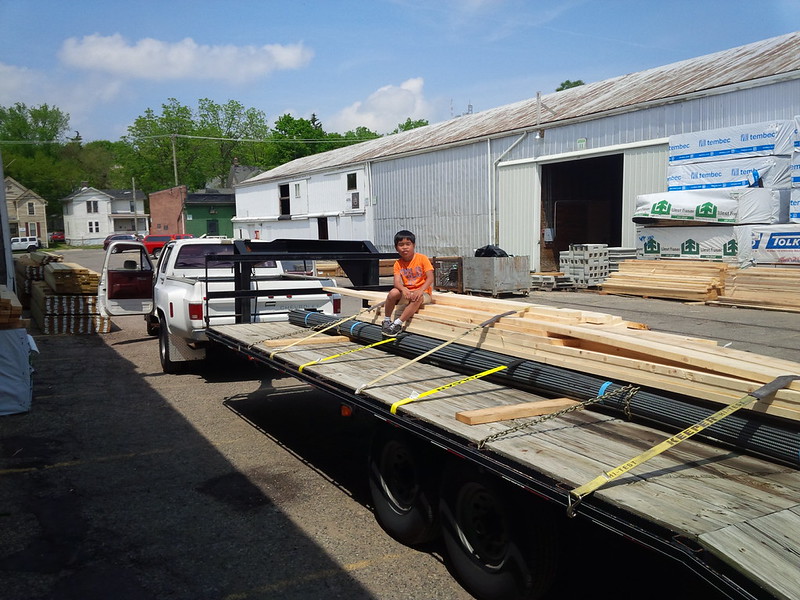
Back to the lumberyard for a "lift" of 2x6x10s and some other framing timbers. I bought the entire thing being about +12 studs extra to what I needed, knowing I'd use the timbers or save them for future projects. I wanted the "housewrap" which comes with the stack for weather protection. I bought the "premium" Biewer lumber which is a made in Michigan product. Good timber with almost zero "wane" meaning rounded over barky sections that make a person go what the....?


I decided to frame an easy wall, short with no windows or doors :)


Erected. I went with ring shank nails on my walls, 16d which are "pole barn nails" in the Grip Rite catalog. I ordered a 25# bucket from the lumberyard, figuring that would be more than necessary.


To be continued...
 

wdrumheller

Well-known member
Joined
Nov 15, 2012
Messages
198
Location
Virginia
FYI, since you're the type of guy that would have an excellent air supply, a good air-powered framing nailer would be really helpful to you for the framing work. I got one, and some galvanized nails with "grippers" on them and let me tell you, they are damn-near impossible to get out after they are nailed. I used them to build shelves in the attic of my big barn. Here's what I have:

http://www.amazon.com/dp/B000A79HWA/?tag=atomicindus08-20 and the nails are something like this with "ring shank" which makes them stick like GLUE. Good grief don't put one where you don't want one. http://www.amazon.com/dp/B00005JRLD/?tag=atomicindus08-20

Best of luck!
 
OP
M

matt_i

Well-known member
Joined
Mar 14, 2008
Messages
10,723
Location
SE Michigan
The concrete and dirt work is a long process. Obviously it could be done much faster by crews that are working daily and not on side work like I am (nights and weekends). However I see so many ways that corners could be cut now that I've been thru it. I have respect for guys in construction as it has got to be a difficult way to make a living trying to balance quality and speed. The rebar prep struck me as one of the easiest ways a person could improve their concrete quality, especially if a heavy duty floor is needed. Get to moving a 10k machine with a 10k forklift and there is a lot of load on the front tires...

I thought long and hard about getting a framing nailer for this project. I wanted a Paslode "combustion" nailer but when I learned they can't shoot true 16ds then I lost interest. I have two excellent framing hammers a Douglas and a Hart-Woody. These are about 16 years old now, the tools have changed designs a little bit but are really nice to use.

Starting to get some progress, built the first door frame. I like to put 2 king studs on each side of my door frames, just to give a more solid "feel" to the building.


I worked long and hard on the design of the walls which include windows (there are a total of 9 windows). Basically I wanted each wall section to be based on an 8 foot top and bottom plate for ease of setting them up, can just barely do this by myself. Also each of the 9 sections are identical, which makes building things easier. The "extra" piece is just measured to fit, slight differences in the foundation makes the last section imperfect. There is apparently an extra king stud on one side of the window frame. This is a joint between two wall sections and allows me to overlap the sheathing plywood across the gap in the top and bottom plate for extra strength. In other words, the sheathing gaps and studwall gaps are not at the same place.


Oops, some snowfall hit. Spent time shoveling the concrete clean again, which is somewhat of a pain as it all has to go out through 1 corner if pushing the pile. Overall its been a nice winter to work outdoors with fairly mild temperatures. I suppose the wet summer somehow made a drier fall and a warmer winter. These things have a way of equalizing back out :)


Oh brother. I sent the hammerhead careening off a nailhead and into my finger when smashing 16ds. That hurt for a couple of days. Im 2 for 2 in index fingernail replacements on this project (!)


To be continued....
 
Last edited:

Cave Creek Ray

Well-known member
Joined
Mar 8, 2015
Messages
383
Location
North Central Arizona
Awesome job Matt. As somebody 2.5 years into a major property renovation, hats off to someone willing to tackle the work and do it right. The pictures are awesome but the best ones are those where your dad is helping. The memories of his assistance will stay with you forever.

Hope you don't get a job transfer! Or your wife decides she wants a different house! :)

Ray
 
To avoid these ads, REGISTER NOW!
Top Bottom