To avoid these ads, REGISTER NOW!

Troubleshooting a Schumacher battery charger

bareass172

Well-known member
Joined
Aug 5, 2012
Messages
817
Location
N'awlins
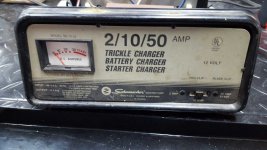
I'm somewhat at a loss here. I snagged this charger for electrolysis and have been trying to run something with it and having no luck at all. After a week of fooling with the electrolysis and having very poor results I'm starting to think the problem is the charger. Not to say I'm perfect, but I read extensively about electrolysis and have modified my rig over and over to eliminate possible problems - I truly believe it's the charger. Unfortunately all I read online, even many posts here, say test it by hooking to a battery and check back later with no further details.

I tested and I'm getting ~12V out of the charger. But when I check for amperage under load I see much less. Even on the 10A setting I was only seeing ~.3-.4A. I checked this with an inline meter (on the 2A setting) and confirmed with a clamp meter on the feed line before the transformer (where the built-in gauge checks also). I realize the AC feed line won't show 10A, etc, but more than .3A would be expected.

All the diodes test good. I broke loose all connections and cleaned them with contact cleaner to be sure it wasn't a corrosion issue. I cleaned and even soldered the wires to the alligator clips to be sure corrosion wasn't an issue there (there was a lot of corrosion on the neg terminal). I don't see any continuity from the coil to ground so I don't suspect a short.

My understanding is that these are relatively bulletproof and if they do fail they are fixable. I would love to figure it out and get it working. I am electrically inclined and have good test tools, not to say I can't be taught, just to say with guidance I should have all necessary testing tools.

I'll explain down here what it's doing during electrolysis in case that matters... I hook it up to my rig with a clean sacrificial rod (rebar) and it works beautifully for about 15 minutes and then the amp gauge drops completely. I pull the rod and it has very slight surface rust on it, but unless I wire wheel the rod clean the amperage will not go up again. So it's working, but barely. This is why I suspect I'm just not getting enough amps out of it.

As always, thanks in advance for any advice and help. :beer:
 

Attachments

  • 20160218_175151.jpg
    20160218_175151.jpg
    103.2 KB · Views: 122
  • 20160218_175157.jpg
    20160218_175157.jpg
    154.2 KB · Views: 129
  • 20160218_175211.jpg
    20160218_175211.jpg
    145.1 KB · Views: 122
  • 20160218_175218.jpg
    20160218_175218.jpg
    154 KB · Views: 125
To avoid these ads, REGISTER NOW!

Savage97

Member
Joined
Jan 16, 2016
Messages
7
What were you using for a load when you measured the current? Have you measured the output voltage under load?
 

jkwilson

Well-known member
Joined
Dec 5, 2012
Messages
758
Location
SW Indiana
0.3A on the AC side would translate to about 3A on the output side. If you'll note the AC power specs on the lower left front it says 0.4A to 1.8? A for the input.

Often a little more soda in the water increases current flow.
 

Hemlock

Well-known member
Joined
Apr 14, 2013
Messages
129
Location
Orlando, FL
What are you cleaning, what's your solution? When I do this, the current drops a lot depending on how clean the item is. It also seems to be limited by the electrode area. Try something bigger than a piece of rebar, it may help. I'm using an old brake disk these days.
 

zkling

Well-known member
Joined
Jan 23, 2007
Messages
16,939
Try putting a battery inline with your electrolysis tank to act as a load, that will tell you if your charger is putting out. Without a DC clamp meter you can make a shunt.

What sort of solution are your running in your tank? Any bubbles? Rough current density?
 
OP
B

bareass172

Well-known member
Joined
Aug 5, 2012
Messages
817
Location
N'awlins
@Savage97
I tested on a battery by itself (normal operation) and tested while hooked to my electrolysis stuff. On a battery I see no voltage differential at all. ~12V from the battery, turn it on and still get the exact same ~12V reading. On the electrolysis tank I was seeing ~10V.

@jkwilson
True, but I was seeing the same .3-.4A whether it was switched to 2A or 10A output.

@Hemlock
I'm cleaning the inside of a motorcycle gas tank which limits me greatly. My solution is between 1-3 tbsp of wash soda per gallon which seemed to be consistent with what I read many places. My piece of rebar is about 14" long and it took a lot of bending and testing to get that much in the tank. I've tried multiple negative locations as well to be certain it's not a grounding issue.
I thought it may have been a cleanliness issue at first so I cleaned and degreased the tank several times with a mix of very strong degreaser and oxy-clean.

@zkling
I thought about using a battery inline with one of my newer chargers so it would trip the nominal voltage and work. Oddly enough I never thought about trying it with this charger. I mentioned solution above. I get good bubbles when the rod is clean, it has been working to some degree, I'm getting the same sludge I see from everyone else and I do get some removal but it's insanely slow for what is barely more than surface rust.
I would need guidance to make a shunt (just point me in a direction and I can search very well) and I'm not sure what my rough current density is.

Thank you all for chiming in. :beer:
 

jallyn

Well-known member
Joined
Jun 29, 2015
Messages
448
Location
Fort Wayne, Indiana
So when you test the charger on a good battery you will be able to measure a difference between the battery voltage by itself, say 12.5 volts. And the battery voltage with the charger connected, say greater than 13.0 volts. Is that what you are seeing?

I would go ahead and hook up your charger to a battery and your electrolysis project. Once the battery is fully charged it won't take much current allowing the electrolysis current (and action) to be good and steady.
 

GreyOwl

Well-known member
Joined
Oct 23, 2007
Messages
549
Location
North Las Vegas
I had to replace a flakey circuit breaker in one of mine to get it to work consistently.
You might temporarily jumper across yours to see if it makes any difference.
 
OP
B

bareass172

Well-known member
Joined
Aug 5, 2012
Messages
817
Location
N'awlins
@jallyn
This is what I said in my last post, when connected to a battery I see no change in voltage. Under load in my electrolysis setup it's only showing ~10V.
This is why I didn't put a battery inline in that setup - I was afraid that the constant drain of the battery and the constant fault of the charger might make an unsafe condition.

@GreyOwl
I had thought about that. I tested it for continuity under normal conditions, but not under load. I'll try it - thanks.
 

gungatim

Well-known member
Joined
Jan 8, 2013
Messages
8,101
Location
west mich
I had to replace a flakey circuit breaker in one of mine to get it to work consistently.
You might temporarily jumper across yours to see if it makes any difference.

this. I see this a lot. usually the breaker is just riveted to the aluminum heat sink and clicks open when it gets hot. they get corroded, fatigue, don't make good contact, etc. literally have a box of them I have snipped out of chargers over the years...check that.
 
OP
B

bareass172

Well-known member
Joined
Aug 5, 2012
Messages
817
Location
N'awlins
I checked the breaker, bypassed completely and no change. While I was at it I did a "no load" test of voltage output to confirm I wasn't crazy with my previous measurements. With no load (just a meter connected to the clamps) I got 9.5V output at the 2A setting, I got 11.5V output at the 10A setting and I got 12.5V output at the 50A setting. None of which are truly adequate to charge a battery.
This is a bad transformer, right? If so, is it fixable or is this a replace situation?
 

gungatim

Well-known member
Joined
Jan 8, 2013
Messages
8,101
Location
west mich
where are you testing for current? direct from the tformer? (use AC scale). those diodes are all crusty looking on that heat sink. you may be losing current there...
 
OP
B

bareass172

Well-known member
Joined
Aug 5, 2012
Messages
817
Location
N'awlins
@gungatim
I clamped onto the same wire that the little ammeter on the front uses (you can see it in one of the pics above). I tested for continuity, voltage, voltage under load, and did a basic diode check on all 4 diodes and they all spec out exactly the same so I assumed they're fine because normally corrosion would not affect all 4 equally. I'm all ears if you have specific suggestions to test.

@TLCObsession
I've read a lot of stuff and watched a lot of videos. I've seen where to buy the diodes and how to replace them with bridge rectifiers if I choose. I am by no means saying they're not bad, but the testing I've done so far doesn't point towards them being the problem (I believe).

@rjtack
It's a motorcycle gas tank so I can't see all the insides. It was left open for I don't know how long so I didn't want to take a chance. What I could see was more than surface rust but not by much. My thinking was that this would be relatively quick before this charger problem popped up.

I've done a lot more testing now, voltages under load seem consistent throughout so I'm not sure hidden corrosion is my problem. I tested AC voltage coming in and out of the transformer, DC coming out of the diodes at multiple points, I checked both sides of the breaker (again, under load) and everything seems to be fine voltage-wise I'm just not getting amperage output. After reading so much online I brushed up a bit and remember how this all works, I just don't see where the shortfall is... :confused:
 
To avoid these ads, REGISTER NOW!
OP
B

bareass172

Well-known member
Joined
Aug 5, 2012
Messages
817
Location
N'awlins
I did when I checked them by themselves. When I was checking continuity and voltage I obviously had to keep them connected.
I do have a small update. I had been suspicious of the slide switch on this from the beginning. Everything else I could remove a terminal, clean, reinstall without issue. The switch, while testing ok, still felt gritty. I finally bent the tabs back, removed the PCB and found all the contacts with a lot of oxidation (even after using a lot of contact cleaner and cycling the switch). A quick hit with a scotchbrite cleaned everything up and a tiny bit of dielectric grease to make it all function better made a big difference. Put it all back together and it appears to be working better now, but it still seems to "fade". I get a good amp reading from it at first but then it quickly dies down. I'm not sure if this is because the battery I have is not discharged or what - but I'm testing it on something right now and will report back after I have time to fool with it some more.

I did put my battery in series for the electrolysis because I have to get that done, and that's definitely working better now. I'll report more later... Hopefully it was just that switch.
 

foghorn1966

Well-known member
Joined
Aug 18, 2012
Messages
228
Location
N. Alberta
As I posted in similar battery charger thread.

Alot of newer style consumer battery chargers will not energize the cables untill they sense some voltage on the leads.

This is a quote from a Solar 1040C charger manual

"This charger is equipped with Auto On-Off Technology.
After connecting to a 12 volt battery, the charger needs to
sense a minimum voltage condition to begin charging and
it will stop charging when it reaches the maximum voltage
condition, but it will continue to monitor the battery charge
level. The charger will "hum" as it monitors. If the battery
charge level drops, the charger will begin charging again."

I suspect that the sense cct sees your electrolysis tank as a big battery cell.
 
Last edited:

G_P

Well-known member
Joined
Jul 11, 2010
Messages
7,135
Location
Central CT
His charger is a "dumb" charger that will put out voltage even with nothing hooked to it.
Try hooking it to a battery that is run down very low and then check the output amperage. It should go up and if its on the 10A setting and only putting out an amp or two you found your problem.
If you have a load tester, thats a good way to quickly run down a car battery so you can use it to test the charger.
 
OP
B

bareass172

Well-known member
Joined
Aug 5, 2012
Messages
817
Location
N'awlins
Update... I still can't make heads or tails of this thing, it still wants to "fade". I drained my battery by putting it in series with my electrolysis setup and this charger. When I cleaned the rebar (anode) the unit ran STRONG showing ~10 amps. This is the first time I've seen it this strong so it must have had something to do with cleaning the switch I mentioned. The problem is that after a short while (15-30 minutes) the amps fade and it goes back to putting out insufficient volts and amps to charge. In the electrolysis system the only way to improve the performance is to clean the rebar again. As to charging the battery directly (not in the electrolysis setup), the only way to bring it back up is to unhook it for awhile and leave it to rest.

Since this is all solid-state stuff I just don't get this behavior, and the transformer isn't overheating at all - I can put my hand on it and it's usually cold and very rarely *slightly* warm.

For now I'm not going to worry much more about it because I have multiple "smart" chargers to do batteries. I'm going to focus on this from the electrolysis angle and see if I can't figure it out there since that's all I really wanted it for...

Thanks so much for those who chimed in and tried to help. If anyone CAN shed more light on this I am all ears and appreciative.
 

My Old Tools

Well-known member
Joined
Jun 4, 2014
Messages
5,434
Location
Hamrick Lake, TX
Sounds like its all about the rebar. I used a dumb 10 amp charger successfully for quite awhile until I upgraded my tank with two large graphite plates. After that it would crowbar the charger in a minute, pulling too many amps. It's all about surface area. It sounds like it is working correctly, you just don't have enough surface area on that rebar and it gets coated quickly. It's hard inside a tank, but try a piece of stainless flat bar.
 

dogdog

Well-known member
Joined
Nov 15, 2011
Messages
12,711
maybe you should verify all the outputs of your transformers at the transformer's secondary then verify the DC output right after the diode outputs....

from the pics at least.... the top portions including the amp selector switch is high voltage area. The bottom of the transformer is the secondary lower voltage outputs.

**** The charger configuration looks very similar to that $30 HF one I have... At least this is how I approached it last time when my HF unit went to take a dump.... end up to be fuse issue... YMMV.


The blue and white wire that goes to the diodes are should give you a lower AC voltage output... the black wire on the bottom that goes to the fuse then to the output leads is the Center Tap wire

on the secondary....
Voltage between the Black and blue then black and white should be the same (secondary low AC voltage output) One set handles the top part of a wave, the other set handles the bottom....

Mine's the HF one is about 15V or 16V AC I don't remember..... the the diode by nature drops the voltage by about .7 volts and converted it to DC voltages,, if that is the only set of diodes....

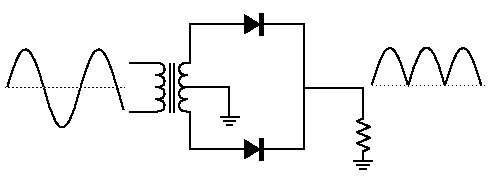
So if you measure between the white and blue it should be 2X of what is measure between the black and white or black and blue. if the transformer is balanced.


Two blue wires (2 diodes parallel) / Two white wires (2 diodes parallel) that goes into the diodes seems to be operate in parallel pretty sure you can google how to test a diode individually with a VOM. once you verify that all are operating correctly the voltage between the secondary AC output and the voltage drop after the diode should be about .7 volt, .7 less than the secondary output....

something to this pic except you have two diodes each..... when you google center tap full wave rectifiers. it's what they used in these chargers.

rectct.gif


Usually chargers are between 14v and 15V on the output side with no load nothing connected. If you verify those... really nothing much to the Manual charger.

Then maybe it's just your electrolyte solution and the electrode you used.... Mine pieces of what ever metal including a used brake rotor I have around would take lots of initial current about 3 or 5 AMP then drops to almost 0 when it's crumb up with stuff until I cleaned it... that was when I was doing the heavy duty cast iron Radiators. Also I notice the closer you put the electrode to the metal you are de-rusting the more amp draws as well.

Also when people say to use a battery along with your "smart" charger usually they mean in parallel ( + of charger goes to + of battery and - of charger goes to - of battery) not in series (the other way around) .... not sure if that is what you did.

Also the amount of those soap solution you use matters.


Good Luck in your troubleshooting.
 

dogdog

Well-known member
Joined
Nov 15, 2011
Messages
12,711
Update... ...... As to charging the battery directly (not in the electrolysis setup), the only way to bring it back up is to unhook it for awhile and leave it to rest.
.....

Maybe this:
This suggest you check that fuse bypass or replace... it's only $5 at autozone... my HF unit craps out that way... since replaced with a better fuse, it's not causing issue.... The bi-metal inside that square look alike fuse on the negative lead of the output..... heats up when current flows through it, It bends the other way opens the circuit when too much current is flowing through it...flex back (re-set/re-seats ) when it cools down.... maybe it's just bad.... and not flexing at the proper current any more.
 

jarboy

New member
Joined
Jan 14, 2012
Messages
2
His rebar is getting dirty. He needs to clean it often, or get a better anode.
 
OP
B

bareass172

Well-known member
Joined
Aug 5, 2012
Messages
817
Location
N'awlins
try a piece of stainless flat bar.
I appreciate the offer of help, but this is very bad advice if you (or anyone else reading) doesn't know. Using stainless as the anode creates hexavalent chromium, an insanely toxic chemical that is heavily regulated. You can get in serious trouble disposing of this stuff.

@dogdog
Thanks very much for taking the time to write this all out. Much of what you recommended I have already checked and rechecked time and again. I did testing across the fuse in all sorts of situations, but you have me thinking about replacing it just to eliminate the possibility that it IS failing after being under load for awhile.
In the interim, I also plan to convert an old ATX PSU from a computer to try next time around. I gave up on this project for now, but will get back to testing and troubleshooting this in a more normal tank rather than inside a motorcycle tank. If the new PSU works then I know what my problem was...

Thank you again for taking the time to write all that - I know how long it takes to type that all out and it's very helpful.
 

dogdog

Well-known member
Joined
Nov 15, 2011
Messages
12,711
Think Graphite Rods is what they used for premium anodes on the electrolysis (was mentioned by some one as well)... the ones they used for EDM process... I just can't justify the cost if my junk metal bar works ie my used rotor and some flat steel stocks.... either case you might want some thing with larger surface area than the rebar.

There was a good article in one of these post here in this forum about this electrolysis process some time back.
 

jallyn

Well-known member
Joined
Jun 29, 2015
Messages
448
Location
Fort Wayne, Indiana
Maybe I missed it, but does your charger charge a 12v battery just fine?

If you are getting any voltage at the output when nothing is connected then the switch is making contact or at least some contact.

Transformers usually work or they don't. They can fail open or shorted. Open and you get nothing at the output. Shorted and it blows a breaker or fuse somewhere...also no output.

I am thinking it is one or more of your diodes. That or an electrolysis/cathode/anode problem that I am not as familiar with.
 

theoldwizard1

Well-known member
Joined
Feb 22, 2011
Messages
43,132
Location
SE MI
Get an old fashioned head light and use it as your load. Better, get 2 and put them in parallel. See if the current "fades" after your current "timeout".
 

gungatim

Well-known member
Joined
Jan 8, 2013
Messages
8,101
Location
west mich
As I posted in similar battery charger thread.

Alot of newer style consumer battery chargers will not energize the cables untill they sense some voltage on the leads.

This is a quote from a Solar 1040C charger manual

"This charger is equipped with Auto On-Off Technology.
After connecting to a 12 volt battery, the charger needs to
sense a minimum voltage condition to begin charging and
it will stop charging when it reaches the maximum voltage
condition, but it will continue to monitor the battery charge
level. The charger will "hum" as it monitors. If the battery
charge level drops, the charger will begin charging again."

I suspect that the sense cct sees your electrolysis tank as a big battery cell.

his is not a smart charger...it should put out full voltage, a load will draw enough amps until the breaker overheats and clicks open...still wondering how you tested the output, you unsoldered the diodes? even if you use a meter to test the diodes and they show they are good in one direction, under load they can still leak. when ever they look crusty like that, I get rid of them and use a radio shack bridge rectifier. they are food for like 50 amps and were only $6 when they were still in business. fortunately I have a few spares I bought before they went under. it also helps to put a small computer fan in there to keep the heat down, I usually get rid of the 6v circuit as I never use it and run a little cpu fan off that...
 

jkwilson

Well-known member
Joined
Dec 5, 2012
Messages
758
Location
SW Indiana
I'm in the camp that you have diode bad.

When converting AC to DC, full-wave rectification is the most common method. The negative AC peaks are flipped around to be positive peaks so you wind up with spiky, noisy power from zero to whatever AC voltage comes out of the transformer. Then you feed this into a capacitor that smooths it out into DC.

When a diode goes on a rectifier, you only get half as many spikes, and when you smooth them out the net DC result is lower than it would have been with all the diodes working.

You should see something like 18-24VAC at the output of the transformer to produce 15 or so VDC at the output of the charger.
 

theoldwizard1

Well-known member
Joined
Feb 22, 2011
Messages
43,132
Location
SE MI
Two blue wires (2 diodes parallel) / Two white wires (2 diodes parallel) that goes into the diodes seems to be operate in parallel pretty sure you can google how to test a diode individually with a VOM. once you verify that all are operating correctly the voltage between the secondary AC output and the voltage drop after the diode should be about .7 volt, .7 less than the secondary output....

something to this pic except you have two diodes each..... when you google center tap full wave rectifiers. it's what they used in these chargers.

rectct.gif
Yes, that is probably the basic circuit, but something tells me there has to be something else in the circuit.

If you switch it to the 50A setting it won't put out 50A for very long. Likewise, the 10A setting will kick down to 2A over time.
 
OP
B

bareass172

Well-known member
Joined
Aug 5, 2012
Messages
817
Location
N'awlins
@dogdog
I'm on the same page. If I get into doing this a lot more then I would invest in the carbon, but for now I have plenty of scrap. I've read probably 3 dozen or more different posts/articles on this forum, others and the internet in general just trying to think this through. and probably almost 2 dozen different bits on the charger itself.

@jallyn
After a lot of discussion, reading, etc I think it may have been the anode in my situation causing at least some of my problem. With that said, I'm not ruling out the circuit breaker as being old because sometimes it works very well and sometimes I get limited voltage/current out of it. I thought it was a corrosion issue early on because I was getting voltage, just not enough of it. After cleaning everything with no change, I'm back looking at the breaker.
What you said about the transformer confirms what I thought, so thanks for that.

@gungatim
I tested the output across the diodes with everything disconnected and then I also tested voltage across (before and after) with it under load. In truth, I tested the charger in so many different ways that I forgot some of my results, but that's mostly because everything seemed to be checking out ok. I want to be clear, I see the picture the same as you do, but in person they don't look as crusty as the picture appears. I'm not saying it's not them, but I want to replace that "circuit breaker" first. You know these are stone simple devices though, so it can only be a couple of things if the transformer is working.
Once I get it sorted out, if I plan to keep using it in my electrolysis setup, I think I'm going to add a small fan and voltmeter to it for good measure. Mine doesn't have a 6V setting, but that stuff pulls so little I don't think it'll be an issue. Besides, even without a fan, the transformer never seemed to get much more than slightly warm.

@jkwilson
I need to double check this once more, but I believe I was in the neighborhood of 19V AC before the diodes.

@theoldwizard1
I have pics of the insides at the beginning of this post. It's a stone simple device without much "fluff".

Thanks!
 
Last edited:
To avoid these ads, REGISTER NOW!
Top Bottom