To avoid these ads, REGISTER NOW!

My Craftsman 5198 Vise Restoration

jreb10

Well-known member
Joined
Oct 18, 2014
Messages
329
Location
Westby, WI
This Spring I was lucky enough to acquire an uncommon Craftsman 5198 vise. The story of its acquisition is in the “Vises” thread page 2196 starting with post # 43914 here:

http://www.garagejournal.com/forum/showthread.php?p=5718705#post5718705

I thought I would put a summary of its restoration in its own thread, to make it easier to find in the future, rather than chopping it up between the “Vises” thread and the “Vise Repair” thread.

By way of background, the Craftsman 51XX vise line has a bit of a following here, as it was Craftsman’s attempt to compete with the major vise manufacturers with its own unique design. Prior to this they sold Craftsman-labeled vises from other manufacturers such as Rock Island and Reed. The Craftsman 51XX vise design incorporates many features from different vise manufacturers, and it is still not known who produced these vises for Craftsman.

The 5198 vise is the largest swivel base version of the line, with 5 inch jaws and an advertised shipping weight of 107 pounds. Very few of these guys have turned up. A few years ago Big Caddy made the first find. Econtrk also found one and did a thread on its restoration here:

http://www.garagejournal.com/forum/showthread.php?t=291812

And I think at least on other was found as well and sold on eBay. That is all that I can remember.

So, here is what mine looked like when I picked it up:

IMG_1212 (Medium).jpg IMG_1214 (Medium).jpgIMG_1216 (Medium).JPG
 
To avoid these ads, REGISTER NOW!
OP
J

jreb10

Well-known member
Joined
Oct 18, 2014
Messages
329
Location
Westby, WI
The first thing I like to do with a newly acquired vise is give it an initial hand cleaning with a wire brush to get an accurate idea of its condition, and identify any areas needing repair. Here it is:

Vise Pic
There was a little bit of original paint left:

IMG_1248 (Medium).jpg

Overall the vise is most certainly used. Not surprising, given that it was expensive in its day. If you bought this large vise you sure intended to use it. There are nicks in the top of the jaws, and some hammer marks on the back on the slide, as well as various dings on the handle and jaw towers. The anvil area is pretty worn. The oil port on the dynamic is missing (how did THAT happen?). The Craftsman badge is in pretty bad shape, and really lets the vise down.

IMG_1222 (Medium).jpg IMG_1247 (Medium).jpg

Given its condition, a plan emerged. I felt I needed to be careful not to “over restore” some parts of the vise. The limiting element was the marks on the back of the slide and the anvil. The rest of the vise should not look “too new” compared to these spots. So I decided to just clean up the jaw inserts with a soft wire wheel and keep most of the patina, and do the same for the handle, spindle, and lockdown. No “polishing” on this one. The paint decision was easy – a new paint job, as close to the original color as I can get.
 
OP
J

jreb10

Well-known member
Joined
Oct 18, 2014
Messages
329
Location
Westby, WI
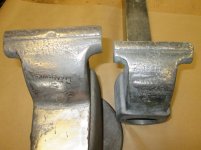
The first problem I noticed was that a part of the jaw insert support ledge on the static had broken away. I have seen this before on Rock Island vises that use the same type of jaw insert support ledge. The PO had managed this situation by fabricating a longer screw for that side. It was not a functional issue since the insert was well supported top and bottom. It was a cosmetic issue that I planned to fix:

IMG_1236 (Medium).JPG IMG_1238 (Medium) (2).jpg


It turns out that the jaw ledge was not the whole story. Close inspection of the dynamic jaw support on the static showed cracks! Bad news indeed.

IMG_1263 (Medium).jpg IMG_1266 (Medium).jpg

I would guess that at some point someone hammered on an object in the vise pretty hard. The hammering broke off the piece of the static jaw insert support, and possibly cracked the dynamic jaw support at the same time.

You can see that the vise design has a big “trench” between the sliding surfaces on the dynamic jaw support. This trench extends well into the static jaw tower. I guess this was a weight/material saving design feature at the time. I’m not a mechanical designer or metallurgist but I think it weakens the dynamic jaw support, and explains why this area is the “Achilles Heel” of the 51XX design.
 
OP
J

jreb10

Well-known member
Joined
Oct 18, 2014
Messages
329
Location
Westby, WI
The first step in the restoration was to repair the cracks in the static. This is a cast iron type of repair. The only thing I knew was that welding cast iron is an art, and requires lots of experience to be sure it is done right. Done wrong, you end up with a much bigger problem.

I had a hard time finding someone I could trust to do the repair. I didn’t want to be the Garage Journal guy that screwed up a 5198! I ended up going to a guy about 45 miles away who had a good reputation for repairing cast iron parts from vintage cars and boats from around the country.

A good reputation means the guy was busy, so it took a while to get done. It also means the guy can charge a lot for his expertise. So this 5198 sort of turned into a labor of love…

We agreed he would do the repair, and I would handle the cleanup to level the sliding surfaces and refit the dynamic to the static. Here are a few shots of the repair:

IMG_1523 (Medium).jpg IMG_1524 (Medium).jpg IMG_1522 (Medium).jpg

And here is the fit after a lot of hand filing and smoothing:

IMG_1549 (Medium).jpg
 
OP
J

jreb10

Well-known member
Joined
Oct 18, 2014
Messages
329
Location
Westby, WI
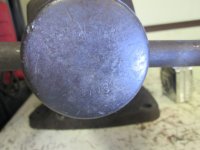
I then turned my attention to the static jaw insert support ledge. This was a cosmetic issue, not a structural issue. I decided to “fill in” the missing portion with Devcon 10110 putty. It is like “industrial strength” JB Weld. As long as no one takes a hammer to the vise again it should work OK.

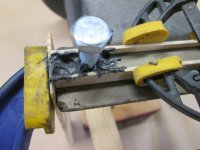
I used some “popsicle” type mixing sticks to build a sort of form, held in place by small quick clamps. I took a long bolt with an unthreaded section, cut down the threaded portion, coated it with paste wax as a release agent, and inserted it into the threads:

IMG_1567 (Medium).jpg

Then I mixed the Devcon and scooped it into the form, a bit over the level of the ledge, as best I could. The only part of this that will be seen is the outside edge, so I made sure it was high enough there:

IMG_1568 (Medium).JPG

After a couple hours I twisted the bolt just a little to make sure it would release.

After a full cure, I used the jaw insert as a guide and slowly and carefully removed Devcon to fit the jaw flush. Here is the result:

IMG_1570 (Medium).JPG IMG_1572 (Medium).jpg

With this repair I intended to paint the sides of the jaw towers so the Devcon would not be seen. I generally prefer them to be bare metal, but the jaw inserts are reasonably wide on the sides, so there will be some bare metal showing there.
 
OP
J

jreb10

Well-known member
Joined
Oct 18, 2014
Messages
329
Location
Westby, WI
I still had to deal with the Craftsman badge. It was in bad shape, not at all in keeping with the rest of the vise.

Removal was a pain. It was held in place by u drive screws, in this case, very, very small u drive screws. A u drive screw is a bit like a rivet with a thread on it that is driven into an “interference fit” sized hole. The hole nearest the handle was a through hole into the interior of the static. The hole farthest away was a blind hole. After a lot of fussing around I got both u drive screws out.

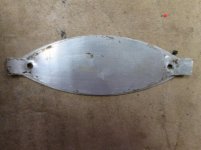
I had figured these Craftsman badges were pretty standard and had been looking on eBay for a replacement badge of the same size. I eventually bought one taken from a King Seeley 103 table saw. Here is the comparison:

IMG_1544 (Medium).jpg

Well, the wording was not quite the same, but it should do fine. The holes on the replacement badge are larger, so I needed to get larger u drive screws and enlarge the holes in the static. Other than that, it should have been easy right?

Well, not so fast. When I tried fitting the new badge into the recessed space on the static, it did not fit. What the ….?

So I put the old one on top of the new one and here is what I got:

IMG_1545 (Medium).jpg

Yep, that’s right, the oval portion is slightly different between the two badges! So much for my standardized badge theory. I didn’t want to alter the badge so I turned my attention to the static.

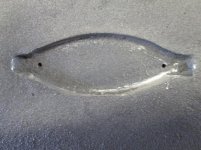
I did note there was some casting flash along the inside edge of the recessed area. I brought out the Dremel and carefully removed the flashing and worked deeper into the edge, especially the far portions of the oval. Eventually I got a fit. Here is the area after the Dremel work:

IMG_1546 (Medium).jpg IMG_1547 (Medium).jpg

The holes do line up and were drilled later. And here is the new badge and its u drive screws. These are small enough in diameter to give some wiggle room to fitting the badge in the recess:

IMG_1548 (Medium).jpg
 
Last edited:
OP
J

jreb10

Well-known member
Joined
Oct 18, 2014
Messages
329
Location
Westby, WI
In preparation for paint I did use my electrolysis tank for the dynamic and the swivel base. The static had been bead blasted prior to welding and was pretty clean, so manual wire brushing here and there was all that was needed. I did belt sand the anvil area, but some marks were too deep to remove. That was OK as it is in keeping with the condition of other parts of the vise.

I wanted to take out the minor dings on the backs of the jaw towers, so I used Devcon in a Bondo-like application, spreading a thin layer to fill them in. After curing, I sanded them down:

IMG_1566 (Medium).jpg IMG_1569 (Medium).jpg IMG_1573 (Medium).jpg


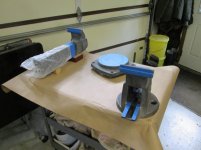
Here are the vise pieces taped up prior to priming and paint:

IMG_1574 (Medium).jpg

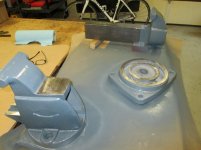
For priming I used Rustoleum etching primer. For paint I used three coats of Valspar 85041 Gloss Cobalt Cannon. I know from previous experience this is a good match to the distinctive Craftsman blue-gray of that era. Plastikote T10 is also very close, being just a touch lighter than the Valspar. Here are the pieces after paint:

IMG_1575 (Medium).jpg
 
OP
J

jreb10

Well-known member
Joined
Oct 18, 2014
Messages
329
Location
Westby, WI
The handle, lockdown, and other exposed metal surfaces such as the anvil and the slide were wiped with Fluid Film, and later the excess was wiped off. I don’t want this vise to start rusting anytime soon.

After assembly the handle spins easily with one finger. I do like the backlash adjustment features of this vise. There is almost no backlash now.

Here is a before/after comparison, and a few other pics of the final result:

IMG_1212 (Medium).jpg IMG_1586 (Medium).jpg

IMG_1592 (Medium).jpg IMG_1587 (Medium).JPG IMG_1589 (Medium).jpg
 

Attachments

  • IMG_1594 (Medium).JPG
    IMG_1594 (Medium).JPG
    140.2 KB · Views: 95
Last edited:
To avoid these ads, REGISTER NOW!

WWShop

Well-known member
Joined
Aug 25, 2015
Messages
948
Location
MN
Great job, Joe....I've been waiting for this thread!! Looks great!
 
Last edited:

PierceA

Well-known member
Joined
Aug 6, 2020
Messages
471
Location
SE Michigan
I know this is a 5-1/2year old thread, but I ran across it in a search for something on the spreadsheet.

jreb10: Your 5198 was used for sure. Both of my 51xx vises [smaller versions] have to be very tough, they are used,
but show very little from the use: Jaws are crisp, and few hammer marks..
I don't know the metalurgy of the jaws, but they definitely hold up well.

I very much liked reading this thread, and I totally agree with trying to match the restoration with the noticeable use that shows..
That keeps the vise from looking like an attempt at a showpiece, and also is more practical if you plan on using the vise..

I've used my 51xx vises, and I agree with you: they are very nice, have good tight tolerances and are a pleasure to use..

Great work! and thanks for the well done synopsis of your restoration.

PierceA.
 
To avoid these ads, REGISTER NOW!
Top Bottom