To avoid these ads, REGISTER NOW!

Pole building insulation idea, thoughts??

tdkkart

Well-known member
Joined
Jun 17, 2006
Messages
6,887
Location
Eastern Iowa
So, while sitting around waiting to get my new floor down, I've been pondering my next step which will be insulation.......Long term plan is to cover the interior walls with standard pole building steel siding, the price on this stuff has started dropping, hopefully it'll be affordable by the time I'm ready for it.

The building is standard pole construction, 6x6 posts 8' apart with horizontal 2x6 stringers between posts spaced on 30" centers vertically.(you can see this in the pics in my other thread).
What this leaves me is cavities that are 8' x 30"x 6" that need to be filled with insulation. The first obvious problem is that as far as I know, common fiberglass batts are no available in 30" widths, that would make it too easy, and that's just not the way things are done around here.

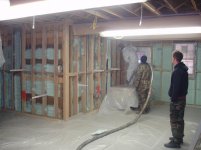
A thought popped into my head the other nite. How about covering the entire wall as is with 1/2 or 3/4" foam board, nailed or screwed to the posts and studs, and then blow in cellulose or fiberglass behind the foam?? Once foam board is up you could holesaw 2 or 3 holes at the top edge of each 2'x30" cavity and fill each one individually. The cavities would be small enough that future settling would be minimal.

This would give a nicely sealed 6" cavity, plus whatever the R-value is of the foam board.

Thoughts???
 
To avoid these ads, REGISTER NOW!

kbs2244

Well-known member
Joined
Nov 11, 2006
Messages
14,065
I don't think the foam board has the strength to be the exposed surface.
 
OP
T

tdkkart

Well-known member
Joined
Jun 17, 2006
Messages
6,887
Location
Eastern Iowa
Didn't intend it to be the exposed surface, will be covered with steel siding panels or OSB after insulation is completed.
 

ironman2424

Well-known member
Joined
Feb 19, 2009
Messages
50
how about doing what i did for my 24x32x10. use 3" roll insulation. it comes in 72" widths and in 150' rolls. i built my walls conventional except on 24" centers and used 1x4's for lathing to screw my sheetmetal to. it staples easy and has a plastic barrier on the down side. i tuck taped the seams and am very happy with it. i put it between the 1x4's and the sheet metal so it will stay in place from now on. just my 2 cents. plus u can run it sideways or straight up and down. thats just a personal prefferance.
 

Dragster Racer

Well-known member
Joined
Feb 9, 2008
Messages
1,891
Location
Morrison, IL
If blowing, then why the foam board? You could use whatever your outside covering is to make the cavity. Not that what you are saying isn't a good idea, but not sure the advantage of just blowing in.
Another way to do it is bookshelfing. Put up 24" stringers horizontally and put R19 batts in between. You do have the added expense of the studs though. I picked up some foam board cheap, and will probably put that against the metal between the purlins, and then the R19 in the 6" cavity inside.
 

mag99

Well-known member
Joined
Dec 4, 2008
Messages
116
Location
tuttle, ok
They make a "netting" material that the insulation installers use, at least around here. It comes in rolls. Our walls are 9', so they had a 9' tall roll, it just staples to the studs, or girts in your case. Then poke a hole in the net in each cavity, and blow in the insulation. The material is pretty tough, but obviously will need to be covered with OSB, steel, sheetrock, etc.
 

uponroof

Active member
Joined
Apr 30, 2009
Messages
28
Location
sePA
I had a similar situation in which I chose to build framed walls and ceilings within the pole barn structure. It wasn't all that difficult or expensive. I used minimum of 2x6 for the walls and stood them six inches off the outer shell to give me a cavity which would accept 12 inch thick batts. The larger of the two shop areas (approx 1200 sq ft) was insulated this way with just batt insulation.

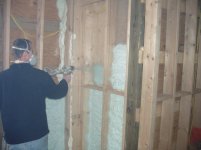
The smaller shop space is super insulated with spray foam (5-6 inches of closed cell) before filling in the remainder of the cavities with fiberglas. The SPF added excellent foam 'R' value and made the space almost airtight, which is the key. The glas batting increases the ability to capture heat.

Obviously this 900 sq ft space is now extremely energy efficient as it can be heated comfortably with two small radiant space heaters. In the summer the nearly air tight space benefits from the natural cooling which comes from the slab floor.

Once you make a space 'air tight', and I mean that almost litterally, the 'R' values of the polyiso or glas overlay increases dramatically. Understand that a simple fiberglas batt wall or cieling is nothing more than a filtration system. It allows air to pass through it. The rate at which this passing happens determines the 'R' value...The slower it passes the more 'Rs' retained as value.

If you spray foam a space (from base of walls at the floor up to and including the entire cieling) you'll stop the flow of air and enormously reduce wasting energy. Carefully sealing doors and windows must be included.

Traditional 'R' value measuring must be multiplied upwards as the air flow through these foamed walls and ceilings stops. In other words, 1 inch of SPF, which is part of a monolitic air barrier, is worth far more 'Rs' than 1 inch of foam board which is not part of a continuous air barrier system.

I'm a roofing contractor and have access to all the 1,2,3 inch foam board I want (returns from commercial roof jobs). But it comes nowhere near to what correctly applied SPF 'air barrier' offers.

From what I found SPF is about twice the cost of fiberglas. I almost got into becomming a SPF contractor given the benefits. With rampant inflation (government printing money) in the pipeline and on the way, which will really jack up energy costs, SPF is one of the best investments you can make. (IMHO).
 

Attachments

  • P209027314.jpg
    P209027314.jpg
    102.6 KB · Views: 224
  • P208026628.jpg
    P208026628.jpg
    87.8 KB · Views: 243
  • P2120338.jpg
    P2120338.jpg
    131.7 KB · Views: 212
  • P4150751.jpg
    P4150751.jpg
    136.1 KB · Views: 193
  • P4150748.jpg
    P4150748.jpg
    88.1 KB · Views: 180
  • P4150752.jpg
    P4150752.jpg
    99.9 KB · Views: 181
  • P4150750.jpg
    P4150750.jpg
    111 KB · Views: 170
Last edited:

Bermudacat

Member
Joined
May 3, 2009
Messages
16
Location
Seattle
After blowing celuose insulation into the walls of my split level via the interior walls, I won't even walk down the isle at the hardware store that has the fiberglass insulation.

Quick, easy and itch free. Not to mention celuose has a higher r-factor than the equivalent thickness of fiberglass.

Seriously, I don't see how fiberglass insulation manufactures can stay in business after experiencing the simple, quick, itch free process that celuose is.

Another bonus of celuose is it has borax (flame retardant) and boric acid (discourages insects) in it.
 

krooser

Well-known member
Joined
Jun 3, 2005
Messages
2,377
Location
Waupaca, Wisconsin
use 24" batts then fill the remaining area with 6" batting cut to fit...

Since my building was disassembled and moved to my lot I used all the old insulation when i rebuilt the building... 3.5", 6", 24/16/48 wide... whatever would work. Once you get the walls covered no one will know.
 

GSSFC

Well-known member
Joined
Apr 13, 2008
Messages
423
Location
Wolfeboro, NH
I had a similar situation in which I chose to build framed walls and ceilings within the pole barn structure. It wasn't all that difficult or expensive. I used minimum of 2x6 for the walls and stood them six inches off the outer shell to give me a cavity which would accept 12 inch thick batts. The larger of the two shop areas (approx 1200 sq ft) was insulated this way with just batt insulation.

The smaller shop space is super insulated with spray foam (5-6 inches of closed cell) before filling in the remainder of the cavities with fiberglas. The SPF added excellent foam 'R' value and made the space almost airtight, which is the key. The glas batting increases the ability to capture heat.

Obviously this 900 sq ft space is now extremely energy efficient as it can be heated comfortably with two small radiant space heaters. In the summer the nearly air tight space benefits from the natural cooling which comes from the slab floor.

Once you make a space 'air tight', and I mean that almost litterally, the 'R' values of the polyiso or glas overlay increases dramatically. Understand that a simple fiberglas batt wall or cieling is nothing more than a filtration system. It allows air to pass through it. The rate at which this passing happens determines the 'R' value...The slower it passes the more 'Rs' retained as value.

If you spray foam a space (from base of walls at the floor up to and including the entire cieling) you'll stop the flow of air and enormously reduce wasting energy. Carefully sealing doors and windows must be included.

Traditional 'R' value measuring must be multiplied upwards as the air flow through these foamed walls and ceilings stops. In other words, 1 inch of SPF, which is part of a monolitic air barrier, is worth far more 'Rs' than 1 inch of foam board which is not part of a continuous air barrier system.

I'm a roofing contractor and have access to all the 1,2,3 inch foam board I want (returns from commercial roof jobs). But it comes nowhere near to what correctly applied SPF 'air barrier' offers.

From what I found SPF is about twice the cost of fiberglas. I almost got into becomming a SPF contractor given the benefits. With rampant inflation (government printing money) in the pipeline and on the way, which will really jack up energy costs, SPF is one of the best investments you can make. (IMHO).

Ahhh!!!

Tim
 

skeletonizer

Well-known member
Joined
Sep 25, 2008
Messages
1,320
Location
Michigan
I would use the Owens Corning Attic Cat fiberglass insulation. It blows in like cellulose, is not itchy, settles less, no dust, and has a higher R value.

I have used both and will never go back to cellulose.

I think their is some pics of the machine in my build thread in my sig.
 

uponroof

Active member
Joined
Apr 30, 2009
Messages
28
Location
sePA
One more time as I think this is something many are not fully aware of, and then I'll leave it alone.

As a 54 year old contractor, brought up accepting the premiss that fiberglas is where most insulation answers are found, I had to rearrange my thinking.

Traditional fiberglas 'R' values are a fairy tale. We've been fed so much lathered up **** about fiberglas that we've come to accept it as gospel. Even with 20+ inches of fiberglas in any building cavity, without taking precautions to eliminate the air infiltration behind it, it's inefficient and sometimes even worthless.

Quote:

"....Studies have shown that as much as 40% of a building’s total energy loss is due to air infiltration. Traditional fiberglass insulation is only stapled, or placed into the wall cavities and does not seal the stud and wall cavities from end to end, or top to bottom. Air infiltration can pass through these gaps, making it far less efficient than SPF. SPF not only adheres to, but forms to the walls and floors to create a tight seal and insulating barrier that stops this air leakage. SPF also boasts the highest R-value per inch than any other commercial material, (upwards of R-7.0, compared with Fiberglass at R-3.5) making your home more comfortable and less expensive to heat in the winter, and cool in the summer.

Since SPF acts as an air barrier, it also helps to reduce moisture infiltration, which is a source of dangerous mold and mildew growth in the home, and can cause severe health problems to its occupants. So save your family and save money at the same time with SPF home insulation systems. Moisture infiltration can also cause structural damage to your home or building...."

http://www.sprayfoam.com/spps/ahpg.cfm?spgid=1

Don't be fooled. Anything that allows air to pass through it is nothing more than a 'filtration system'. Does that sound like an efficient preservation of energy? Air movement must be eliminated if you want to maximize energy efficiency. Fiberglas and carefully placed caulk cannot come close to what expanding foam offers regarding the sealing of each and nook, cranny and the smallest of cracks.

So if eliminating air inflitration is so important, why doesn't it receive more attention?

It's starting to. 'Air barrier' technology is taking over in Canada where they've adopted it as mandatory on both private (citizen) and public (government funded) buildings...And the US is close behind with most government buildings (taxpayer funded) being specified with air barrier/SPF (and I believe a few New England states are now requesting air barrier compliance). Air barrier boosts energy savings (R values) like nothing else. It also eliminates mold through the elimination of penetrating moisture. This is a major consideration when considering the problems taxpayer funded schools and hospitals have had with mold. So government projects are now becomming 'air barrier' mandatory.

http://www.basf-pfe.com/index.php?location=CNE&section=view-ART&select=203

***


Simply put, SPF over all walls and ceilings essentially seals a living space making energy savings incredibly efficient...way beyond what we've been trained to believe regarding traditional fiberglas 'R' value formulas. Not all air barrier systems are SPF, but it seems to be the most popular given it offers both insulation and airtightness. Explore and reach your own decision.

If you are locked into thinking of insulation as fiberglass and inches you've been successfully brainwashed by the fiberglas manufacturer's of the world. Open your mind to what it actually takes to trap and preserve energy.

.03
 
Last edited:

Dragster Racer

Well-known member
Joined
Feb 9, 2008
Messages
1,891
Location
Morrison, IL
I sure agree with the air infiltration points. But isn't that the point of Tyvek wraps and/or caulking? I know that both are difficult to do properly in a pole building, but it can be done. So take your time getting this part right. Even using foam in places where you need a little expansion is good. Just be careful to use low expansion around doors and windows.
Why isn't the foam getting more attention? Cost! There does seem to be a great variance from location to location and among contractors in cost. But around here, there was no way for me to justify the foam in my house, let along in my shop. I even ran numbers using the foam saving me all of my energy use, and still the payback was well past my retirement, and I am a young man!
And using schools and muni's as an example of using good economical sense isn't convincing me. I have seen schools put up wind turbines with a promise of 15 year payback, with no regard to the maintenance or even lifespan of the equipment. Muni's are very good at capital expenditures, and hate ongoing costs, so it works well for them.
I appologise for being so disagreeable on this topic, but I have run the numbers for myself, and they never have worked. To say that the previous 30 years of insulating knowlage is brainwashing and that foam is where it is at regardless of cost sounds like a victim of brainwashing talking to me.
If I can somehow get the numbers to work out for my home when we get to that point, I will use the foam. It is a superior product and serves multiple functions well. If it doesn't make sense, then I won't use it.
 

rinny_tin_tin

Well-known member
Joined
Dec 20, 2008
Messages
636
Location
Northern Virginia
One more time as I think this is something many are not fully aware of, and then I'll leave it alone.

As a 54 year old contractor, brought up accepting the premiss that fiberglas is where most insulation answers are found, I had to rearrange my thinking.

Traditional fiberglas 'R' values are a fairy tale. We've been fed so much lathered up **** about fiberglas that we've come to accept it as gospel. Even with 20+ inches of fiberglas in any building cavity, without taking precautions to eliminate the air infiltration behind it, it's inefficient and sometimes even worthless.

Quote:

"....Studies have shown that as much as 40% of a building’s total energy loss is due to air infiltration. Traditional fiberglass insulation is only stapled, or placed into the wall cavities and does not seal the stud and wall cavities from end to end, or top to bottom. Air infiltration can pass through these gaps, making it far less efficient than SPF. SPF not only adheres to, but forms to the walls and floors to create a tight seal and insulating barrier that stops this air leakage. SPF also boasts the highest R-value per inch than any other commercial material, (upwards of R-7.0, compared with Fiberglass at R-3.5) making your home more comfortable and less expensive to heat in the winter, and cool in the summer.

Since SPF acts as an air barrier, it also helps to reduce moisture infiltration, which is a source of dangerous mold and mildew growth in the home, and can cause severe health problems to its occupants. So save your family and save money at the same time with SPF home insulation systems. Moisture infiltration can also cause structural damage to your home or building...."

http://www.sprayfoam.com/spps/ahpg.cfm?spgid=1

Don't be fooled. Anything that allows air to pass through it is nothing more than a 'filtration system'. Does that sound like an efficient preservation of energy? Air movement must be eliminated if you want to maximize energy efficiency. Fiberglas and carefully placed caulk cannot come close to what expanding foam offers regarding the sealing of each and nook, cranny and the smallest of cracks.

So if eliminating air inflitration is so important, why doesn't it receive more attention?

It's starting to. 'Air barrier' technology is taking over in Canada where they've adopted it as mandatory on both private (citizen) and public (government funded) buildings...And the US is close behind with most government buildings (taxpayer funded) being specified with air barrier/SPF (and I believe a few New England states are now requesting air barrier compliance). Air barrier boosts energy savings (R values) like nothing else. It also eliminates mold through the elimination of penetrating moisture. This is a major consideration when considering the problems taxpayer funded schools and hospitals have had with mold. So government projects are now becomming 'air barrier' mandatory.

http://www.basf-pfe.com/index.php?location=CNE&section=view-ART&select=203

***


Simply put, SPF over all walls and ceilings essentially seals a living space making energy savings incredibly efficient...way beyond what we've been trained to believe regarding traditional fiberglas 'R' value formulas. Not all air barrier systems are SPF, but it seems to be the most popular given it offers both insulation and airtightness. Explore and reach your own decision.

If you are locked into thinking of insulation as fiberglass and inches you've been successfully brainwashed by the fiberglas manufacturer's of the world. Open your mind to what it actually takes to trap and preserve energy.

.03


What can you say about the VOC issue with SPF and any continued off gassing, AND what about the flammability of the SPF when contrasted to other borous-treated/flame retardant treated options?
 

uponroof

Active member
Joined
Apr 30, 2009
Messages
28
Location
sePA
Dragster Racer,

All very good points...and I do appreciate the time you took to articulate them.

I've tyvek'd and caulk more buildings than I care to remember...trust me, they come nowhere near to providing the airtight integrity/energy efficiency that monolitic SPF offers.

I guess we all have to actually experience it to believe it. I know it took me awhile, and I went kicking and screaming. But the first time you close a door on a foamed in room you'll know there's a difference as your ears almost pop at the pressure created. Airtight is airtight, it's not achieved with carefully wrapped or miticulously caulked efforts. There's a big, big difference.

As for cost justification... I agree with much of what you suggest. In fact I've run cost analysis from a few perspectives...

I almost entered into the SPF field a few years ago. I bought a box truck, registered myself and my son to a seminar/pre qualification process in Dallas, and began to accumulate the equipment. I was looking at a 70K investment expense to get one truck up and running for both roofing and building interior applications.

Once you buy into the equipment/material there's the training to insure the product is accurately applied without harm to the applicator, property, sensitive gun or expensive equipment. Then there are the logistic hurdles such as not being able to transport the 2 part product to the job site immediately before application (the product must sit still or 'rest' for 8-12 hours before applying).

There are many more challenges associated with SPF I could list but I think you get the point. SPF is still a very tough business to streamline into competitive profiting. As such the delivered expense is considerably more than staus quo, permanently branded into the conscientiousness of America... 'fiberglas'. The demand is just not there at this point in time.

But at some point in the very near future, thanks to the 'brilliant' fiscal policies of our government, inflation will put energy costs on steroids....That is when SPF cost formulas will more than pan out and when fiberglass will present the energy appeal of our grandparents oak and brass ice boxes. At that point I might finally enter the SPF business.

So I see your point about hard costs and would concur that it's hard to justify from a strictly dollars and cents perspective. But I'd argue that comfort is a value relative to each persons preferences. What makes cents for one person might not make sense to another. Struggling to keep a space warm while at the same time dialing down the thermostat to save energy is not 'comfort', and slants what true energy costs might be.

Till the great awakening each of us must determine our energy and comfort future (expense) through what we select today.

(IMHO)

:beer:

***

rinny_tin_tin,

There was a time when urethane insulations on residential properties were against code due to the toxic gases caused when burning. I can also remember the advent of venting attics back in the early 70s, which of course went on to become the extremely rigid code compliant issue of today....or did it?

As energy/property demands gain more and more weight those particular concerns are vetoed by politically motivated (industry driven) legislatures. To give you an example...

The state of Florida has fully adopted the 'closed attic' (non vented) attic assembly...This is nothing less than a cardinal sin as far as most roofing manufacturer's and code writers are concerned. But both are so ever slowly coming to grips with accepting the theory of unvented or 'closed attic assemblies'.

http://www.demilecusa.com/Repository/File/Whats_under_your_Roof_Brochure2.pdf

Why?

Well, they have this problem called the hurricane, or tropical storm, which when they hit a building water becomes a serious problem. Florida has found that sealing all attic, soffit, and sidewall areas with foam greatly limits the damage that wind driven rain can produce. Interior damages, moisture penetration, mold etc all become less expensive and less of a liability. So, the lesser of two evils is adopted, and in fact (thought I'd never live to see the day) the argument is now on as to just how important venting an attic actually is!

The point being in time VOC and flammable concerns will give way to what are perceived, and likely are, the outweighing benefits.
 
Last edited:

L+10

Well-known member
Joined
Aug 27, 2006
Messages
54
Location
Wicomico Church, VA
Might want to look at DOW Thermax with White Finish. Comes in various thicknesses through 2" at R13; finish is apparently robust enough to be cleaned with a power washer.

I'm looking at it as insulation and a substitute for an interior drywall finish on my pole garage here in Virginia. Looks to me as if it can be installed between the girts.
 

Dragster Racer

Well-known member
Joined
Feb 9, 2008
Messages
1,891
Location
Morrison, IL
Great thread! L10, if you install between the girts, does that leave the girt area unnsulated? I am even looking at that where my poles are. I can slide foam behind the poles between the girts, and thought I would just do the entire area between the girts with thinner foam, and then caulk. This is a huge caulking job in a 40X40X15, but I think it will be a good start to follow up with R19 batts. As was said above, air infiltration can ruin even the best job of insulating.
 
To avoid these ads, REGISTER NOW!

rinny_tin_tin

Well-known member
Joined
Dec 20, 2008
Messages
636
Location
Northern Virginia
Dragster Racer,

All very good points...and I do appreciate the time you took to articulate them.

I've tyvek'd and caulk more buildings than I care to remember...trust me, they come nowhere near to providing the airtight integrity/energy efficiency that monolitic SPF offers.

I guess we all have to actually experience it to believe it. I know it took me awhile, and I went kicking and screaming. But the first time you close a door on a foamed in room you'll know there's a difference as your ears almost pop at the pressure created. Airtight is airtight, it's not achieved with carefully wrapped or miticulously caulked efforts. There's a big, big difference.

As for cost justification... I agree with much of what you suggest. In fact I've run cost analysis from a few perspectives...

I almost entered into the SPF field a few years ago. I bought a box truck, registered myself and my son to a seminar/pre qualification process in Dallas, and began to accumulate the equipment. I was looking at a 70K investment expense to get one truck up and running for both roofing and building interior applications.

Once you buy into the equipment/material there's the training to insure the product is accurately applied without harm to the applicator, property, sensitive gun or expensive equipment. Then there are the logistic hurdles such as not being able to transport the 2 part product to the job site immediately before application (the product must sit still or 'rest' for 8-12 hours before applying).

There are many more challenges associated with SPF I could list but I think you get the point. SPF is still a very tough business to streamline into competitive profiting. As such the delivered expense is considerably more than staus quo, permanently branded into the conscientiousness of America... 'fiberglas'. The demand is just not there at this point in time.

But at some point in the very near future, thanks to the 'brilliant' fiscal policies of our government, inflation will put energy costs on steroids....That is when SPF cost formulas will more than pan out and when fiberglass will present the energy appeal of our grandparents oak and brass ice boxes. At that point I might finally enter the SPF business.

So I see your point about hard costs and would concur that it's hard to justify from a strictly dollars and cents perspective. But I'd argue that comfort is a value relative to each persons preferences. What makes cents for one person might not make sense to another. Struggling to keep a space warm while at the same time dialing down the thermostat to save energy is not 'comfort', and slants what true energy costs might be.

Till the great awakening each of us must determine our energy and comfort future (expense) through what we select today.

(IMHO)

:beer:

***

rinny_tin_tin,

There was a time when urethane insulations on residential properties were against code due to the toxic gases caused when burning. I can also remember the advent of venting attics back in the early 70s, which of course went on to become the extremely rigid code compliant issue of today....or did it?

As energy/property demands gain more and more weight those particular concerns are vetoed by politically motivated (industry driven) legislatures. To give you an example...

The state of Florida has fully adopted the 'closed attic' (non vented) attic assembly...This is nothing less than a cardinal sin as far as most roofing manufacturer's and code writers are concerned. But both are so ever slowly coming to grips with accepting the theory of unvented or 'closed attic assemblies'.

http://www.demilecusa.com/Repository/File/Whats_under_your_Roof_Brochure2.pdf

Why?

Well, they have this problem called the hurricane, or tropical storm, which when they hit a building water becomes a serious problem. Florida has found that sealing all attic, soffit, and sidewall areas with foam greatly limits the damage that wind driven rain can produce. Interior damages, moisture penetration, mold etc all become less expensive and less of a liability. So, the lesser of two evils is adopted, and in fact (thought I'd never live to see the day) the argument is now on as to just how important venting an attic actually is!

The point being in time VOC and flammable concerns will give way to what are perceived, and likely are, the outweighing benefits.

..Wow..I ask a simple question and I get back Dickens [cross] Voltaire....... I'm not interested in how SPF performs in hurricanes -- I'm in an area where hurricanes are not a major concern....I'm chiefly interested in flammability as insulation represents a major fire load....Do you know how SPF rates in this regard - or - by skipping over the question are you tacitly telling me that SPF does not perform very well int he face of fire. Any flame retardant at all - Halogens? Water Fillers? Anything? I dont believe that any insulation would be offered that didnt address this question. Also - VOCs are another major area of concern - and frequently the VOC issue collocates with flammability issues.....

I dont see a great cost-benefit of an insulation that although may reduce my fuel bill by 10 or 20% - yet is akin to providing risks to living in a powder room - ready to explode- and/or off-gassing noxious gasses. Are you an SPF salesman?
 

hidollartoys

Well-known member
Joined
Jul 15, 2008
Messages
594
Location
K. C. Metro area
This whole "What is the best insulation?" question will be debated until the the second coming. If one would do a through analysis of the issue one would find that there is no one single answer. This analysis would not include insulation mfg'rs specs or product information.

One would first have to have a firm understanding of heat loss/gain (conduction, convection, radiation) in a building envelope and yes air infiltration or movement (into, out of and inside walls). Also geographic location (heating vs cooling days) and relative humidity should be considered. Lets not forget construction type, siding, overhang, windows, doors, exterior shading/wind block, people occupation and comfort level to name a few.

Additionally there is the whole argument of to either seal the building from the outside to the inside or to seal it from the inside to the outside. Two different schools of thought based on two different condensation control schemes. This is outside of any local enviromental issues such as hurricanes(southeast) or wildfires(west) which is usually based on loss prevention and has no bearing of building effeciency.

We should consider the building envelope as a system and start our construction plans based on something more than initial cost. All buildings are a compromise of cost vs benefits. What is initally less expensive to construct is usually more expensive to own/maintain/operate over the building's life.

Just a couple of random thoughts. Some insulation is better than none. Some sealing of the building envelope is better than none. Both items when done incorrectly or to excess can lead to failure.
 

rinny_tin_tin

Well-known member
Joined
Dec 20, 2008
Messages
636
Location
Northern Virginia
This whole "What is the best insulation?" question will be debated until the the second coming. If one would do a through analysis of the issue one would find that there is no one single answer. This analysis would not include insulation mfg'rs specs or product information.

One would first have to have a firm understanding of heat loss/gain (conduction, convection, radiation) in a building envelope and yes air infiltration or movement (into, out of and inside walls). Also geographic location (heating vs cooling days) and relative humidity should be considered. Lets not forget construction type, siding, overhang, windows, doors, exterior shading/wind block, people occupation and comfort level to name a few.

Additionally there is the whole argument of to either seal the building from the outside to the inside or to seal it from the inside to the outside. Two different schools of thought based on two different condensation control schemes. This is outside of any local enviromental issues such as hurricanes(southeast) or wildfires(west) which is usually based on loss prevention and has no bearing of building effeciency.

We should consider the building envelope as a system and start our construction plans based on something more than initial cost. All buildings are a compromise of cost vs benefits. What is initally less expensive to construct is usually more expensive to own/maintain/operate over the building's life.

Just a couple of random thoughts. Some insulation is better than none. Some sealing of the building envelope is better than none. Both items when done incorrectly or to excess can lead to failure.

As you imply *best* may have many forms. However, flammability is not a trivial issue to be bantered in the fora of simple economic trade-offs - as the impetus behind most all the codes governing building construction deal with life-safety... as you seem to indicate - while holding efficiency and other economic items a distant second if int he race at all (as far as the code is concerned). If the fire performance of insulation type A is comparable to insulation type B - then and only then should the distant second metric be evaluated - in this case R factor, for instance. So - while it is true that the debate may forever run on - the debate is centered on economic issues - not life-safety. Frankly, and without doing more research at the moment - I suspect that the flame performance of the SPF insulation to be acceptable - otherwise - the manufacturers would (could not have) no have offered it for sale - however, I wanted to hear it from someone who ostensibly is better versed on the topic.
 

uponroof

Active member
Joined
Apr 30, 2009
Messages
28
Location
sePA
rinny,

Sorry, you missed the point...

Building codes, which through adopting a product bless flammable resistance levels of that product. 'Code compliant' and 'life threatening' simply don't exist as explanations for each other within the written code.

This might help illustrate that the emphasis is always on meeting code:
http://www.haifire.com/download/PlasticMaterials.pdf

The point made was understand how easily 'code' is manipulated when improved energy savings or corporate interests are involved (our safety might not stack up favorably against energy or insurance industry savings). Along those lines it's been years since I've attached any credibility to government generated 'information'.

Therefore, it would seem that in the end you fill your walls at your own risk. (and I'm sure that's not what you want to hear).

Specific comparative flammability data, which hopefully helps you further, is available via a simple google search. Have at it.
 

L+10

Well-known member
Joined
Aug 27, 2006
Messages
54
Location
Wicomico Church, VA
Great thread! L10, if you install between the girts, does that leave the girt area unnsulated? I am even looking at that where my poles are. I can slide foam behind the poles between the girts, and thought I would just do the entire area between the girts with thinner foam, and then caulk. This is a huge caulking job in a 40X40X15, but I think it will be a good start to follow up with R19 batts. As was said above, air infiltration can ruin even the best job of insulating.
I like the most recent pics of ol55's pole garage interior (posted on the Garage Gallery a few days ago). So my thought at this point is to get the same look by using 1 1/2" Dow Thermax with white finish between the girts and between the poles and the sheathing. Then 1/2" Thermax with white finish over everything with 1/2" x 4" pine screwed through the last layer of Thermax back into the girts. The "false" girts provide nailers for hanging stuff and keeps the original pole building look intact. Finding a price on the white faced Dow Thermax is the challenge before I move out on the plan
 

Dragster Racer

Well-known member
Joined
Feb 9, 2008
Messages
1,891
Location
Morrison, IL
That method does look neat, and should be ok in your neck of the woods. Up north, the exposed 6X6's I would think would be a source of heat loss both from the wood not being as good of an insulator and from all of the potential air infiltration through and around the wood. I have a friend with that type of system up here, and it isn't all that bad in the winter. Calked all the edges, which is a bunch of caulk, but not un doable.
 

hidollartoys

Well-known member
Joined
Jul 15, 2008
Messages
594
Location
K. C. Metro area
As you imply *best* may have many forms. However, flammability is not a trivial issue to be bantered in the fora of simple economic trade-offs - as the impetus behind most all the codes governing building construction deal with life-safety... as you seem to indicate - while holding efficiency and other economic items a distant second if int he race at all (as far as the code is concerned). If the fire performance of insulation type A is comparable to insulation type B - then and only then should the distant second metric be evaluated - in this case R factor, for instance. So - while it is true that the debate may forever run on - the debate is centered on economic issues - not life-safety. Frankly, and without doing more research at the moment - I suspect that the flame performance of the SPF insulation to be acceptable - otherwise - the manufacturers would (could not have) no have offered it for sale - however, I wanted to hear it from someone who ostensibly is better versed on the topic.

Rinny
I believe that you may have misunderstood my points. My position is that there are only compromised solutions to ALL building issues AND that the building envelope should be considered a system, where individual decisions that ultimately make up the final product are made to achieve a final result. Therefore if an individual solution of the system is dictated in the design then the SYSTEM should be re-evaluated to incorporate the individual solution effectively. For example, if flamability and/or off-gassing are the primary concerns then solutions should be sought to effectively achieve the final required results. This however may/will have direct effects on the efficiency of the other elements of the building envelope and will more than likely require other design changes.
 

uponroof

Active member
Joined
Apr 30, 2009
Messages
28
Location
sePA
Rinny
I believe that you may have misunderstood my points. My position is that there are only compromised solutions to ALL building issues AND that the building envelope should be considered a system, where individual decisions that ultimately make up the final product are made to achieve a final result. Therefore if an individual solution of the system is dictated in the design then the SYSTEM should be re-evaluated to incorporate the individual solution effectively. For example, if flamability and/or off-gassing are the primary concerns then solutions should be sought to effectively achieve the final required results. This however may/will have direct effects on the efficiency of the other elements of the building envelope and will more than likely require other design changes.

Exactly, such as incorporating thicker drywall to delay the fire from reaching a less fire resistant SPF...or using class 'A' (rated) steel siding on the exterior...etc.

'Code' is a living breathing sum of parts, in constant flux due to material and delivery 'advancements'.... and of course- it's all channeled through the backdrop of laboratory lobbyists applying political pressure.
 
Last edited:

agibson396

Member
Joined
May 11, 2009
Messages
5
Sounds like a reasonable plan from an insulation standpoint- you may want to check- many building codes & jurisdictions require foam board insulation to have a fire barrier over it of a specified rating, such as drywall. Best of luck with the project!
 

redsky49

Well-known member
Joined
Jan 21, 2009
Messages
582
Location
near the coast in eastern North Carolina
While hidollar and Rinny both make valid points, this thread is starting to go off topic.

First, foam insulating boards have little if any structural capability, though some have more compressive strength than others. Be cautious if using such a material to span across the posts.

Second, virtually every building product has a rating for flame and smoke propagation. Look for something with a 25/50 rating, approved for the intended usage.

Third, insulation is installed to reduce the conductance or transmission of heat and/or cold. Vapor barriers are installed to reduce the transmission of water vapor. Airflow retarders are primarily installed to reduce the infiltration of outside air.

Frequently, some of these materials will serve dual duty, such as insulating and providing a degree of airflow restriction. In any case, the exterior walls should be considered in their entirety to accomplish all three requirements stated above, as necessary based on their use and climatic conditions.

I don't know precisely where the OP is located, other than eastern Iowa, so I will select a representative town for which I have climatic data.

The town of Cedar Rapids has a 1% heating design temp of -5 degrees F., and a cooling design temp of 89db/74wb degrees. I would consider this a mixed climate ( as opposed to a cooling climate such as southern Florida or a heating climate such as in the Canadian provinces) for the purpose of thermal and moisture control design.

Airtight construction is recommended in all climates. Thus an airflow retarder such as Tyvek will always be an important component.

In mixed climates, most types have buildings have less of a need for a vapor barrier, though this could (and is) argued both ways. If you choose to install such a barrier, its placement can present a dilemma. In heating climates the vapor barrier goes on the inner side of the exterior wall. In cooling climates it goes on the outside of the insulation. In mixed climates the choice and placement of the vapor barrier should be carefully considered. With the weather data I have used, I would consider this situation to be heating dominated and would use the vapor barrier installation as in a heating climate. If a vapor barrier is installed on the inner side of the wall, the exterior sheathing/airflow retarder should have sufficient permeance to allow the passage of water vapor and thus the drying of the wall assembly.

What I am attempting to illustrate is that some thought, as well as some knowledge and experience, is required to make the best decision in such cases. The exterior wall is an assembly and should be considered as such for it to accomplish its various tasks. I would recommend that you visit the library and review the latest building references such as Architectural Graphic Standards by Ramsey and Sleeper for details of wall construction, the ASHRAE Handbook Fundamentals for discussion on insulation, as well as ventilation and infiltration, and examine the requirements of local codes and regulations that are applicable to your situation and jurisdiction.

If all else fails, stick your head in an engineering or architectural firm and ask them to mark up a sketch of your existing wall as currently configured. Even if they charge you a few bucks, they will point you in the right direction and that could save you a lot headaches (and money). Most A/E firms are pretty slow now, by the way.

Time spent caulking and sealing all cracks and gaps is important, especially at the top and bottom plate of any rigid insulating sheathing. Super insulating is rarely cost effective. Insulating costs vary by area, though typically fiberglass batts are the most cost effective, and require the least skill to install properly.

Good luck with your project.

As always, offered only as opinion
 

rinny_tin_tin

Well-known member
Joined
Dec 20, 2008
Messages
636
Location
Northern Virginia
Rinny
I believe that you may have misunderstood my points. My position is that there are only compromised solutions to ALL building issues AND that the building envelope should be considered a system, where individual decisions that ultimately make up the final product are made to achieve a final result. Therefore if an individual solution of the system is dictated in the design then the SYSTEM should be re-evaluated to incorporate the individual solution effectively. For example, if flamability and/or off-gassing are the primary concerns then solutions should be sought to effectively achieve the final required results. This however may/will have direct effects on the efficiency of the other elements of the building envelope and will more than likely require other design changes.


No - I understand the issues - however, like you - I'm not sure what your point is. The term "building envelope" appears to be a much misused term of late - which is pretty much meaningless w/o considering all other items - HM&E, etc.

If you are dealing with a product that has certain problems - especially problems related to life safety - traditional sound and economically viable solutions is normally to use something else - not entomb the product in a special casket of sorts to make it work/safe/inert, etc. Although there are some special exceptions to such items, this product is not one of them.
 

hidollartoys

Well-known member
Joined
Jul 15, 2008
Messages
594
Location
K. C. Metro area
redsky and uponroof you guys really get it. Thanks for re-enforcing my overall explanation that a building has several, if not tens, of elements that should be incorporated collectively. My posts do not advocate any one single element, but an overall approach to constructing an efficient building.
 

teleman37

Well-known member
Joined
May 10, 2011
Messages
99
Location
Newcastle, Wyoming
I will pass on what was told to me by a professional insulator. You DO not want to put cellulose in the walls...or your attic for that matter, where it is touching you steel exterior or interior walls. The chemicals that make it flame retardant and bug proof will corrode your steel panels.

I don't know this for fact, I just took his advise and put plastic on my exterior walls in the attic to the level of the cellulose. Better safe than sorry. Oh by the way, I have a bookshelf girt building, and insulating and interior finish work was a breeze. Pain in the *** building, real quick finish on the interior.

Kevin
 
Last edited:
Joined
Aug 4, 2011
Messages
2
Functionality of building enclosures is as crucial to the cost of construction and maintenance as lacking in architectural and engineering curricula. I have realized this because of this discussion. Thanks a lot!
 

harley rider

Active member
Joined
Jul 21, 2011
Messages
27
Location
kansas
very interesting thread. I recently built a 30 x60 pole frame building. contractor installed a roll insulation on out side under metal exterior, foil one side white vinel on inside. I left a dead air space then covered walls @ cieling with 7/16 osb sealed all edges @ seems. theory was to make dead air space with no air movement . what do you think?
 
To avoid these ads, REGISTER NOW!
Top Bottom