

Redlunn
Well-known member
You've probably all heard references to the Internet Of Things (IOT), the growth of small internet connected everyday devices, so here it is applied to a garage. I have played around with connecting various devices to the internet and gathering data in the past with varied success but recently tried again and I'm amazed at how easy and inexpensive it has become.
My home away from home is a 24x32 detached building with a 100 amp electrical service and propane heat. I have a 1 gigabit/s wired ethernet connection to the house which then comes to a screeching halt when it reaches the 1.5 Mb/s DSL connection to the outside world. The parameters I was interested in remotely monitoring were temperature, humidity, and electrical current usage. I also wanted to be able to turn the heat on remotely (flip it on from the house and wait until a reasonable temp has been reached before venturing across the frozen tundra).
I ended up with 2 wifi connected devices, one at the furnace which enables the heater, measures temp and humidty, and the other at the electrical panel measuring current.
For these tasks i decided on the NodeMCU board which uses the popular ESP8266 wifi chip. It can be sourced on Amazon for a whopping $8.79. This board features an 80mhz processor, built in wifi, and supports programming updates over the network.
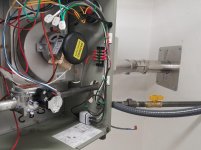
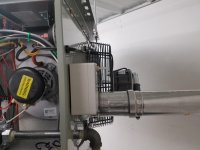
First, the unit at the furnace. This consists of a NodeMCU controller communicating over a 2 wire I2C network to a temperature/humidity sensor and controlling a relay to close the thermostat circuit. It is housed in a small plastic box which is attached to the back of the furnace.
Parts list and cost.
NodeMCU
$8.79
BME280 Temp Sensor
$9.99
Project Box
$8.15
Relay Board
$15 for 5 so $3 each
Misc wire, connectors, power supply
$10
Total approx $40.

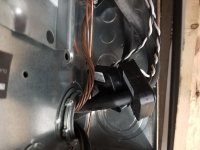
Next, the unit at the electrical panel. This consists of a 2 current transformers(one for each leg of the incoming power), a NodeMCU controller and a MCP3304 analog to digital converter chip. The converter samples the voltage produced by the current transformers(about 55,000 times per second) and computes the RMS current being used.
Parts list and cost.
NodeMCU
$8.79
Project Box
$8.15
MCP3304 Analog Converter
$4.45
Current Transformer
$7.61 x 2
Note: These are not the part I used but similar. Mine are a few years old and I couldn't find that same part online.
Misc wire, resistors, power supply
$10
Total approx $47.

Now, what to do with this info? Thats where a wonderful smart phone app named Blynk comes in. Blynk lets you create fancy screens that easily connect to your devices. You can add pushbuttons, selectors, sliders, numeric displays, history graphs, ...etc. The app is updated with new features regularly and it's fun to see how you can apply the new features.
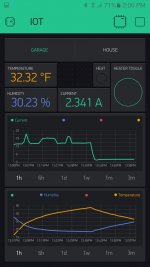
Here is a screen capture from my phone. This gets updated every 0.5 seconds so you get a pretty good view on the graphs of what is happening. (yes, it is 32 deg F out there right now, that's why I'm in the house writing this)

That's it for now. Thanks for looking. I'd like to see what others have created or hear ideas for additional features that could be added.
Redlunn
My home away from home is a 24x32 detached building with a 100 amp electrical service and propane heat. I have a 1 gigabit/s wired ethernet connection to the house which then comes to a screeching halt when it reaches the 1.5 Mb/s DSL connection to the outside world. The parameters I was interested in remotely monitoring were temperature, humidity, and electrical current usage. I also wanted to be able to turn the heat on remotely (flip it on from the house and wait until a reasonable temp has been reached before venturing across the frozen tundra).
I ended up with 2 wifi connected devices, one at the furnace which enables the heater, measures temp and humidty, and the other at the electrical panel measuring current.
For these tasks i decided on the NodeMCU board which uses the popular ESP8266 wifi chip. It can be sourced on Amazon for a whopping $8.79. This board features an 80mhz processor, built in wifi, and supports programming updates over the network.
First, the unit at the furnace. This consists of a NodeMCU controller communicating over a 2 wire I2C network to a temperature/humidity sensor and controlling a relay to close the thermostat circuit. It is housed in a small plastic box which is attached to the back of the furnace.
Parts list and cost.
NodeMCU
$8.79
BME280 Temp Sensor
$9.99
Project Box
$8.15
Relay Board
$15 for 5 so $3 each
Misc wire, connectors, power supply
$10
Total approx $40.
Next, the unit at the electrical panel. This consists of a 2 current transformers(one for each leg of the incoming power), a NodeMCU controller and a MCP3304 analog to digital converter chip. The converter samples the voltage produced by the current transformers(about 55,000 times per second) and computes the RMS current being used.
Parts list and cost.
NodeMCU
$8.79
Project Box
$8.15
MCP3304 Analog Converter
$4.45
Current Transformer
$7.61 x 2
Note: These are not the part I used but similar. Mine are a few years old and I couldn't find that same part online.
Misc wire, resistors, power supply
$10
Total approx $47.
Now, what to do with this info? Thats where a wonderful smart phone app named Blynk comes in. Blynk lets you create fancy screens that easily connect to your devices. You can add pushbuttons, selectors, sliders, numeric displays, history graphs, ...etc. The app is updated with new features regularly and it's fun to see how you can apply the new features.
Here is a screen capture from my phone. This gets updated every 0.5 seconds so you get a pretty good view on the graphs of what is happening. (yes, it is 32 deg F out there right now, that's why I'm in the house writing this)
That's it for now. Thanks for looking. I'd like to see what others have created or hear ideas for additional features that could be added.
Redlunn
 Having everything from my home thermostat to the refrigerator connected to the World Wide Web leaves me a little apprehensive about the ability to secure everything. Just ask Hillary how it worked out for her.
