To avoid these ads, REGISTER NOW!

Help me build a wall-mounted ladder in my barn

astrohip

Well-known member
Joined
Mar 7, 2015
Messages
338
Location
Brenham TX
(Well, my wife's barn...)

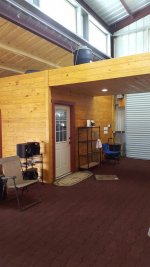
My wife wants a wall-mounted ladder so she can access the top of her tack room without hauling out a ladder every time. The pictures can explain this better than I can.

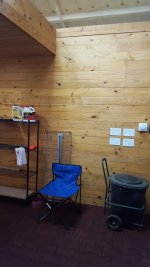
Pic 1 shows the outside wall of the tack room. She wants the ladder mounted on this wall. The wall is about 9' tall, and is a typical stud wall, covered with 2x6 tongue and groove pine boards.

Pic 2 shows the same wall from a different perspective. The ladder will go just to the right of the bridge.

This is all under cover, open to weather but protected from rain/etc. It will be infrequently used, so it doesn't have to "perfectly conform" to ladder standards. For example, if the depth of a tread is not as deep as desired, but still usably safe, that's ok. It must be flat against the wall, as horses use this passageway.

Most important, my carpentry skills are basic intermediate. :eyecrazy: So whatever I do has to match my skill set.

My initial thought was 4x6x12' posts, mounted to the wall. Drill holes for 1" dowels as the treads. Leave 2-3 feet of post above the wall for handholds.

Then I thought 4x6 posts might look too bulky, so I considered 2x6 or 2x8 for the rails, with dowels or 2x4 for treads.

Ideas?
 

Attachments

  • barn-1.jpg
    barn-1.jpg
    116.5 KB · Views: 270
  • barn-2.jpg
    barn-2.jpg
    121.9 KB · Views: 270
To avoid these ads, REGISTER NOW!

LXCam

ALLIANCE MEMBER
Joined
Apr 23, 2013
Messages
19,104
Location
AZ
The only issue with using dimensional lumber for the hand grab extending past the floor is its normally too big for most to grab a hold of. You could however still use those for the framing and then get some 3-4ft pieces of galv pipe that's threaded on both sides, install 90's with a 2" ****** to a plumbers flange and then attach the flanges to the 4X6's. Just make sure you extend those high enough to where it's a natural grab elevation and not too low.
 

The Tool Tyrant

ALLIANCE MEMBER
Joined
Dec 19, 2011
Messages
2,182
Location
Bonita, Ca. (San Diego)
I'd use 1-1/2" x .083" wall steel tubing for the rails with a 90° bend at the bottom with mounting tabs welded at the end of the 90° At the top, run the rails above the top of the floor by 3' and bend 180° to return down to the deck, again weld mounting tabs to the rails.
I'd use 1"x 1-1/2" rectangular tubing for the rungs, fish-mouthed to fit the rails and weld. Clean and simple.

Stain it to LOOK like wood, and tell her 'Form follows Function'
 
Last edited:

vettex2

Banned
Joined
Jul 30, 2012
Messages
1,146
Location
Northern Ca.
The only kind I could find were metal ladders. She wants wood. My googling skills didn't turn up any that fit her requirements.

I'm open to ideas though!
How long of a ladder do you need?
This comes in various lengths.
WSTR-Series-2.jpg

http://www.nationalladder.com/Single-Straight-Wood-Ladder-p/wstr-series.htm

I'd use 1-1/2" x .083" wall steel tubing for the rails with a 90° bend at the bottom with mounting tabs welded at the end of the 90° At the top, run the rails above the top of the floor by 3' and bend 180° to return down to the deck, again weld mounting tabs to the rails.
I'd use 1"x 1-1/2" rectangular tubing for the rungs, fish-mouthed to fit the rails and weld. Clean and simple.
See above
 
Last edited:

Fatboy148

Well-known member
Joined
Feb 15, 2017
Messages
999
The steeper the incline of the ladder gets, the harder it is to climb. Vertical is about as straight up and down as you can get.

Here is some "crazy talk"....

Would you/she consider a drop down stair case hinged to the wall with pulleys on the ceiling and running parallel to your "bridge". Would be safer and more convenient too. Could be motorized, a boat winch, even just a rope if you could gain enough mechanical advantage through pulleys....
 

WhiffySpark

Well-known member
Joined
Oct 22, 2009
Messages
6,252
The steeper the incline of the ladder gets, the harder it is to climb. Vertical is about as straight up and down as you can get.

Here is some "crazy talk"....

Would you/she consider a drop down stair case hinged to the wall with pulleys on the ceiling and running parallel to your "bridge". Would be safer and more convenient too. Could be motorized, a boat winch, even just a rope if you could gain enough mechanical advantage through pulleys....

I would feel better about doing the stairs
 

larry_g

Well-known member
Joined
Apr 28, 2007
Messages
16,874
Location
oregon
http://irastar.com/tremendous-loft-ladder-decorating-ideas/

Did a google search on Loft ladder and the above, as well as many others, popped up. I suggest that you do not do a vertical ladder against the wall rather have some angle to it. Even if you have it on a pivot at the top and pull the bottom away from the wall while in use. The proper angle with a flat step allows one to come down the ladder facing away from the wall and carry something. I also would suggest a permanent railing to hold onto when mounting and dismounting the ladder at the top

lg
no neat sig line
 
OP
A

astrohip

Well-known member
Joined
Mar 7, 2015
Messages
338
Location
Brenham TX
I'd use 1-1/2" x .083" wall steel tubing for the rails <snip>
I have -zero- metal working skills. I have a great welder friend, who could make a steel ladder in his sleep. He built an amazing wash rack for her. But she wants wood.
How long of a ladder do you need?
This comes in various lengths.
http://www.nationalladder.com/Single-Straight-Wood-Ladder-p/wstr-series.htm
Actually, I did see those. Problem is they have to be angled against the wall. If you flat mount, there isn't enough foothold. And she wants it flat-mounted, so her horses (which have the brains of a cheeto, but you didn't hear that from me) can't get tangled in it.

The steeper the incline of the ladder gets, the harder it is to climb. Vertical is about as straight up and down as you can get.
Understand and agree. But it will be so rarely used, and without any payload 99% of the time, vertical is acceptable. On the rare occasion something needs to be lifted up, I'll get my extension ladder.

Here is some "crazy talk"....

Would you/she consider a drop down stair case hinged to the wall with pulleys on the ceiling and running parallel to your "bridge". Would be safer and more convenient too. Could be motorized, a boat winch, even just a rope if you could gain enough mechanical advantage through pulleys....
Interesting idea. Do the stairs fold against the wall?
 

tjdux

Well-known member
Joined
Feb 4, 2014
Messages
801
Location
Southern Nebraska
I would skip the wood dowels for black metal plumbing pipe. 1 or larger dowels are very strong but if one cracks then your gonna fall off the ladder.

Its also very uncomfortable to climb a 90 degree up and down ladder, but doable.

Can you weld? Welding would make this easier even though she wants wood metal would be cheaper.

Anyways... If I were to build it with wood I would use a 2x8 or 2x6 as the rails. Next if you want dowels try and go for as big as possible. 1.25 or 1.5 inch for strength and to not hurt your feet.

Other option is to use flat steps. For flat steps get some 1x8 or 1x6 oak. Use a circular saw set to 1/4 inch deep and cut notches for the steps, carpenters call them dados. Make the outside edge cuts then keep cutting through the middle. Then clean out with a chisel.

The rails should go up over the top by about 3 ft so you have something to hold onto when climbing down. These will need some kind of angled support.

As far as attaching look in the building hardware section fo 90 degree bracketd. Not the little filmsy ones that are prepackaged with screws. Get the good ones kept with joist hangers and other galvanized building products. Good luck with it.

Signiture; Check out my garage progress http://www.garagejournal.com/forum/showthread.php?t=352703
 

WhiffySpark

Well-known member
Joined
Oct 22, 2009
Messages
6,252
I would have someone build it if you don't do woodwork. That's a beautiful barn there don't clobber something together.
 
OP
A

astrohip

Well-known member
Joined
Mar 7, 2015
Messages
338
Location
Brenham TX
I suggest that you do not do a vertical ladder against the wall rather have some angle to it. Even if you have it on a pivot at the top and pull the bottom away from the wall while in use.
She would be ok with a ladder that could lay flat, and pull/pivot out. I couldn't figure out how to design it.

If it is long enough to pivot out and rest on the floor, how do you push it flat?
 
OP
A

astrohip

Well-known member
Joined
Mar 7, 2015
Messages
338
Location
Brenham TX
Anyways... If I were to build it with wood I would use a 2x8 or 2x6 as the rails. Next if you want dowels try and go for as big as possible. 1.25 or 1.5 inch for strength and to not hurt your feet.

Other option is to use flat steps. For flat steps get some 1x8 or 1x6 oak. Use a circular saw set to 1/4 inch deep and cut notches for the steps, carpenters call them dados. Make the outside edge cuts then keep cutting through the middle. Then clean out with a chisel.

The rails should go up over the top by about 3 ft so you have something to hold onto when climbing down. These will need some kind of angled support.

As far as attaching look in the building hardware section fo 90 degree bracketd. Not the little filmsy ones that are prepackaged with screws. Get the good ones kept with joist hangers and other galvanized building products. Good luck with it.
Great feedback. I can make a dado. Is 1/4" enough? I assume I would also screw them in for support?

I like dowels because it seemed like they would be easier to also use as handholds while climbing. The rails would only be about 12" apart, so 1" to 1.5" dowels should offer plenty of strength.
I would have someone build it if you don't do woodwork. That's a beautiful barn there don't clobber something together.
That's Plan B. Another good friend, a retired carpenter, he did the work you see there. I just thought this would be a good project to stretch my skills on. But yeah, before I ****** it, I'd call for help. :sad:
 
OP
A

astrohip

Well-known member
Joined
Mar 7, 2015
Messages
338
Location
Brenham TX
I like dowels because it seemed like they would be easier to also use as handholds while climbing. The rails would only be about 12" apart, so 1" to 1.5" dowels should offer plenty of strength.
If I use dowels, couldn't I dado them also? Drill a hole 1/4" deep, chisel it out. Or even drill a hole all the way thru, for the dowel to slide into.
 
OP
A

astrohip

Well-known member
Joined
Mar 7, 2015
Messages
338
Location
Brenham TX
As y'all can start to see, I have the basic skills to do simple wood work. What I don't have is the experience to know what will work and what won't.
 

tjdux

Well-known member
Joined
Feb 4, 2014
Messages
801
Location
Southern Nebraska

toplessHO

Well-known member
Joined
Oct 20, 2014
Messages
14,013
Location
central florida
turn ladder 90* to the wall so it can go at proper angle,hinge it at top of wall but have it extend 4 ft above for hand hold.Ladder can swing up when not in use similar to afire escape ladder. Build with #1 grade clear oak with real steps vs rungs.Go to the local library and check those ladders out.
 

JRC3

Well-known member
Joined
Jun 30, 2014
Messages
12,481
Location
Southwestern OH
Stair stringers used backwards take up far less room than regular stairs. To get to your height you will need 9 or 10 steps sticking out 63-70". I have this in my crawspake to get me up 4'. I'm considering doing the same thing to my 8'+ garage attic.
 

Attachments

  • stair.jpg
    stair.jpg
    125.4 KB · Views: 154
To avoid these ads, REGISTER NOW!

alwaysFlOoReD

Well-known member
Joined
Sep 24, 2013
Messages
2,388
Location
Airdrie, Alberta, Canada
I've used ladders built to the wall. A couple or three 2x's nailed on the flats to the wall. Horizontal 1x4's nailed to the 2x's. More 1x4's nailed vertically in between the horizontals to prevent movement. And finally another 1x or 2x nailed over vertically to prevent horizontal 1x4 pullout when climbing. I agree with going up past the upper level. Maybe 2'. Of course you could go longer and once you see where your hands land cut it down to whatever height suits you. Ring shank nails or screws. Fir for the horizontal 1x4. Pine for the rest. Avoid knots.
 

Jackfre

Well-known member
Joined
Dec 26, 2010
Messages
4,407
Location
N CA
I would suggest that a wall ladder is the worst type of ladder from a safety standpoint. It your honey's ladder. If you made a ladder with flat steps and casters on the bottom you could pull the bottom out from the wall. At the top you could have a bracket that would catch and limit the extension of the ladder. When not in use it could be pushed flush with the wall.
 

alwaysFlOoReD

Well-known member
Joined
Sep 24, 2013
Messages
2,388
Location
Airdrie, Alberta, Canada
I would suggest that a wall ladder is the worst type of ladder from a safety standpoint. It your honey's ladder. If you made a ladder with flat steps and casters on the bottom you could pull the bottom out from the wall. At the top you could have a bracket that would catch and limit the extension of the ladder. When not in use it could be pushed flush with the wall.

I like this idea.
 
OP
A

astrohip

Well-known member
Joined
Mar 7, 2015
Messages
338
Location
Brenham TX
Stair stringers used backwards take up far less room than regular stairs. To get to your height you will need 9 or 10 steps sticking out 63-70". I have this in my crawspake to get me up 4'. I'm considering doing the same thing to my 8'+ garage attic.
That would still stick out from the wall. I can't have anything that sticks out permanently. It's a horse passage.

I've used ladders built to the wall. A couple or three 2x's nailed on the flats to the wall. Horizontal 1x4's nailed to the 2x's. More 1x4's nailed vertically in between the horizontals to prevent movement. And finally another 1x or 2x nailed over vertically to prevent horizontal 1x4 pullout when climbing. I agree with going up past the upper level. Maybe 2'. Of course you could go longer and once you see where your hands land cut it down to whatever height suits you. Ring shank nails or screws. Fir for the horizontal 1x4. Pine for the rest. Avoid knots.
I did something very similar in our old barn. Just a couple of 2x4's nailed as rails, and short pieces of 2x4 nailed over them as treads. It worked. That's what gave her the idea to duplicate it in her new barn. I just want to make it nicer this time.

Other than the fact it was utilitarian ugly, the depth of the treads was iffy. Just using a 2x4 as a rail isn't enough. That's why I was thinking 2x6 or 2x8.

I would suggest that a wall ladder is the worst type of ladder from a safety standpoint. It your honey's ladder. If you made a ladder with flat steps and casters on the bottom you could pull the bottom out from the wall. At the top you could have a bracket that would catch and limit the extension of the ladder. When not in use it could be pushed flush with the wall.
Interesting idea. I could even use a ladder like vettex2 linked to. Any ideas on how to design the bracket?
 

Fatboy148

Well-known member
Joined
Feb 15, 2017
Messages
999
Originally Posted by Fatboy148 View Post
Here is some "crazy talk"....

Would you/she consider a drop down stair case hinged to the wall with pulleys on the ceiling and running parallel to your "bridge". Would be safer and more convenient too. Could be motorized, a boat winch, even just a rope if you could gain enough mechanical advantage through pulleys....

Interesting idea. Do the stairs fold against the wall?

Nope...

My concept would have it not folded up against the wall but when not in use, the bottom would be up in the air right next to and at the same elevation as your "bridge". So the top of the stair is hinged at the upper lever floor into the top plate/studs of your wall and pivots there. The raise/lower cables would be attached to the outside structure of the stairway (stringers) somewhere near the bottom of the stair and go to the roof structure where a change of direction pulley would be and then go to a winch that raise/lower the stair. If the winch was electric, the controller could be placed about anywhere on the ground level. If it was manual, you would have to run the cable through a couple more pulleys to change direction to get them back to ground level where a manual winch could be mounted. This could be any width even a full width stair and should have rails on each side, making it much safer to traverse than any ladder. As nice as your building looks with the couple pictures you posted, the stairs could be made out of nice lumber, finished to match the walls and add to the character of your building vs being something that may not fit in. If your skill level isn't there, this would be a fun project for couple days for a (good) finish carpenter and you could be his/her helper!

Now lets get real crazy....

Same concept but made out of steel, painted black with expanded steel treads!!!!

Sorry that I don't do MS Paint or anything like that to express my concepts better. Shoot me your address and I could sketch it up and send it on a napkin, paper plate or scrap piece of lumber. :)
 

lakeroadster

Well-known member
Joined
Jan 19, 2015
Messages
5,166
Location
Central Colorado
What I don't have is the experience to know what will work and what won't.

Have you, or your wife, ever climbed a ladder mounted flat to a wall?

Have you or your wife ever tried to carry an item down, or up, using a ladder mounted flat to a wall?

They aren't nearly as ergonomically correct as a slanted ladder.
 
OP
A

astrohip

Well-known member
Joined
Mar 7, 2015
Messages
338
Location
Brenham TX
Have you, or your wife, ever climbed a ladder mounted flat to a wall?

Have you or your wife ever tried to carry an item down, or up, using a ladder mounted flat to a wall?

They aren't nearly as ergonomically correct as a slanted ladder.
Yes, see my replies from earlier in this thread...
I did something very similar in our old barn. Just a couple of 2x4's nailed as rails, and short pieces of 2x4 nailed over them as treads. It worked.
Understand and agree. But it will be so rarely used, and without any payload 99% of the time, vertical is acceptable. On the rare occasion something needs to be lifted up, I'll get my extension ladder.


you are going to like this
Love it! Not sure it will fly, but you gotta admire the simplicity of the concept.
 

Voi

Well-known member
Joined
Oct 10, 2010
Messages
5,140
Location
Western South Dakota
What's behind the 2x6 wall where the ladder will go? Is it insulated?

If there is an empty stud bay I'm wondering if you couldn't use the studs as your stringers? That would keep the ladder completely set back from a horse.

My first thought was an RV ladder but they're pretty light and I think a horse could do some serious damage. But maybe one of those would fit in a stud bay.

I've seen several of these tiny house shows where a ladder hangs flush with the wall when on one mounting bracket. When it's needed for use the ladder is lifted up a couple of inches and lowered to a lower mounting point and then has an easier to climb angle.

Again, depending on what's behind that wall and how it's built this idea could possibly fit in a stud bay when not in use.
 

NWOhioChevyGuy

Well-known member
Joined
Feb 20, 2007
Messages
1,924
Location
Buckeye Hill (Morenci, MI)
Could you not just use a standard wooden ladder (built or bought) that is 2-3 rungs taller than the loft, hinge it at the loft level on standard angled setting against the floor.
Place a rope on the bottom rung up through a pully to the ceiling down to a tie off on the wall?

When using lower it down, when not in use it is above head at the height of the loft.

Can you picture that idea?

You could even place a counter weight on the ropes end so raising it would be a balanced net zero effort.
 
Last edited:

Jackfre

Well-known member
Joined
Dec 26, 2010
Messages
4,407
Location
N CA
Interesting idea. I could even use a ladder like vettex2 linked to. Any ideas on how to design the bracket?[/QUOTE]

Depending upon what your ladder ends up looking like it will vary, but essentially I'd have a metal bracket mounted to the outside of the ladder. Another bracket mounted to the top landing where the ladder rests. A bolt would to thru the permanent mounted bracket at the top. That bolt head would be captured in the slot on the long bracket mounted on the side of the ladder. So as you pull the ladder away from the wall the bolt head slides in the channel and limits the movement of the ladder.
 
OP
A

astrohip

Well-known member
Joined
Mar 7, 2015
Messages
338
Location
Brenham TX
Wow, lots of great ideas. I need to sit in the barn, stare at the wall, and ruminate on a few of these.

What's behind the 2x6 wall where the ladder will go? Is it insulated?
It's a stud wall, with open cell spray foam in between the tongue and groove outer wall, and the sheetrock inner wall.
 

Firebrick43

Well-known member
Joined
May 12, 2015
Messages
14,012
Location
West central Indiana
I have used wall mounted ladders my whole life to get into hay lofts. You cant carry any thing down but you mount a pulley and rope near the edge of the loft to lower things down.

We alway built them by using 3" construction screws(not drywall screws) make you vertical uprights with a 2x4 screw on edge to a 2x4 laid flat to form a L shape. They give you the depth of a 2x6 but make it easy to bolt or screw to the wall through the flat one. 1x4 oak treads screwed to the 2x4 on edge. Pre drill the holes in the oak to prevent splitting.
 

James-W

Well-known member
Joined
Feb 3, 2013
Messages
12,432
Location
Southeastern Wisconsin
Instead of a ladder or a stairs, perhaps a lift would be a better idea. It would be safer and she could actually put stuff up there and get it back down again if she wanted to.
 

padroo

Well-known member
Joined
Nov 25, 2011
Messages
564
Location
Chesterton, In.
Make your ladder with slides on the top and rollers on the bottom. When you need it it would roll away from the wall and stop when it hits the bottom of the slides on top. It wouldn't be in the way when stored.
 

ard

Well-known member
Joined
Feb 16, 2015
Messages
4,391
Location
Sierra Foothills... California
Funny topic.

After 12 years of using a ladder to get up to her loft in the barn, I built permanent steps for my wife. The "original" plan was a folding ladder, that would allow it to be moved to allow drive through. To keep it out of the horses way...but after 12 years, I virtually NEVER moved it. So I lose 28 inches of width I've never needed... 12ft wide breezeway.

Rise 11 feet, run 9 feet. Not code compliant. Welded railings using 1.5" shed 40 steel. Stringers 1.75x11.25 LVLs, treads 2x10s trimmed as required. Simpson tread brackets.

Funny thing was that it was a chrismas present. I built and painted it in my shop over a week or so. She kept asking what I was working on- I kept telling her I was rearranging the rear of the shop. I'd pile more **** up on the tables near the door in case she looked in..... On Christmas Eve, my son and I ducked down and installed it. She didn't notice we were gone.

Next AM, daughter caught it on video. Wifes first comment: "I knew he wasn't rearranging!"
 

Marctrees

Well-known member
Joined
Mar 5, 2015
Messages
6,265
Location
TX/LA border - Toledo Bend
Seems to me Davejo showed a great solution, using ideally a commercially made straight ladder., if you can't just store a ladder on the wall otherwise.

If too low on wall, hoist up like some other posts suggest above Horsey head height.

Crawling up an angled ladder, you can release your hands grip, no problem.

What happens if you do that on a plumb vertical ladder?

Wheelchair selection Horsey sellin time.

Really unsafe option., plumb ladders.

Marc
 
Last edited:
To avoid these ads, REGISTER NOW!
Top Bottom