To avoid these ads, REGISTER NOW!

Plumbing for shop bathroom

Bigrhamr

Well-known member
Joined
Apr 16, 2009
Messages
293
Location
North Idaho
So besides the fact that it all has to run downhill there's a few more things I need to know about plumbing for sink and toilet drains. I'm pouring a floor soon and want to put drain lines under the slab.

One toilet and one sink is all there will be, is 3" line big enough? And how much drop per foot does it need to have?

When I bring the 3"?? line up out of the slab for the toilet can I just stub it off and add the flange or whatever is needed later or is there something that needs to be set in the slab when I pour?

Is there a standard distance the C/L of the toilet drain should be from the wall behind and beside it?

I believe I need a vent up through the roof. Does location matter? What I would like to do is put the toilet upstream from the sink and the vent upstream from the toilet at the end of the line where I can easilly hide it in a wall.

Any details on line sizes, fittings etc.. would be appreciated.
 
To avoid these ads, REGISTER NOW!

Kevin54

MEMBER EMERITUS
Joined
Jan 12, 2005
Messages
29,341
Location
Urbana, Ohio
I'm sure some plumbers will chime in, but basically you need to get a book on basic plumbing from someplace like Lowes, Home Depot, or the Library. The toilet will have to be set at a specified distance, the fall in your main waste line is something like 1/4" per ft. What you don't want to do is have so much fall that the liquid runs faster than the solid waste. It doesn't matter if the toilet comes before the sink or visa versa. The vent can go anywhere and at the head of the run preferably. The vent does two things, it is an escape for gases but it is also an air release so your water flows. Same principle as holding your thumb over a straw. No water escapes until you break the seal. Your toilet distance and sink distance for the drains can come from where you get the items at. Here is a good online place to get some answers at HomeTime. Dean Johnson usually does a pretty good job explaining things. The site has articles and videos. http://www.hometime.com/home.html
 
Last edited:

larry4406

Well-known member
Joined
Jan 27, 2006
Messages
19,136
Location
Northern Virginia
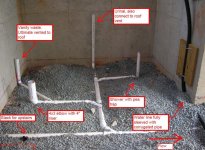
Run your plumbing at 1/4 inch per foot of fall. For the toilet, it's center should be 13 inches off the finished rear wall. Make sure your toilet will net 15 inches side to side clearance minimum with walls, vanities, etc (work to finished dimensions, not rough framing).

On the toilet rough in, they make an adapter that converts 3 inches to 4 inches. The 4 inch will be vertical and come up thru your floor. Run the 4 inch high relative to the floor and cap it with a test cap. Later, after the concrete is poured and your finished floor is installed (vinyl, ceramic, etc), you will cut the 4" riser flush with the fininished floor and your closet flange (toilet flange) will then slip into the 4" inch pipe for gluing (you will need to radius the inside of the 4" to receive the closet flange, the closet flange will then sit flush to the finished surface). A 3" inch riser is a POA since the hub on the closet flange would then have to slip over the pipe making you chip the concrete out.

Regarding venting, your sink should tee/wye into the toilet line, rise vertically with a stub out for your vanity, and then continue rising to the vent. Hope attached picture of my ground works rough-in helps you.
 

Attachments

  • Plumbing Rough.jpg
    Plumbing Rough.jpg
    135 KB · Views: 690

thdewey

Well-known member
Joined
Feb 26, 2008
Messages
532
Location
Gastonia, NC
Larry
That's a great picture that expains it all. When I add on a bathroom I'll use this to plan it out!
 
OP
B

Bigrhamr

Well-known member
Joined
Apr 16, 2009
Messages
293
Location
North Idaho
Thanks guys, that pretty well explains it.

Larry,
is the corrugated sleeve on the water line necessary for under slab? I'm using schedule 40 PVC and it will be in the gravel bed as yours is.
 

larry4406

Well-known member
Joined
Jan 27, 2006
Messages
19,136
Location
Northern Virginia
Sorry for the delayed response. The sleeved waterline - here in VA, they require the water line to be sleeved as it penetrates the floor and thru the footing. I went the extra and sleeved it all the way out - if I ever had to change it, the sleeve is my conduit.

Make sure you pressure test your water line before you pour.
 

sharpe427

Well-known member
Joined
Mar 3, 2008
Messages
113
Just a suggestion; but if you're going to add a tiolet and sink, think about going the next step and adding a simple shower. Being able to get cleaned up before going into the house or a nice ride pays big dividends. :)
If space is really tight, make the toilet a squat toilet and use it for the drain of the shower. :wtf:
 
To avoid these ads, REGISTER NOW!
OP
B

Bigrhamr

Well-known member
Joined
Apr 16, 2009
Messages
293
Location
North Idaho
Just a suggestion; but if you're going to add a tiolet and sink, think about going the next step and adding a simple shower. Being able to get cleaned up before going into the house or a nice ride pays big dividends. :)
If space is really tight, make the toilet a squat toilet and use it for the drain of the shower. :wtf:

Hmmm, I might have to think about that. The old farmhouse I lived in as a kid had a shower in the basement. Just a drain in the concrete floor, very handy for muddy kids and stuff, just strip 'em down and hose 'em off.
 

InPrimer

Well-known member
Joined
Jul 10, 2007
Messages
651
Location
lake Havasu AZ
I'll second that, just built a new house here in Az... wanted my bathroom with shower etc great way to keep the Mrs. off your back, and also keep the dirt/grime/grease in a small area away from the main house . The cost will be minimal in comparison to the results :)
 

nate379

Banned
Joined
Feb 2, 2009
Messages
7,279
Location
Palmer, AK
Don't know about you guys but I'm pretty sure some of the "monsters" that end up in my toilet would stop up a 3" pipe.

I was talking to my Dad a few weeks ago about sewer line and he was saying 1" per 5ft.
 

larry4406

Well-known member
Joined
Jan 27, 2006
Messages
19,136
Location
Northern Virginia
I second the shower in the garage bathroom - I have a shower, sink, toilet, and urinal.

Nate379 - the 1" per 5' slope is more shallow than 1/4" per 1' (1" per 4'). I would stick with 1/4" per 1'
 

nate379

Banned
Joined
Feb 2, 2009
Messages
7,279
Location
Palmer, AK
That's correct. You can have pipe too steep as well.

My Dad's not a plumber per say... just a plumber, electrician, welder, machinist, carpenter, etc aka "jack of all trades"
 

redsky49

Well-known member
Joined
Jan 21, 2009
Messages
582
Location
near the coast in eastern North Carolina
1/4" slope per foot is typical for sanitary waste piping. Minimum slope (if not prohibited by local authority) is 1/8" per foot. Maximum slope is 1/2" per foot. Anytime that a waste pipe will be installed beneath a slab you should go with 4" dia., either PVC or cast iron.

You need to determine the elevation of the waste piping "point of connection". This is referred to as the "invert elevation". You should slope the new piping as required to make this critical dimension. This, more than anything else, will determine the actual piping slope. This information will be available from the local water authority or sometimes, determined by actual measurement.

Note that the vent line must also be sloped to drain back to waste. With a 4" Waste, provide a 2" Vent extending up to a 2" VTR (vent thru roof).

Note that current water closets have reduced "carry" compared to earlier fixtures and are more sensitive to piping arrangements. To avoid clogging, do not tax the system with excessive bends or undersized pipe.

There are also close-coupled toilets that install closer to the wall if space is an issue.

If freezing might be an issue, take precautions and provide drain down piping.

Single lever sink faucets work better if your hands are covered with grease.

If there are any plans to connect the potable water system with any equipment (hose bibbs, etc.), provide back-flow protection in accordance with code.

Good luck with your project.

As always, offered only as opinion
 
To avoid these ads, REGISTER NOW!
Top Bottom