To avoid these ads, REGISTER NOW!

Mono Slab Cracks- 1.5 weeks old

spike0137

Well-known member
Joined
Nov 4, 2016
Messages
73
Location
Wisconsin
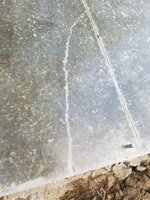
I had a mono slab poured about a week and a half ago. I just noticed some cracks in the slab that run across the floor to a edge and all the way down. Is this normal? I know slabs crack and can get hairline cracks. Probably just me being paranoid but curious what you all think.

About the slab.

-28x50
-has 2" foam and pex for infloor heat ran
-haunches are 12x12 except in back corner where the grade was very low so it is about 24"x12".
-1/2" rebar every 5'
-4000 psi concrete with fiber
-5" thick in middle

Prep work-

-all top soil removed
-3/4" with fines brought in and compacted on 4" lifts
-slab is 5" above natural grade at highest point.

Thanks for the comments fe982cb4dcb0ab8771ab46bfc7b1199d.jpg77594735b5a0c41bf626089091a53792.jpgb18c6d34962890e529c7dead1e9a40d7.jpg072aabeee351e58507ebcb35870c36f0.jpg

Sent from my SM-G930V using Tapatalk
 

Attachments

  • fe982cb4dcb0ab8771ab46bfc7b1199d.jpg
    fe982cb4dcb0ab8771ab46bfc7b1199d.jpg
    100.1 KB · Views: 0
  • 77594735b5a0c41bf626089091a53792.jpg
    77594735b5a0c41bf626089091a53792.jpg
    115.9 KB · Views: 0
  • b18c6d34962890e529c7dead1e9a40d7.jpg
    b18c6d34962890e529c7dead1e9a40d7.jpg
    151.3 KB · Views: 0
  • 072aabeee351e58507ebcb35870c36f0.jpg
    072aabeee351e58507ebcb35870c36f0.jpg
    134.5 KB · Views: 1
To avoid these ads, REGISTER NOW!

walrus

Well-known member
Joined
Nov 12, 2008
Messages
11,675
Location
Maine
What does rebar 5 ft on center do?

Sent from my SM-G950U using Tapatalk
 

Firebrick43

Well-known member
Joined
May 12, 2015
Messages
14,015
Location
West central Indiana
There is no reasonable way to keep a residential monolithic slab from not cracking. Concrete shrinks and due to the down turned skirt a mono slab is restrained.
 
Joined
Feb 26, 2017
Messages
23
I have done residential walls, footings and slabs for years, and we do #4 rebar every two feet in both walls and slabs. 5 feet is way too far apart for the tensile strength of rebar to do much good. Better than nothing, yes, but not correct

Sent from my XT1585 using Tapatalk
 

Bighead38

Well-known member
Joined
Nov 11, 2012
Messages
5,612
Location
Rockland County NY
Looks like the concrete dried to fast imo. I've poured a good amount of concrete and have only gotten cracks like that I'm very hot days when the concrete dried super quick or didn't get sprayed down enough. I would t worry about it but I would keep an eye on it. I've never heard of rebar being spaced so far apart, that seems wrong.
 

lakeroadster

Well-known member
Joined
Jan 19, 2015
Messages
5,166
Location
Central Colorado
I think Bighead38 identified the issue OP.

Tell us about the temperature and sunshine during and after the pour? Did you keep the slab hydrated? If so, how and for how long?

You haven't driven anything heavy on the slab right?

Any compaction testing done prior to the pour?

The re-bar being spaced to far apart wouldn't cause cracking on a 1.5 week old slab... but 5' spacing is problematic if the slab shifts at the cracks.
 

readhead

Well-known member
Joined
Dec 8, 2012
Messages
6,177
Location
Durango, Co.
I would agree with John that the concrete cured to quickly. At this point you are living with it so don't dwell on it. Rebar at five foot on center was a waste of time and material. I'm involved with both residential and commercial construction and I don't think I have ever seen spacing exceed two foot.

Andy
 
OP
S

spike0137

Well-known member
Joined
Nov 4, 2016
Messages
73
Location
Wisconsin
I think Bighead38 identified the issue OP.

Tell us about the temperature and sunshine during and after the pour? Did you keep the slab hydrated? If so, how and for how long?

You haven't driven anything heavy on the slab right?

Any compaction testing done prior to the pour?

The re-bar being spaced to far apart wouldn't cause cracking on a 1.5 week old slab... but 5' spacing is problematic if the slab shifts at the cracks.
I also have a feeling it is from the heat. I used a few sprinklers on the slab for the first 3 days. Then the company pulled the forms and told me with the sealer they used I shouldn't need to water it anymore. It has been in the 70s the last week with a lot of Sun.

Nothing has been set or driven on the slab.

No compaction tests were done but I will tell you that I had to dig a few spots out after the first day of excavation, I needed to get a pick axe to get throughwhere they compacted it. I believe there is not a compaction issue.

With the rebar spacing. I had 8 estimates done by a lot of very good concrete companies in the area. They all said 6' on center rebar is more than plenty. I questioned them all and asked about doing 2x2 and got the same answer that it would be over kill.

Sent from my SM-G930V using Tapatalk
 

wssix99

Well-known member
Joined
Mar 2, 2011
Messages
5,158
Location
Chicago, IL
It's better than nothing. Every company I had out said 6x6 I'd did 5x5 to feel better 🤣

Sent from my SM-G930V using Tapatalk

You don't need rebar at all, as long as your saw cut joints are the proper depth and spacing.

A lot of this ^ speculation. Can you give us some more information?
- A layout of the entire slab with a map of your saw cut joints and where the cracks are. Do you have any penetrations in the slab?
- The spacing of your saw cut joints
- The depth of your saw cut joints
- Where you are located
 

EasyE

Well-known member
Joined
Dec 3, 2011
Messages
72
Everyone here is missing the boat...

Its a shrinkage crack, it happens.

The important question is what was your concrete slump at time of pour?
Too much water can exasperate the cracking. This is some of the reason why fluidifiers are used.
 

n20junkie

Well-known member
Joined
Aug 22, 2010
Messages
538
Location
Grand Island, NY
You don't need rebar at all, as long as your saw cut joints are the proper depth and spacing.

A lot of this ^ speculation. Can you give us some more information?
- A layout of the entire slab with a map of your saw cut joints and where the cracks are. Do you have any penetrations in the slab?
- The spacing of your saw cut joints
- The depth of your saw cut joints
- Where you are located


I disagree. Rebar is what keeps that crack from becoming a raised edge.
 

joes169

Well-known member
Joined
Sep 19, 2011
Messages
663
Location
WI
Nearly impossible to give an educated guess form online, but from the third picture, I would assume THAT crack developed outside of the joint because they didn't saw deep enough at the thickened edge. Not sure how many more cracks there are.

Can you take a rule or even a knife blade and check the depth inside of the joints at a few places? Should be 2-3" minimum at the edges........
 

G-ManBart

Well-known member
Joined
Jan 24, 2015
Messages
2,059
Location
Michigan
I drove a concrete truck for years during high school and college (pre-CDL days at first) and the vast majority of concrete contractors have way too much water added, and that's usually why the slabs crack so soon, and so badly. Hot temps only make it worse.

Those sure look like shrinkage cracks....and having a crack right next to a relief cut reinforces that theory. No way you should be seeing cracks that soon.

We poured the 40x40 section of slab for my barn three years ago, and it still doesn't have a single crack I'm aware of. We kept the mix tight, added steel and fiber, and then kept it wet for about a week.
 

metaleltr

Well-known member
Joined
Sep 4, 2009
Messages
2,680
Location
Western Ohio
"Normal" or not there is no way I would be happy with and brand new slab that developed cracks that quickly. I also would have poured it with rebar spaced closer, wire mesh, and fiber in the mix.
 
To avoid these ads, REGISTER NOW!

njc41980

Well-known member
Joined
Jun 21, 2017
Messages
617
Location
Idaho Falls
Everyone here is missing the boat...

Its a shrinkage crack, it happens.

The important question is what was your concrete slump at time of pour?
Too much water can exasperate the cracking. This is some of the reason why fluidifiers are used.

+1

Looks like nothing to worry about.
 

njc41980

Well-known member
Joined
Jun 21, 2017
Messages
617
Location
Idaho Falls
General contractor here,

I can guarantee three things about concrete:
- It IS hard
- It WILL crack
- No one will steal it

Seriously though, small shrinkage cracks, as long as they don't open up and start moving, are often unavoidable and nothing to worry about.
 

wssix99

Well-known member
Joined
Mar 2, 2011
Messages
5,158
Location
Chicago, IL
I disagree. Rebar is what keeps that crack from becoming a raised edge.

If a slab is inside and protected against the cracks from getting freezing water in them (causing the cracks to spread) and if the slab isn't exposed to high stresses of fast moving traffic, small shrinkage cracks should be interlocked by the aggregate.

Either way - even with reinforcing bars - one still needs proper control joints and the cracking should still occur in those joints.


Everyone here is missing the boat...

Its a shrinkage crack, it happens.

The important question is what was your concrete slump at time of pour?
Too much water can exasperate the cracking. This is some of the reason why fluidifiers are used.

It's definitely a shrinkage crack and they definitely (always) happen. I think the bigger question is, "Why didn't it occur in the control joint, right next to the crack, in the very place it was supposed to happen???
 

cbracer

Well-known member
Joined
Feb 27, 2012
Messages
637
Location
Costa Mesa, CA
Those are normal for 4000 psi concrete. I'm sure someone here on GJ is going to flame me and tell me I'm wrong, but in most cases people who pour drive ways or garages with 4000 psi get those cracks. I did my garage in 3500 psi concrete and it got warm when setting. Kept it wet for two days. No cracks. The guys said 4000 psi gets too warm when setting and it doesn't matter how wet you keep it, the heat is inside and the cool outside together causes those cracks. I wish people wouldn't use 4000 psi and know that 3500 is as high as you can go if you're concerned about those shrinkage cracks. The rebar will be nice to prevent the sides from lifting up as my old original garage floor did.
 

G-ManBart

Well-known member
Joined
Jan 24, 2015
Messages
2,059
Location
Michigan
Those are normal for 4000 psi concrete. I'm sure someone here on GJ is going to flame me and tell me I'm wrong, but in most cases people who pour drive ways or garages with 4000 psi get those cracks. I did my garage in 3500 psi concrete and it got warm when setting. Kept it wet for two days. No cracks. The guys said 4000 psi gets too warm when setting and it doesn't matter how wet you keep it, the heat is inside and the cool outside together causes those cracks. I wish people wouldn't use 4000 psi and know that 3500 is as high as you can go if you're concerned about those shrinkage cracks. The rebar will be nice to prevent the sides from lifting up as my old original garage floor did.

I'm not going to flame you, but that's simply not true. I used 4000psi concrete for all my slabs. I have a 40x40 slab with no cracks, a 24x40 slab with no cracks, and a 12x64 slab with no cracks.

People saying that you'll always get cracks on concrete simply don't know what they're talking about. Concrete poured correctly over a good base, with properly spaced control joints shouldn't crack....the expansion joints are the cracks.
 
Last edited:

EasyE

Well-known member
Joined
Dec 3, 2011
Messages
72
I'm not going to flame you, but that's simply not true. I used 4000psi concrete for all my slabs. I have a 40x40 slab with no cracks, a 24x40 slab with no cracks, and a 12x64 slab with no cracks.

People saying that you'll always get cracks on concrete simply don't know what they're talking about. Concrete poured correctly over a good base, with properly spaced expansion joints shouldn't crack....the expansion joints are the cracks.

There is a big difference between expansion joint and control joint.

Expansion joints use black board or redwood or some sort of media that will allow the concrete to move around some. Generally smooth dowels are inserted through the media to keep the concrete from moving differentially on either side of the joint.

Control joints are cut usually 1/3 of the way through the concrete creating a weak area for the cracking to occur. Sometimes things like rebar placement, subgrade uniformity, and mix design and placement can work against you and make the concrete crack else where. Regardless of that, whether it cracks in the joint or not the concrete will still retain the same strength. The cracking in the joint is just a nice aesthetic way of hiding the crack.

Another note worth mentioning, depending on the climate and location of where the concrete is placed will dictate the amount of expansion it can take before cracking. I may be able to pour a 10X12 square in the southeast united states with no expansion or control joints and it probably will not crack. If I was to try the same amount of concrete in a different area or even a different application in the same area (inside vs outside) it may react differently.
 

wssix99

Well-known member
Joined
Mar 2, 2011
Messages
5,158
Location
Chicago, IL
Those are normal for 4000 psi concrete. I'm sure someone here on GJ is going to flame me and tell me I'm wrong, but in most cases people who pour drive ways or garages with 4000 psi get those cracks.

It's totally normal if the people placing the concrete have no idea what the hell they are doing.

^ So, yes. It's very common.
 

Falcon67

Well-known member
Joined
Jun 11, 2009
Messages
18,371
Location
Merkel, TX
It's better than nothing. Every company I had out said 6x6 I'd did 5x5 to feel better ��

Sent from my SM-G930V using Tapatalk

Code here is 3/8 bar 18" (inch) OC, at least two 1/2 bars in the footers and any grade beams. We have expansive clay type soil so the ground will be pushing any slab around like it or not.

OP -
Looks like the same shrinkage cracks we see in any slab around here. Neighbor's house has 92 yards in the floor. Once they did the dark stained the floor, those cracks became quite stylish. Looks better than tile.

Note the arguments about "control" and "expansion" joints - we are pretty much 100% mono slab here, no frost depth and nobody - nobody - cuts anything in a house slab. Or a garage, or shed, etc. They do in something like a Lowes size slab. I don't have any joints in the 24x40 that we poured with 4000 psi back in 2011 and none of the shrink cracks have changed one bit.
 
Last edited:

jeepntxj

Well-known member
Joined
Jul 19, 2009
Messages
94
We pour 4000 psi slabs daily and like said above, they only crack when the contractor doesn't know what they're doing.

I'm going to agree with shrinkage cracks, but for a different reason... How much rain has your area had lately? If it's been DRY dry, go by the batch plant that the mud came out of and see if they're watering the rock.

Sent from my XT1585 using Tapatalk
 

heffneil

Well-known member
Joined
Apr 12, 2009
Messages
722
Location
Naples FL
My slab cracked the same day it poured and they drenched it. The crack jumped the expansion joint and I asked my guy how and he told me it did it before the joint was cut. He saw it instantly. I didn't notice it for many days later. He poured my pad for the parking area and it too cracked. Really can't get too upset about it. They say concrete and stucco isn't done until its cracked :) The integrity isn't really in question unless it was sizable.
 

wssix99

Well-known member
Joined
Mar 2, 2011
Messages
5,158
Location
Chicago, IL
They say concrete and stucco isn't done until its cracked :)

Designers don't (can't) use this excuse. :)

I keep getting reminded of the saying, Q: "What do you call someone who gets straight "D"'s in medical school?" A: "A Doctor."

We should probably have our own saying, Q: "What do you call someone who takes your money?" A: "A Pro."
 

Mikeske

Well-known member
Joined
Apr 28, 2017
Messages
2,125
Location
Washington State
My slab is 4000 psi. It doesn't have the cracks you say are normal.... anywhere at this point.... except in the control joints. Poured over a year ago.

Wait for about three years, my concrete in garage is 4,000 PSI and the cracks started around the three year mark in the control cuts and couple outside of the control cuts. It had rebar every 18" and fiber mesh in the concrete and had absolutely no cracking until about 4-5 months ago which is the three year mark. I am not even bothered by it. The old saying in these parts is there is two forms of concrete "fresh poured concrete and cracked dry concrete"
 

GMCGarage

Well-known member
Joined
Jan 31, 2017
Messages
1,264
Research the concrete code and calculate the spacing that rebar needs to be to control cracking.
 

Majordisorder

Well-known member
Joined
Jan 5, 2014
Messages
234
Location
North Idaho
Go to the batch plant and ask to see the load tickets. In addition to the specs on what was ordered, the amount of water that was added on site should also be listed. This will more than likely confirm the shrinkage cracks and might indicate a lower than target psi value as well.
 

n20junkie

Well-known member
Joined
Aug 22, 2010
Messages
538
Location
Grand Island, NY
If a slab is inside and protected against the cracks from getting freezing water in them (causing the cracks to spread) and if the slab isn't exposed to high stresses of fast moving traffic, small shrinkage cracks should be interlocked by the aggregate.

Either way - even with reinforcing bars - one still needs proper control joints and the cracking should still occur in those joints.


It's definitely a shrinkage crack and they definitely (always) happen. I think the bigger question is, "Why didn't it occur in the control joint, right next to the crack, in the very place it was supposed to happen???

Tell that story to my basement floors. They have a differing opinion.
 

lakeroadster

Well-known member
Joined
Jan 19, 2015
Messages
5,166
Location
Central Colorado
Re: Rebar can cause shrinkage cracking

What does rebar 5 ft on center do?

Sent from my SM-G950U using Tapatalk

It's better than nothing. Every company I had out said 6x6 I'd did 5x5 to feel better ��

Sent from my SM-G930V using Tapatalk

After re-reading this thread it seems there was a break down in communication. Those companies saying 6 x 6 were referring to 6" x 6" wire mesh, not reinforcing steel laid out on 6' x 6' spacing.
 
OP
S

spike0137

Well-known member
Joined
Nov 4, 2016
Messages
73
Location
Wisconsin
Re: Rebar can cause shrinkage cracking

After re-reading this thread it seems there was a break down in communication. Those companies saying 6 x 6 were referring to 6" x 6" wire mesh, not reinforcing steel laid out on 6' x 6' spacing.


No they were talking 6'x6' 1/2" rebar
 
OP
S

spike0137

Well-known member
Joined
Nov 4, 2016
Messages
73
Location
Wisconsin
I had a guy that has done cement for many years come out to take a look. He said the cracks are just shrinkage. I should have kept a sprinkler going when the sun is directly on it to not have it happen. He said the control joints are doing their job by stopping the cracks from spreading across the floor. Also had the company that did the slab out, he is a great guy and will stand behind their work.

The cracks do look big in the pictures i posted. I will pit a penny down next to one and post later to have a comparison.

I am running a sprinkler on the slab during the sunny hours until i can get to building the garage in August.

I also asked for a second opinion on the rebar spacing and around here in Southern WI 5'x5' spacing is plenty. I even took a trip to look at another guys shop that is a 40x80 mono with 6x6 spacing rebar that was done 10 years ago and it looks great. He even has the small shrinkage cracks like mine, they never raised or got bigger. You can notice them unless you look.

I hope this can help out others that may have the same issue as me and could nt find much info on the web.

Thanks for all the replies guys.
 
To avoid these ads, REGISTER NOW!
Top Bottom