To avoid these ads, REGISTER NOW!

Garage gable end: enough shear strength here?

laurie71

Well-known member
Joined
Apr 20, 2016
Messages
181
Location
Centerville, Ohio, USA
Posting here instead of on my build thread in hopes of more eyes... :lol_hitti

I'm planning on building a 36' x 56' foot garage / shop. The south end will be sectioned off as a three car parking garage, the remainder is going to be my shop. My question is will I have enough shear strength in the gable end wall with the way I have it laid out?

I want to put a (36") man door plus an 18' and an 8' garage door into a 36' span, giving me ~2' of wall on either side of the two garage doors and the man door as close as I can frame it to the adjoining wall.

Garage doors will be 8' tall and I'll be framing for 12' ceiling height, so I'll have ~4' from top of rough openings to top of the top plates across the full width. I'm also thinking some metal bracing straps from mud sill to upper top plate crossing the 2' wall sections would be a good idea.

Is this enough?

Plan and ortho. for illustration:

floor-plan.jpg
ortho.jpg
 
To avoid these ads, REGISTER NOW!

matt_i

Well-known member
Joined
Mar 14, 2008
Messages
10,723
Location
SE Michigan
Personally I'd attempt to move the man door around the corner to the left, just past the corner, keeping it close. That would buy you a lot of area to assist with the problem.

I can't say whether you have enough as-drawn, usual ways to improve it are to plywood inside and out, nail 3" on-center with #10s everywhere you have a stud. Metal "X" bracing made of Simpson 16ga flat strapping as a few ideas. You can also look at the cutaway construction of Simpson's "strong wall" for ideas as well.
 

spudley

Well-known member
Joined
Dec 27, 2016
Messages
702
Location
Northeast Wisconsin
Are you using trusses? If so, the end wall won't be bearing much weight to speak of. I'm planning a similar wall with an 18' and a 9' door, no man door on a 38' wall. That only leaves 11' to space into 3 sections. Ideally 4' on the corners keeps your structure tight but I'm a little short and I'm on the "hip/shed" side of the gabled roof, so 1/2 the weight is on that side. Could you move the man door?
 
OP
L

laurie71

Well-known member
Joined
Apr 20, 2016
Messages
181
Location
Centerville, Ohio, USA
I originally had the stairs laid out to start in front of the man door (placed as drawn) and turn at a landing. Now I've changed the stair layout, moving the man door around the corner would be doable, and would let me increase that 8' door to a 9' that my truck could squeeze through. I need to think about that.

Yes, I'll be using trusses, so I'm not concerned on weight, just shear strength.
 

kbs2244

Well-known member
Joined
Nov 11, 2006
Messages
14,065
It may be a code issue.
Ask your inspector.
He can tell if and how to do it.

Codes are built on a local history of fails.
They try to prevent them from happening again.
 

Homerr

Well-known member
Joined
Mar 16, 2012
Messages
379
Location
Seattle, WA
Probably could be done with some engineering. Seek out an engineer, this is an easy one for them.
 

tcianci

Well-known member
Joined
Feb 7, 2009
Messages
4,242
Location
Walpole, Ma
Go to the Simpson Strongtie web site and checkout their hardware for Portal framing.

The newspeak in framing details is that the configuration you're describing doesn't yield enough shear strength to keep it from racking due to the 4 little "legs" that the gable end is standing on. So, Simpson's answer is to engineer a bunch of hardware ($$$) and then get their designs codified, so they have an eternal source of revenue.

Your jurisdiction may require such hardware however, if the garage has a flat ceiling in the plane of the top plate of the sidewall, sheathing that ceiling or better still, an attic floor with plywood will do a great job of keeping the structure from racking without introducing enormous point loads the way the Simpson hardware does.
 

jack stand

Well-known member
Joined
Feb 29, 2012
Messages
3,307
Location
Lakes Region Maine
Unless your subject to some crazy winds, moving the man door and stepping up to a 5/8 sheathing, (I'm think Advantech) and maybe even glued or t&g or both, you'd be good. If you're still worried you could also sheath the inside as well. I've "let in" a (3/4 or 2x) into the longest "run" I could get from the top to bottom plate like they used to do. Very effective. Running your 4x8 sheathing might be better with the 8' dimension horizontal. Guy's vary regionally on witch way they do this and usually it's not an issue. With your 4' above the OHD's you'll pick up some shear this way.
 
OP
L

laurie71

Well-known member
Joined
Apr 20, 2016
Messages
181
Location
Centerville, Ohio, USA
It may be a code issue.
Ask your inspector.
He can tell if and how to do it.

Codes are built on a local history of fails.
They try to prevent them from happening again.

The only way I've found to talk to an inspector is to schedule an inspection; there's never one in at the office... :eyecrazy:

Probably could be done with some engineering. Seek out an engineer, this is an easy one for them.

I realize I can get this answered by hiring an engineer; I was just hoping someone here would have the experience to know that it's OK, or a no-no, or marginal enough to require an engineer.

Go to the Simpson Strongtie web site and checkout their hardware for Portal framing.

The newspeak in framing details is that the configuration you're describing doesn't yield enough shear strength to keep it from racking due to the 4 little "legs" that the gable end is standing on. So, Simpson's answer is to engineer a bunch of hardware ($$$) and then get their designs codified, so they have an eternal source of revenue.

Your jurisdiction may require such hardware however, if the garage has a flat ceiling in the plane of the top plate of the sidewall, sheathing that ceiling or better still, an attic floor with plywood will do a great job of keeping the structure from racking without introducing enormous point loads the way the Simpson hardware does.

Yeah, the '4 little "legs"' is the bit I'm worried about. I am planning to use RIA trusses, and although I wont be finishing the attic space at this time, I did plan to put in a sub-floor up there.

Unless your subject to some crazy winds, moving the man door and stepping up to a 5/8 sheathing, (I'm think Advantech) and maybe even glued or t&g or both, you'd be good. If you're still worried you could also sheath the inside as well. I've "let in" a (3/4 or 2x) into the longest "run" I could get from the top to bottom plate like they used to do. Very effective. Running your 4x8 sheathing might be better with the 8' dimension horizontal. Guy's vary regionally on witch way they do this and usually it's not an issue. With your 4' above the OHD's you'll pick up some shear this way.

I was thinking about sheathing with Zip System panels, which I believe are only 1/2", but they can be had in tonge-and-groove. This end of the garage isn't going to be finished (since it's just parking) but I could sheath the inside of that wall, that's a good idea! :beer:
 

Lynden

Well-known member
Joined
May 23, 2015
Messages
672
Location
Southern California
To avoid these ads, REGISTER NOW!

Falcon67

Well-known member
Joined
Jun 11, 2009
Messages
18,371
Location
Merkel, TX
Sheath with 12' OSB, etc should provide a strong wall. Also, you can lay diagonal braces across the top of the joists (or bottom chords) to brace the corners, tied to the top plates. It'll stay square and not move.
 
OP
L

laurie71

Well-known member
Joined
Apr 20, 2016
Messages
181
Location
Centerville, Ohio, USA

I've looked a little at the Simpson stuff but haven't found anything that explains its use well enough for me to "get it". Thanks, I'll check those links out.

Sheath with 12' OSB, etc should provide a strong wall. Also, you can lay diagonal braces across the top of the joists (or bottom chords) to brace the corners, tied to the top plates. It'll stay square and not move.

Hmm, I hadn't thought of adding braces in that plain, I'll add that to my construction plan! :beer:
 

kbs2244

Well-known member
Joined
Nov 11, 2006
Messages
14,065
Whatever idea you come up with, do a rough sketch and take it in to the building department office.
Every one I have gone to has had an in house engr.
Have them OK it.
Then all he inspector has to do is confirm you did it as drawn.
 

mk18

Member
Joined
Aug 3, 2016
Messages
16
Location
New West, BC, Canada
I am in the midst of a garage build that has a similar situation, 2 large doors in the gable end with only 2 feet of shear wall in either corner and a post in the middle between doors.
I am not using trusses, but instead an I beam as the ridge and rafters to maximize height inside.
I had an engineer do up the drawings for about $700 including stamps and required letters for the city.

they used a Simpson 24" wide Shearwall in each corner with 1" anchors extending 36" down into the footings, to establish the required shear strength. Also the design has a continuous PSL beam that runs all the way across both shearwalls and is tied in with a bunch of fasteners and brackets, its then to be sheathed in min 1/2" D.Fir ply
 

keen

Well-known member
Joined
Sep 12, 2010
Messages
125
Location
geneva, fl
I'm planning on building a 36' x 56' foot garage / shop. The south end will be sectioned off as a three car parking garage, the remainder is going to be my shop. My question is will I have enough shear strength in the gable end wall with the way I have it laid out?

you don't mention some really important things that impact your question:

how is the building framed? conventional stick? concrete block? post frame? steel? (red? galv? square tube? metal studs stick?)

you also don't mention where your plans are coming from - sounds like you're in sketch-and-build territory where you don't need engineer stamped plans for everything? lucky.. :)

you also don't mention wind load requirements - but I think your profile said ohio, so your windload requirements probably are 90-110mph (or less). but if you dont need stamped plans, no one is going to be checking. 30 miles from the florida coast everything I have to do is 125+ (my shop is built for 150+), so the challenges are a bit higher.


if it's post frame with post-in-ground, you'll get your primary shear strength there. same thing for a red iron frame (ish. the diagonal braces come a lot into play, but...)

but I'm assuming you're doing it conventional stick.....in which case, I'd suggest having it reviewed by an engineer. even if it's just for the end wall, and you dont need it stamped. should be a few hundred bucks well spent.

otoh, if you're into the self engineering thing, the data is out there to figure it out and do the math. :) if you can't find the data, hire someone.
 
OP
L

laurie71

Well-known member
Joined
Apr 20, 2016
Messages
181
Location
Centerville, Ohio, USA
Whatever idea you come up with, do a rough sketch and take it in to the building department office.
Every one I have gone to has had an in house engr.
Have them OK it.
Then all he inspector has to do is confirm you did it as drawn.

No in-house engineer, just "office staff" that handle submission of permit applications, scheduling of inspections, etc. and a team of inspectors, who come in first thing, pick up their schedule of inspections for the day, and head out. :eyecrazy:

I am in the midst of a garage build that has a similar situation, 2 large doors in the gable end with only 2 feet of shear wall in either corner and a post in the middle between doors.
I am not using trusses, but instead an I beam as the ridge and rafters to maximize height inside.
I had an engineer do up the drawings for about $700 including stamps and required letters for the city.

they used a Simpson 24" wide Shearwall in each corner with 1" anchors extending 36" down into the footings, to establish the required shear strength. Also the design has a continuous PSL beam that runs all the way across both shearwalls and is tied in with a bunch of fasteners and brackets, its then to be sheathed in min 1/2" D.Fir ply

Wow, that's massively more structural than the framing plan I have drawn up... :3gears: OK, I think I should get an engineer involved and be safe.
 
OP
L

laurie71

Well-known member
Joined
Apr 20, 2016
Messages
181
Location
Centerville, Ohio, USA
you don't mention some really important things that impact your question:

how is the building framed? conventional stick? concrete block? post frame? steel? (red? galv? square tube? metal studs stick?)

Sorry; I do state in my build thread that this will be stick framed, but I should have included that detail here.

you also don't mention where your plans are coming from - sounds like you're in sketch-and-build territory where you don't need engineer stamped plans for everything? lucky.. :)

Correct; all I'm required to submit is a typical wall section drawing and a site plan. I did also submit a floor plan and elevation drawings so if the inspector has any concerns about this wall while reviewing the application he'll call and ask questions -- which will be my best opportunity to ask questions back and see what he's going to want to see built.

you also don't mention wind load requirements - but I think your profile said ohio, so your windload requirements probably are 90-110mph (or less). but if you dont need stamped plans, no one is going to be checking. 30 miles from the florida coast everything I have to do is 125+ (my shop is built for 150+), so the challenges are a bit higher.

Ohio, yes. I can probably look up the required wind loads on the building inspection office's site but yeah, no one's going to be checking...

if it's post frame with post-in-ground, you'll get your primary shear strength there. same thing for a red iron frame (ish. the diagonal braces come a lot into play, but...)

but I'm assuming you're doing it conventional stick.....in which case, I'd suggest having it reviewed by an engineer. even if it's just for the end wall, and you dont need it stamped. should be a few hundred bucks well spent.

Yeah, based on the engineered solution described above, it seems I probably need a *lot* more structure than I'd planned on, and an engineered plan would be a good investment.

otoh, if you're into the self engineering thing, the data is out there to figure it out and do the math. :) if you can't find the data, hire someone.

Hey, I'm a software engineer, not a structural engineer -- there's no way I'd trust my own math! :scared: :bounce:
 

mk18

Member
Joined
Aug 3, 2016
Messages
16
Location
New West, BC, Canada
It is definitely pretty substantial, here we dont have the high wind loads to deal with but we do have seismic requirements that need to be taken into account.
the rest of the walls all employ various Simpson HDU hold down brackets with 5/8" bolts with typically 10" embedded into the concrete.

the Simpson site has some decent documentation on the Shearwalls, including lots of stuff on there "portal" systems.
Definitely worth getting an engineer to draw it up and do the calcs.
It wasnt that expensive for my project and that included foundation reinforcing and a suspended slab design so I have storage under part of the garage.
 

forAK

Well-known member
Joined
Nov 11, 2015
Messages
380
Location
Peters Creek AK
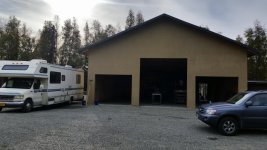
When I was sketching up my addition, a engineer buddy of mine looked over my drawings and made the following recommendations - 5/8ths j-bolts, osb sheeting outside, spray foam, simpson flat strapping in x-braces, osb interior and then sheetrock over that. Nailing schedule was 4" with #10's. I have 2' spacing between the doors and on the corners.

I guess time will tell if it was done right or not.
 

Attachments

  • 20160903_174747.jpg
    20160903_174747.jpg
    147.7 KB · Views: 12

kbs2244

Well-known member
Joined
Nov 11, 2006
Messages
14,065
forAK, in your case , all that OSB you have above the doors will provide a lot of racking resistance.
 
OP
L

laurie71

Well-known member
Joined
Apr 20, 2016
Messages
181
Location
Centerville, Ohio, USA
It is definitely pretty substantial, here we dont have the high wind loads to deal with but we do have seismic requirements that need to be taken into account.
the rest of the walls all employ various Simpson HDU hold down brackets with 5/8" bolts with typically 10" embedded into the concrete.

the Simpson site has some decent documentation on the Shearwalls, including lots of stuff on there "portal" systems.
Definitely worth getting an engineer to draw it up and do the calcs.
It wasnt that expensive for my project and that included foundation reinforcing and a suspended slab design so I have storage under part of the garage.

Yeah, no real seismic requirements here AFAIK. Sounds like you needed quite a lot of engineering into your design.

When I was sketching up my addition, a engineer buddy of mine looked over my drawings and made the following recommendations - 5/8ths j-bolts, osb sheeting outside, spray foam, simpson flat strapping in x-braces, osb interior and then sheetrock over that. Nailing schedule was 4" with #10's. I have 2' spacing between the doors and on the corners.

I guess time will tell if it was done right or not.

That sounds more doable! :bounce: I think I'll draw up something along those lines and have an engineer review.

Although after finding out what a simple survey to accurately establish the property line and an easement boundary would cost, I terrified of what an engineer round here might charge me...!
 
To avoid these ads, REGISTER NOW!
Top Bottom