To avoid these ads, REGISTER NOW!

Historical Tracking of SUPERRATCHET trademark use on Williams Tools

DadsTools

Well-known member
Joined
Jul 27, 2017
Messages
1,852
Hi, folks! New to the group, although I've been reading posts for some time. Some of the most knowledgeable people on vintage tools anywhere. My first post here's about finding info on exactly when the "Superratchet" name disappeared from the Williams product. I have a 1/2" drive S-52 that is obviously a Superratchet in every respect except for the name on it, which is just "S-52 Williams" on one side and "Williams USA" on the other. Now I know that Snap-On acquired the Williams brand in 1993 and marked the Williams line similarly (they appear never to have used the Superratchet trademark and actually allowed it to die without re-registering it), but from what I've read, when Snap-On re-started Williams production, they changed the design of the S-52 so that even the parts were no longer interchangeabole with the earlier design (I wonder if this is true or false?). Remember, the S-52 'Williams' I have is identical inside and out to several S-52 'Superratchet' I also have. Yes, I searched the Alloy Artifacts site, which has a lot of info on the tools and markings but very little about the company's business activities. Since "Superratchet" is a trademark, I conducted a search on the USPTO site that records trademark activity, and although that database only tracks back to 1955, it covers the relevant time period. Here's what I found:

1958: Greenfield Tap & Die, United Drill and Tool, and JH Williams & Co. merge to form United-Greenfield Corp, a Delaware corp. There may have have been a prior relationship with these entities as all three are listed as the assignors of the SUPERRATCHET trademark to assignee U-G. Apparently at this time, JHW was wholly owned by U-G, a fact that is not mentioned in any other online reference I found.

1969: U-G merges with TRW and assigns the Superratchet trademark to the parent TRW, an Ohio corp.

Here's where it starts getting muddy....

1984: TRW assigns the Superratchet trademark to JH Wiliams Industrial Products, Inc. Apparently at some point betwwen 1958 and 1984, JHW & Co. changed its name. Also interesting is the JHWIP address is listed as New York, but the corporation is registered in Delaware where U-G was reistered. It is assigned "The entire Interest & Goodwill" meaning TRW was done with it.

1986: JHWIP changes its name to Williams Hand Tool, Inc. and is assigned the Superratchet trademark.

1988/08/01: Through a bankruptcy sale of assets, the Superratchet trademark is assigned to the new owner, MLIF Acquisition, a Delaware corp.

1988/8/18 17 days later, MLIF files a name change in Delaware to the JH Wiliams Industrial Products, Inc. (??!!)

1993: Snap-On acquires the Superratchet trademark from JHWIP.

1996: Snap-On allows the Superratchet trademark to die without re-registering.

All this raises several questions involving the Superratchet trademark use on Williams

tools:
1. When TRW divested JHW in 1984, did tool producting continue?
2. When the company name was changed to Williams Hand Tool in 1986, did tool production continue or cease?
3. If production continued, coud this be when the Superratchet trademark was dropped from the tools?
4. Did tool production continue throuh the **** bankruptcy acquisition?
5. When Snap-On acquired the line, did it continue existing production, re-start previously ceased production wit existing Williams designs and tooling, or re-vamp the line before re-starting production?

I know this is a lot to chew on, but as a tool history buff, I see this as a huge gap in a very important company's history, and because of the relatively recent time period, there are tons of these tools still in circulation on which we have poor accounting. Any additional info you might have will be great.
 
Last edited:
To avoid these ads, REGISTER NOW!

Gmonkee

Well-known member
Joined
May 9, 2010
Messages
2,915
Did you know about the Tool Archives site Twertsy runs?

He runs into the minitua on that type of stuff.
 
OP
D

DadsTools

Well-known member
Joined
Jul 27, 2017
Messages
1,852
Thanks for the suggestion. Every time I try to get on that site, the browser just grinds and grinds, and then it times out. Don't know what the tech issue is, but I don't have such problems with most other sites. I feel someone in GJ must have some insights into this SUPER- name issue.
 

PFSard

Well-known member
Joined
Sep 12, 2013
Messages
2,423
Location
Mesa, AZ
Thanks for the suggestion. Every time I try to get on that site, the browser just grinds and grinds, and then it times out. Don't know what the tech issue is, but I don't have such problems with most other sites. I feel someone in GJ must have some insights into this SUPER- name issue.

Twertsy may be in the middle of technical difficulties. I don't know. He posted this thread the other day. You may want to try contacting him.

Alert - The ToolArchives.com Clean Up
https://www.garagejournal.com/forum/showthread.php?t=366367
 
OP
D

DadsTools

Well-known member
Joined
Jul 27, 2017
Messages
1,852
Thanks. I did contact him and he replied, so maybe we can find a solution to my accessing his website.

With regard to the original thread subject, I'm still hoping members who read it may have some info to fill the Williams gaps.
 

jakemac

Well-known member
Joined
May 21, 2013
Messages
9,035
Location
New England
5. When Snap-On acquired the line, did it continue existing production, re-start previously ceased production wit existing Williams designs and tooling, or re-vamp the line before re-starting production?

I don't have answers to your questions, or a whole lot of knowledge about SnapOn or Williams, but I can tell you that after putting together a full set of TRW/Williams Superrench combo wrenches up to 2-1/4", there are distinct differences between the two designs.

1. The shank (hande) on the SnapOn/Williams is smoother and has slightly rounder edges. The TRW/Williams is a slightly rougher finish and has a sharper more rectangular profile.

2. The SnapOn/Williams wrenches are shorter than the TRW/Williams equivalent. At the top end of the sizes, the TRW/Williams can be up to 2-1/2" longer.

The longer reach is why I prefer the wrenches from the TRW era.

Physical observation leads me to believe that SnapOn did a complete re-tooling of the tool line loosely based on the previous designs. They didn't simply stamp a new logo on old inventory. SnapOn truly made the tools their own.

Now, if you really want to muddy the waters, try to figure out why/when TRW stopped stamping metric wrenches with the Superrench name and used the Vulcan brand instead. All the while, continuing the Superrench label on SAE wrenches. :evil:
 
Last edited:

twertsy

Well-known member
Joined
Jan 5, 2014
Messages
6,726
Location
Reedville, VA
Did you know about the Tool Archives site Twertsy runs?

He runs into the minitua on that type of stuff.
I don't know how to take that :dunno: :bounce:

I "get off" on the minutia! It's very gratifying to me to find stuff that hasn't previously come to light, and that helps tell the stories of these men, women and companies that are such an important part of our industrial past, particularly on this site.

Thanks. I did contact him and he replied, so maybe we can find a solution to my accessing his website.

With regard to the original thread subject, I'm still hoping members who read it may have some info to fill the Williams gaps.

I sent you back login information, hopefully it works out for you. I did review all the compatibility issues with the software I'm using and didn't see anything that would hinder your access. Regardless, we'll get it figured out. Please let me know how it works/doesn't work for you.

Todd

PS, nice job on the trademark trace. I'm going to use what you did to dig a little deeper on the UG umbrella angle. Thanks again.
 
Last edited:
OP
D

DadsTools

Well-known member
Joined
Jul 27, 2017
Messages
1,852
Thanks jakemac. Good info from a serious collector! From your observations, it seems you are in agreement with the other source I mentioned who felt Snap-On indeed altered the product when they started their Williams production. The "S-52 Williams" and "S-52 Superratchet" ratchets I have are virtually identical except for just the slightest of forging die variation. This would lend weight to the idea that my ratchet in question is indeed pre-Snappy, and that somewhere near 'the end' Williams removed the Superratchet name.

Of the many TRW era Williams I've seen, I have a lone example of a 1027B doe marked with both the Williams AND the TRW names, but no "Superrench" which also supports the notion that the "Super-" monikers were dropped during the TRW era. Since it looks as if TRW sold Williams brand in 1984, all these wrenches must pre-date that. Interestingly, I noticed a variation too within TRW, where the wrench shanks on the "super" marked are narrower and thicker than those marked with just "Williams", almost as if the same amount of metal is being used but just flattened out more. Both have the identical format of forged-in codes so they were apparently made in the same facility.

Now we're getting somewhere...THANKS for the info...keep it coming, folks!

I'll post what I found out about Vulcan next.
 
Last edited:
OP
D

DadsTools

Well-known member
Joined
Jul 27, 2017
Messages
1,852
Thanks, Twertsy. Appreciate your help, AND your supportive words. I too am into the minutia. It's HISTORY! A collector should be interested in the history too, it's the intrinsic value beyond an object with a dollar sign. Tools are even better cause we actually get to USE THEM, not just sit on a shelf and look at it.

Yes, the United-Greenfield connection. As I mentioned the database I searched only went back to '55, but by '58 there was a relationship, so it may be possible that Greenfield Tap & Die or United already owned JHW. Intriguing.....

Tools are unique. They are more than just utilitarian, they are actually extensions of our bodies and minds, physically bridging our mental focus and that upon which we are focused. They allow us to alter the real world according to what we envision in our imagination. Tools give us the power of mind over matter.
 
OP
D

DadsTools

Well-known member
Joined
Jul 27, 2017
Messages
1,852
Thanks, Brian.

I thought it was "It's better to need 'em and not have 'em than to use 'em and not want 'em." Isn't that right?
 

ganymede

Well-known member
Joined
Nov 29, 2012
Messages
2,332
Location
New England
Great topic.
Another ratchet marking variation I've wondered about is when they switched from "J.H. Williams & CO"
To "J.H.Williams" and then finally to just "Williams".
 
To avoid these ads, REGISTER NOW!

Gmonkee

Well-known member
Joined
May 9, 2010
Messages
2,915
Don't ever take it as an insult to be known as the best option for a search Todd. Your site has surpassed AA in a few ways already for detailed history.

That isn't light work. I know because I did the Ford T toolkit research myself. Finding reliable sources then sorting it all out and putting it in a timeline was not easy. And I am still not sure all the dates are pinned down better than ballpark range.

And you are covering all the brands. Impressive efforts.
 

twertsy

Well-known member
Joined
Jan 5, 2014
Messages
6,726
Location
Reedville, VA
Here is what I got prior to the 1958 merger:

In 1920, Williams merged with the Whitman & Barnes company.

In approximately 1936, the United Drill and Tool Corporation was established as an "umbrella entity." Williams and W&B continued to produce tools under their respective brands, and other companies such as the Buckeye Twist Drill Co., Chicago-Latrobe, and Unimet Carbide were brought in under United Drill and Tool.

In late November of 1957, the boards of United Drill and Tool and Greenfield Tap & Die agreed in principle to merge. By March of 1958, the merger was complete and a new entity, Unified-Greenfield Corp. was formalized. Again, Greenfield, Williams etc. continued to produce products under their traditional branding.

I've posted this link before but for those who love "minutia," Ms. Maggie Blanck has done an unbelievable job documenting the early history of J. H. Williams.
 
OP
D

DadsTools

Well-known member
Joined
Jul 27, 2017
Messages
1,852
Here is what I got prior to the 1958 merger:

In 1920, Williams merged with the Whitman & Barnes company.

In approximately 1936, the United Drill and Tool Corporation was established as an "umbrella entity." Williams and W&B continued to produce tools under their respective brands, and other companies such as the Buckeye Twist Drill Co., Chicago-Latrobe, and Unimet Carbide were brought in under United Drill and Tool.

In late November of 1957, the boards of United Drill and Tool and Greenfield Tap & Die agreed in principle to merge. By March of 1958, the merger was complete and a new entity, Unified-Greenfield Corp. was formalized. Again, Greenfield, Williams etc. continued to produce products under their traditional branding.

I've posted this link before but for those who love "minutia," Ms. Maggie Blanck has done an unbelievable job documenting the early history of J. H. Williams.
That's good info, twertsy! It verifies what is indicated by the 1958 USPTO record of the Superratchet trademark assignment that there was already an established relationship between these three entities.
 
OP
D

DadsTools

Well-known member
Joined
Jul 27, 2017
Messages
1,852
Great topic.
Another ratchet marking variation I've wondered about is when they switched from "J.H. Williams & CO"
To "J.H.Williams" and then finally to just "Williams".
ood question, ganymede. We have three elements inconsideration as to when they were dropped: the '& Co', the 'JH' and the 'Super-' markings. We would assume the '& Co.' was dropped when the company name was changed from JHW & Co. to JHW Industrial Products. All I can say right now based on the limited information I have found is that this change occurred sometime between 1958 and 1984. That's quite a wide swathe. I suspect that the change did not occur until the TRW years starting in 1968, so that at least may eliminate a decade. Wish I could find a registration for this name change but so far, no luck. As for the ratchet mark changeover from 'JH Williams' to just 'Williams', I would guess that happened sometime during the TRW years 1968-84. Appears it was decided at some point that the "JH" was no longer relevant or meaningful. The wrench I mentioned that is clearly a 'Superrench' design but having only the 'Williams' name along with 'TRW' tends to confirm this--it provides the evidence that it was TRW that at some point decided to start playing around with the brand naming.

Of course, different products were marked differently--for example, the "JH" had been dropped from the open/box wrenches as far back as the 1920s while persisting on the Superratchets long after. The dropping of the 'Superratchet' name from ratchets like the S-52 may also or hinge on whether tool production continued after TRW divestment (1984) long enough for the 1986 company name change from JHWIP to Williams Hand Tools in 1986--WHT products would have certainly dropped the "JH" to reflect the new name, and perhaps the 'Superratchet' as well. It's still not clear to me that Williams tools were actually being made between 1984 and 1993. I remember reading in a post somewhere by someone working from personal memory that Williams tools "disappeared for awhile" before being made again by Snap-on. WHT went bankrupt in 1988 and was acquired by MLIF Acquisition, which then changed its name back to the earlier JHWIP (What the heck was going on there????). If tool production ceased in 1988, did Snap-On merely buy the Williams name, intellectual property and other assets in 1993, or did it purchase an actual operating tool factory???? Would be kind of funny if Snappy only bought the name.

I feel the only way to know for sure is to lay our hands on a contiguous set of Williams yearly catalogs from that era or find individuals who were there through all this and who could recount all the happenings.
 
OP
D

DadsTools

Well-known member
Joined
Jul 27, 2017
Messages
1,852
I don't have answers to your questions, or a whole lot of knowledge about SnapOn or Williams, but I can tell you that after putting together a full set of TRW/Williams Superrench combo wrenches up to 2-1/4", there are distinct differences between the two designs.

1. The shank (hande) on the SnapOn/Williams is smoother and has slightly rounder edges. The TRW/Williams is a slightly rougher finish and has a sharper more rectangular profile.

2. The SnapOn/Williams wrenches are shorter than the TRW/Williams equivalent. At the top end of the sizes, the TRW/Williams can be up to 2-1/2" longer.

The longer reach is why I prefer the wrenches from the TRW era.

Physical observation leads me to believe that SnapOn did a complete re-tooling of the tool line loosely based on the previous designs. They didn't simply stamp a new logo on old inventory. SnapOn truly made the tools their own.

Now, if you really want to muddy the waters, try to figure out why/when TRW stopped stamping metric wrenches with the Superrench name and used the Vulcan brand instead. All the while, continuing the Superrench label on SAE wrenches. :evil:
I encountered some info on Vulcan Tools during my frolic through the vaporous mists of the WWW (Wondrous World of Williams). Apparently, Vulcan was introduced by United-Greenfield in the early 1960s as a tool truck brand to compete with the likes of Snap-On and MAC. Interestingly enough, the trade name was originally registered by JH Williams way back in 1900, and was one of the intellectual properties transferred to U-G in the 1958 merger. According to anecdotal reports found on the GJ boards and elsewhere, the tools were of very high quality, and continued to be sold off trucks into the 1980s. According to the USPTO, the Vulcan trademark stayed with Williams at the 1984 TRW divestment. In 1986, the trademark was sold to a Deearby Corp, which from what I could find was a foreign company with a location in the USA. I think it's safe to say that production of Vulcan tools ceased with TRW, or at the very least, by the time of the Deearby sale, since it seems clear that Deearby did not acquire the Williams manufacturing facility. The trademark was then transferred to Fleet Factors in a foreclosure against Deearby in 1989, then on the same day (!) transferred to a TSC, Inc. TSC changed its name to Post Tool of California in 1990, but it appears to have been an entity having foreign tools made with its own brand names, so it wasn't a mfr itself. The plan was apparently to re-introduce the Vulcan name on foreign-made tools (where have we heard of that before?). It doesn't appear as if this plan ever came to fruition because after a couple of legal games with paper companies and name changes, the Vulcan trademark finally ended up in the late 1990s with BankAmerica Business Credit (no doubt as a result of a loan default), where it was left to die like so many other old American trade names.

I've only seen a small handful of Vulcan tools firsthand. Based on those observations, I can say that Vulcan was indeed made at the Williams factory because both have the same unique Williams forge marking styles of shallow, wide characters. Some Vulcan tools are found also bearing the name Williams in an apparent attempt to begin marketing Vulcan as a sub-brand of Williams instead of a standalone brand. I am unsure exactly when this changeover took place, but I suspect it came from the later TRW era when some Einsteins in its corporate white tower began playing with the names on the tools.

As for your 'muddy waters' suggestion that Williams replaced 'Superrench' with 'Vulcan' on all its metric wrenches, I humbly submit that this is an erroneous assumption based on the same kind of lack-of-good-info I'm trying to address in this thread. If you are looking at nearly identical wrenches where some are marked 'Superrench' and others marked 'Vulcan', the most likely explanation (and the most rational) is that TRW simply decided to use the same blanks for both brands and to just stamp Vulcan on some for the tool truck distribution. To suggest that a tool company would eliminate a huge portion of their established main-line Top-tier brand of wrenches and begin marking them with their second-tier brand based merely on the fact they were metric is incredible in the sense of the word that means 'not credible'. I think this notion falls under the category "Extraordinary claims require extraordinary proof'. It may be you encountered a body of Vulcan-marked metric wrenches using the identical blanks as the Williams Superrenches and may have jumped to a conclusion that a changeover was made when in fact the 'Vulcan' and 'Superrench' varieties were made side by side at the same time. It happened to me before when I was researching my book on collectible Plummer fishing lures--one tiny scrap of new evidence would turn the whole proposed scenario or timeline on its head. However, I am keenly interested to hear about any sound evidence to the contrary.
 

ganymede

Well-known member
Joined
Nov 29, 2012
Messages
2,332
Location
New England
Thanks Dadstools.
I search Ebay to look at vintage tool catalogs. Williams cats rarely come up but last year I think there was an early 80's catalog and I posted about it because of something on the cover.
I can't find the post or remember what I saw :/
 
OP
D

DadsTools

Well-known member
Joined
Jul 27, 2017
Messages
1,852
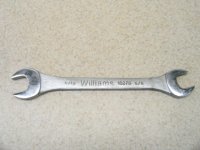
Photos showing both sides of what's clearly a Superrench design but bearing the Williams and TRW names with no 'Superrrench'. The wide shallow forge marking to the left of the Williams side tags this as having come from the Williams factory. The font used for the Willaims name is identical to that used on the Superratchets that only bear the name Williams with no 'JH" or '& Co'. This is the only Williams wrench I've found marked this way, so I suspect it was made near the very end of the TRW era.
 

Attachments

  • IMG_6772.JPG
    IMG_6772.JPG
    100.5 KB · Views: 22
  • IMG_6773.JPG
    IMG_6773.JPG
    100.6 KB · Views: 23
OP
D

DadsTools

Well-known member
Joined
Jul 27, 2017
Messages
1,852
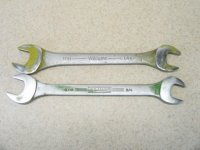
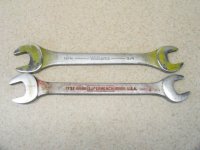
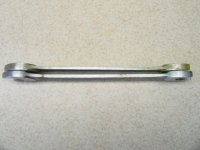
Side-by-side photos of model 1731 TRW Williams wrenches, earlier 'Superrench' marked (bottom) and later plain 'Williams' marked (top). Notice that the shank on the later Williams is wider but shallower than the earlier Superrench while the shank on the latter is slightly longer, almost as if both had the same volume of metal but only flattened out. The later Williams actually has more metal, weighing about 240g while the Superrench weighs 221g. Don't know whether this makes the later one stronger, but it might, which may mean it was actually an improved design. I believe these were both from specialty 'high visibility' sets, hence the traces of bright paint, but probably from different sets because of the different markings. Hope this info helps anyone trying to better identify their Williams wrenches.
 

Attachments

  • IMG_6774.JPG
    IMG_6774.JPG
    96.1 KB · Views: 15
  • IMG_6775.JPG
    IMG_6775.JPG
    101.9 KB · Views: 13
  • IMG_6776.JPG
    IMG_6776.JPG
    90.8 KB · Views: 16
OP
D

DadsTools

Well-known member
Joined
Jul 27, 2017
Messages
1,852
Thanks Dadstools.
I search Ebay to look at vintage tool catalogs. Williams cats rarely come up but last year I think there was an early 80's catalog and I posted about it because of something on the cover.
I can't find the post or remember what I saw :/
Thanks ganymede. ANY Williams catalog from the 1980s would be very revealing indeed. I think our problem locating these stems from when TRW decided to chage the company name from JH Williams & Co to JH WILLIAMS Industrial Products. I believe this is when began the shift in philosophy from Williams being a quality mechanic's tool to a brand intended for industrial use. This would make catalogs in the hands of the general public scarce, as they were now being sent to industrial businesses only. Perhaps the change from 'Vulcan'-only marked wrenches to 'Vulcan-Williams' marked was an effort to maintain a Williams line specifically aimed at the mechanics market so they now had two Williams brands covering both bases. Certainly would be a logical explanation for all the name juggling. The question sill remains as to WHEN WHEN WHEN did all this change begin to take place?. :dunno: I suspect late 1970s into the 1980s. The catalogs would tell all.:thumbup:
 

jakemac

Well-known member
Joined
May 21, 2013
Messages
9,035
Location
New England
Thanks for the info about the Vulcan label.
My question about the use of the label concerning metric combo wrenches comes from trying to put together a metric set from the TRW era. It is very difficult to find Superrench labeled metrics. The overwhelming majority of metric wrenches I see are marked with Williams (three-line w/underlined logo) on one side and Vulcan on the other. The Williams Superrench metrics are rare birds.

The '76 catalog I have makes no mention of the Vulcan brand on the wrenches.

Part of the issue could be the rarity of metric wrenches in general, until the mid-late 70's.
The Superrench versions may be harder to find because fewer were sold. While by the time TRW started pushing the Vulcan name, more import vehicles were showing up and metric sales were starting to grow.

Another observation, unlike the SAE wrenches the metric Williams/Superrench, SnapOn/Williams, and the Williams/Vulcan are the same length for the long pattern, but the shorty's that I've found are shorter in the Williams/Vulcans than the Williams/Superrench (I don't have any shorty SnapOn/Williams to compare).
 
Last edited:
OP
D

DadsTools

Well-known member
Joined
Jul 27, 2017
Messages
1,852
Thanks for the info about the Vulcan label.
My question about the use of the label concerning metric combo wrenches comes from trying to put together a metric set from the TRW era. It is very difficult to find Superrench labeled metrics. The overwhelming majority of metric wrenches I see are marked with Williams (three-line w/underlined logo) on one side and Vulcan on the other. The Williams Superrench metrics are rare birds.

The '76 catalog I have makes no mention of the Vulcan brand on the wrenches.

Part of the issue could be the rarity of metric wrenches in general, until the mid-late 70's.
The Superrench versions may be harder to find because fewer were sold. While by the time TRW started pushing the Vulcan name, more import vehicles were showing up and metric sales were starting to grow.

Another observation, unlike the SAE wrenches the metric Williams/Superrench, SnapOn/Williams, and the Williams/Vulcan are the same length for the long pattern, but the shorty's that I've found are shorter in the Williams/Vulcans than the Williams/Superrench (I don't have any shorty SnapOn/Williams to compare).
I think you're on to something, jakemac. Let's assume for a moment that the development of company names and the names on wrenches that we can see and trace actually correspond with a corporate movement toward dividing Williams into two major families of tools, one for the mechanics market and the other toward industrial application. This probably would have happened sometime in the 1970s. At the time, as you say, metrics were beginning to become more prevalent in the mechanics field with the foreign cars. However, domestic industrial machinery and equipment would have still been almost exclusively domestic made, and therefore SAE. If that is so, we'd certainly see an increase in the number of Vulcan metrics because it was the mechanics line, while the industrial Superrench line would see very few because of the SAE industrial machinery. As TRW moved away from pushing Superrench to the mechanics market, the number of Superrenches sold in metric sizes would have slowed to a trickle, while the Vulcan metrics would have seen a noticeable increase. That scenario would not only fit with what we observe in the company name changes, but also the tool markings.

If your 1976 Vulcan catalog does not show tools dual-marked 'Vulcan-Williams', this would mean that at this time they were still being marketed as two distinct product lines. This would also lend support to my belief that TRW's move to present Vulcan as a sub-brand of Williams with the dual markings did not occur until at least the late 1970s. The catalogs are key.

It seems that a clear picture is emerging regarding all the changes from the later TRW era. We're treading out new historical ground. Good stuff. I love it!:willy_nil
 

jakemac

Well-known member
Joined
May 21, 2013
Messages
9,035
Location
New England
To clarify, the catalog that I have is the Williams Toolpower Catalog No. 308.
I think it was printed in 1976, but can't find a date on it anywhere.

Inside, it lists the company as :
J.H. Williams & Co.
400 Vulcan St. Buffalo, NY
a United-Greenfield division of TRW INC.
Established 1882


The registered trademarks listed are :
MEASURRENCH
SUPERECTOR
SUPERJUSTABLE
SUPERRATCHET
SUPERRENCH
SUPERSOCKET
VULCAN
WILLIAMS

The metric wrenches in the catalog are listed as the Superrench brand, no mention in the catalog of the Vulcan brand other than the trademark list that I've found so far.
 
OP
D

DadsTools

Well-known member
Joined
Jul 27, 2017
Messages
1,852
To clarify, the catalog that I have is the Williams Toolpower Catalog No. 308.
I think it was printed in 1976, but can't find a date on it anywhere.

Inside, it lists the company as :
J.H. Williams & Co.
400 Vulcan St. Buffalo, NY
a United-Greenfield division of TRW INC.
Established 1882


The registered trademarks listed are :
MEASURRENCH
SUPERECTOR
SUPERJUSTABLE
SUPERRATCHET
SUPERRENCH
SUPERSOCKET
VULCAN
WILLIAMS

The metric wrenches in the catalog are listed as the Superrench brand, no mention in the catalog of the Vulcan brand other than the trademark list that I've found so far.
Thanks for the additional info. That makes a lot of sense. It still is listing Williams as the J.H. Williams & Co., which means it had not made the company name change yet to J.H. Williams Industrial Products. If it is indeed a 1976 catalog, this narrows the time of the name change to between 1977 and 1984. That falls in nicely with my working supposition of late 1970s to 1984. I believe the dropping of the '& Co.' corresponds with the name change to JHWIP. and I believe the dropping of the 'Super-' moniker shortly followed.

Think about it. The world was growing more informed, more sophisticated, skeptical and even jaded--the innocence of traditional America had all but disappeared. The "super-" prefix would have seemed trite, contrived and gimmicky. "We make Super-tools!" Yeah, right....I'm sure everyone would have taken that seriously in the late 1970s! "What makes YOUR tools so super?" Especially the industrial customers.

This is all making a lot of sense.

With the help of all of you, we're putting together a model of what happened in the last years of the old Williams company and documenting it for the first time.
 
To avoid these ads, REGISTER NOW!
Top Bottom