Private Lugnutz
Well-known member
I recently acquired an early (1910-1922 era) pressed steel socket wrench set with 11/16-inch external and 1/2-inch internal square drive sockets and a mix of internal and external square drive tools. More to come on the set itself, which I am still in the process of spec'ing and sorting out, prompting a number of different research deep dives.
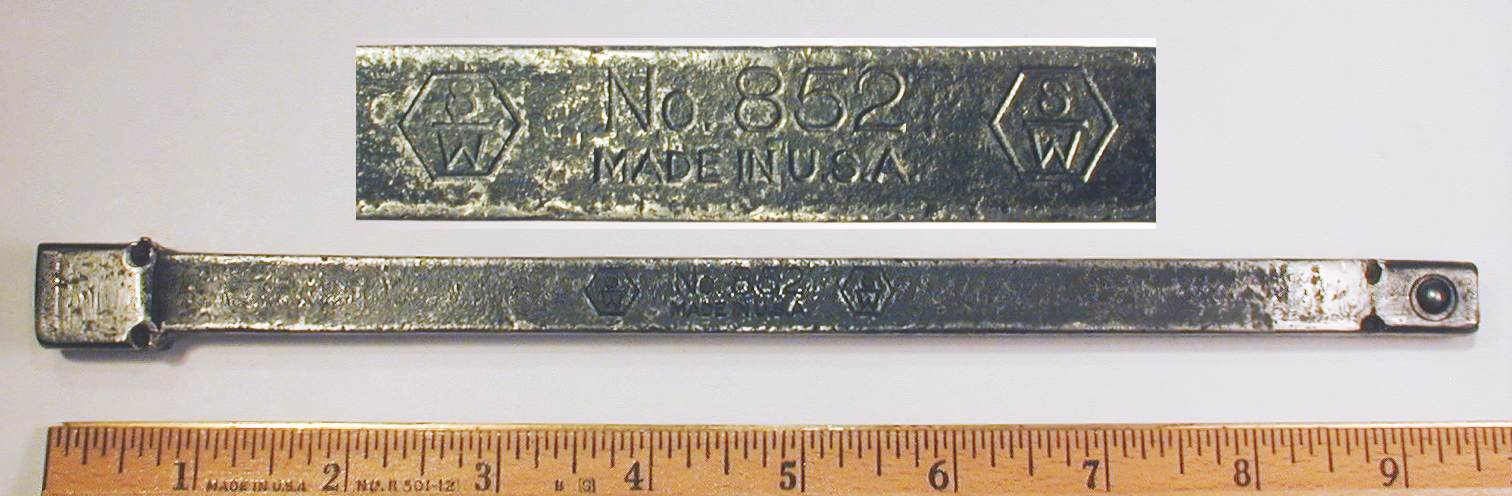
One of those deep dives concerns this extension.
View media item 77177
It's OOAK in construction and branding, with no other known examples in the vintage hand tools websphere, as far as I have been able to find or determine, so far.
It's 7 inches long. Steel. Finished, like the set, in some kind of black rust-proofing. The smaller end with the friction ball is 1/2-inch O.D., to drive the sockets from the inside. The larger end is 11/16-inch O.D., to fit inside the 11/16-inch female drive opening in the ratchet like a drive plug. I'm not sure, but it almost looks like the 11/16-inch drive stud was hot-crimped onto the end of the shank. It's not forged. Looking for thoughts on this.
View media item 77179
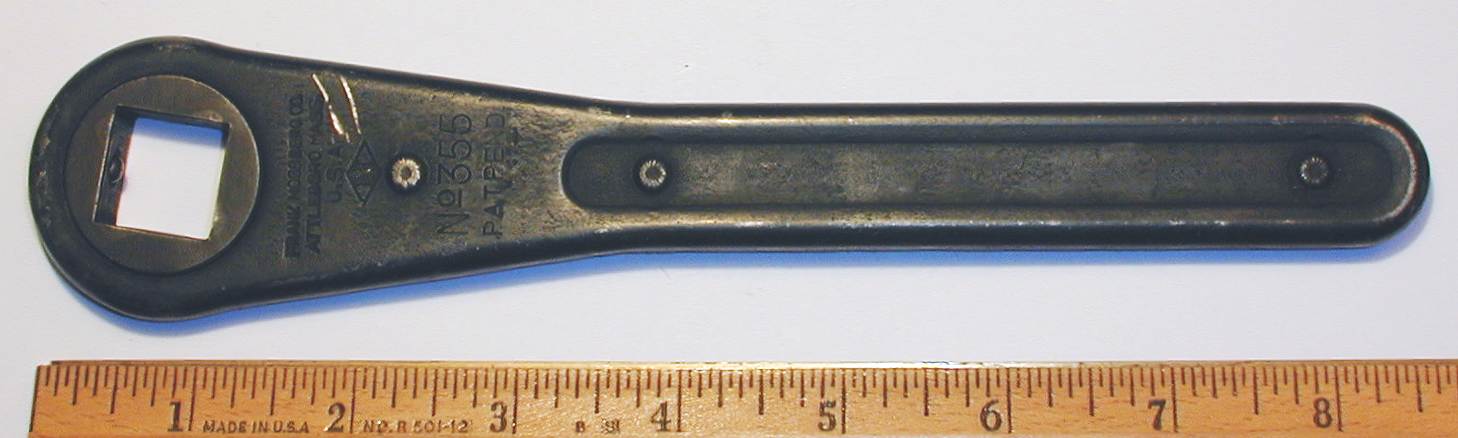
It's similar to the approach Walden took on their early pressed steel socket drive tool extensions, which came in different lengths. But the large end on the Walden extensions were female, and drove the sockets from the outside of the socket base. Here is a 10-inch for comparison.

It's also similar to the approach taken by Mossberg in the No. 1 Auto-Cle set in the sense of using a 1/2-inch square bar stock. But it was 1/2-inch on both ends. Here is that extension for comparison.

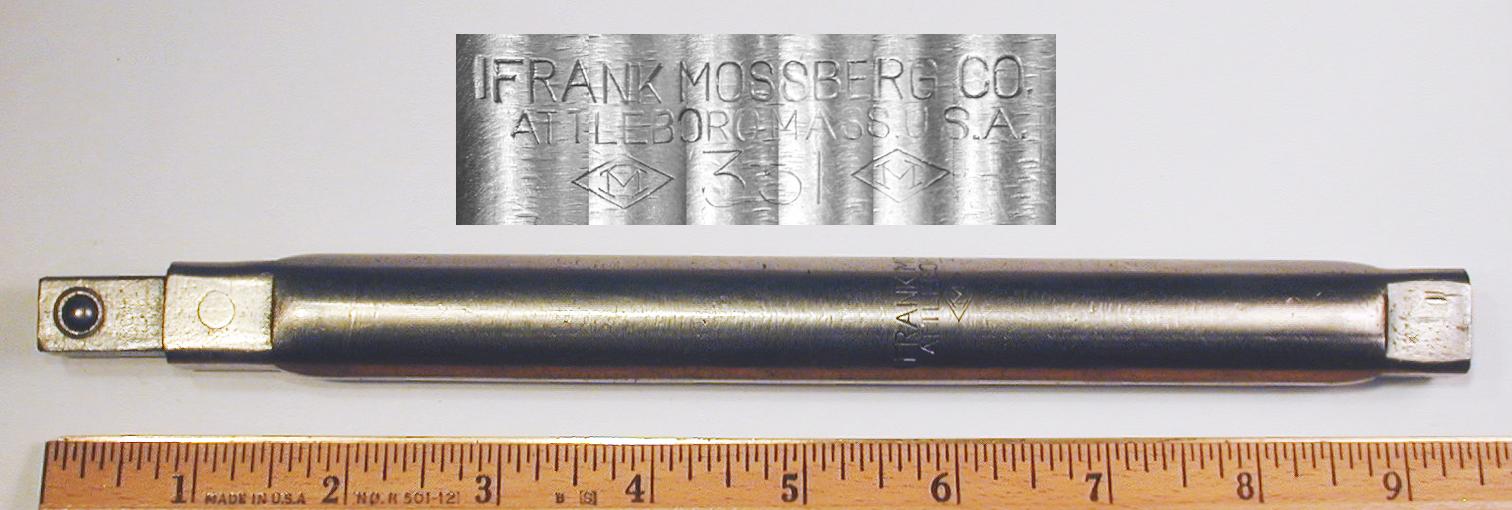
And it's very similar to the approach taken by Mossberg on the later No. 351 extension in the sense that one end was 1/2-inch (for internal socket drive) and the other end 11/16-inch (internal ratchet drive). But the Mossberg 351 was made from thick steel tubing swaged into a square on the big end and pinched around a solid 1/2-inch drive stud on the smaller end.
Here is an example...
Moving on to the really fun stuff, here is a close-up of the brand and model number marking.
View media item 77178
As I mentioned above, I can’t find another example of this monograph style logo anywhere in the hand tools websphere, and that includes Alloy Artifacts.
My first thought - and after careful further study and analysis, it's now my conclusive theory - is that the "boxed MW fraction" logo (for wont of a better economical and descriptive term) signifies the Mossberg Wrench Company.
Here's my rationale:
- Note that the pronounced serifs in the "M" (and the "W" - which is a mirror image of the "M") are very reminiscent of the serifs in the "M" in many examples of the Frank Mossberg Company so-called "M-Diamond" logo. That could be a coincidence, but a crazy one, if so.
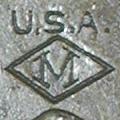
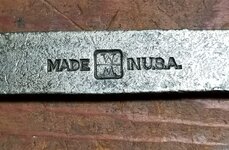
- Note also that the Frank Mossberg Company demonstrated a propensity for the same marking scheme, with a pair of logos bracketing a model number, like this: "< M > model number < M >".
Here are some examples from AA:

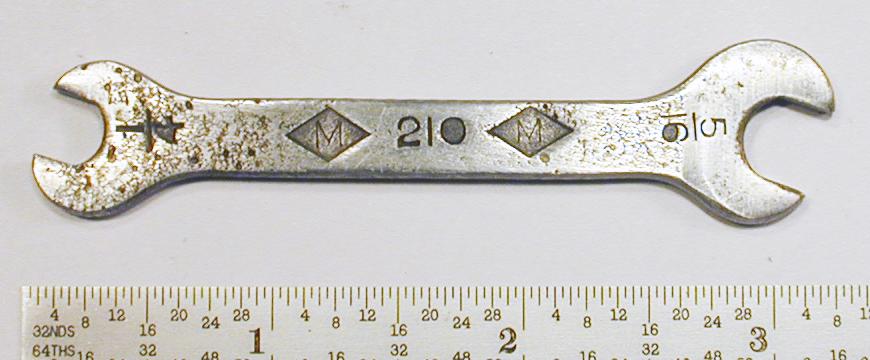
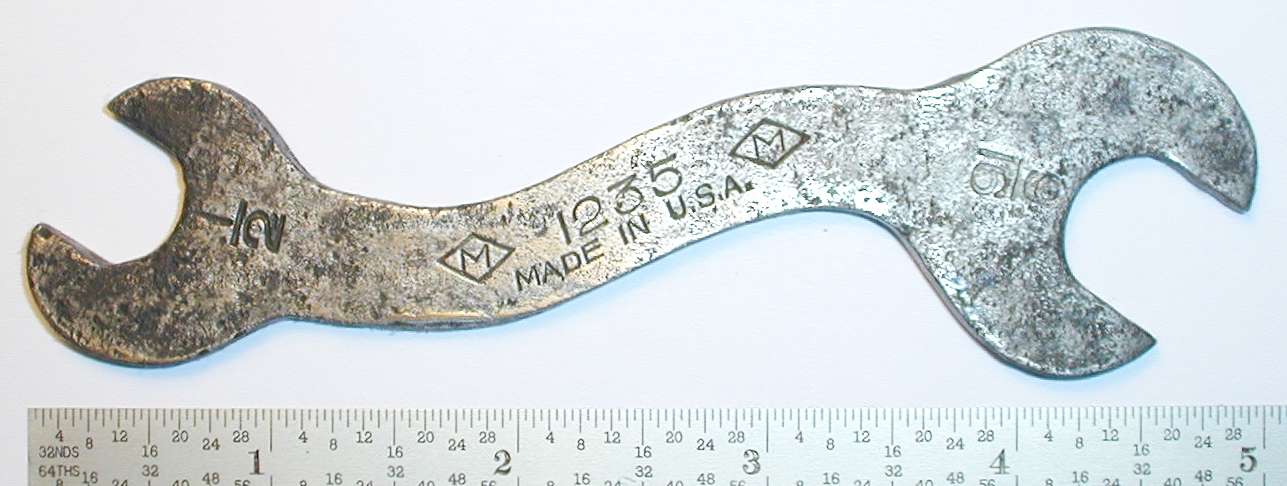

- Note that the Mossberg No. 351 extension bears a very similar model number. Not uncommon for mfgrs to do that for tools in different lines or those made by subsidiaries.
- Note that the ratchet in the set is a ratchet made by Mossberg but marked "W. & M. Co.". (This is a whole 'nother subject and thread topic that I am not prepared to introduce yet, but AA has one if you want to see an image.)
- Lastly, through process of elimination - what else could a "boxed MW fraction" logo reasonably stand for?
It's not Walden. And it doesn't belong to any of the smaller enterprises making pressed steel socket wrench sets in that era (Syracuse, Charles Miller, and King).
EDIT: It's not Montgomery Ward. They had an MW logo, briefly, but much later.
If you're not read up on Mossberg stuff, Frank Mossberg was in business as early as 1894 as the Frank Mossberg Company, although he didn’t trademark the M-Diamond logo until June 27, 1905. He trademarked the name "Mossberg Wrench Company" a year later, on June 12, 1906, several of his early patents (bicycle wrenches) were assigned to it, and it continued to show up as a separate business entity in legal gazettes "until at least 1915 or so," per AA. But the exact nature of the relationship between the two companies is strange and not known. Most pertinent to this thread, no hand tools have been found that are marked with the name "Mossberg Wrench Company" or a logo indicating the Mossberg Wrench Company as opposed to the M-Diamond logo indicating Frank Mossberg Company, as far as I have been able to tell.
Until now, that is, perhaps.
It stands to reason, in my opinion, that Frank was using the Mossberg Wrench Company to fulfill orders, and maybe especially for the pieces in the 3rd party pressed steel socket wrench sets he was making for re-badging by others (e.g., Sears & Roebuck Aristocrat No. 1). Perhaps other pieces were marked with this "boxed MW fraction" logo and they just haven’t been recovered.
Also - and I should've said this earlier... If anyone has a tool with this marking, or knows of a tool in another collection with this marking, please post it. It's possible that it's out there somewhere even though no examples show up on AA, Etsy, Worthpoint, etc.
Anybody have any other ideas or theories?
All comments welcome.
One of those deep dives concerns this extension.
View media item 77177
It's OOAK in construction and branding, with no other known examples in the vintage hand tools websphere, as far as I have been able to find or determine, so far.
It's 7 inches long. Steel. Finished, like the set, in some kind of black rust-proofing. The smaller end with the friction ball is 1/2-inch O.D., to drive the sockets from the inside. The larger end is 11/16-inch O.D., to fit inside the 11/16-inch female drive opening in the ratchet like a drive plug. I'm not sure, but it almost looks like the 11/16-inch drive stud was hot-crimped onto the end of the shank. It's not forged. Looking for thoughts on this.
View media item 77179
It's similar to the approach Walden took on their early pressed steel socket drive tool extensions, which came in different lengths. But the large end on the Walden extensions were female, and drove the sockets from the outside of the socket base. Here is a 10-inch for comparison.
It's also similar to the approach taken by Mossberg in the No. 1 Auto-Cle set in the sense of using a 1/2-inch square bar stock. But it was 1/2-inch on both ends. Here is that extension for comparison.
And it's very similar to the approach taken by Mossberg on the later No. 351 extension in the sense that one end was 1/2-inch (for internal socket drive) and the other end 11/16-inch (internal ratchet drive). But the Mossberg 351 was made from thick steel tubing swaged into a square on the big end and pinched around a solid 1/2-inch drive stud on the smaller end.
Here is an example...
Moving on to the really fun stuff, here is a close-up of the brand and model number marking.
View media item 77178
As I mentioned above, I can’t find another example of this monograph style logo anywhere in the hand tools websphere, and that includes Alloy Artifacts.
My first thought - and after careful further study and analysis, it's now my conclusive theory - is that the "boxed MW fraction" logo (for wont of a better economical and descriptive term) signifies the Mossberg Wrench Company.
Here's my rationale:
- Note that the pronounced serifs in the "M" (and the "W" - which is a mirror image of the "M") are very reminiscent of the serifs in the "M" in many examples of the Frank Mossberg Company so-called "M-Diamond" logo. That could be a coincidence, but a crazy one, if so.
- Note also that the Frank Mossberg Company demonstrated a propensity for the same marking scheme, with a pair of logos bracketing a model number, like this: "< M > model number < M >".
Here are some examples from AA:
- Note that the Mossberg No. 351 extension bears a very similar model number. Not uncommon for mfgrs to do that for tools in different lines or those made by subsidiaries.
- Note that the ratchet in the set is a ratchet made by Mossberg but marked "W. & M. Co.". (This is a whole 'nother subject and thread topic that I am not prepared to introduce yet, but AA has one if you want to see an image.)
- Lastly, through process of elimination - what else could a "boxed MW fraction" logo reasonably stand for?
It's not Walden. And it doesn't belong to any of the smaller enterprises making pressed steel socket wrench sets in that era (Syracuse, Charles Miller, and King).
EDIT: It's not Montgomery Ward. They had an MW logo, briefly, but much later.
If you're not read up on Mossberg stuff, Frank Mossberg was in business as early as 1894 as the Frank Mossberg Company, although he didn’t trademark the M-Diamond logo until June 27, 1905. He trademarked the name "Mossberg Wrench Company" a year later, on June 12, 1906, several of his early patents (bicycle wrenches) were assigned to it, and it continued to show up as a separate business entity in legal gazettes "until at least 1915 or so," per AA. But the exact nature of the relationship between the two companies is strange and not known. Most pertinent to this thread, no hand tools have been found that are marked with the name "Mossberg Wrench Company" or a logo indicating the Mossberg Wrench Company as opposed to the M-Diamond logo indicating Frank Mossberg Company, as far as I have been able to tell.
Until now, that is, perhaps.
It stands to reason, in my opinion, that Frank was using the Mossberg Wrench Company to fulfill orders, and maybe especially for the pieces in the 3rd party pressed steel socket wrench sets he was making for re-badging by others (e.g., Sears & Roebuck Aristocrat No. 1). Perhaps other pieces were marked with this "boxed MW fraction" logo and they just haven’t been recovered.
Also - and I should've said this earlier... If anyone has a tool with this marking, or knows of a tool in another collection with this marking, please post it. It's possible that it's out there somewhere even though no examples show up on AA, Etsy, Worthpoint, etc.
Anybody have any other ideas or theories?
All comments welcome.
Last edited: