To avoid these ads, REGISTER NOW!

DASCO DOE marked 3-25

Mintgrun

Well-known member
Joined
Oct 7, 2015
Messages
2,101
Location
Kingston, Wa.
I picked up this wrench last week and have not been able to find any information about it online.
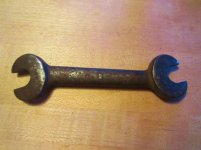
009 (800x600).jpg
The tapered tips are what caught my attention.
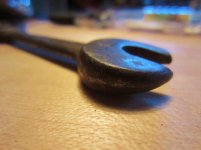
016 (800x600).jpg
Alloy Artifacts does not mention DASCO...
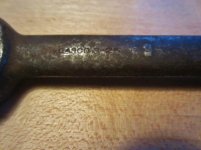
012 (800x600).jpg
Does anyone have an idea as to why the tips are tapered this way?

The markings on the ends are a bit odd too. I believe both ends are the same size. I will measure them and report back.
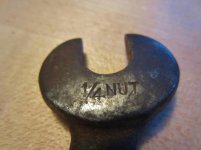
010 (800x600).jpg011 (800x600).jpg
Any information/insight appreciated.
Thanks,
Tom
 
To avoid these ads, REGISTER NOW!

Stadger

Well-known member
Joined
Nov 19, 2016
Messages
483
Looks like an old lathe wrench that has been ground/filed down by a previous owner.
 
OP
M

Mintgrun

Well-known member
Joined
Oct 7, 2015
Messages
2,101
Location
Kingston, Wa.
Maybe. It looks like a factory taper to me though.
It is very even, with no signs of grinding marks.
The taper does not affect the stamped lettering.

It seems odd that both ends are the same size and marked differently.
I have run across a lot of wrenches that have been opened up, but once again, this looks original.

Dasco is a modern/current tool maker. I have some punches and cold chisels. No info on old wrenches by that name though.

Boring topic, I know.... :)
 

Ole Slewfoot

Well-known member
Joined
Feb 22, 2016
Messages
5,098
Location
Freedom, CA
Daamascus Steel Products Co now DBA DASCO Pro
1925 catalog
shows 'double beveled wrenches' to make room for your hand by the work, like the 15* angle on many later tools.
And some cool cutlery.
And round nose cape chisels for cutting oil groves...never seen one of those.
 
Last edited:

Private Lugnutz

Well-known member
Joined
Mar 30, 2012
Messages
30,488
Location
The Authentic Jersey Shore
The markings on the ends are a bit odd too. I believe both ends are the same size. I will measure them and report back.
FWIW, both ends measure .512"
It seems odd that both ends are the same size and marked differently.
Long before wrenches were marked with the size of the milled opening on their jaw faces, they were commonly marked with the size and type of bolt, screw or nut they would fit instead. Nuts and the heads of screws and bolts had different diameters across the flats depending on who made them and what standard they followed. If you look in a Machinery's Handbook or any vintage catalog you will see tables in the wrench sections correlating milled opening size to various fastener standards (e.g., American Standard, S.A.E., U.S.S., and Hex Cap Screws).

A 1/4" U.S.S. nut had a head that was 1/2" in diameter, requiring a 1/2" milled opening to turn it.

A 5/16" Hex Cap Screw (that's your "C.S.") also had a head that was a 1/2" in diameter, requiring a 1/2" milled opening to turn it. For this standard you will also see a hexagon shaped symbol followed by a "C.S." stamped into the face.

EDIT: I added some additional examples of primitive size markings.
 

Attachments

  • 20170915_171505.jpg
    20170915_171505.jpg
    52.7 KB · Views: 13
  • 20171007_120137.jpg
    20171007_120137.jpg
    65.6 KB · Views: 10
Last edited:
To avoid these ads, REGISTER NOW!

notlob

Well-known member
Joined
Aug 19, 2013
Messages
1,384
Location
norcal
Slew -

Thanks for posting up that catalog link. I was not aware Dasco dated back to the 1920's.

From the Dasco website: http://www.dascopro.com/about

DASCO PRO, Inc. has been in the forged hand tool industry since 1922. Our company has been a leader of innovation, new packaging and superior technology for 89 years.

In 1984, DASCO merged with angle finder manufacturer Pro Products and formed DASCO PRO, Inc. Our production facilities include three manufacturing plants in Rockford, IL. totaling 216,000 square feet. The upset head on the largest striking tools was developed and trademarked as Targethead® tools in 1948.
 

notlob

Well-known member
Joined
Aug 19, 2013
Messages
1,384
Location
norcal
Have seen several before, definitely factory. I just don't remember who made them.

Blackhawk patented and made that type wrench for a while; called it the "Wedg-Head." Made them for Snap On, too.
 
OP
M

Mintgrun

Well-known member
Joined
Oct 7, 2015
Messages
2,101
Location
Kingston, Wa.
Thank you for all the insight. :)

The catalog is fun to look through.
It is funny that the description of the double beveled wrenches says,
"The openings are made to avoid duplications as much as possible."
Although the two ends are labeled differently, the size is the same, which seems like a duplication.

My wrench appears to be number 333 in that catalog.
 

Private Lugnutz

Well-known member
Joined
Mar 30, 2012
Messages
30,488
Location
The Authentic Jersey Shore
Tom,

I'm pretty sure DASCO is referring to the entire set or series, which goes from 5/16" to 1-1/4" in ten (10) wrenches, covering nineteen (19) unique ends, and duplicating only one (1/2"), which happens to be on your wrench. Then they throw two (2) more wrenches in that repeat the 1/2", 7/16", and 9/16" openings in combinations not included in the first range. Believe it or not, if you page through old catalogs you'll see that most mfgrs repeated several popular sizes in combination with different sizes on the other end in both DOE and DBE wrenches.

EDIT: Note that Bonney made a DOE wrench set that went from 3/8" to 1" in six (6) wrenches without any redundant ends that they trumpeted in their catalog text for that virtue.
 
Last edited:

shanny19

Well-known member
Joined
May 24, 2014
Messages
1,209
Location
PNW
Blackhawk patented and made that type wrench for a while; called it the "Wedg-Head." Made them for Snap On, too.

60s vintage Barcalo combination wrenches have the BOX end tapered like that, it's the only brand I know of with the box tapered. Kinda weird but cool.
 

Private Lugnutz

Well-known member
Joined
Mar 30, 2012
Messages
30,488
Location
The Authentic Jersey Shore
It is cool. I didn't look at the catalog page before my first post, and I have to admit I didn't understand Slew's description of it as a hand-clearance design, or his allusion to wrenches with 15* angle head placement. But now I get it. Because of the bevel, when the face of the jaw is flush with the fastener, it raises the shank and therefore the hand above any potential adjacent low-lying obstructions.
 
To avoid these ads, REGISTER NOW!
Top Bottom