To avoid these ads, REGISTER NOW!

Makita 3612BR Plunge Router Collet Failure

sbosecker

Well-known member
Joined
Sep 25, 2012
Messages
3,539
Location
Peachtree City, GA
I purchased a Makita 3612BR Plunge Router sometime in the mid-80's. It has served me well for over 30 years.
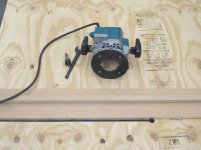


2018 05 03 - Makita 3612BR Collet Failure.jpg

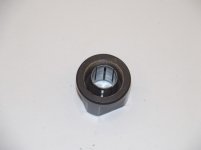
A few days ago the collet appears to have failed.

I was routing using a 1/2-inch straight bit (probably about the same age as the router) in 11/32-inch plywood. A bit over 2 feet into the cut something bad happened.

I shut down the router and attempted to remove the bit but it was jammed inside the collet. I removed the collet nut and the collet, nut & bit all came out together. The bit is fast inside the collet and the collet is not coming apart from the collet nut.

I don't believe in the 30+ years I've had this machine that I've ever completely removed the Collet Nut - I don't know if the collet is supposed to come out with the collet nut or what its behavior is supposed to be.

Questions:

1. Anyone else ever have this happen?

2. If so, will replacing the collet and the collet nut repair the machine?

3. Any other useful information?

Thanks.

Scott
 
To avoid these ads, REGISTER NOW!
OP
S

sbosecker

Well-known member
Joined
Sep 25, 2012
Messages
3,539
Location
Peachtree City, GA
Wow... that's cool. Would love to see a close-up of the machine end of the collet and of where it fell off from.

PelicanPines

It didn't fall off. The Collet Nut was still tightened down on the machine and the Collet was still inside the Collet Nut. The Bit was still in the Collet and could not be removed by hand even after the Collet Nut (and everything else) was removed from the Router.

I did just set the Collet Nut up on a partially opened vice and struck the end of the Bit with a hammer and punch. One sharp rap removed the Bit. The Collet is still fast inside the Collet Nut. I don't know if that's normal or not.

I think not.

Scott
 

dnschmidt

Well-known member
Joined
Oct 3, 2014
Messages
7,298
Location
Phoenix, AZ
These don't come apart. The way they are designed is that you need to loosen the collet nut twice. Once to loosen the collet and the second to extract the bit. The collet will actually force the bit forward for extraction. There is sort of a snap ring arrangement that holds the collet to the nut. Dewalt uses the same system as do most all European manufacturers such as Festool.
 

IowaDon

Well-known member
Joined
Nov 2, 2016
Messages
103
Location
SW IA
I'm a little confused. My Dewalt router has both a 1/2" and a 1/4" collet, so I've removed them many times to switch. I've always just called the whole assembly the collet. What I think you are calling the collet isn't designed to be easily removed from the nut, although I'm sure it can be.

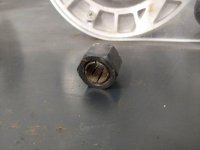
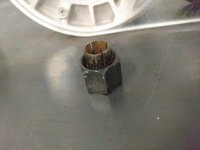
I'm not so sure there's anything wrong with your collet. If the threads on the router are not damaged, your router is fine.IMG_20180507_212658724.jpgIMG_20180507_212648260_BURST001_LL.jpg
 
Last edited:
OP
S

sbosecker

Well-known member
Joined
Sep 25, 2012
Messages
3,539
Location
Peachtree City, GA
dnschmidt & IowaDon,

As I mentioned, I had never completely removed the Collet Nut so I didn't know how the collet & the nut interacted.

However, Makita's parts list of the 3612BR shows the Collet (Collet Cone) and the Collet Nut as 2 different parts.

Best regards,

Scott
 
Last edited:

neophyte

Well-known member
Joined
Apr 23, 2012
Messages
9,814
Location
Pennsylvannia
In the first photo posted, the collet looks like it might have been placed backwards into the arbor and the nut tightened down on it. Admittedly, I haven’t used that makita router model, so I don’t know what exactly the collets look like, but the taper on the collet sticking out of the nut, looks like the lower half of the collets on the large Dewalt DW625 routers, and that would be the side that goes into the router arbor, and then the nut gets tightened on top.
 

neophyte

Well-known member
Joined
Apr 23, 2012
Messages
9,814
Location
Pennsylvannia
I'm a little confused. My Dewalt router has both a 1/2" and a 1/4" collet, so I've removed them many times to switch. I've always just called the whole assembly the collet. What I think you are calling the collet isn't designed to be easily removed from the nut, although I'm sure it can be.

I'm not so sure there's anything wrong with your collet. If the threads on the router are not damaged, your router is fine.IMG_20180507_212658724.jpgIMG_20180507_212648260_BURST001_LL.jpg

Technically, the Dewalt routers have two separate parts; the collet and the collet nut. The two parts are sold separately, or at least they used to be. If you bought a Dewalt router it came with two collets, the 1/4” and 1/2”, and one collet nut. Some router manufacturers, for at least some models sell the two parts as single units, so when you purchase the collet it comes with a colleg nut attached, and usually uses a collet design that’s hard to remove from the collet nut, because the collet has a groove that leaves it captive on the nut. With some collet/nut designs, the collet is still captive on the nut, but is somewhat easy to remove to switch the nut from one collet to another. On other designs, sort of like on Dremel tools, the collet is separate from the nut, and will remain in the arbor after the nut is removed, because the collet snd nut don’t interconnect at all.
 

dutchgray

Well-known member
Joined
Sep 28, 2014
Messages
6,470
Location
Dorset. England.
Provided the threads and the taper in the end of the router spindle are undamaged, a new nut and collet will fix it.
Collets don't last forever, they seem to give up with use and not tighten properly. I think that is the same design (except bigger) that they use on the 1/4" trimmers, which I don't rate at all, ours is only a couple years old and has trouble holding a bit already, though I believe it was over tightened.
 

neophyte

Well-known member
Joined
Apr 23, 2012
Messages
9,814
Location
Pennsylvannia
I may have made a mistake there. I might have gotten mistaken over which side was the top/bottom of the collet nut. Sometimes router bits stick in the collet. Usually this is because the bit is lightly over sized and there’s a press fit. If for some reason the bit was loose in the collet, and started spinning in and against the collet, while trying to make a cut, the collet could have slightly friction welded itself to the bit. This could hppen if the bit is undersized, or the collet has gotten worn and is slightly oversized. It could also happen if the arbor taper has gotten worn. If the arbor taper is worn the arbor would probably need to be replaced. If the problem is just the collet, then replace the collet and nut, use a bit you’ve used successfully, and make test cuts towards the maximum cut width/depth to make sure everything is fine.
 
To avoid these ads, REGISTER NOW!
OP
S

sbosecker

Well-known member
Joined
Sep 25, 2012
Messages
3,539
Location
Peachtree City, GA
Today I went out and pushed the end of the collet sticking out of the nut around a bit. I then got a needle-nose pliers, gripped the collet, and gave a tug. The collet came out without too much of a fuss.


2018 05 03 - Makita 3612BR Collet Failure-09.jpg

Once I had the collet free I tried inserting a 1/2" bit into the collet. It would not slide all the way through. It stopped about a third of the way into the collet. I did not force it but I did apply what I thought should be more than enough force to overcome a normal amount of friction. It certainly wasn't this hard to get the bit into the router prior to this incident.

I have ordered a replacement collet and collet nut. It could be a couple of weeks before they arrive.

Scott
 

Bob Heine

ALLIANCE MEMBER
Joined
Oct 24, 2009
Messages
10,709
Location
Boca Raton, Florida
Scott, I think you're on the right track. My Craftsman routers have circlips on the protruding part of the collet so it is forced open when you loosen the nut to a certain point. The collets that don't have a circlip can sometimes get wedged into the nut, usually more frequently as those parts wear. The two new parts should keep it working fine for another 30 years.
 

BukitCase

Well-known member
Joined
Apr 11, 2017
Messages
1,075
Location
Oregon
Once you get new parts for your collet, NEVER bottom out a bit before tightening - because of the way collets work, if the bit is bottomed out BEFORE you tighten the nut, tightening the nut will first compress the collet on the shank, then if you continue tightening (un-avoidable) as the nut tightens, it forces the collet (and bit shank) HARD against the bottom of the chuck.

Very much of this, and the collet and bit are LOCKED into the chuck, even if you completely remove the nut.

Mark Sommerfeld makes a few bit sets that are designed with "automatic" depth settings (shank lengths) so you can swap bits and still have the two pieces line up; to do that, the bits MUST be bottomed out or the "instant swap" thing won't work -

To get around this, Mark includes a 1/2" GROMMET with each matched set - you drop the bit in, it sets on the grommet, then when you tighten the nut the grommet slightly compresses, but does NOT lock the collet and bit into the chuck

https://sommerfeldtools.com/3-pc-tongue-groove-cabinetmaking-set?filter_name=tongue
https://sommerfeldtools.com/rubber-grommet?filter_name=grommet

His stuff is a bit expensive but works - but for bits that do NOT require the repeatability of depth setting, just do NOT bottom the bit before tightening the collet and you shouldn't have the problem again... Steve
 

dnschmidt

Well-known member
Joined
Oct 3, 2014
Messages
7,298
Location
Phoenix, AZ
BukitCase, it has been fairly common practice for years to put an o-ring at the end of the router shaft as you don't want the end of the bit to be in physical contact with the shaft for vibration and collet reasons. If it's a fairly tight fit the o-ring doesn't fall out or move so it's a one time deal of installing the o-ring.
 

6PTsocket

Well-known member
Joined
Mar 12, 2014
Messages
4,593
Glad that is straightened out. I had my own Makita collet adventure with a GEO 600 die grinder that accepts I/8 and I/4 collets. The collet is tightened with two wrenches, on the shaft and on the nut. The area where the flats are on the shaft leaves it rather thin walled. The collets have a turned down area that ends up under the flats. Makita supplied some cheap stamped wrenches. The shaft wrench had a shallow throat that did not go all the way across the flats. One day I could not get the collet out. The flat had actually caved in and was trapping the collet by the turned down area. I finally forced it out and straightened the hole in the shaft with the back of a drill bit. The cure was to use a decent wrench that fully spanned the flats. Still working after a lot of years.

Sent from my SM-G900V using Tapatalk
 

WWheeler

Well-known member
Joined
Jun 23, 2015
Messages
4,105
Location
Middleofnowhere USA
BukitCase, it has been fairly common practice for years to put an o-ring at the end of the router shaft as you don't want the end of the bit to be in physical contact with the shaft for vibration and collet reasons. If it's a fairly tight fit the o-ring doesn't fall out or move so it's a one time deal of installing the o-ring.

Thast's an old-school trick that works, but I've seen a lot of confusion/arguing about it before.

There are two good but different reasons and different placements I know of for using an oring with a router. I've never done either but it's good to know why some do, as the reasoning can save your router, your workpiece, or yourself:

First, if you have a router with a shorter collet (some examples I'm aware of are the Hitachi M12V, Bosch 1617, and even Porter Cable 690) or just have bits with longer shanks (which is a good thing in most cases), an oring dropped into the collet before inserting a bit can help keep the bit from bottoming out before you tighten it, which is bad for a couple of reasons, hence the oft-referred to good advice to put a bit down in as far as it can go and then lift it back up ~1/8" before tightening the collet. Of course sometimes you'll need to lift it up a bit more than that to get it in a position to work which is fine as long as it's still inserted the full depth of the collet, but I digress.

Collets need to be able to actually 'pull' the bit in just a hair more while tightening to get a proper bite. If the bit is already bottomed out the collet can't do that. The result can lead one to thinking the bit is tight when it isn't which can let the bit walk up on you while using it, which at the very least will ruin the workpiece, or worse the bit could come clean out at 20K rpm. That could lead to a really bad day. The other thing is a bit that was bottomed out before tightening can lock into place and be really hard to get out.

Second oring trick I've seen is placing an oring around the shank of the bit to keep it from dropping all the way into a deep collet. The only person I know who regularly did that did so because he was using a router mounted in a table and even with the motor raised all the way up the collet was recessed a couple inches below table height. Larger bits that dropped all the way down could be hard to lift back up and the oring sitting on the bit's shaft resting just above the collet would serve to keep the bit in position while he needed two hands for the two wrenches it took to tighten his collet up. It seemed to work well for him.

- -

As far as collet failure, the best way I know to destroy a collet is to bottom a bit all the way into the collet and tighten up the collet on the tapered part where the shaft meets the working part of the bit instead of on the flat part of the shaft. Again, it's an issue solved by raising the bit up a tad before tightening (an oring won't help here if the shaft is short enough to let the bit drop all the way in), but once it's done the collet can be damaged and never work right. It can either lock onto a bit and not release at all or not hold a bit tight anymore. Neither is good.
 
Last edited:

svtrader

Member
Joined
Dec 30, 2010
Messages
12
I'm stunned somebody who's been using a router for 30+ yrs. has no clue a collet nut and cone can be removed and replaced.
 

svtrader

Member
Joined
Dec 30, 2010
Messages
12
You've been a member for 8 years, and the third post you've ever made is to flame someone for not knowing something?

I've gotten a lot of useful information over the years—this one is a full turkey.

Imagine a fighter pilot who's been fllying for 30 yrs. and all of sudden asking what the eject button does. :lol_hitti :wtf:
 
Last edited:
OP
S

sbosecker

Well-known member
Joined
Sep 25, 2012
Messages
3,539
Location
Peachtree City, GA
I've gotten a lot of useful information over the years—this one is a full turkey.

Imagine a fighter pilot who's been fllying for 30 yrs. and all of sudden asking what the eject button does. :lol_hitti :wtf:

svtrader,

I guess you're referring to me when you indicate you are stunned that someone who has been using a router for 30+ years "has no clue that a collet cone can be removed & replaced".

I've been using it as a tool - I haven't been repairing them. There isn't anything in the manual regarding removing & replacing the collet.

Makita 3612BR Owners Manual

As to the Fighter Pilot flying for 30 years and all of a sudden asking what the eject button does...

I was a Naval Aviator for 5 years and have flown for a major airline for over 30 years...

When it comes to pilots and eject "buttons", you really don't know what you're talking about.


Best regards,

Scott
 
Last edited:
To avoid these ads, REGISTER NOW!
Top Bottom